
Edible
Cranberry
Vaccinium macrocarpon
Also known as American cranberry, Large cranberry
How to grow cranberry, Vaccinium macrocarpon. Why you do not need a bog, the acid soil it does need, and picking in October after the first frost.
At a glance
- Difficulty
- Moderate
- Water
- Never let it dry out, so two or three times weekly in summer
- Light
- Full sun
- Temperature
- Fully hardy to about -30 deg C
- Hardiness
- USDA 2-7, RHS H7, hardy to -35 C
- Type
- Evergreen perennial, long-lived
- Height
- 10-20 cm high, spreading to 1 m or more
- Native to
- Eastern North America
- Best month
- October in the Northern Hemisphere, April in the Southern Hemisphere
The flooded bogs of the commercial harvest are a picking method rather than a growing condition, and the plant wants damp acid peat rather than standing water. Chill runs to about 1000 hours, and fruit colour needs cool autumn nights, so warm-winter regions give pale berries or none.
Hardiness zones describe winter cold alone. Summer heat, humidity, rainfall and the length of the growing season decide as much, so treat the range as the outer limit rather than as a recommendation.
Every month named in this guide is for the temperate Northern Hemisphere. If you garden in the Southern Hemisphere, shift each one by six months, so October becomes April. Closer to the equator the wet and dry seasons matter more than the calendar, and the shift stops being a useful guide.
Not known to be toxic
- Safe to eat
- The berries
The berries are food and the plant carries no toxicity concern. Neither the RHS nor the ASPCA lists Vaccinium as harmful, and the ASPCA does not record the genus as toxic to cats or dogs. Eating a large quantity of any Vaccinium berry loosens the stomach, which is a property of the fruit rather than a poison. One caution belongs to foraging rather than to gardening. Several unrelated plants of the same heath and moorland ground carry dark berries and some are dangerous, so identify by the whole plant rather than by berry colour before eating anything wild. Deadly nightshade, which is lethal, grows on chalk and woodland edge rather than acid moor, and its berries sit singly in a green star-shaped calyx on a plant a metre or more tall, which no Vaccinium resembles.
Sources: RHS potentially harmful garden plants, ASPCA toxic and non-toxic plants
About
Cranberries are grown in flooded fields commercially, and that image puts people off growing them. The flooding is a harvesting method rather than a growing requirement. The plant wants acid soil that never dries out, and a large pot of ericaceous compost standing in a saucer of rainwater satisfies it completely.
What it will not tolerate is lime. Tap water in a hard-water area will kill a cranberry over a couple of seasons, and the symptoms creep up slowly enough that most people blame something else.
The plant is a low evergreen mat rather than a bush, so it works as ground cover in a raised acid bed, in a trough, or spilling over the edge of a large container. It is fully hardy and long-lived.
Fruit ripens in October and improves after the first frost, which is when the flavour sharpens and the colour deepens.
Appearance and character
A low creeping evergreen with fine wiry stems that run along the surface and root as they go, forming a dense mat 10 to 20 cm high.
Leaves are tiny, 5 to 10 mm, oval, leathery and dark glossy green, turning bronze in winter.
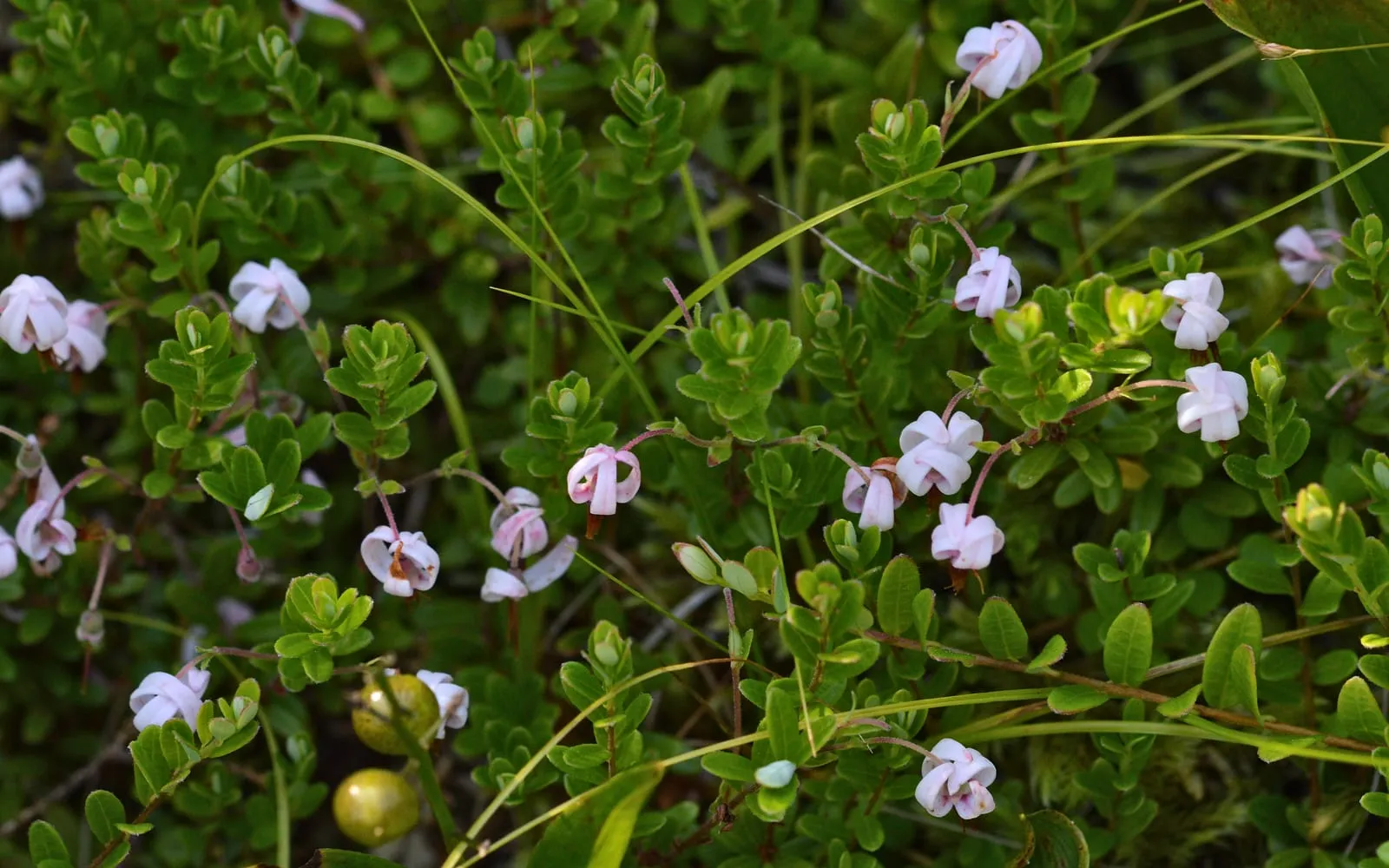
Flowers appear in June, small and pink, with four sharply reflexed petals and a protruding beak of fused stamens. The shape reminded early settlers of a crane’s head, which is where the name comes from.
Fruit is round to oval, 1 to 2 cm, glossy and deep red when ripe, and it floats, which is why the commercial fields are flooded to harvest.
The berries hang on the plant well into winter if birds allow it.
Where it is from
Cranberry is native to bogs, wet acid heath and pond margins across eastern North America, from Newfoundland down to the Appalachians.
It grows naturally in sphagnum peat where the water table is high and the ground is strongly acid and very low in nutrients.
Native American peoples used it as food, as a preservative in pemmican and as a dye. Commercial cultivation began in Massachusetts in the early nineteenth century.
The flooded beds seen at harvest are a twentieth-century invention. Water is let in to float the berries off the vines, and the plants themselves spend the growing season on damp ground rather than underwater.
A smaller relative, Vaccinium oxycoccos, grows on raised bogs right around the northern hemisphere and is native to Europe and North America both.
How it grows
Buy young plants in spring. Cranberry is slow from seed and named varieties such as ‘Pilgrim’ and ‘Early Black’ fruit far sooner.
Grow in ericaceous compost, either in a container of at least 30 cm or in a raised bed filled with acid compost and composted bark.
Set plants 30 cm apart and let the runners knit together into a mat.
Stand a container in a saucer or tray of rainwater through the growing season. The plant is one of the few that likes wet feet.
Use rainwater only. Tap water in a hard-water area raises the pH and causes the yellowing that eventually kills the plant.
Top-dress with a thin layer of sharp sand in spring, which encourages the runners to root along their length.
Expect the first useful crop in the third year.
Harvest in October, after the first frost has sharpened the flavour. Ripe berries are deep red throughout and bounce when dropped, which is how they are graded commercially.
Through the seasons
Spring is for planting, top-dressing with sand and starting the ericaceous feed. Keep the compost damp as growth begins.
June brings the flowers. Do not let the plant dry out at any point from now until harvest.
Summer is for watering. Two or three waterings a week with rainwater, and a tray beneath a container.
October is harvest, after a frost. Pick over the mat by hand.
Winter needs nothing. The plant is fully hardy, the foliage bronzes, and any berries left will hang on.
Care difficulty
Moderate, and it comes down to two requirements that are absolute rather than preferred.
Acid soil, at pH 4 to 5.5. Ordinary garden soil and ordinary compost are both too alkaline, so the plant lives in ericaceous compost or it does not live.
Constant moisture, supplied as rainwater. Cranberry has fine shallow roots and no drought tolerance, and hard tap water undoes the acidity over a season or two.
Get those right and nothing else is difficult. The plant is fully hardy, needs no pruning, has very few pests and lives for decades.
Weeding is the ongoing chore, since the mat is low and slow and weeds come through it.
Watering
Water with rainwater two or three times a week through the growing season and never let the compost dry out.
Stand containers in a tray of rainwater from April to September. This is the simplest way to keep the moisture constant.
Use rainwater rather than tap water wherever the supply is hard. Tap water raises the pH and the plant yellows and declines.
Ease off in winter, when the plant is dormant and standing water can rot the crowns. Remove the tray from October.
Mulch with composted bark or leaf mould in spring, which holds moisture and keeps the surface acid.
Warning signs, diseases and pests
Yellow leaves with green veins mean lime-induced chlorosis, which is caused by hard tap water or alkaline compost. Switch to rainwater and repot into fresh ericaceous compost.
Vine weevil grubs eat the roots of container plants and the first sign is a mat that lifts away in the hand. Use a biological nematode drench in late summer.
Grey mould rots the berries in a wet autumn where air movement is poor.
Birds strip ripening fruit in October, and netting is the answer.
A mat that goes brown and crisp in summer has dried out, and it recovers slowly.
Poor cropping on a healthy plant usually means too much shade or too much nitrogen.
Growing environment
Full sun. Cranberry crops poorly in shade.
Acid soil at pH 4 to 5.5, and this is not negotiable. Use ericaceous compost mixed with composted bark.
Moisture-retentive ground that stays damp all season. A raised bed lined to slow drainage works well, as does a large container in a tray.
Cold is not a problem. The plant survives -30 deg C and needs no winter protection.
Shelter is unnecessary, since the growth is low and wind does not trouble it.
A trough, a half-barrel or a dedicated acid bed all suit it better than trying to amend a patch of ordinary garden soil, which reverts to its natural pH.
Feeding
Cranberry is adapted to very poor ground and is easily overfed.
Use an ericaceous liquid feed at half the recommended strength, monthly from April to July.
Stop feeding after July so the growth hardens before winter.
Avoid all general-purpose fertilisers, which are too rich and usually raise the pH.
Nitrogen is the specific thing to avoid, since it produces long runners and very little fruit.
Top-dress with composted bark or ericaceous compost each spring instead of feeding more heavily.
Troubleshooting
The leaves are yellow with green veins. Lime-induced chlorosis from hard tap water or alkaline compost. Use rainwater and repot into ericaceous compost.
Lots of runners and no fruit. Too much nitrogen, or too much shade. Feed less and move it into full sun.
The mat went brown and crisp. It dried out. Cranberry has no drought tolerance. Stand containers in a tray of rainwater.
The plant lifts up when I pull it. Vine weevil grubs have eaten the roots. Apply nematodes in late summer.
Do I need a bog? No. Flooding is a harvesting technique. Damp acid compost that never dries out is all the plant needs.
When are they ripe? October, and better after a frost. A ripe berry is deep red right through and firm enough to bounce.
Can I use tap water? Only in a soft-water area. Hard water will kill the plant over two or three seasons.
Do I need two plants? No. Cranberry is self-fertile, and a group crops better and knits into a mat faster.
Cranberry problem guides
Not sure what is wrong? See the common vegetable pests guide.