
Edible
Lowbush blueberry
Vaccinium angustifolium
Also known as Wild blueberry, Late lowbush blueberry, Sweet-hurts
How to grow lowbush blueberry, Vaccinium angustifolium. The wild blueberry of Maine and Quebec, low and spreading, with better flavour than the tall kind.
At a glance
- Difficulty
- Moderate
- Water
- Weekly through the growing season
- Light
- Full sun
- Temperature
- Fully hardy to -35 deg C
- Hardiness
- USDA 2-6, RHS H7, hardy to -40 C
- Type
- Deciduous perennial shrub, long-lived, spreading by rhizome
- Height
- 15-60 cm, spreading indefinitely
- Native to
- North-eastern North America
- Best month
- July and August in the Northern Hemisphere, January and February in the Southern Hemisphere
Winters that would kill highbush blueberry are what it is built for, and snow cover matters more than air temperature because the plant is low enough to spend the cold months buried. Warm regions are the wrong place entirely. It needs roughly 1000 chill hours and declines in summers that stay hot.
Hardiness zones describe winter cold alone. Summer heat, humidity, rainfall and the length of the growing season decide as much, so treat the range as the outer limit rather than as a recommendation.
Every month named in this guide is for the temperate Northern Hemisphere. If you garden in the Southern Hemisphere, shift each one by six months, so July becomes January. Closer to the equator the wet and dry seasons matter more than the calendar, and the shift stops being a useful guide.
Not known to be toxic
- Safe to eat
- The berries
The berries are food and the plant carries no toxicity concern. Neither the RHS nor the ASPCA lists Vaccinium as harmful, and the ASPCA does not record the genus as toxic to cats or dogs. Eating a large quantity of any Vaccinium berry loosens the stomach, which is a property of the fruit rather than a poison. One caution belongs to foraging rather than to gardening. Several unrelated plants of the same heath and moorland ground carry dark berries and some are dangerous, so identify by the whole plant rather than by berry colour before eating anything wild.
Sources: RHS potentially harmful garden plants, ASPCA toxic and non-toxic plants
About
Almost every tinned or frozen wild blueberry sold comes from this plant. It grows across Maine, the Maritimes and Quebec on sandy acid barrens, and it is managed rather than planted, since the plants are already there.
The berries are small, dense and far more strongly flavoured than the large highbush sort. Anyone who has compared the two in a pie knows the difference.
For a garden it makes a low spreading mat rather than a bush, which suits the front of an acid bed or a raised trough. Autumn colour is a strong scarlet.
Growing it needs the same acid conditions as any blueberry, plus more sun and sharper drainage. Get the pH right and the rest is undemanding.
Appearance and character
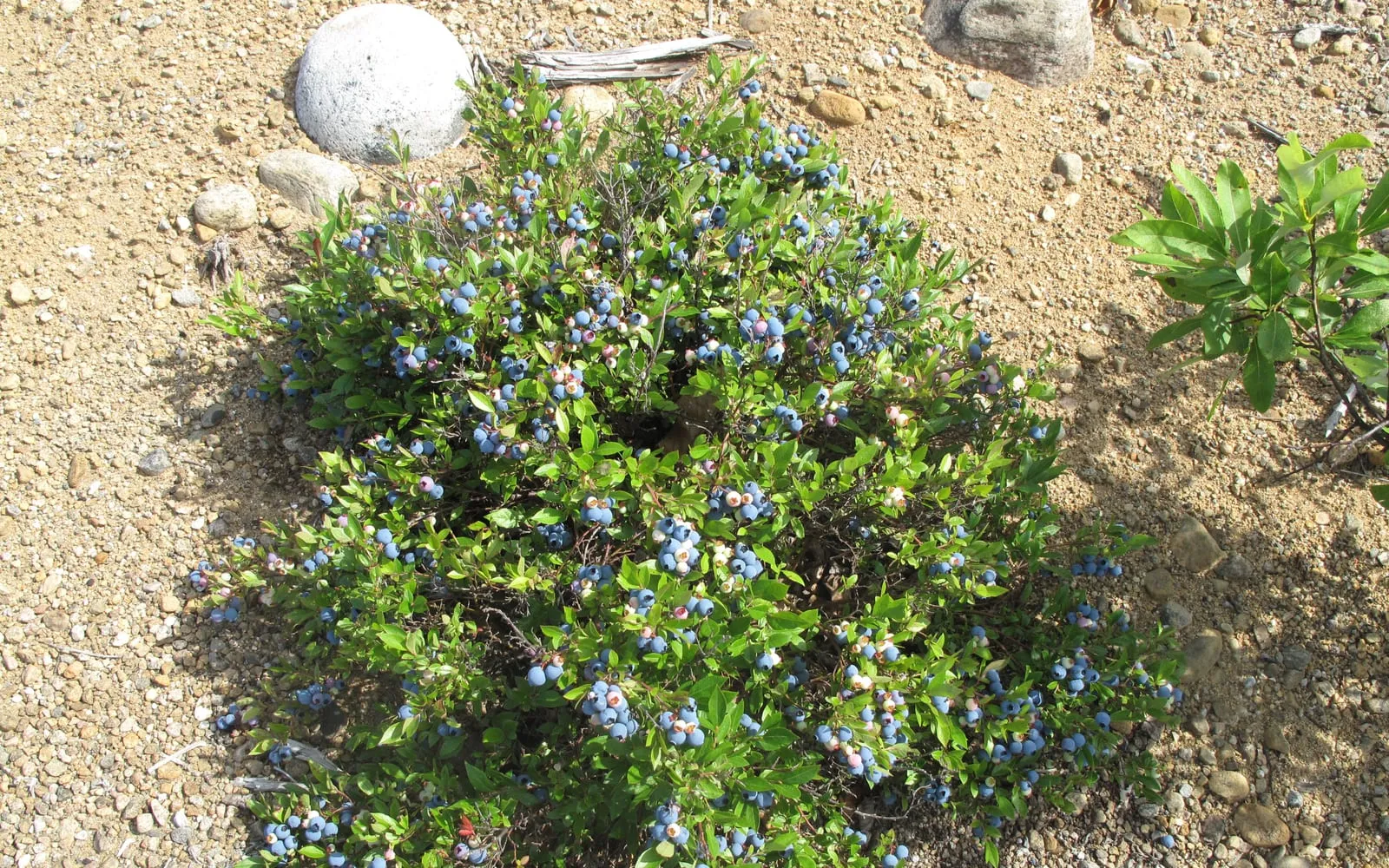
A low deciduous shrub spreading by underground rhizomes into a broad mat of fine twiggy upright shoots.
Stems are slender, green when young and turning reddish-brown, often with fine warty markings.
Leaves are narrow and lance-shaped, 1 to 4 cm, with smooth or finely toothed edges, bright green and turning brilliant scarlet in autumn.
Flowers open in May, small white or pink-tinged bells in short clusters at the shoot tips, hanging downwards.
Fruit is round, 5 to 12 mm, blue-black with a strong pale bloom, ripening over several weeks in July and August. Berries are far smaller than highbush blueberries and much more intensely flavoured.
Where it is from
Vaccinium angustifolium is native to north-eastern North America, from Newfoundland and Labrador down through New England and west to Manitoba.
It grows on acid sandy barrens, rocky outcrops, burnt ground and open pine woodland, in soil that is thin, sharply drained and very low in nutrients.
The wild blueberry industry of Maine and Nova Scotia manages existing wild stands rather than planting them. Fields are mown or burnt on a two-year cycle, so half the land is cropping while the other half regrows.
Burning is the traditional management and works because the rhizomes survive underground while competing woody plants do not.
Indigenous peoples of the region dried the berries for winter and burnt the barrens deliberately to maintain them, a practice that predates the commercial industry by centuries.
How it grows
Buy container-grown plants from a specialist fruit nursery. Named selections such as ‘Brunswick’ and ‘Burgundy’ are sold by specialist fruit nurseries, and ‘Top Hat’ is a compact hybrid often offered for pots.
Test the soil pH before anything else. It needs 4.2 to 5.2, which is lower than most temperate gardens provide.
On alkaline ground, grow in containers or a raised bed filled with ericaceous compost and composted bark rather than trying to acidify open soil.
Plant in full sun, 45 to 60 cm apart, and let the rhizomes fill the gaps.
Plant two different varieties. Cross-pollination raises the yield and the berry size substantially.
Mulch with pine needles, composted bark or sawdust to a depth of 5 cm, which maintains acidity and holds moisture.
Through the seasons
Growth starts in April, with fine new shoots rising from the rhizome mat.
May brings the flowers, small white bells that bumblebees work efficiently.
Fruit sets in June and colours through July, ripening over three or four weeks rather than all at once.
Pick from mid-July into August. Ripe berries release with a light roll of the thumb, and a berry that needs pulling is not ready.
Autumn brings scarlet foliage, which is one of the best reasons to grow the plant even without the fruit.
Every second or third winter, cut a portion of the mat right down to ground level to renew it, which imitates the burning cycle used commercially.
Care difficulty
Moderate. The plant itself is hardy and undemanding, and the pH requirement is what raises the difficulty.
Acid soil at 4.2 to 5.2 is stricter than highbush blueberry needs, and few temperate gardens have it naturally.
Container growing solves that, at the cost of watering all season with rainwater.
Once the medium is right, the plant is long-lived, extremely hardy and largely free of pests.
Renewal pruning is unfamiliar work. Cutting a third of the mat to the ground looks drastic and is the correct treatment.
Watering
Water weekly through the growing season, wetting the top 20 cm rather than sprinkling the surface.
Use rainwater. Tap water in a hard-water area pushes the pH up and causes yellowing within a season or two.
The mat is shallow-rooted, so it suffers in drought faster than a deeper-rooted shrub.
Water steadily through July while the fruit is sizing, since irregular moisture gives small berries.
Mulch thickly with bark or pine needles, which cuts watering considerably and keeps the root zone cool.
Warning signs, diseases and pests
Leaves yellow with green veins. Lime-induced chlorosis, from tap water or from soil that is not acid enough. Switch to rainwater, apply chelated iron, and check the pH.
Fruit disappearing through July. Birds, which find small blueberries as appealing as you do. Net before the berries colour.
Grey furry mould on the fruit. Grey mould in a wet summer. Thin the mat for airflow and remove affected berries.
Plant collapsing in a container with roots eaten. Vine weevil grubs. Apply nematodes in late summer.
White powdery film on leaves in August. Powdery mildew, cosmetic at that point in the season.
Mat thinning and cropping poorly after several years. Renewal overdue. Cut a third to ground level in winter.
Growing environment
Full sun. This is a plant of open barrens and it fruits poorly in shade.
Acid soil at pH 4.2 to 5.2 is the governing requirement, and sandy free-draining ground suits it best.
Low fertility is an advantage. Rich soil produces leafy growth and less fruit.
Cold is no obstacle, with hardiness to -35 deg C, and the plant needs a proper winter chill to flower well.
A raised bed of ericaceous compost mixed with composted bark and grit, in an open sunny position, reproduces the barrens closely enough to crop well.
Feeding
Feed very little. A half-strength ericaceous fertiliser once in spring is the most this plant wants, and many growers give none.
It is adapted to soil with almost no available nutrients, and a standard fertiliser dose scorches the fine roots.
Mulch annually with pine needles, composted bark or sawdust, which supplies what is needed as it breaks down and holds the pH down.
Never apply lime, mushroom compost, wood ash or general fertiliser.
Yellowing is a pH signal rather than a hunger signal, so test before feeding.
Troubleshooting
Leaves yellowing between green veins. pH too high, usually from tap water. Rainwater, chelated iron and an acid mulch.
Berries small and few. Only one variety planted. Add a second for cross-pollination and expect a marked improvement.
Plant growing well but barely fruiting. Too much shade, or too much nitrogen. Move it into full sun and stop feeding.
Crop declining after five or six years. The mat needs renewing. Cut a third of it to ground level each winter over three years.
Berries dropping before ripe. Drought during fruit development. Water steadily through July.
Mat creeping into a neighbouring bed. Rhizomes spreading. Edge it with a spade in spring.
Lowbush blueberry problem guides
Not sure what is wrong? See the common vegetable pests guide.