
Edible
Arrowroot
Maranta arundinacea
Also known as West Indian arrowroot, Obedience plant, Araruta, Maranta
How to grow arrowroot, Maranta arundinacea. The starch that thickens clear, its family connection to the prayer plant on your windowsill, and the island that still supplies most of it.
At a glance
- Difficulty
- Moderate
- Water
- Twice a week through growth, tailing off in autumn
- Light
- Light shade or dappled sun, and it scorches in full glare
- Temperature
- 20-30 deg C, and it stops below 15
- Humidity
- High
- Hardiness
- USDA 10-12, RHS H1b, hardy to 8 C
- Type
- Tender herbaceous perennial grown from rhizomes
- Height
- 1-1.5 m
- Native to
- northern South America, the Caribbean
- Best month
- May in the Northern Hemisphere, November in the Southern Hemisphere
It wants 10 to 12 months of warm wet weather with light shade, and rhizomes lifted early yield starch that will not set. Nothing below 15 deg C. Outside the tropics it grows as a foliage plant under glass and never makes a crop worth digging.
Hardiness zones describe winter cold alone. Summer heat, humidity, rainfall and the length of the growing season decide as much, so treat the range as the outer limit rather than as a recommendation.
Every month named in this guide is for the temperate Northern Hemisphere. If you garden in the Southern Hemisphere, shift each one by six months, so May becomes November. Closer to the equator the wet and dry seasons matter more than the calendar, and the shift stops being a useful guide.
Not known to be toxic
- Safe to eat
- The rhizome, processed into starch or cooked whole
Arrowroot is food and no part of it is recorded as harmful. Neither the RHS nor the ASPCA lists Maranta arundinacea as toxic, and the ASPCA lists the related prayer plant, Maranta leuconeura, as non-toxic to cats and dogs. The purified starch is one of the blandest foods there is, which is why it was given to infants and to people recovering from illness for two centuries. Raw rhizome is fibrous and unpalatable rather than dangerous. The name comes from a traditional use of the pounded rhizome as a poultice on arrow wounds, or possibly from the Arawak aru-aru, and neither origin implies anything about safety.
Sources: RHS potentially harmful garden plants, ASPCA toxic and non-toxic plants
About
Arrowroot is the starch in the cupboard that thickens a sauce to a clear gloss rather than the cloudy opacity cornflour gives, sets at a lower temperature, and does not break down when frozen. Bakers use it, cooks thickening a fruit glaze use it, and it is the standard thickener for anyone avoiding wheat and maize.
The plant behind it is a leafy tropical perennial, related closely enough to the prayer plant on a windowsill that the family is named after the same man. Both are Marantaceae, named for the sixteenth-century Venetian physician Bartolomeo Maranta.
Saint Vincent in the Windward Islands built an industry on it in the nineteenth century and still supplies a large share of the world’s genuine arrowroot. Much of what is sold under the name elsewhere is cassava or potato starch, since the word became a category rather than a species.
Appearance and character
An upright herbaceous perennial forming a leafy clump 1 to 1.5 m tall, spreading by fleshy underground rhizomes.
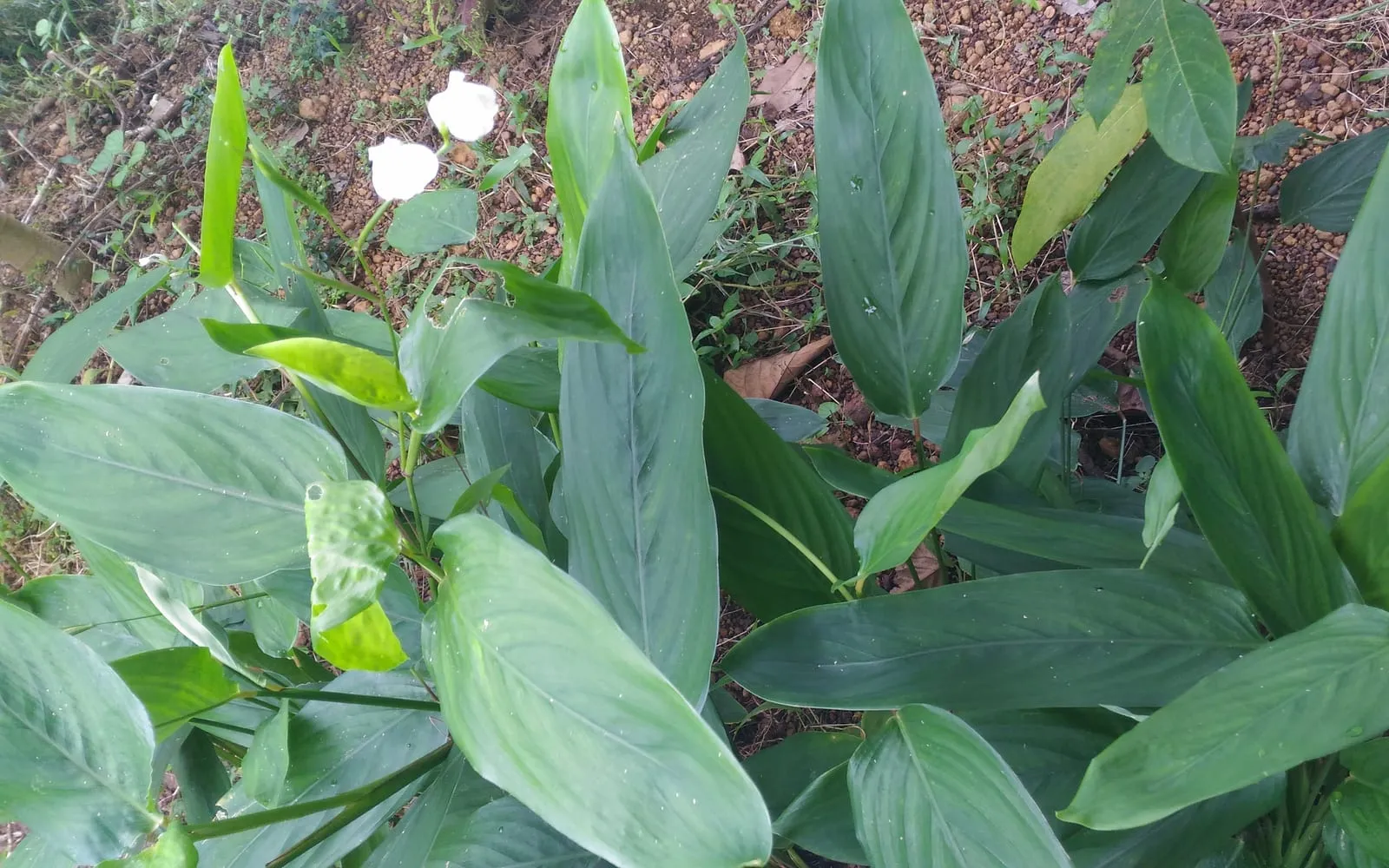
Leaves are broadly lance-shaped to oval, 15 to 30 cm long, mid green, with the distinctive Marantaceae leaf joint. A swollen hinge called the pulvinus sits at the top of each leaf stalk and moves the blade, so the leaves lie flat by day and lift towards vertical at night.
That movement is what earns the family the name prayer plant, and arrowroot does it as clearly as its ornamental relatives.
Stems are slender, branching, and the plant becomes untidy and floppy in anything less than good light.
Flowers are small, white and asymmetrical, carried in loose pairs on thin stems above the foliage. They are pretty and inconspicuous and the plant rarely sets seed in cultivation.
The rhizomes are the crop. Fleshy, cylindrical, 15 to 30 cm long and 2 to 5 cm thick, covered in overlapping papery scales that give them the look of a slim white pine cone.
Cut flesh is white, crisp and full of very fine starch grains, which is the quality that made it worth extracting.
Where it is from
Maranta arundinacea comes from the lowland forests of northern South America, most likely the Amazon and Orinoco basins, and it was carried into the Caribbean and Central America in pre-Columbian times.
Archaeological starch grains put it in cultivation in the Americas for several thousand years, and it turns up on stone tools from sites in Panama and Colombia.
Arawak communities in the Caribbean grew it, and the name may come from their word aru-aru, meaning meal of meals, rather than from the arrow wound story that competes with it.
Saint Vincent and the Grenadines commercialised it in the nineteenth century, and arrowroot became the island’s principal export, supplying British and North American kitchens and the infant food trade.
Production is now spread across Saint Vincent, Brazil, India, Indonesia and the Philippines, though the Saint Vincent product still carries the reputation.
How it grows
Start from rhizomes rather than seed, which is rarely available and rarely germinates.
Plant sections of rhizome, each with two or three visible buds, 5 to 8 cm deep in April or May at 22 deg C.
Use a wide container or a greenhouse border, since the plant spreads sideways as much as it grows down.
Give light shade or dappled light rather than full sun. Direct summer glare under glass scorches the leaves.
Keep it warm and humid through summer, at 20 to 30 deg C, with damp air.
Water evenly and never let the compost dry out completely.
Feed monthly with a balanced feed.
Expect ten to twelve months from planting to a harvestable rhizome, which outside the tropics means running the plant through one winter under heat.
Harvest when the foliage yellows and dies back, digging the whole clump and separating the rhizomes.
Save several rhizome sections and store them in barely damp compost at 15 deg C over winter, then replant in spring.
Through the seasons
April and May are for planting rhizome sections in warmth.
June brings the first shoots, and the plant grows away steadily once it starts.
July and August are leafy growth, and the months to keep humidity up and the sun off.
September and October carry the growth on, with the rhizomes beginning to form.
Winter is when the plant needs holding at 15 deg C or above, since a full crop takes ten to twelve months.
The following spring and summer are the second growth season and the point the rhizomes bulk properly.
Autumn of the second year is harvest, once the foliage yellows and dies back.
Care difficulty
Moderate, and the difficulty is time rather than temperament.
Ten to twelve months to a crop means keeping a greenhouse warm through the winter.
The plant itself is easy, and it is grown as a houseplant in its own right.
Light shade rather than full sun is the requirement people get wrong most often.
Dry indoor air browns the leaf edges within days.
As a foliage plant it is handsome and undemanding, which is the fallback if the rhizomes disappoint.
Watering
Water twice a week through the growing season, keeping the compost evenly damp.
Never let it dry out completely, since the leaves brown at the edges and do not recover.
Never leave it sodden either, which rots the rhizomes.
Use rainwater in a hard water area, as with any Marantaceae.
Mist or stand the pot on damp gravel to keep humidity up.
Reduce watering sharply as the foliage yellows in autumn, and keep stored rhizomes barely damp.
Warning signs, diseases and pests
Brown crisp leaf edges mean dry air, hard water, or both.
Fine pale stippling with webbing in the leaf axils is red spider mite, which is the main pest indoors.
White waxy fluff at the leaf bases is mealybug.
Bleached patches on leaves in direct summer sun are scorch, and the plant wants shade.
Yellowing lower leaves with a wilt that does not recover overnight is root rot from cold wet compost.
Leaves that stay flat at night mean the plant is stressed, usually by drought or cold.
Rhizomes that are soft and brown at planting time were stored too damp or too cold.
Growing environment
A heated greenhouse or a warm humid room indoors.
Light shade or filtered light, never direct summer sun under glass.
Minimum 15 deg C year round, with 20 to 30 deg C for growth.
High humidity.
Rich loose moisture-retentive compost with good drainage.
A wide container, since the clump spreads sideways.
Rainwater in a hard water area.
Feeding
Work compost into the planting medium before starting.
Feed a balanced liquid feed monthly from the first shoot.
Reduce feeding through winter without stopping entirely, since the plant is still growing.
Switch to a high-potash feed in the second summer, as the rhizomes bulk.
Avoid heavy nitrogen late on, which pushes leaf at the expense of rhizome.
Stop feeding as the foliage yellows before harvest.
Troubleshooting
What is arrowroot used for? Thickening. It sets clear rather than cloudy, works at a lower temperature than cornflour, holds up to freezing, and contains no gluten. It is added at the end of cooking rather than boiled hard, since prolonged heat breaks it down.
Is the arrowroot in my cupboard from this plant? Possibly not, since much of what is sold under the name is cassava or potato starch. Genuine West Indian arrowroot usually says Saint Vincent on the packet.
Is it related to my prayer plant? Yes, closely. Both are Marantaceae, and arrowroot moves its leaves at night in the same way.
Why are my leaf edges going brown? Dry air or hard water. Raise the humidity and switch to rainwater.
How long until I can harvest? Ten to twelve months from planting, which outside the tropics means keeping the plant warm through a winter.
Can I eat the rhizome whole? It is fibrous and dull, and the point of the plant is the extracted starch. Grate the rhizome, wash the starch out in water, let it settle, pour off the liquid and dry the white sediment.
Will it grow outdoors in a cool climate? No. It needs 15 deg C as a minimum all year and will not survive a frost.
My plant flopped over. Not enough light, or a pot that is too small. Give it bright filtered light and a wide container.
Can I grow it as a houseplant instead? Yes, and it makes a good one. Warm, humid, bright shade, rainwater, and it will be handsome for years.
Arrowroot problem guides
Not sure what is wrong? See the common vegetable pests guide.