
Edible
American Hazelnut
Corylus americana
Also known as American Filbert
Practical guidance for growing American hazelnut, Corylus americana, including its suckering thicket habit, native tolerance of eastern filbert blight, wildlife hedgerow use, and edible nuts.
At a glance
- Difficulty
- Easy
- Water
- Rarely once established
- Light
- Full sun for the heaviest nut crop; tolerates partial shade
- Temperature
- Extremely hardy; late frost can damage the female flowers
- Hardiness
- USDA 3-9, RHS H7, hardy to -35 C
- Type
- Deciduous suckering shrub, effectively immortal as a colony
- Height
- 2-3 m, spreading indefinitely by suckers unless contained
- Native to
- eastern North America
A shrub of the prairie edge and the Great Lakes woodland margin, built for a harsher, more continental winter than the European hazel most gardeners picture when they hear the word hazelnut. It takes cold that would damage or kill many other nut-bearing shrubs without complaint, and the real limit on cropping is a late spring frost catching the tiny female flowers rather than anything about the winter itself.
Hardiness zones describe winter cold alone. Summer heat, humidity, rainfall and the length of the growing season decide as much, so treat the range as the outer limit rather than as a recommendation.
Not known to be toxic
- Safe to eat
- The nuts
American hazelnut is not toxic. The ASPCA does not list Corylus among plants harmful to cats, dogs or horses, and it does not appear on the RHS list of potentially harmful garden plants either; foliage, bark and catkins present no poisoning risk, and the nuts are a genuine food crop eaten fresh or dried. The real caution has nothing to do with plant chemistry: hazelnut is a declarable allergen under food labelling regulation across most major markets, tree nut allergy is widespread and reactions range from mild to severe, so a household managing a nut allergy should weigh that before planting a shrub that drops nuts across a garden or hedgerow every autumn. A dog eating fallen nuts risks little beyond stomach upset from the shell, though a whole shell swallowed can pose a choking or obstruction risk in a small dog.
Sources: ASPCA toxic and non-toxic plants, RHS potentially harmful garden plants
About
American hazelnut is a native North American shrub that behaves differently in the ground from the European hazel most gardening advice assumes. Where European hazel grows as a clump or, coppiced, as a small multi-stemmed tree, American hazelnut spreads steadily outward by underground suckers, forming a widening thicket rather than staying put as a single defined clump.
That spreading habit is exactly why it has been widely planted for wildlife hedgerows, windbreaks and habitat restoration across its native range, and exactly why it needs a different kind of site than a small formal border, where a shrub determined to expand outward every year is more nuisance than asset.
Appearance and character
A deciduous shrub rarely taller than 2 to 3 m, made up of many slender stems rising from a spreading network of underground suckers rather than a single trunk or a tight coppice stool.
Leaves are rounded to broadly oval, doubly toothed and softly hairy, similar in general shape to European hazel’s but typically smaller. Male catkins form in autumn and open into pale yellow lamb’s tails in late winter to early spring, and the tiny crimson female flowers appear on the same twigs, easy to miss without a close look.
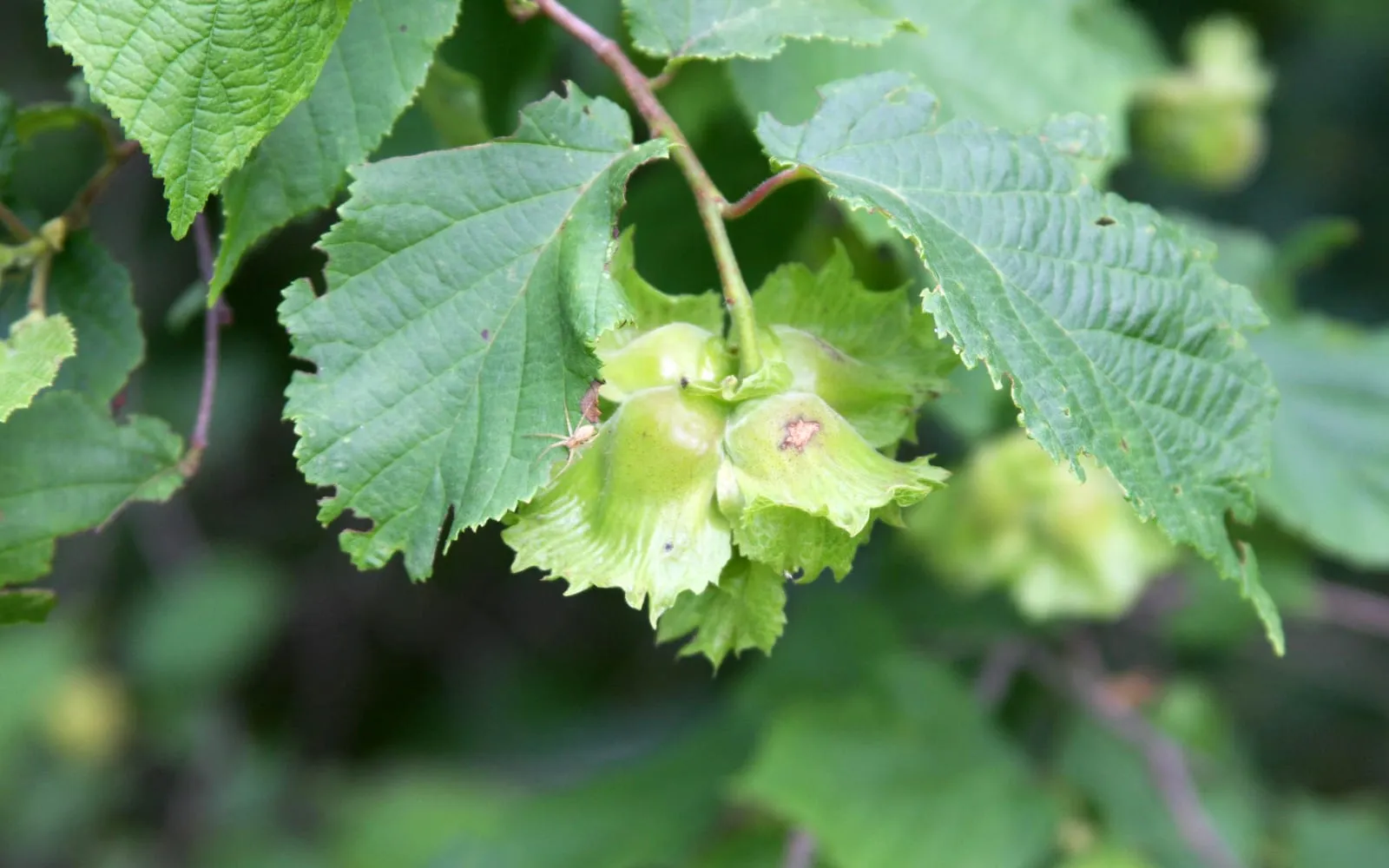
Nuts ripen in late summer to early autumn, each enclosed in a short, ragged, hairy husk that covers most of the shell without extending far beyond it, distinguishing it from the closely related beaked hazelnut, Corylus cornuta, whose husk is drawn out into a dramatic tubular beak well past the nut itself.
Where it is from
Corylus americana is native across a broad swathe of eastern North America, from southern Ontario and Quebec and the Great Lakes region south into Georgia and west onto the eastern edge of the prairies in the Dakotas and Oklahoma, typically found at woodland edges, along fence lines and in old fields rather than deep inside closed forest.
Its suckering habit is a genuine adaptation to that edge habitat, letting a colony persist and expand along disturbed, sunlit ground where a single-stemmed tree would eventually be shaded out by taller neighbours. Indigenous peoples across its range harvested the nuts as a significant wild food, and the shrub remains a valued component of hedgerow and habitat plantings for the cover and food it provides songbirds, grouse and small mammals.
One ecological detail sets it apart from its European relative. Eastern filbert blight, a fungal canker disease caused by Anisogramma anomala, is native to eastern North America and has co-evolved with American hazelnut, which mostly tolerates it without serious harm. The same fungus is devastating to the introduced European hazel when the two grow in the same region, since European hazel has no comparable natural resistance, a reversal of the more familiar pattern in which an introduced pathogen is the one doing the damage to a native species.
How it grows
Plant in full sun for the best nut crop, though it tolerates partial shade well and still produces a useful yield there. Almost any soil suits it, from poor sandy ground to heavier loam, with a preference for moist, well-drained conditions if there is a choice.
Plant with the suckering habit in mind from the start. A single specimen will expand into a thicket several metres across within a few years unless the spread is actively managed, so it suits a hedgerow, a naturalised planting or a dedicated wildlife corner far better than a small ornamental border.
Plant at least two genetically different shrubs for a reliable nut crop, since it shares European hazel’s largely self-incompatible pollination and a lone colony, even a large one, is often genetically a single individual.
Control the spread, where needed, by mowing or cutting unwanted suckers at ground level through the growing season, which is straightforward and can be repeated as often as required without harming the parent plant.
Harvest nuts in late summer as the husks begin to brown, checking regularly once ripening starts, since squirrels and other wildlife are quick to take a crop once it is ready.
Through the seasons
Late winter brings the male catkins into full, pollen-releasing bloom, with the tiny crimson female flowers opening on the same twigs.
Spring is leaf growth, and a late, hard frost at this stage can damage or destroy the season’s female flowers and reduce the eventual nut crop.
Summer is when suckers spread most vigorously and the nuts develop inside their husks, ripening toward the end of the season.
Autumn is harvest, gathered as the husks brown, and a good time to manage unwanted suckers before winter dormancy sets in.
Care difficulty
Easy, in the sense that the shrub itself is exceptionally tough, tolerant of poor soil and severe cold, and largely free of serious pest or disease pressure within its native range. The suckering habit needs more management than the plant’s basic care. To keep one shrub contained, mow or cut unwanted shoots every year.
Watering
Water new plants through their first summer to help the root and sucker system establish.
Once settled, an established colony needs no supplemental watering under normal rainfall, drawing on a root system well adapted to the sometimes-dry conditions of its native prairie-edge and woodland-margin habitat. A young nut crop benefits from watering during a dry spell while the kernels are filling in late summer.
Warning signs, diseases and pests
Filbert weevil bores into the developing nut and lays an egg inside, leaving a legless grub that hollows out the kernel and a neat exit hole once it has finished, the same style of damage the nut weevil family causes on hazel crops generally. Collecting and destroying nuts that drop early, before the main harvest, removes a share of the next generation.
Squirrels and other wildlife are drawn to a ripening nut crop as readily as they are to European hazel, and a colony left unwatched can lose most of its yield within days of the nuts colouring.
Japanese beetle feeds on the foliage in summer where it is established, skeletonising leaves between the veins, and can be picked off by hand on a small planting or managed with traps set well away from the shrub.
Aphids cluster on new shoots and the undersides of young leaves, occasionally enough to distort growth, and are generally kept in check by ladybirds and other predators without intervention.
Growing environment
Full sun gives the heaviest nut crop; partial shade is tolerated and still produces fruit, just less of it.
Almost any soil works, including poor and sandy ground, with a preference for moist, well-drained conditions where a choice exists. Space plantings widely, or plan for active management, since the suckering habit will fill the available ground given a few seasons.
A hedgerow, a wildlife corner, a windbreak or the naturalised edge of a larger garden all suit its spreading habit far better than a small, tightly maintained border.
Feeding
Little feeding is needed on typical soil, since this is a shrub adapted to comparatively lean, disturbed ground at a woodland or prairie edge.
A potassium-rich feed applied once in early spring can improve a nut crop on a shrub grown specifically for harvest, and heavy nitrogen feeding is best avoided, since it pushes vegetative growth and suckering at the expense of flowering and nuts.
Troubleshooting
My plant has spread into a thicket I did not expect. This is normal behaviour for this species, which spreads by underground suckers rather than staying as a single clump the way European hazel does. Mow or cut unwanted suckers at ground level through the growing season to keep it within bounds.
How is this different from the hazel sold at most nurseries? Most hazel sold for a garden is Corylus avellana, the European species, which grows as a defined clump or small tree rather than a spreading thicket and lacks this species’ strong natural tolerance of eastern filbert blight.
The nuts have small round holes and no kernel inside. Filbert weevil. Collect and destroy nuts that drop early, and cultivate the ground beneath the shrub in winter to disturb overwintering grubs.
No nuts have set even though the shrub flowers well. Check whether there is a second, genetically distinct plant nearby, since a single colony is often one individual spread by suckers and cannot pollinate itself.
Can I grow it purely for wildlife rather than for a nut harvest? Yes, and that is one of its most common garden uses. The dense, spreading thicket habit that makes it awkward in a small border makes it valuable cover and food for birds and small mammals in a hedgerow or naturalised planting.