
Edible
Turkish hazel
Corylus colurna
Also known as Turkish filbert, Constantinople hazel, Tree hazel
How to grow Turkish hazel, Corylus colurna. A single-trunked hazel that makes a proper tree, never suckers, and tolerates drought and city air.
At a glance
- Difficulty
- Easy
- Water
- First three summers, then none
- Light
- Full sun to part shade
- Temperature
- Fully hardy to -30 deg C
- Hardiness
- USDA 4-7, RHS H7, hardy to -35 C
- Type
- Deciduous tree, living two centuries or more
- Height
- 15-20 m, occasionally 25 m
- Native to
- South-east Europe, Turkey, Caucasus
- Best month
- September and October in the Northern Hemisphere, March and April in the Southern Hemisphere
A single-stemmed tree rather than a suckering bush, tolerant of drought, compacted soil and city air, which is why it is planted along streets far more often than for its nuts. It resists eastern filbert blight and is used as breeding stock against it. The nuts are small with thick shells.
Hardiness zones describe winter cold alone. Summer heat, humidity, rainfall and the length of the growing season decide as much, so treat the range as the outer limit rather than as a recommendation.
Every month named in this guide is for the temperate Northern Hemisphere. If you garden in the Southern Hemisphere, shift each one by six months, so September becomes March. Closer to the equator the wet and dry seasons matter more than the calendar, and the shift stops being a useful guide.
Not known to be toxic
- Safe to eat
- The kernels
The kernels are food. Nut allergy is the point that matters most here, and tree nuts are among the most significant food allergens, capable of causing anaphylaxis in sensitised people. Neither the RHS nor the ASPCA lists Corylus as a poisonous plant, and the ASPCA does not record hazelnuts as toxic to cats or dogs, though a dog that eats whole nuts in quantity risks a blockage and the shells are hard enough to break a tooth. Mouldy nuts left on the ground are a separate hazard, since moulds growing on fallen nuts can produce tremorgenic toxins that cause seizures in dogs. Clear windfalls rather than leaving them to rot where a dog forages.
Sources: RHS potentially harmful garden plants, ASPCA toxic and non-toxic plants
About
Every other hazel is a suckering shrub. This one is a tree, growing on a single straight trunk to 20 m with a neat conical crown, and it never throws a sucker in its life.
That habit made it a street tree. Turkish hazel tolerates compacted soil, drought, road salt and polluted air, and it holds a symmetrical shape without pruning, which is why it appears in car parks and along verges across Europe.
Nurseries also use it as the rootstock for grafted hazelnut trees, since a non-suckering root solves the maintenance problem that ordinary hazel creates.
The nuts are edible and small, with thick shells and a good flavour. They come in clusters wrapped in deeply fringed husks that look like a ragged green rosette, and they are the tree’s most decorative feature.
Appearance and character
A large deciduous tree with a single trunk and a strongly conical crown when young, broadening with age.
Bark is the giveaway: pale grey-brown, thick and corky, breaking into rough vertical plates unlike the smooth brown bark of a common hazel.
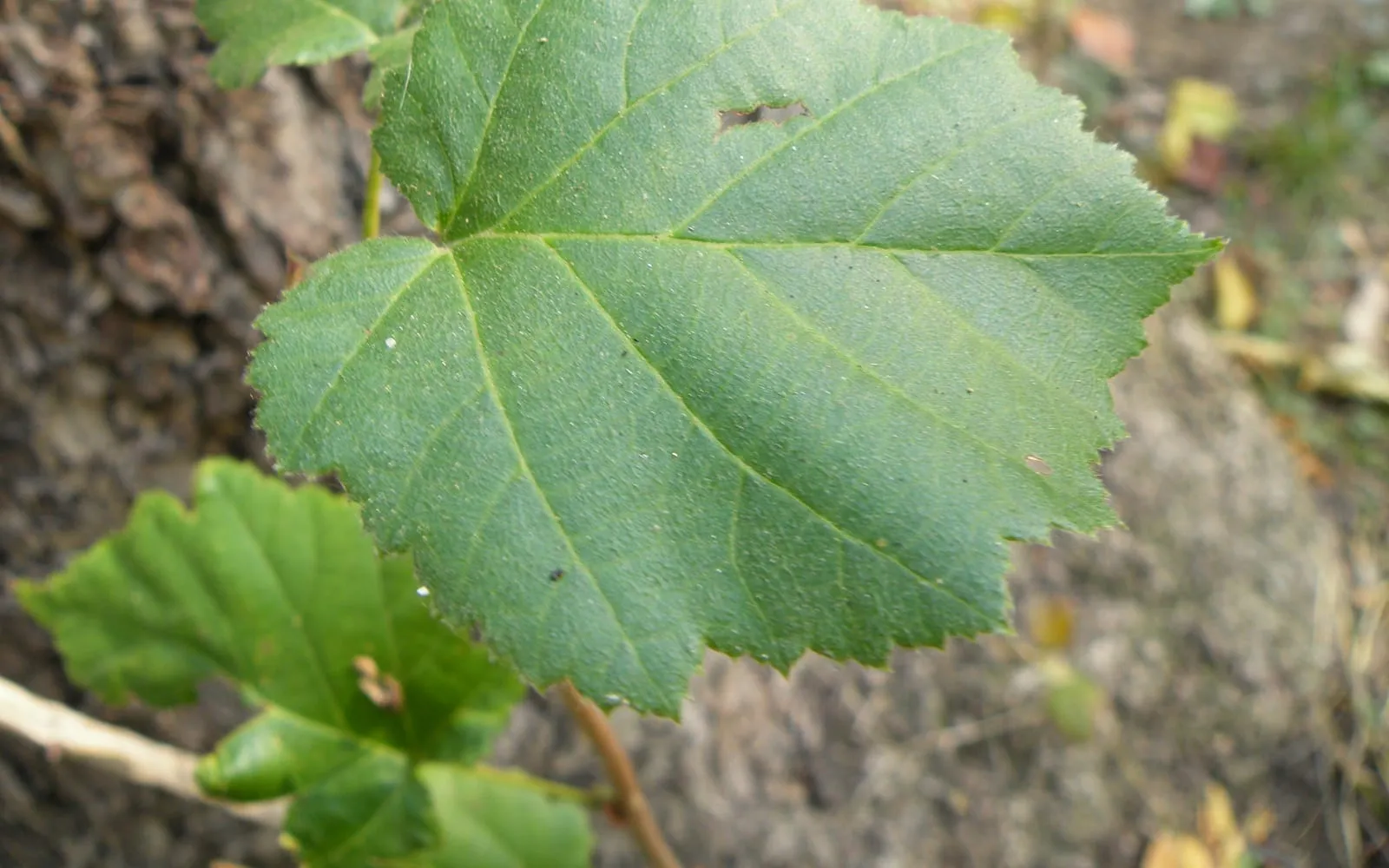
Leaves are rounded to heart-shaped, 7 to 15 cm, doubly toothed, dark green and turning clear yellow in autumn.
Catkins form in autumn and shed pollen in February and March, hanging in groups of three to five and longer than those of common hazel.
Nuts ripen in tight clusters of three to eight, each wrapped in a husk cut into narrow curling fringed lobes that extend well beyond the nut.
Where it is from
Corylus colurna is native to south-east Europe, Turkey, the Caucasus and into the Himalaya.
It grows in mixed woodland on well-drained slopes, often on limestone, and reaches a greater age and size than any other hazel.
It has been in British cultivation since 1582, longer than most introduced trees, and mature specimens exist in several botanic gardens and parks.
Its use as a street tree developed in the twentieth century, when its tolerance of difficult urban conditions and its self-maintaining shape were recognised.
Turkish growers also use it as a timber tree, and the wood is fine-grained and valued for furniture and veneer.
How it grows
Buy a young tree from a nursery stocking street or specimen trees. It is more widely available than its rarity in gardens suggests.
Plant bare-root between November and March into any well-drained soil, including chalk and heavy clay.
Stake for the first three years and guard against rabbits and deer.
Give it room. This is a full-sized tree reaching 20 m with a crown to match, and it is a poor choice for a small garden.
Water through the first three summers while it establishes, then leave it alone.
Prune only to remove dead or damaged wood. The tree builds a symmetrical crown without help, which is much of its value.
Through the seasons
Late winter brings the catkins, longer and later than common hazel, shedding pollen in February and March.
Leaves follow in April, and the crown is dense and dark through summer.
Nuts develop through summer in their fringed husks, which are conspicuous from July onwards.
September and October bring the harvest. Nuts are ready when the husks brown and the clusters fall.
Autumn colour is a clear yellow, holding for a fortnight or so.
Winter shows the corky bark and the conical outline, both of which are the tree’s best structural features.
Care difficulty
Easy. This is among the most trouble-free large trees available.
It tolerates drought, compaction, chalk, salt, pollution and cold to -30 deg C.
The absence of suckering removes the one maintenance job that common hazel and filbert both create.
It needs no pruning, since the crown develops symmetrically without intervention.
The only real requirement is space, and that is the reason it appears in parks and streets rather than in gardens.
Watering
Water weekly through the first three summers, 20 litres at a time.
Establishment is slower than for a shrubby hazel, which is why the watering period is longer.
After the third year the tree needs nothing further in a temperate climate and is notably drought-tolerant.
Mulch generously in spring during the establishment years, kept clear of the trunk.
It grows on dry limestone slopes in the wild, so an established tree handles drought better than most.
Warning signs, diseases and pests
Nuts disappearing before harvest. Squirrels, which reach a tall tree as easily as a shrub.
Small hole in the shell with the kernel gone. Nut weevil. Collect fallen nuts and destroy affected ones.
White powdery film on leaves in late summer. Powdery mildew, cosmetic.
Curled shoot tips with clustered insects. Aphids on young growth, which a tree outgrows.
Brown leaf margins in a hot dry summer on a young tree. Leaf scorch before the roots are established. Water and mulch.
Branches dying back, white sheets under the bark at the base. Honey fungus, which is fatal and untreatable.
Growing environment
Full sun to part shade. It grows well in both and makes the best shape in the open.
Almost any well-drained soil, including chalk, clay, sand and compacted urban ground.
Drought tolerance is high once established, and the tree handles hot dry summers without stress.
Cold, wind and pollution are all tolerated fully.
Space is the constraint. Allow at least 10 m of spread, and plant it where a 20 m tree is welcome in fifty years.
Feeding
No feeding is needed. The tree grows on poor limestone soil in the wild.
Mulch with compost through the first three or four years to help establishment.
Avoid nitrogen, which produces soft growth on a tree that has no need of it.
Leave leaf litter to accumulate beneath the crown once the tree is established.
A container is unsuitable beyond the first year or two given the eventual size.
Troubleshooting
Tree growing slowly for the first few years. Normal. It establishes slowly and then grows steadily for a century.
No nuts on a solitary tree. Turkish hazel is more self-fertile than other hazels but crops better with a second tree or a common hazel nearby.
Nuts hard to crack. Characteristic. The shells are thicker than a filbert’s, which is part of why it is grown for shade rather than for a nut crop.
Suckers appearing. Not from this species. Check whether the tree is grafted and the suckers are coming from a different rootstock.
Crown looking lopsided when young. It corrects itself. This tree builds a symmetrical crown without pruning.
Too large for the garden. Usually, yes. Plant a filbert instead where space is limited.
Turkish hazel problem guides
Not sure what is wrong? See the common vegetable pests guide.