
Edible
Sugar Cane
Saccharum officinarum
Also known as Noble cane, Ganna, Canne a sucre, Cana de acucar
How to grow sugar cane, Saccharum officinarum. The giant grass that carried the slave trade, how a cane is planted lying down, and what a heated greenhouse can do with it.
At a glance
- Difficulty
- Moderate
- Water
- Two or three times a week, generously
- Light
- Full sun
- Temperature
- 24-32 deg C, and growth stops below 15
- Humidity
- High
- Hardiness
- USDA 9-11, RHS H1c, hardy to 0 C
- Type
- Tender perennial grass
- Height
- 3-5 m
- Native to
- New Guinea
- Best month
- May in the Northern Hemisphere, November in the Southern Hemisphere
Wet tropical New Guinea. It needs a long hot season of ten to eighteen months to build sugar, so it survives USDA 9 as a foliage grass and yields properly only in the tropics and warm subtropics. Frost kills the top and the stools regrow.
Hardiness zones describe winter cold alone. Summer heat, humidity, rainfall and the length of the growing season decide as much, so treat the range as the outer limit rather than as a recommendation.
Every month named in this guide is for the temperate Northern Hemisphere. If you garden in the Southern Hemisphere, shift each one by six months, so May becomes November. Closer to the equator the wet and dry seasons matter more than the calendar, and the shift stops being a useful guide.
Skin irritant
- Safe to eat
- The juice and the pith of a sound cane
- Do not eat
- Mouldy cane, which can carry a potent fungal neurotoxin, and the leaf margins, which cut
- Harm from
- Eating it and handling it
- Affects
- People
Sound sugar cane is food and its juice is drunk fresh across the tropics. Two hazards attach. The leaf margins carry fine silica teeth that cut skin like a blade, and cane cutters have always worn long sleeves for that reason. The more serious one concerns storage. Cane that has been kept damp and allowed to mould can be colonised by Arthrinium species, which produce 3-nitropropionic acid, a potent neurotoxin. Mouldy sugar cane poisoning is documented in northern China, mostly in children, causing vomiting followed by seizures and permanent neurological damage. Throw away any cane with red or brown discolouration in the pith, or that smells sour or of alcohol, rather than chewing it. Fresh cane cut and used within a few days is not a concern. Neither the RHS nor the ASPCA lists Saccharum officinarum, and fresh cane is not toxic to cats or dogs, though the fibre is an obstruction risk.
Sources: RHS potentially harmful garden plants, ASPCA toxic and non-toxic plants
About
Sugar cane is a grass that stores sucrose in its stem instead of starch in its seed, and that single difference reshaped the world. Cane plantations drove the transatlantic slave trade, and something like two thirds of all Africans transported to the Americas were sent to grow and cut this plant.
The cane itself is a thick jointed stem 3 to 5 m tall, packed with a fibrous pith holding juice at around 12 to 16 per cent sugar. Crushing gives the juice, which is boiled down to raw sugar and molasses, fermented to rum, or drunk fresh with lime as guarapo, garapa or ganne ka ras.
Britain grew rich on it without ever growing it. Bristol, Liverpool and Glasgow built their sugar houses on Caribbean cane, and the refining industry persisted long after the plantations changed hands.
In a heated greenhouse it is a rewarding foliage plant. Given warmth and water it throws 3 m canes in a season, and a length of cane cut and chewed at the end of the summer is a reasonable reward for the space.
Appearance and character
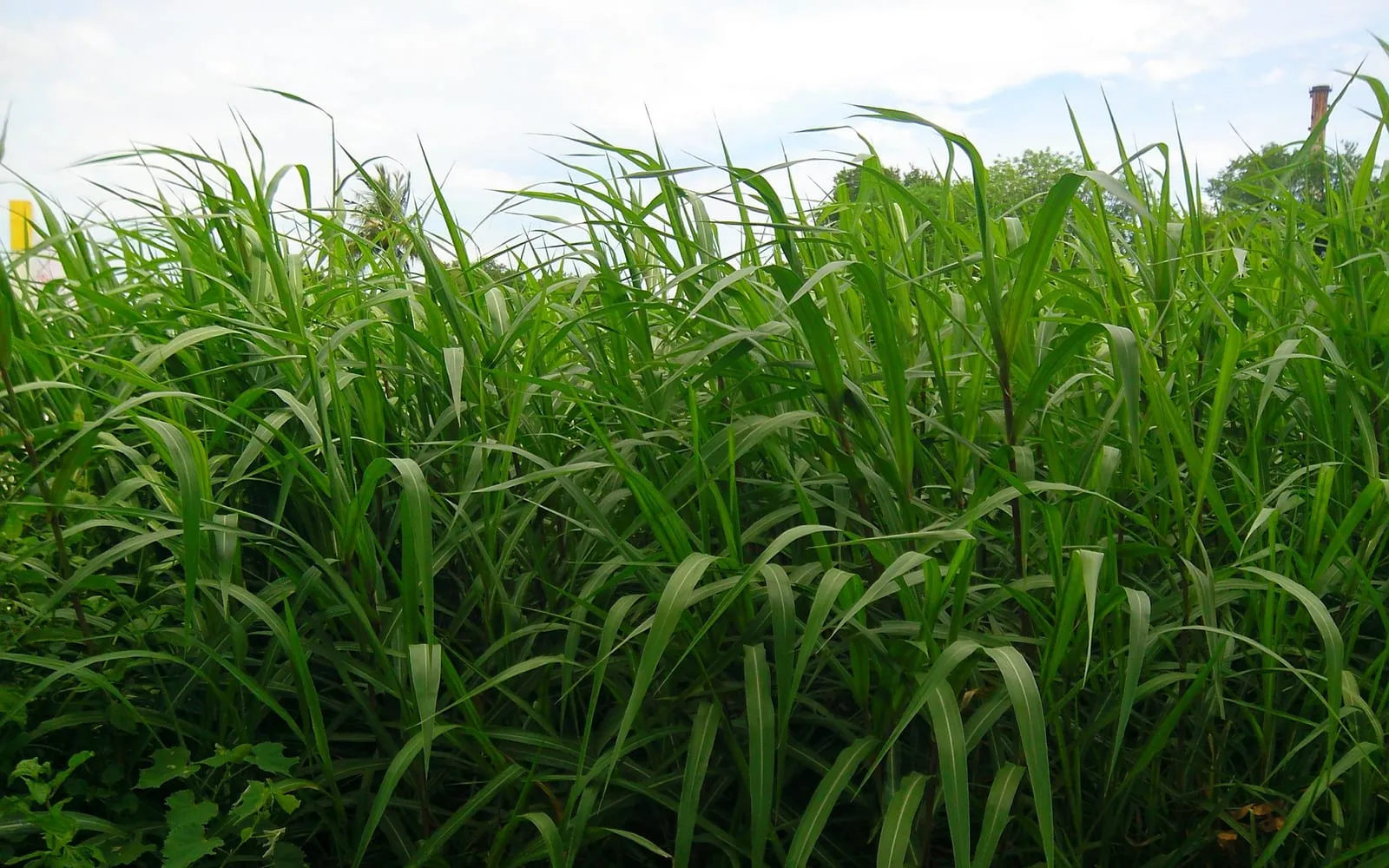
A robust perennial grass forming a dense clump of canes, 3 to 5 m tall and 2 to 5 cm thick.
Canes are jointed like bamboo, with a distinct node at each joint carrying a bud and a ring of root primordia, and a smooth internode between. Colour runs from green through yellow to deep purple-red depending on the cultivar.
Leaves are long and strap-like, 1 to 2 m by 4 to 10 cm, arching, with a prominent white midrib and margins carrying fine silica teeth sharp enough to cut skin.
Leaf sheaths wrap the cane, and old ones dry and hang until stripped.
Flowers, where the plant is old enough and the day length right, come as a silvery plume 30 to 60 cm long at the top of the cane, called the arrow. In commercial cane, flowering is unwanted, since it stops sugar accumulating.
Roots form a dense fibrous mat, and the buds at each node will root if a cane is laid on damp soil.
Cut across, the cane shows a pale fibrous pith holding the juice, which is what the whole plant exists to store.
Where it is from
Saccharum officinarum was domesticated in New Guinea, where people selected thick sweet canes from wild Saccharum robustum around 8,000 years ago, chewing them rather than processing them.
Austronesian voyagers carried it west into island South East Asia and on to India, where the technology changed. Indian growers worked out how to boil the juice down to a solid, and the Sanskrit sharkara gives the word sugar in most European languages.
Persians and then Arabs took cultivation and refining west, and by the medieval period sugar was being grown in Egypt, Sicily and southern Spain and traded into Europe as a luxury.
Columbus took cane to the Caribbean on his second voyage in 1493. The plantation system that followed, in Brazil, the Caribbean and later Louisiana, was built on enslaved African labour on a scale no other crop matched.
Brazil and India now lead world production, with Thailand and China following. Almost all modern commercial cane is a hybrid of this species with the hardier Saccharum spontaneum.
How it grows
Plant a cutting rather than seed. A length of cane with three or four nodes, called a sett, is the standard planting material.
Choose a fresh cane from a grocer with visible buds at the nodes and no drying at the cut ends.
Lay the sett horizontally in a tray or a large pot, covered with 5 cm of compost, at 25 to 30 deg C. Buds shoot from the nodes and roots come from the same rings.
Pot on into a large deep container or plant into a greenhouse border in late May.
Give full sun, heat and high humidity, with 24 to 32 deg C for real growth.
Water generously. Sugar cane is one of the thirstiest crops in agriculture.
Feed a nitrogen-rich feed through the growing period, then switch to potash late on.
Support tall canes, since a clump in a pot will lean.
Harvest by cutting canes at ground level at the end of the season, from about eight months in the tropics and at whatever length a temperate season manages.
Cut the stool back and keep it above 15 deg C over winter, and it will ratoon, sending new canes up from the base the following spring for several years.
Through the seasons
March and April are for laying setts flat in warmth to sprout.
May is potting on or planting into a greenhouse border.
June and July are the main growth period, and the canes lengthen fast.
August is peak growth, and the point at which the plant is drinking most.
September is when to switch from nitrogen to potash, which encourages sugar rather than more leaf.
October is harvest for a temperate crop, cutting whatever canes have formed.
Winter is a warm rest above 15 deg C for the stool, watered sparingly, ready to ratoon in spring.
Care difficulty
Moderate under glass, and the plant asks for heat, water and food in quantity.
Growth stops below 15 deg C, so an unheated greenhouse gives a short sulky season.
Water and feed are both needed generously, which few of the other tropical crops here ask for.
A clump fills a large pot in one season, so give it root room.
Ratooning makes the second year easier and more productive than the first.
Handling the leaves without long sleeves is how people learn about the silica teeth.
Watering
Water two or three times a week, generously, through the growing season.
Increase in hot weather, since the plant transpires enormously.
Keep humidity high in the greenhouse.
Never let the clump dry out, which checks growth and it does not resume quickly.
Reduce from October as the season closes.
Keep a dormant winter stool barely damp rather than wet.
Warning signs, diseases and pests
Fine speckling with webbing on the leaves is red spider mite in dry glasshouse air.
White waxy fluff between the leaf sheath and the cane is mealybug, which sugar cane harbours readily.
Canes that stay thin and short mean too little heat, water or feed.
Yellowing between the veins usually means the plant wants nitrogen.
A silvery plume at the top of a cane is flowering, which stops sugar accumulating and is unwanted in a crop.
Red or brown discolouration in the pith of a cut cane means it has begun to spoil, and it should be discarded rather than chewed.
Wilting in wet compost is root rot from cold roots.
Cuts on the forearms are the leaf margins, and long sleeves prevent them.
Coconut rhinoceros beetle also bores into cane where it occurs. Native to Africa and tropical Asia, it has spread through much of the Pacific and continues gaining ground; clearing rotting plant debris nearby, where it breeds, is the main defence.
Desert locust swarms can strip a cane field to bare stems within hours during an upsurge, across an invasion area spanning North and West Africa, the Middle East and south-west Asia. It is the most destructive migratory pest on earth, and a hopper band or swarm within that range should be reported to the national locust control authority immediately.
Growing environment
A heated greenhouse, polytunnel or conservatory.
Full sun.
Minimum 15 deg C, with 24 to 32 deg C for growth.
High humidity.
Deep rich moisture-retentive soil or a large container.
Room for a clump 3 m tall and a metre across.
Support for the canes, which lean as they lengthen.
Feeding
Dig in rotted manure or rich compost before planting.
Feed a nitrogen-rich liquid feed fortnightly from May to August, since stem growth is the crop.
Switch to a high-potash feed from September, which favours sugar over further growth.
Mulch to hold moisture and feed at once.
Stop feeding a month before cutting.
Feed nothing to an overwintering stool.
Troubleshooting
How do I plant it? Lay a length of cane with three or four nodes flat under 5 cm of compost at 25 deg C. Shoots come from the buds at the nodes and roots from the same rings. Planting it upright like a stick does not work as well.
Can I use a cane from a grocer? Yes, if it is fresh, has visible buds at the nodes, and the cut ends are not dried out.
Will it grow outdoors in a cool climate? It will survive a warm summer outdoors and grow very little. Growth stops below 15 deg C, so a greenhouse is needed for anything worth cutting.
How do I get the juice out? Strip the hard rind with a knife, cut the pith into short lengths, and chew it and spit out the fibre. Extracting juice properly needs a roller mill.
Why did my cane flower? Age and day length. Flowering stops sugar accumulating, which is why commercial growers work to prevent it.
What is ratooning? Cutting the canes and letting the stool send up new ones from the base the following season. It works for several years and is how commercial cane is managed.
Why are my hands cut? The leaf margins carry fine silica teeth that cut like a blade. Wear long sleeves and gloves when handling the plant.
Is mouldy cane dangerous? Yes. Cane that has been stored damp can grow Arthrinium moulds producing a potent neurotoxin, and poisoning cases are documented in northern China. Discard any cane with red or brown pith or a sour smell.
Is this the same plant as sweet sorghum? No. Sweet sorghum is a different grass grown for syrup. Sugar cane is Saccharum, and modern commercial cane is a hybrid with a hardier wild relative.
Sugar Cane problem guides
Not sure what is wrong? See the common vegetable pests guide.