
Edible
Medlar
Mespilus germanica
Also known as Common medlar, Openarse
How to grow medlar, Mespilus germanica. What bletting is and how to do it, why the fruit is picked hard in November, and the tree's very short pest list.
At a glance
- Difficulty
- Easy
- Water
- Weekly for the first two summers, rarely after that
- Light
- Full sun to light shade
- Temperature
- Fully hardy to about -25 deg C
- Hardiness
- USDA 5-8, RHS H6, hardy to -25 C
- Type
- Deciduous tree, long-lived
- Height
- 4-6 m, and usually wider than tall
- Native to
- South-eastern Europe, Western Asia
- Best month
- November in the Northern Hemisphere, May in the Southern Hemisphere
Blossom comes so late, well after apple and pear are over, that spring frost is close to irrelevant. Autumn is the limiting end. The fruit needs a long ripening period and then frost or a fortnight in store to blet, and in a climate with no autumn cold it stays inedibly astringent.
Hardiness zones describe winter cold alone. Summer heat, humidity, rainfall and the length of the growing season decide as much, so treat the range as the outer limit rather than as a recommendation.
Every month named in this guide is for the temperate Northern Hemisphere. If you garden in the Southern Hemisphere, shift each one by six months, so November becomes May. Closer to the equator the wet and dry seasons matter more than the calendar, and the shift stops being a useful guide.
Edible, with limits
- Safe to eat
- The ripe bletted fruit
- Do not eat
- The seeds
- Harm from
- Eating it
- Affects
- People
The bletted fruit is food and has been eaten in Europe for two thousand years. The caution is the same one that applies across the Rosaceae, which is that the large seeds contain cyanogenic glycosides and should not be crushed and eaten. There are five of them in each fruit and they are big, hard and easy to avoid, so in practice nobody swallows them. Neither the RHS nor the ASPCA lists Mespilus germanica as harmful. The one point worth stating plainly concerns bletting itself, because the process deliberately takes the fruit to a state that looks like rot. Correctly bletted fruit is brown, soft and smells winey and sweet. Fruit that has gone over smells sour or of alcohol and vinegar, may show fur or leaking liquid, and should be thrown away. The difference is easy to learn and worth learning, since the whole point of a medlar is eating fruit at a stage that would be a fault in anything else.
Sources: RHS potentially harmful garden plants, ASPCA toxic and non-toxic plants
About
The medlar is the fruit you have to let go soft before it is worth eating. Picked hard in November and left in a cool room for two or three weeks, it turns from gritty and mouth-drying to brown, soft and sweet, tasting of spiced apple and dates. That process is called bletting and it is the whole trick of the tree.
It is one of the easiest fruit trees in a temperate garden and one of the least grown, which is a fair reflection of a fruit that needs explaining before anyone will try it. The tree itself asks for almost nothing. It is fully hardy, self-fertile, barely troubled by pests, and needs no annual pruning.
It is also a beautiful small tree. The flowers are large, solitary and white, the autumn colour is russet and gold, and the crooked wide crown of an old medlar is the reason they turn up in ornamental planting as often as in orchards.
Appearance and character
A small spreading tree, 4 to 6 m, usually broader than it is tall, with crooked branches and a low irregular crown. Old trees lean and gnarl in a way that looks much older than they are.
Leaves are large, oblong, dull dark green and softly hairy underneath, turning yellow, russet and deep red in November.
Flowers are the surprise. Single, white or blush pink, 3 to 6 cm across, sitting one to a shoot tip in late May and June, with five broad petals and a fringe of long narrow sepals.
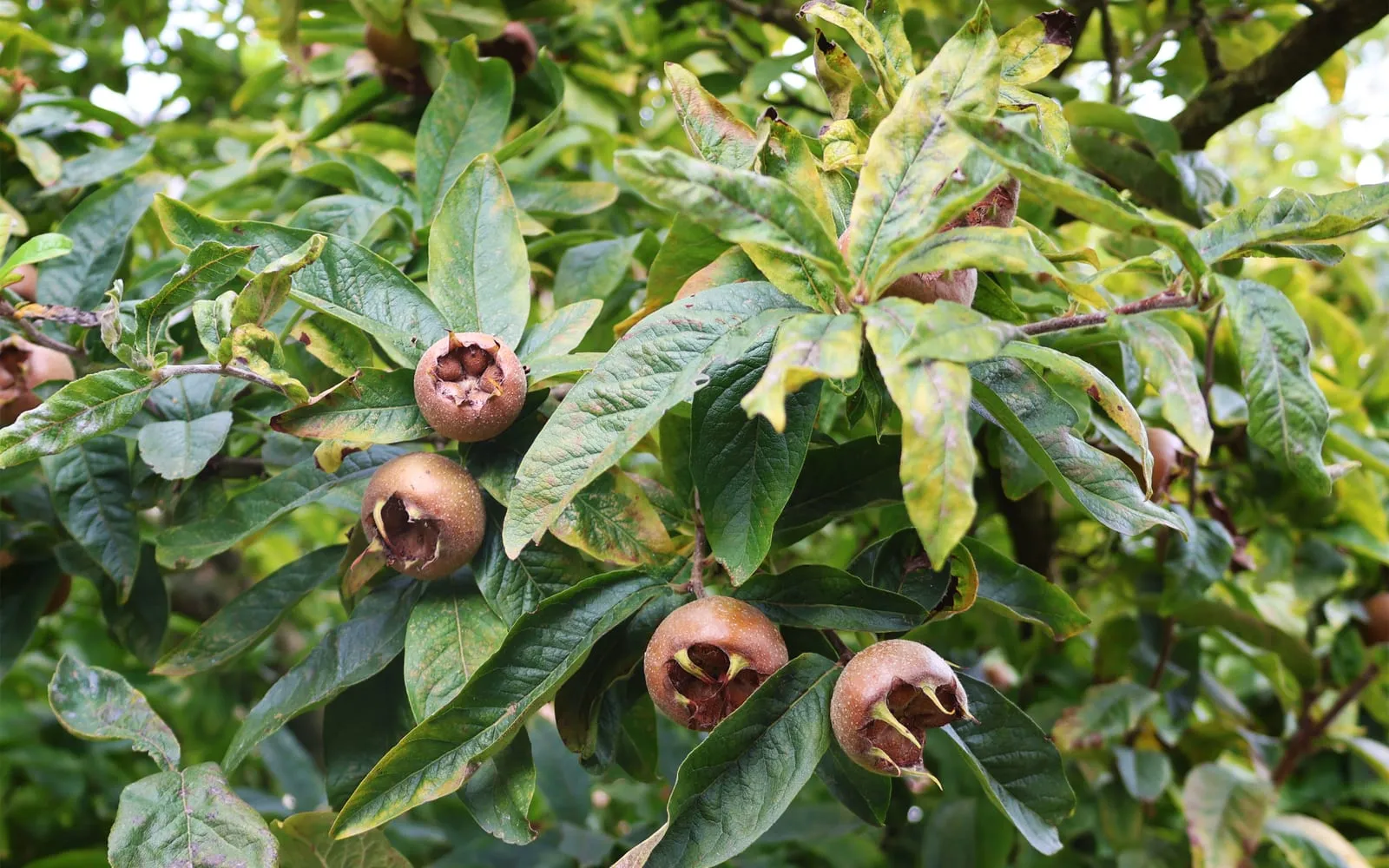
Fruit is dull russet brown, 3 to 5 cm across, flattened, and open at the end where the calyx flares into a wide ring of five sepals with the eye showing between them. That open end is unmistakable and gave the tree its old English name.
Flesh is white and hard at picking and turns to a soft brown pulp the texture of apple sauce once bletted.
‘Nottingham’ has smaller fruit with more flavour and an upright habit. ‘Dutch’ has much larger fruit and a spreading, almost weeping shape.
Where it is from
Medlar is native to south-eastern Europe, the Caucasus and northern Iran, and it has been grown so long around the Mediterranean that its exact wild range is argued over.
The Greeks and Romans both grew it, and the Romans brought it north. It was a standard fruit across medieval Europe, valued precisely because it comes ready in midwinter when almost nothing else does.
It appears throughout English literature, usually as a joke. The old name was openers, from the open end of the fruit, and Shakespeare uses it in Romeo and Juliet and As You Like It for exactly the reason you would expect.
The fruit fell out of fashion in the nineteenth century as imported and stored fruit made a midwinter apple ordinary, and it has never come back.
Britain has naturalised populations in hedgerows in the south, descended from old orchard trees.
How it grows
Buy a grafted tree. Medlars are usually worked onto hawthorn, quince or pear rootstock, and quince gives the smallest tree.
Plant between November and March in full sun or light shade, in deep ground that holds moisture but does not sit wet.
Space at 4 to 6 m and stake for two years. One tree is plenty, since medlar is self-fertile.
Leave it alone. Medlar needs no annual pruning, and the natural crooked shape is part of the point. Remove dead, damaged or crossing wood in winter and nothing else.
Expect fruit from the third or fourth year on a grafted tree.
Pick in early to mid November, after the first frost but before the fruit softens on the tree. They should still be rock hard. Twist them off with the stalk attached.
Blett them indoors. Lay the fruit stalk upwards in a single layer on a tray in a cool, dry, airy place, not touching each other. After two to four weeks the skin goes wrinkled and dark brown and the flesh softens to a pulp. That is when they are ready.
Through the seasons
Winter is for planting bare-root trees and for the small amount of remedial pruning the tree ever needs. It is also when you eat last month’s harvest.
Spring brings leaves and, at the very end of May, the flowers. Watch for aphids on the shoot tips and leave them to the predators unless the growth is badly distorted.
Summer asks nothing beyond watering a young tree in a drought.
Autumn is the display. Leaves turn russet and gold through October while the fruit swells and browns.
November is the harvest. Pick after a frost, while the fruit is still hard, then blett indoors for two to four weeks and eat through December.
Care difficulty
Easy, and easier than any other tree fruit in this collection.
The tree is fully hardy, self-fertile, tolerant of most soils, and has almost no pest or disease problems worth planning for.
The real difficulty is knowing when to pick and how to blett, and both are matters of confidence rather than skill. Pick too early and the fruit shrivels instead of bletting. Leave it on the tree too long and it bletts unevenly and rots.
The second difficulty is that most people have never eaten one and will not trust a brown, collapsed fruit. That is a presentation problem rather than a growing one.
Squirrels are the one genuine nuisance, since they take the fruit in late October just as it becomes worth taking.
Watering
Water weekly through the first two summers after planting, around 20 litres as a single soak.
An established medlar rarely needs water in a temperate climate.
Water in a prolonged drought if the tree is carrying a crop, since drought stress gives small fruit that bletts badly.
Mulch in late winter with compost over the root spread, kept clear of the trunk.
Avoid waterlogged ground. Medlar tolerates heavy soil but not standing water over winter.
Warning signs, diseases and pests
Brown rot is the main problem and it follows fruit left on the tree past its picking date, or bruised during picking. Affected fruit goes firm and brown with concentric rings of buff pustules. Remove and destroy every mummified fruit.
Aphids cluster on the soft shoot tips in spring and distort the new growth. On an established tree they are not worth treating.
Powdery mildew whitens the shoot tips in a dry summer and does no lasting harm.
Leaf spot browns and drops some leaves in a wet year, usually late enough in the season not to matter.
Squirrels strip the crop in late October, and there is no reliable answer beyond picking as early as you dare.
Fruit that shrivels rather than softens was picked too early.
Fruit that rots on the tray was bruised, or the room is too warm and damp. Bletting wants cool and airy.
Growing environment
Full sun gives the best crop, and the tree is content in light shade at the cost of some fruit.
Deep, moisture-retentive, well-drained soil is ideal, and medlar is not fussy. It grows on clay, loam and sand alike provided winter drainage is reasonable.
Around pH 6 to 7.5, and it tolerates mild alkalinity better than quince does.
Shelter is worth having for the fruit rather than the tree, since wind knocks ripening fruit off in October.
Give it room to spread. A medlar wants 5 m of width and looks wrong pruned into a narrow shape.
It is a good choice for a lawn specimen, being small, well-shaped, late-flowering and interesting in autumn.
Feeding
A medlar needs very little feeding and crops perfectly well on ordinary ground.
Mulch each late winter with well-rotted compost or manure spread over the root spread and kept off the trunk.
Add sulphate of potash at 20 g per square metre in February if the tree is cropping heavily.
Avoid nitrogen-rich feeds, which give leafy growth and less fruit and make the shoot tips more attractive to aphids.
On very poor sandy ground a balanced spring feed helps a young tree establish, and after three or four years it should not be needed.
Troubleshooting
The fruit shrivelled instead of going soft. Picked too early, or bletted somewhere too warm and dry. Pick after the first frost and blett somewhere cool and airy.
The fruit went mouldy on the tray. Too warm, too damp, or the fruit were touching. Lay them out in a single layer with air around each one.
How do I know when a bletted medlar is ready? The skin is wrinkled and dark brown and the flesh gives completely under light pressure. It smells sweet and winey. Sour, vinegary or furry means it has gone over.
The tree flowers and sets no fruit. Unusual, since medlar is self-fertile. Frost during flowering or a very wet flowering period are the likely causes.
Something is taking the fruit in October. Squirrels. Pick as early as you can get away with.
Do I need two trees? No. Medlar is self-fertile.
How do I eat them? Scoop the pulp out of the skin with a spoon and eat it as it is, traditionally with cheese and port. It also makes an excellent amber jelly, and medlar cheese in the way quince makes membrillo.
Does it need pruning? No. Take out dead or crossing wood in winter and otherwise leave the shape alone.
Medlar problem guides
Not sure what is wrong? See the common vegetable pests guide.