
Pest
Nut weevil
Curculio nucum
Also called Hazelnut weevil, Hazel weevil, Cobnut weevil, Nut borer
Nut weevil leaves a pinhead-sized hole in a hazelnut and a fat white grub where the kernel should be. Adult control has to happen in early summer, before females lay into soft green nuts.
At a glance
- Type
- Pest
- Cause
- Insect
- Severity
- Destroys the crop or display
- Affects
- Garden plants, Herbs and edibles
- Active
- April to September
- Established in
- Europe and Asia
What you are seeing
- A single neat circular hole about 1.5 mm across drilled through the shell
- The kernel gone or reduced to a shrunken remnant packed with brown frass
- A legless white grub curled inside the shell, with a brown head and no legs at all
- Nuts dropping early, in July and August, well before the crop should fall
- Fallen nuts that rattle, or that float when put in a bucket of water
- Nuts with no hole that turn out to be hollow, where the egg failed
- A weevil on the foliage in spring with a snout as long as the rest of it
- The snout longer than the body on the female, and noticeably shorter on the male
Before you treat anything
Nothing here is harmful to handle and an infested nut is unpleasant rather than dangerous. The practical warning is about storage: a crop brought in with grubs still inside it will be chewed through in the sack, and the grubs leave and wander. Float-test the crop before it goes into store, and dry it properly, since damp nuts in a bag turn mouldy faster than they turn wormy.
What you are looking at
One neat circular hole, about a millimetre and a half across, drilled straight through the shell of a hazelnut. The edge is clean. Nothing has gnawed at it.
Crack the nut and the kernel is gone, or reduced to a shrunken brown remnant packed with frass. Crack one that has fallen early and has no hole yet and the animal is still in there. It is a fat white grub curled into a C, with a brown head and no legs whatsoever.
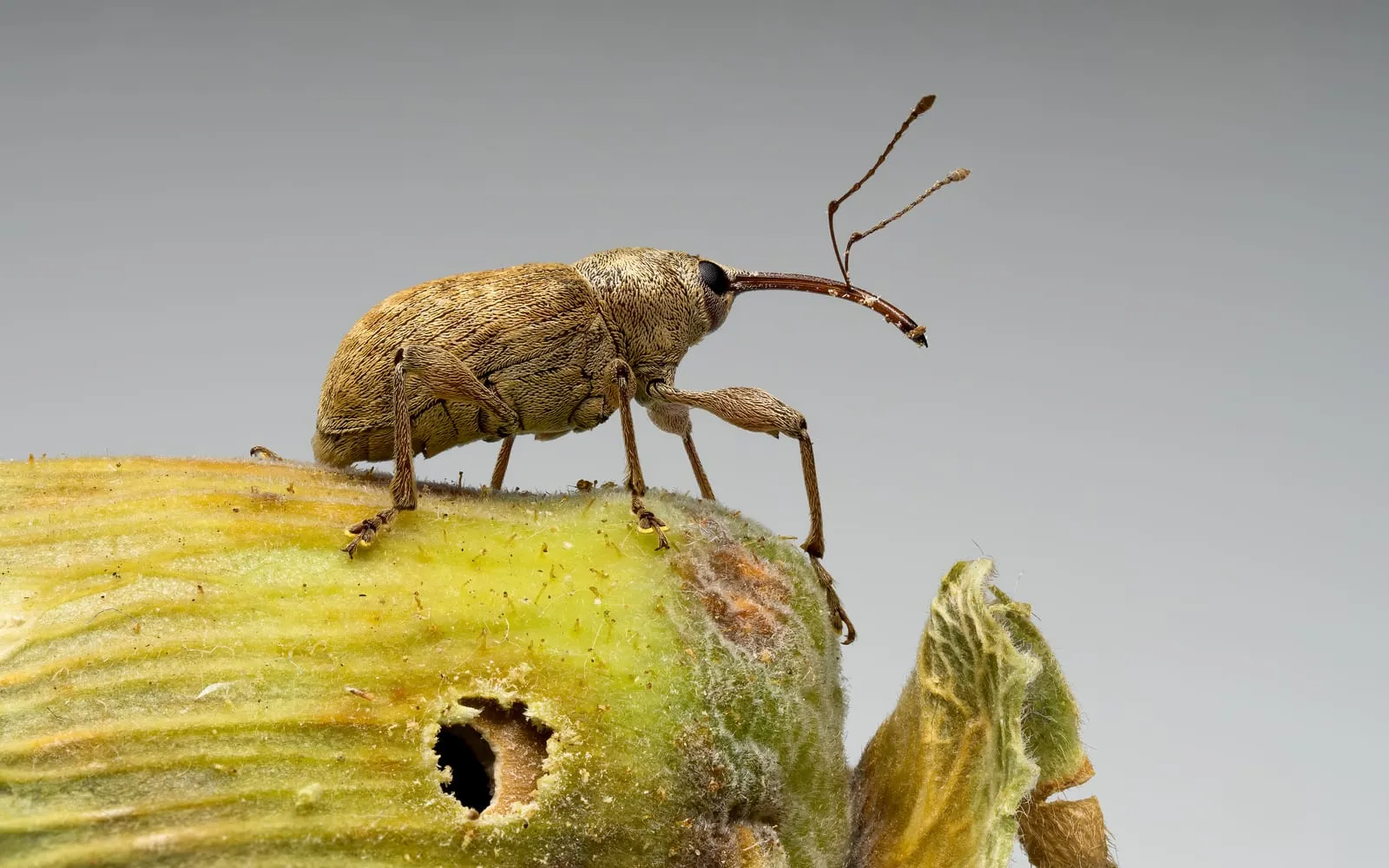
The adult is worth seeing once. It is a brown weevil about 7 mm long, and the female carries a snout longer than the whole of the rest of her body, curving down like a needle. It is the drill.
The hole means you are too late
A hole in a nut is an exit rather than an entrance.
The grub eats the kernel from the inside over several weeks, and when it has finished it cuts its way out through the shell, drops to the ground and burrows in. So the tidy round hole marks a nut the insect has already left, and the insect is now in the soil under the tree.
That is why collecting nuts matters and why it matters early. Infested nuts drop before the crop is ready, in July and August, because a nut with the kernel eaten out has nothing to hold it. Those early droppers are the ones worth picking up, and picking them up while the grub is still inside them is the difference between removing the insect and tidying up after it.
The grub then stays down there. Most spend one winter in a cell a few centimetres deep, and a substantial proportion spend two, some three, before pupating and coming up as adults. A single good year of collection therefore does not clear a tree, and the response has to be repeated.
The egg-laying window is short
The female drills her egg chamber through the shell while the nut is still soft and green. Once the shell lignifies she physically cannot, and every egg for the year has to be laid before that happens.
That window is a couple of weeks in early summer. Controls aimed at the adult work only during that period.
The way to use it on a garden tree is the way orchardists have always used it. Spread a sheet under a branch on a cool morning, when the weevils are sluggish, and tap the branch sharply. They drop and lie still rather than flying, which is a weevil’s defence and its weakness. Repeat every few days through the window and a real share of the females never lay.
Outside that fortnight the insect is inside a nut or inside the ground, and neither is reachable.
The floor is where the work is
Almost every effective action here is on the ground rather than in the tree.
Collect the early drop weekly, and keep the ground mown or bare so that you can see it. Float the harvested crop and discard what rises, which catches the ones whose grub has not yet cut its way out and left no hole to see.
Cultivate under the trees in autumn and again in late winter to break open the overwintering cells. Hens do the same job thoroughly if you have them and can fence them.
Entomopathogenic nematodes have been trialled against both the larvae and the emerging adults, and they are worth a try on warm moist soil. They are an addition to the cultivation rather than a substitute for it.
What to do about it
Collect the early drop every week through July and August, and bin it.
Float the harvest and throw away everything that rises.
Shake the branches onto a sheet every few days through early summer.
Keep the ground under the trees mown or bare so the drop is visible.
Cultivate that ground in autumn and again in late winter.
Run hens under the trees if you have them.
Do not compost infested nuts.
Expect to repeat it for several years, because the grubs come up over more than one winter.
What it gets mistaken for
A squirrel splits the shell or leaves a ragged gnawed opening with tooth marks.
A mouse leaves a hole with a chewed rim rather than a drilled one.
Codling moth puts a legged caterpillar into an apple, and this grub has no legs.
Big bud mite swells the buds and never touches the nuts.
A hazel that sets nothing at all has a pollination problem rather than a pest.
What to do, in order
Start here
Prevention, and the changes that stop the problem returning. Most of these pages should end at this tier.
- Pick up every fallen nut, and do it early
- Nuts fall early because there is a grub in them, so the ones on the ground in July and August are the infested ones. Collecting those before the grub chews its way out and burrows into the soil is the single most effective thing available, and it is the whole of the control on a garden scale. Once the hole is there the grub has already left.
- Float the crop and discard what rises
- Tip harvested nuts into a bucket of water. A sound nut is dense and sinks, and one that has been eaten out is light and floats. It sorts a crop in minutes, catches the ones with no visible hole, and the floaters go in the bin rather than the compost.
- Cultivate the ground under the trees
- The grub spends the winter, and often two or three winters, in a cell a few centimetres down. Hoeing or lightly forking that ground in autumn and again in late winter breaks the cells open and exposes them to frost and to birds. Keeping the ground bare under the trees rather than grassed makes both the cultivation and the collection easier.
- Run poultry or pigs under the trees where you can
- Hens work the top few centimetres of soil thoroughly and take both grubs and emerging adults. This is old orchard practice and it is effective for the same reason cultivation is, by attacking the stage that is out of the nut and in the ground.
- Do not compost infested nuts
- A garden heap will not reliably kill a grub in a cell, and spreading the compost puts it back under the trees. Bin them, burn them or feed them to stock.
Then reach for a barrier
Netting, hand removal and water. Nothing here harms anything except the target.
- Shake the adults out onto a sheet in spring
- Adults feed on the buds and young foliage before laying. Spread a sheet under a branch on a cool morning, tap the branch sharply, and the weevils drop and play dead rather than fly. Repeating this every few days through late spring takes a real share of the egg-laying females off a garden tree, and it is the only way to reach the insect before it is inside a nut.
- Time the effort to the fortnight that matters
- The female drills through the shell while it is still soft and green, and once it hardens she cannot. That gives a window of a couple of weeks in early summer during which every egg for the year is laid. Shaking and collecting are worth doing then and worth little either side of it.
- Keep the ground under the trees clear enough to see
- Long grass hides the early drop, which is exactly the part of the crop worth collecting. Mown or bare ground turns a job that needs doing weekly into one that takes minutes.
Then bring in the predators
Encourage what already lives in the garden, and buy predators in where the problem is under glass and nothing will arrive on its own.
- Leave the ground beetles and birds that work the orchard floor
- Carabid beetles take grubs and pupae in the soil, and tits and finches work the branches for adults in spring. Rough corners, a log pile and an unsprayed floor keep both, and they are attacking the stages that nothing else reaches.
- Consider entomopathogenic nematodes on the orchard floor
- Steinernema species have been tested against the larvae in the soil and against emerging adults, with results good enough to be worth trying and not good enough to rely on. They need warm moist soil to work, so water the ground before and after applying, and treat it as an addition to cultivation rather than a replacement for it.
Biological controls are live organisms and their sale and release are regulated country by country. An agent sold freely in one place may be unapproved in another, so buy from a licensed supplier where you live and never import or move one yourself.
Plants affected
Guides that name it among the problems to watch for. The list is the plants it is characteristic of rather than everything it will feed on.