
Edible
Tuberous Pea
Lathyrus tuberosus
Also known as Earthnut pea, Aardaker, Dutch mice, Fyfield pea
How to grow the tuberous pea, Lathyrus tuberosus. A hardy European perennial with chestnut-flavoured tubers, scented crimson flowers, and a habit of running where it is not wanted.
At a glance
- Difficulty
- Easy
- Water
- Rarely once established. Water new plants in their first summer
- Light
- Full sun
- Temperature
- Fully hardy. It dies back to the tubers each winter
- Hardiness
- USDA 4-8, RHS H6, hardy to -25 C
- Type
- Hardy herbaceous perennial climber
- Height
- 1-1.2 m
- Native to
- Europe, western Asia
- Best month
- March, June and October in the Northern Hemisphere, September, December and April in the Southern Hemisphere
Fully hardy and perennial from tubers, which is unusual in a pea and is what makes it worth growing. It runs about by rhizome and is treated as a weed of arable land across much of Europe, so give it a spot where spreading does not matter.
Hardiness zones describe winter cold alone. Summer heat, humidity, rainfall and the length of the growing season decide as much, so treat the range as the outer limit rather than as a recommendation.
Every month named in this guide is for the temperate Northern Hemisphere. If you garden in the Southern Hemisphere, shift each one by six months, so March becomes September. Closer to the equator the wet and dry seasons matter more than the calendar, and the shift stops being a useful guide.
Edible, with limits
- Safe to eat
- The tubers, cooked or raw
- Do not eat
- The seeds and pods, which are not eaten
- Harm from
- Eating it
- Affects
- People, cats and dogs
The tubers are food and have been eaten in Europe for centuries, roasted or boiled, with a flavour closer to sweet chestnut than to a pea. The seeds are a different question. Several Lathyrus species contain the neurotoxic amino acid ODAP, and long-term heavy consumption of grass pea, Lathyrus sativus, causes lathyrism, an irreversible paralysis of the legs. Lathyrus tuberosus is grown for its tubers and its seeds are not part of any food tradition, so the sensible position is to eat the tubers and leave the pods alone. The ASPCA lists the ornamental sweet pea, Lathyrus odoratus, as toxic to cats, dogs and horses, and the RHS lists Lathyrus as harmful if eaten, both of which concern the seed rather than the tuber. Keep the pods away from animals and children.
Sources: RHS potentially harmful garden plants, ASPCA toxic and non-toxic plants
About
The tuberous pea is a European vetch that grows small brown tubers on its running roots, and it was a field crop in the Netherlands and parts of Germany until the potato pushed it out. Dutch growers called it aardaker and sold the tubers in markets into the twentieth century.
Each tuber is 1 to 3 cm, dark brown, knobbly and dense. Boiled or roasted the flesh is white, sweet and floury with a taste much closer to sweet chestnut than to anything in the pea family, and they are good raw as well.
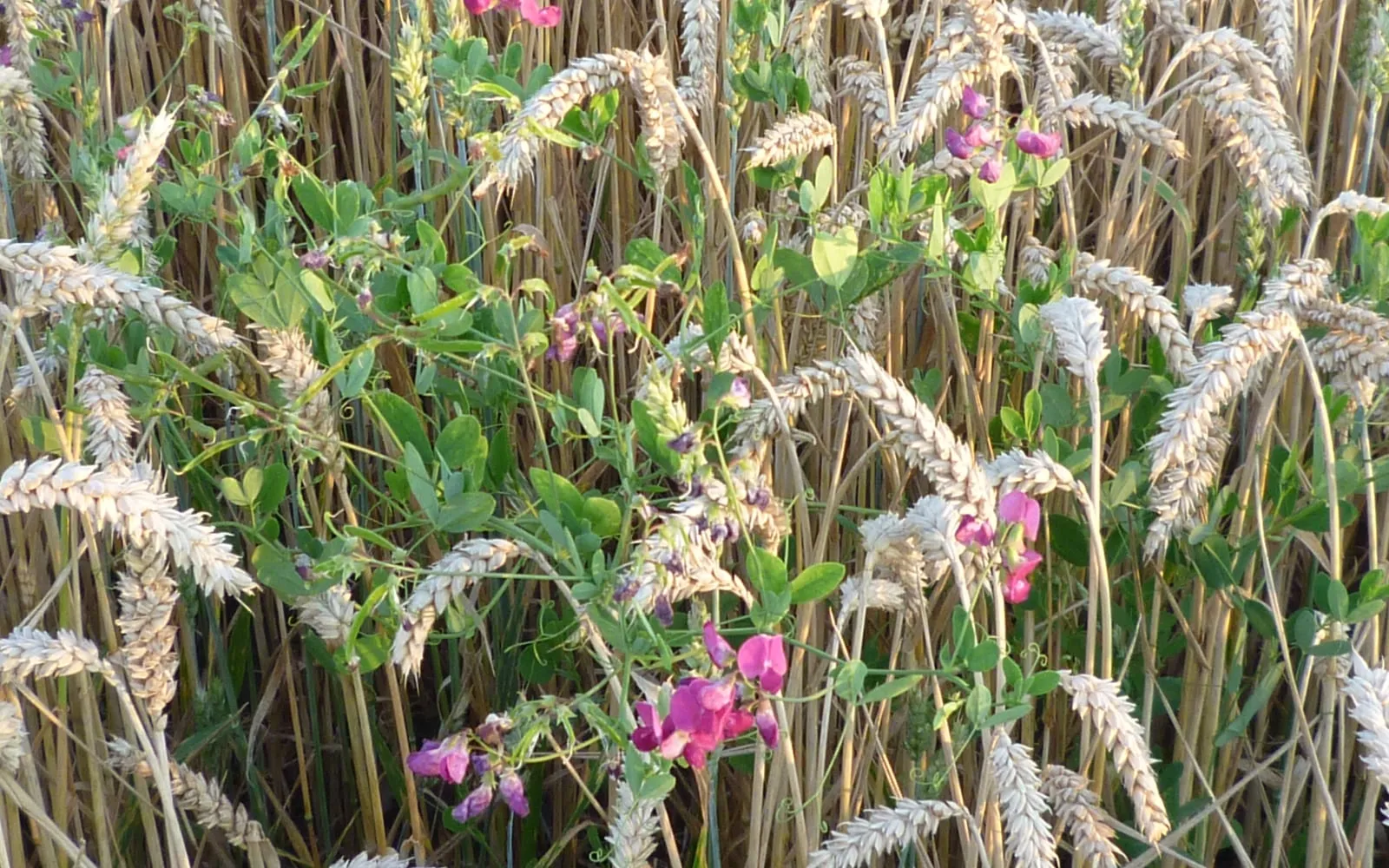
The flowers are the other reason to grow it. Deep crimson-pink pea flowers in loose sprays from June, strongly and pleasantly scented, on a plant that scrambles rather than climbs.
Britain has it as an archaeophyte, an ancient introduction naturalised in cornfields and on chalky banks. The Essex village of Fyfield gave the plant one of its English names after a population found there, and it is scarce enough now to be a notable find.
Appearance and character
A slender hardy perennial climber to about a metre, dying back to the tubers each winter and reappearing in spring.
Stems are thin, angled and not winged, which separates it from several relatives at a glance.
Leaves carry a single pair of narrow oval leaflets, 2 to 5 cm long, blue-green, with a branched tendril at the tip of the leaf stalk doing the climbing.
Flowers come in loose racemes of two to seven, each 1.5 to 2 cm, deep rose to crimson, with the pea family shape and a strong sweet scent.
Pods are slim, 2 to 4 cm, ripening brown and splitting to throw a few small seeds.
The tubers form on the rhizomes, spaced along them like beads on a string, 1 to 3 cm across, dark brown with a rough skin and white starchy flesh.
Its running rhizome is the reason it stays out of tidy borders. One plant will travel a metre or more a year through light soil.
Where it is from
Lathyrus tuberosus is native across Europe and western Asia, from Spain and France east through central Europe into Russia, Turkey and Iran, on chalky grassland, field margins and disturbed ground.
Cultivation was a northern European affair. Dutch and German growers raised it as aardaker or Erdnuss for its tubers, and it appears in Dutch market records and herbals from the sixteenth century onwards.
The potato ended it. A crop giving 3 cm tubers on a running root could not compete on yield with something giving 200 g tubers in a clump, and by the nineteenth century the tuberous pea had retreated to gardens and hedgerows.
Britain has it as an ancient introduction rather than a native, arriving with agriculture and persisting in arable weed communities on chalk and limestone, particularly in the south and east.
Interest in it has revived among growers of perennial vegetables, where its hardiness, its nitrogen fixation and its flowers all count in its favour.
How it grows
Start from tubers, which is far more reliable than seed. Plant them 5 cm deep in March or in October.
Seed can be used, and it needs scarifying and a period of cold before it will germinate, then two or three years to a crop.
Choose a sunny spot with well-drained soil. Chalky and poor suits it better than rich and moist.
Give it something to scramble through. Pea sticks, a low fence, or a shrub it can lean on. Left flat it will sprawl and flower less.
Water in the first summer and then leave it alone.
Feed nothing. It is a legume, and feeding it produces stem and rhizome rather than tubers.
Contain it. Growing it in a bottomless bucket sunk in the ground, or in a raised bed with a hard edge, keeps the rhizome where you put it.
Harvest tubers in late autumn after the top growth has died back, in the second or third year rather than the first.
Lift only part of a clump and leave the rest to carry on, which is how it is managed as a perennial crop.
Divide in spring or autumn by lifting a length of rhizome with several tubers on it.
Through the seasons
March is for planting tubers and for watching the first shoots come through.
April and May are for scrambling growth up whatever support it has been given.
June and July are the flowering months, and the scent is worth planting it for on its own.
August brings pods, which are best cut off unless you want seed.
September is when the tubers bulk on the rhizome.
October is planting time for new tubers and the start of the harvest window.
November onwards the top growth dies away and the tubers can be lifted at any point until the ground freezes.
Care difficulty
Easy, and the easiest plant in this whole group.
Fully hardy, which nothing else in this group can claim.
It wants poor well-drained soil and full sun, and it resents being fed.
Slugs on the spring shoots are the only real pest.
The running rhizome needs containing, or it will spread quietly through a border.
Yields are modest. Nobody grows this instead of potatoes.
Watering
Water new plantings through their first summer.
Leave established plants alone, since the tubers carry them through a dry spell.
Water in a prolonged drought if the foliage starts to wilt.
Avoid watering into autumn, when the plant is dying back.
It will not tolerate waterlogged winter soil, which rots the tubers.
Nothing is needed in winter.
Warning signs, diseases and pests
Shoots grazed to the ground in April are slug damage.
Sticky flower stems with black growth are aphids.
White powder on the leaves in a dry August is powdery mildew, which does little harm this late.
Plenty of growth and few flowers usually means too much shade or too rich a soil.
Tubers that are soft and brown at lifting have sat in waterlogged ground.
Shoots appearing a metre from where you planted it are the rhizome doing what it does, and they mark the point at which containment becomes worthwhile.
Holes in the soil over the tubers in winter are mice.
Growing environment
An open sunny position outdoors anywhere in its hardiness range.
Full sun.
Well-drained soil, ideally chalky or neutral, and poor rather than rich.
Something to scramble through, up to about a metre.
Room for the rhizome to run, or a physical barrier to stop it.
No protection of any kind is needed.
Feeding
Feed nothing. This is a nitrogen-fixing legume on poor soil by preference.
Skip manure entirely, since it produces rank growth and few tubers.
Add grit rather than compost to a heavy soil.
Lime a strongly acid soil, which suits the plant.
Leave the dying top growth to return its nitrogen to the ground, or cut and compost it.
Nothing is wanted at any point in the year.
Troubleshooting
What do the tubers taste like? Sweet chestnut, more than anything else. Boiled or roasted the flesh is white, floury and sweet, and they are pleasant raw as well.
How big do they get? Small. One to three centimetres, on a running rhizome, which is the reason the potato replaced them.
Can I eat the peas in the pods? No. Leave the seed alone. Several Lathyrus species carry a neurotoxic amino acid and this one has no food tradition around its seed.
Is it hardy? Fully. It dies back to the tubers each winter and comes up again in spring, right across its range.
When do I harvest? From late autumn of the second year onwards, once the top growth has died back. Lift part of a clump and leave the rest.
It is spreading. Yes, it does that. Sink a bottomless container around it or plant it somewhere the rhizome can run without causing trouble.
Do the flowers have a scent? A strong and pleasant one. Deep crimson-pink sprays through June and July on a plant that also feeds you.
Can I grow it from seed? Yes, with patience. Scarify the seed, give it a cold period, and expect two or three years before there is anything to lift. Tubers are much quicker.
Why is it called the Fyfield pea? After a population found at Fyfield in Essex. It is an ancient introduction to Britain rather than a native, and it is now scarce in the wild.
Tuberous Pea problem guides
Not sure what is wrong? See the common vegetable pests guide.