
Pest
Red palm weevil
Rhynchophorus ferrugineus
Also called Asian palm weevil
A palm that looks healthy until its whole crown suddenly topples, hollowed from within by a grub that can grow to the length of a finger. Native to South and Southeast Asia, now established across the Middle East, North Africa and the Mediterranean, and one of the reasons ornamental and date palms in those regions are monitored so closely.
At a glance
- Type
- Pest
- Cause
- Insect
- Severity
- Can kill the plant
- Affects
- Herbs and edibles, Garden plants
- Active
- All year
- Established in
- Asia, Africa and Europe
What you are seeing
- A palm's entire crown collapsing suddenly, sometimes with almost no external warning beforehand
- Wilting, yellowing or drooping of the youngest, central fronds first, while older outer fronds still look normal
- Holes in the trunk, often oozing a gummy, fermented-smelling liquid, from which chewed fibrous frass may be pushed out
- A hollow, fibrous cavity found inside the trunk or crown when a dead or dying palm is cut open
- Fat, legless, cream-coloured grubs up to 5 cm long with a dark brown head, found feeding inside the trunk
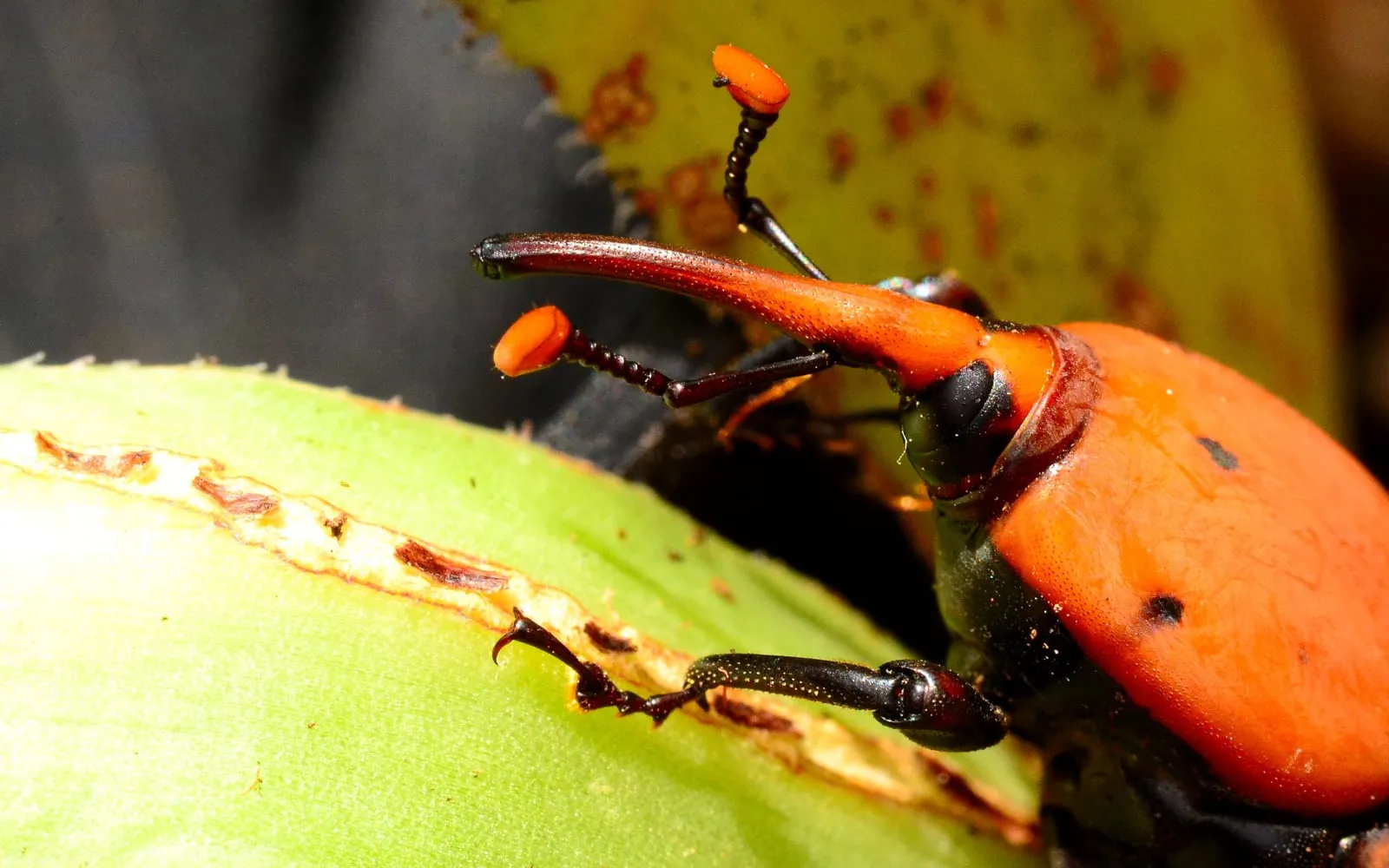
- Large reddish-brown adult weevils, 2 to 5 cm long, with a long curved snout, occasionally seen flying at dusk
Before you treat anything
A collapsing crown is a genuine physical hazard. Keep clear of a palm suspected of heavy infestation and have it assessed and removed by a professional rather than working beneath or around it.
What you are looking at
A palm whose central, youngest fronds start wilting, yellowing or drooping while the older outer fronds still look completely normal, an early and easily missed sign that something is wrong deep inside the trunk. Left untreated, an infested palm’s entire crown can collapse suddenly with little further warning, because the weevil’s grubs have hollowed out the fibrous tissue that holds the crown up from within.
Cut into an affected trunk and the damage becomes obvious. A hollow, fibrous cavity sits inside, sometimes packed with fat, legless, cream-coloured grubs up to 5 cm long with a dark brown head. From outside, holes in the trunk sometimes ooze a gummy, fermented-smelling liquid, occasionally with chewed fibrous frass pushed out alongside it. The adult is a large reddish-brown weevil, 2 to 5 cm long, with a long curved snout, occasionally seen flying at dusk but rarely noticed before the damage it has already caused becomes visible.
From South Asian coconuts to Mediterranean date palms
Native to the Indian subcontinent and Southeast Asia, this weevil damaged coconut palms there for well over a century before international trade in ornamental palms carried it to the Middle East in the 1980s. From there it spread across the Arabian Peninsula, North Africa and the Mediterranean basin, where it is now the dominant threat facing both commercial date palms and the ornamental Canary Island date palms planted along so much of southern Europe’s coastline. It is currently present in roughly 49 countries.
Isolated detections have occurred in parts of the southern United States and the Caribbean, but a self-sustaining population has not established across North America, and any find there is treated with the same urgency as a first arrival anywhere else. Australia and New Zealand have never had it and both treat a suspected sighting as an immediate biosecurity matter.
What to do about it
Buy palms only from certified, inspected nurseries, since infested ornamental stock is the main way this weevil crosses into new regions.
Avoid unnecessary pruning wounds and mechanical damage to the crown, and seal any cuts promptly, since adults are drawn to the scent of fresh wounds.
Where the weevil is present, monitor high-value palms with pheromone traps and treat early-stage infestations with entomopathogenic nematodes or fungi applied by a professional; a heavily infested palm is rarely saveable once symptoms are visible from outside, and preventive insecticide injection is a last resort worth discussing with a professional only for an exceptionally valuable specimen.
Report a suspected infestation immediately rather than waiting to confirm it personally, given how much damage happens hidden inside the trunk before any external sign appears.
Stay clear of a palm suspected of heavy infestation; a collapsing crown is a genuine physical hazard.
What it gets mistaken for
Honey fungus kills a broad range of trees and shrubs gradually, with white fungal sheets under the bark near the base and toadstools appearing in autumn, quite different from the fibrous hollowed trunk and gummy oozing holes this weevil leaves specifically in a palm.
Not established in North America, Australia and New Zealand
Do not prune, spray or otherwise treat a suspected case. Doing so risks spreading an organism the country has kept out, and it disturbs the evidence needed to identify it. Photograph what you can see, leave the plant alone, and contact your national or state plant health authority. The control advice further down this page is written for regions where this problem is already established.
Native to the Indian subcontinent and Southeast Asia, where it has damaged coconut palms since the nineteenth century. It reached the Middle East in the 1980s, almost certainly through the international trade in infested ornamental palms, and has since spread across the Arabian Peninsula, North Africa and the Mediterranean basin, where it has become the dominant threat to both date palms and the ornamental Canary Island date palms widely planted along southern European coasts. It is now present in around 49 countries. Isolated detections have occurred in parts of the southern United States and the Caribbean, but it has not established a self-sustaining population across North America, and a find there is treated the same way a first arrival anywhere would be. Australia and New Zealand have never had it and both treat a suspected sighting as an immediate biosecurity concern.
What to do, in order
The steps below apply where this problem is already established.
Nothing available to a gardener will cure this once a plant has it. The steps below are about limiting the spread and deciding what to plant in its place.
Start here
Prevention, and the changes that stop the problem returning. Most of these pages should end at this tier.
- Buy palms only from certified, inspected nurseries
- Movement of infested ornamental palms between countries is the main way this weevil has spread internationally, and it remains the single greatest risk for introducing it into a currently unaffected area. Certified stock, inspected before sale and ideally treated preventively, is the standard safeguard recommended everywhere the weevil is a live concern.
- Avoid pruning wounds and mechanical damage to the crown
- Adults are drawn to the scent of fresh wounds and stressed tissue, and pruning cuts, transplant damage or storm injury all create entry points. Pruning only when necessary, sealing cuts promptly, and avoiding unnecessary damage to the crown reduces how attractive a palm is to egg-laying females.
- Report a suspected infestation immediately
- Because damage happens hidden inside the trunk and a heavily infested palm can collapse with little external warning, early detection through reporting suspicious symptoms, rather than waiting to confirm them personally, is what protects neighbouring palms and gives any treatment a chance of working before the crown fails.
Then reach for a barrier
Netting, hand removal and water. Nothing here harms anything except the target.
- Monitor with pheromone-baited traps
- Aggregation pheromone traps, often combined with a food bait, attract and capture adult weevils and are the standard early-warning tool in affected regions, giving growers and municipalities time to inspect and treat nearby palms before an infestation becomes terminal.
Then bring in the predators
Encourage what already lives in the garden, and buy predators in where the problem is under glass and nothing will arrive on its own.
- Apply entomopathogenic nematodes or fungi to early infestations
- Nematodes and fungal biopesticides applied into trunk injection points or wound sites can reduce larval survival in an early-stage infestation, though a heavily hollowed trunk is generally beyond saving by the time symptoms are obvious from outside.Sold and used across parts of the Mediterranean and Middle East as part of integrated management programmes; check local registration and availability.
Biological controls are live organisms and their sale and release are regulated country by country. An agent sold freely in one place may be unapproved in another, so buy from a licensed supplier where you live and never import or move one yourself.
Plants affected
Guides that name it among the problems to watch for. The list is the plants it is characteristic of rather than everything it will feed on.