
Edible
Maprang
Bouea macrophylla
Also known as Marian plum, Gandaria, Plum mango, Ma-praang
How to grow maprang, Bouea macrophylla. The plum mango of Thailand and Java, a small orange fruit that tastes of mango and behaves like a plum, and the family it shares with mango and cashew.
At a glance
- Difficulty
- Difficult
- Water
- Twice a week in growth, less in winter
- Light
- Full sun when mature, light shade when young
- Temperature
- Minimum 15 deg C. Damaged below 12 deg C
- Humidity
- High
- Hardiness
- USDA 11-12, RHS H1b, hardy to 15 C
- Type
- Tender evergreen tree
- Height
- 10-27 m in the open, 1.5-2 m in a pot
- Native to
- the Malay peninsula, Sumatra, Java
- Best month
- May and June in the Northern Hemisphere, November and December in the Southern Hemisphere
Wet lowland Thailand, Malaysia and Indonesia. Constant warmth and humidity, and no tolerance of cool nights.
Hardiness zones describe winter cold alone. Summer heat, humidity, rainfall and the length of the growing season decide as much, so treat the range as the outer limit rather than as a recommendation.
Every month named in this guide is for the temperate Northern Hemisphere. If you garden in the Southern Hemisphere, shift each one by six months, so May becomes November. Closer to the equator the wet and dry seasons matter more than the calendar, and the shift stops being a useful guide.
Skin irritant
- Safe to eat
- The ripe flesh, and the young leaves as a vegetable
- Do not eat
- The seed, which is bitter, and the sap for anyone sensitive to the family
- Harm from
- Eating it and handling it
- Affects
- People
Maprang is not toxic and nothing in it is listed as harmful to cats or dogs. Two family cautions apply. It sits in the Anacardiaceae alongside mango, cashew and poison ivy, so the sap can raise a rash in anyone strongly sensitive to that group, and gloves are sensible when pruning. The seed is bitter, tinged purple in some forms, and is not eaten. Unripe fruit is sharply sour rather than harmful, and it is eaten green in Thailand with salt and chilli. The young leaves are eaten as a vegetable in Java and Sumatra, which is a good indication of how benign the plant is.
Sources: ASPCA toxic and non-toxic plants, RHS potentially harmful garden plants
About
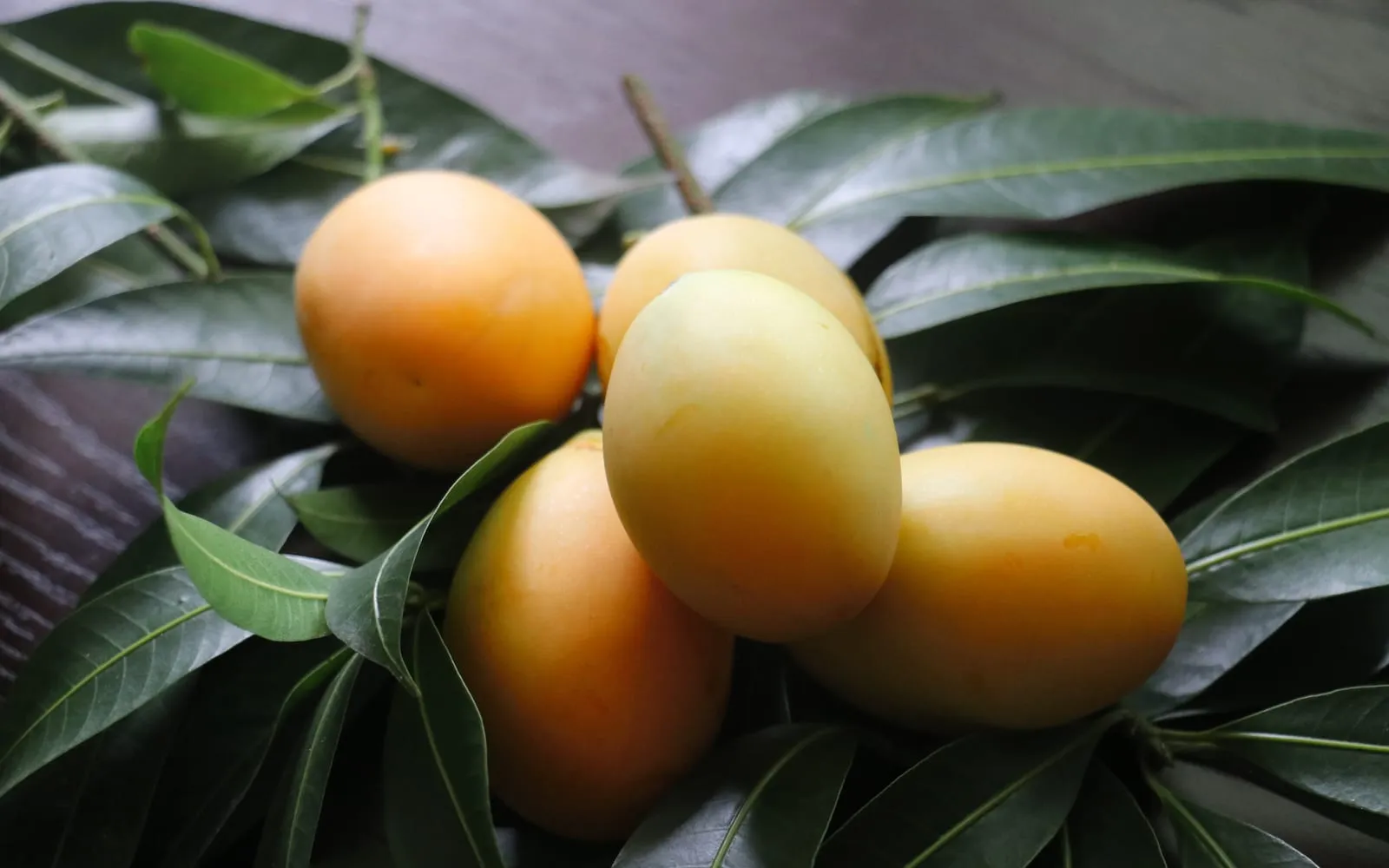
Maprang looks like a small mango and eats like something between a mango and a plum. The fruit is 3 to 5 cm, smooth-skinned and bright orange when ripe, with soft sweet flesh around a single seed and a resinous note that gives away its family.
Thailand sells it two ways. Ripe and orange as a dessert fruit, and unripe and green as a crunchy sour snack with salt and chilli, and the green form is the one most Thais would name first.
The tree is slow, tender and hard to source, which makes it one of the more difficult plants in this collection to attempt seriously outside the tropics.
Appearance and character
A narrow evergreen carrying a dense conical crown, reaching 10 to 27 m where nothing crowds it, and holding that pointed outline even as a young pot plant.
Bark stays grey-brown and smooth for years before it begins to fissure.
Leaves are the diagnostic feature. They are lance-shaped to oblong and very large at 20 to 45 cm, glossy, leathery, drawn out to a fine point, and set in opposite pairs. Almost everything else in the family carries its leaves alternately, so an opposite-leaved Anacardiaceae with mango-scented sap is Bouea and very little else. Each flush opens pink or copper and hardens to dark green over a fortnight.
Flowers are small, cream to pale yellow, in branched sprays in the leaf axils and at the shoot tips.
Fruit hangs in clusters, round to oval, 3 to 5 cm, ripening from green through yellow to a clear bright orange, with a thin smooth skin.
Flesh is orange, soft, juicy and sweet with a resinous mango note.
The seed is single and large, and in some forms it is tinged purple, which is a character growers use to distinguish types.
The whole tree is handsome and the pink new growth is the reason it is sometimes planted ornamentally.
Where it is from
Maprang is native to the Malay peninsula, Sumatra and Java, where it grows in lowland rainforest.
Thailand and Indonesia are where it is cultivated seriously. Thai growers have selected named cultivars for size and sweetness, and maprang is a familiar market fruit there in the hot season.
Java calls it gandaria and uses the young leaves as a vegetable and the unripe fruit in sambal.
It reached Malaysia, Vietnam and the Philippines and is grown in a small way in each.
Outside South East Asia it is rare, with small plantings in Australia, Hawaii and Florida.
Temperate markets do not see the fruit, and a plant would have to come from a specialist tropical nursery.
How it grows
Sow the stone straight out of the fruit. It has a shelf life of days and no dormancy to fall back on.
Bottom heat at 25 to 30 deg C brings it through in three to six weeks, in an open compost on the acid side.
Watch for more than one shoot from a single stone, which happens often. Maprang is polyembryonic in the way a mango is, and most of the seedlings from one seed are nucellar clones of the mother tree rather than the product of pollination. Keep the strongest two or three and pull the weakest, which is usually the odd one out and the only true seedling in the pot.
A grafted plant is still the shorter road, since a seedling that is not nucellar can take six to ten years to flower.
Shade the first years, then give it as much light as the house has.
Nothing below 15 deg C at any point, which is warmer than most of the tropical fruit here demands, and humidity high with it.
Water twice a week through growth and cut back over winter without letting the compost dry.
Feed monthly from April to September with something carrying iron.
Expect very little to happen for a long time. Even a grafted plant takes four to six years, and the tree grows slowly enough that a season can pass with two flushes of leaves and nothing else.
Through the seasons
Winter is a warm rest rather than a cold one. Hold 15 deg C as a floor, keep the air damp, water lightly and feed nothing.
Spring opens a flush of pink leaves, and on a mature tree the small cream flower sprays come with them.
Early summer sets fruit in hanging clusters, several to a spray.
Midsummer swells and ripens the crop, matching the Thai hot season when maprang fills the Bangkok markets.
Late summer brings a second flush of leaves, pink again.
Autumn ends the feeding while the warmth and humidity stay where they were.
Care difficulty
Difficult, on grounds of warmth, patience and supply rather than technique.
The floor of 15 deg C has no exceptions. Several tropical fruits in this collection will sit out a night at 8 deg C and shrug; this one drops leaves below 12 deg C and takes a season to replace them.
Humidity has to hold through the winter as well as the summer.
Growth is slow enough to test anyone. Four to six years to fruit on a graft is the optimistic figure, and it assumes nothing has checked the plant in between.
Hard water brings iron chlorosis quickly, and a yellowing maprang is slow to recover its colour.
Finding a plant at all is the first obstacle, since no general nursery outside South East Asia carries it.
Treated as a foliage plant it succeeds easily, and the large glossy leaves with their pink flushes are reason enough to grow one. Fruit is the ambition to hold loosely.
Watering
Twice a week through the growing months, keeping the compost evenly damp without ever soaking it.
Less in winter, and still never dry. There is no drought rest in this species.
Drainage has to be free in every month, because a cold wet rootball is what kills these under glass.
Humidity from damped gravel and grouped plants, which holds it far better than a daily misting.
Rainwater where the supply is hard, and the leaves will tell you within a season if you ignore this.
A steady supply through fruit swell, since a check at that point drops the crop.
Water at glasshouse temperature rather than cold from the tap, and never leave the pot standing in it.
Warning signs, diseases and pests
Pink or copper new growth is normal and is one of the tree’s best features.
Yellowing between green veins is iron shortage on hard water.
Brown leaf edges mean dry air.
Leaf drop after a cold night is chill damage below 12 deg C.
Brown limpets on the stems are scale.
White fluff in the leaf axils is mealybug.
Fine webbing on the leaves is spider mite.
Wilting in damp compost is root rot.
Very slow growth is normal for the species.
Growing environment
A heated humid greenhouse or conservatory, since nothing outside the tropics holds a maprang through a winter in the open.
A floor of 15 deg C, and 25 to 32 deg C for anything that counts as growth.
Humidity high in every month.
Light shade over a young plant, and full glasshouse light once the leaves have hardened.
Deep, rich, free-draining compost on the acid side, pH 5.5 to 6.5.
Rainwater in the can wherever the tap supply is hard.
A pot of 40 cm or more, and headroom. Leaves 45 cm long need space that a crowded bench will not give them.
Feeding
A balanced liquid feed carrying iron, monthly from April to September.
Sequestered iron the moment the veins start standing out green against a paler blade, rather than waiting to see how far it goes.
Nothing from October onwards, and nothing through the winter rest.
A top-dressing or a repot each spring, before the first flush opens.
A light hand throughout. The tree grows too slowly to use a heavy feed, and what it cannot use accumulates as salt around the roots.
Magnesium where the yellowing starts on the older leaves rather than the young ones, which separates it from the iron problem above.
Troubleshooting
What does it taste like? Sweet and soft with a resinous mango note, and a texture closer to a plum. Unripe it is sharply sour and is eaten green in Thailand with salt and chilli.
Is it a mango? No, but it is in the same family. Bouea is a separate genus in the Anacardiaceae alongside mango, cashew and poison ivy.
Why is the new growth pink? A normal flush colour, and one of the tree’s best ornamental features. It hardens to dark green in a week or two.
The leaves went yellow between the veins. Iron shortage from hard water. Use rainwater, slightly acid compost and sequestered iron.
How long until it fruits? Four to six years on a grafted plant, six to ten from seed, and both are slow.
Several seedlings came from one seed. Normal for this species.
Where do I get one? From a specialist tropical nursery. There is no European trade in the plant or the fruit.
Can I eat the leaves? The young ones, yes. Java and Sumatra use them as a vegetable and in sambal.
Maprang problem guides
Not sure what is wrong? See the common vegetable pests guide.