
Edible
Canistel
Pouteria campechiana
Also known as Egg fruit, Yellow sapote, Tiesa
How to grow canistel, Pouteria campechiana. The egg fruit whose flesh has the texture of a hard-boiled yolk, why it divides people so sharply, and how to eat one properly.
At a glance
- Difficulty
- Moderate
- Water
- Weekly in growth, sparingly in winter
- Light
- Full sun
- Temperature
- Minimum 5 deg C. A mature tree takes a light frost
- Humidity
- Moderate
- Hardiness
- USDA 10-11, RHS H1b, hardy to 5 C
- Type
- Tender evergreen tree
- Height
- 8-25 m in the open, 1.5-2 m in a pot
- Native to
- southern Mexico, Central America
- Best month
- May, June and October in the Northern Hemisphere, November, December and April in the Southern Hemisphere
Seasonally dry Central American forest. It takes drought better than most tropical fruit and a brief light chill without damage, though not frost.
Hardiness zones describe winter cold alone. Summer heat, humidity, rainfall and the length of the growing season decide as much, so treat the range as the outer limit rather than as a recommendation.
Every month named in this guide is for the temperate Northern Hemisphere. If you garden in the Southern Hemisphere, shift each one by six months, so May becomes November. Closer to the equator the wet and dry seasons matter more than the calendar, and the shift stops being a useful guide.
Not known to be toxic
- Safe to eat
- The ripe flesh
- Do not eat
- Unripe fruit, which is astringent rather than harmful
Canistel is not toxic and nothing in the plant is listed as harmful to people or to cats and dogs. Unripe fruit is astringent and dry enough to be unpleasant, which is a quality problem rather than a safety one. The seeds are large and hard and are not eaten. The flesh is very dense and dry, and eating a lot at once without a drink is uncomfortable, which is why it is usually blended or eaten with something wet. Some sources note that the species has occasionally caused mouth irritation when eaten under-ripe, and the answer is the same as for the taste: wait until it is soft.
Sources: ASPCA toxic and non-toxic plants, RHS potentially harmful garden plants
About
Canistel divides opinion more sharply than anything else here. The flesh of a ripe one has the texture of a hard-boiled egg yolk, dense, dry and crumbling, with a sweet flavour of custard and sweet potato behind it.
People who expect a juicy fruit put it down after one mouthful. People who treat it as a starch, eating it with a spoon and something to drink, or blending it with milk into a shake, tend to come round.
Timing is everything with it. Picked mature and left to soften for a week, it is rich and pleasant. Eaten early it is dry, astringent and disappointing, and that is how most people meet it.
Appearance and character
An upright rather narrow evergreen tree, 8 to 25 m in the open, branching from low down.
All parts bleed a white latex when cut, as every Pouteria does.
Leaves cluster towards the shoot tips, oblong to lance-shaped, 10 to 28 cm, glossy mid-green, thin, and tapering at both ends.
Flowers are small, cream to greenish yellow, borne singly or in small clusters in the leaf axils and on older wood, and they smell faintly sweet.
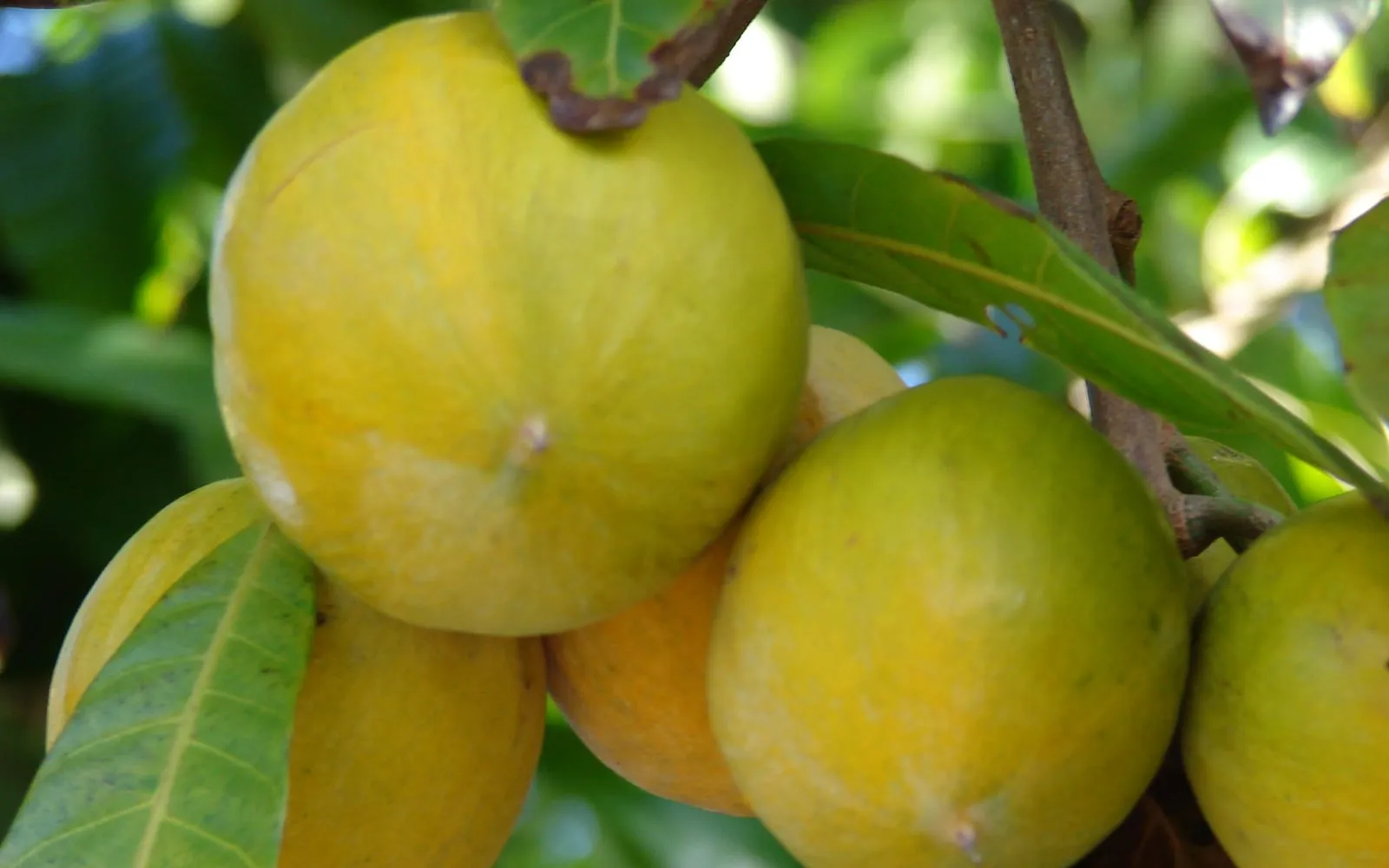
Fruit is variable in shape, which is part of its charm. Round, oval, or a pointed spinning-top form, 7 to 12 cm, ripening from green to a bright orange-yellow.
Skin is thin, smooth and glossy, and often carries a pointed beak at the far end.
Flesh is deep orange-yellow, dense, dry, smooth and mealy, with the texture of cooked egg yolk.
Seeds are one to four, large, glossy brown, and easily removed.
Where it is from
Canistel is native to southern Mexico, Belize and Guatemala, in the same lowland forests as its relative the mamey sapote.
It was cultivated across Mesoamerica before European contact and the Nahuatl name survives in some regional Spanish.
The Spanish carried it to the Philippines, where it is grown as tiesa, and from there it reached South East Asia.
Vietnam grows it commercially in a modest way, and it is planted in Florida, Hawaii, Australia and India.
It has never become a major export crop, because the dense dry flesh is a minority taste and the fruit bruises.
Temperate markets see it very rarely, in Latin American and South East Asian speciality shops.
How it grows
Take seed from a fruit you have just eaten and sow it within a fortnight. The large glossy stones stay viable for only a few weeks and they come up over three to six weeks with bottom heat around 25 deg C.
A grafted plant is the better buy. Seedlings vary in shape, size and quality of flesh, and although they crop faster than most of the Sapotaceae they still ask for three to six years of patience.
Any open compost suits it. This is a tree of Yucatan limestone, and it grows on thin alkaline ground that would starve most tropical fruit, which is why it took so well to the oolitic soils of south Florida.
Full sun, and a floor of 5 deg C rather than the 10 or 15 its relatives demand.
Water weekly through the growing months and cut back sharply once growth stops.
Feed monthly from April to September.
Prune while the plant is young. The habit is upright and narrow, the wood is brittle, and a leader shortened early saves a split branch later.
Flowers are bisexual and set without a partner, so a single plant will crop. Expect fruit three or four years after grafting.
Pick at full orange-yellow while the fruit is still hard. It is climacteric and finishes off the tree, softening on a windowsill over five to ten days.
Through the seasons
Winter is a genuine cool rest. Hold above 5 deg C, water just enough to keep the compost from going dust dry, and feed nothing.
Spring brings both the growth flush and the flowers, which open in the leaf axils and along the older wood. Repot now and start feeding.
Early summer sets fruit, and a light natural drop follows within weeks.
Midsummer swells what is left, slowly. Canistel takes months over a fruit that a Java apple would finish in four weeks.
Autumn is the harvest, picked hard and ripened indoors. A warm house often brings a second flowering and a smaller late crop with it.
Late autumn ends the feeding, and watering drops back as the light goes.
Care difficulty
Moderate, and the least demanding of the Sapotaceae grown under glass.
Cold is the reason. Where mamey sapote and star apple want 10 deg C or more, canistel holds at 5 deg C and a mature specimen shrugs off a touch of frost on the outer leaves.
Alkaline and impoverished ground suits it, which removes the compost question that dogs most tropical fruit in a pot.
The narrow upright habit takes cutting well, so a plant can be held at head height indefinitely.
Ripening happens indoors on a windowsill, so the glasshouse is free of the plant weeks before the fruit is ready.
What disappoints people is the eating rather than the growing. A fruit cut while it still feels firm is dry, chalky and mouth-puckering, and almost everyone who dislikes canistel has met it in that state.
Watering
A thorough weekly soak through the growing months, with the surface allowed to dry in between.
Barely damp through the winter rest, which is a real difference from the wet-tropics fruits that want the same routine in January as in July.
Free drainage in every month, since standing water rots the roots faster than drought harms them.
Steady supply while the fruit is swelling. Erratic watering at that stage is what makes a tree drop half its crop small.
Tap water is fine, including where the supply is hard. Few tropical fruits tolerate lime this well.
Moderate humidity is enough, and misting is unnecessary.
An established plant will forgive a fortnight of neglect, which is not true of anything else in this part of the collection.
Warning signs, diseases and pests
Dry astringent flesh means the fruit was eaten too soon. Let it soften for five to ten days after picking.
Yellowing between green veins is iron shortage on hard water.
Brown limpets on the stems are scale.
White fluff in the leaf axils is mealybug.
Fine webbing on the leaves is spider mite in dry air.
Wilting in damp compost is root rot.
Leaf drop after a cold snap is chill damage. Cut back to live wood in spring.
Fruit dropping small is irregular watering or too heavy a set.
Growing environment
A frost-free greenhouse or conservatory, with the pot stood outside for the warmest two or three months of the year.
A floor of 5 deg C, and 22 to 30 deg C for growth and fruit.
Full sun, which the fruit needs for its colour and its sugars.
Moderate humidity. This is a seasonally dry forest tree and it has no use for the saturated air the wet-tropics fruits demand.
Open compost of moderate fertility that tolerates lime, anywhere from pH 6.0 to 8.0.
A pot of 35 to 45 cm before it will carry a crop.
Shelter from cold wind, which browns the leaves faster than cold air alone.
Feeding
A balanced liquid feed monthly from April to September.
High potash once the fruit is swelling, which the tree will be doing for months rather than weeks.
Nothing from the end of September, and nothing at all through the winter rest.
A top-dressing or a repot each spring, done before the flowers open.
Sequestered iron where the young leaves come through yellow between green veins, which is the usual sign on hard water in a pot.
Restraint with nitrogen. A well-fed canistel makes a large handsome plant that carries very little fruit.
Troubleshooting
Why is the flesh so dry? That is the fruit. Ripe canistel has the texture of a hard-boiled egg yolk, which is where the name egg fruit comes from. It is a starch to be eaten with a spoon or blended rather than a juicy fruit.
Mine was astringent and horrible. It was under-ripe. Pick when fully orange-yellow and let it soften on a windowsill for five to ten days before cutting.
How should I eat it? With a spoon out of the halved fruit, with something to drink, or blended with milk and a little sugar into a shake. It also bakes into custards and breads.
Is it related to mamey sapote? Yes, the same genus. Mamey has salmon flesh and takes up to two years to ripen on the tree. Canistel is yellow-orange, smaller and much quicker.
How soon will it fruit? Three or four years from a grafted plant and three to six from seed, which is fast for this family.
Can I grow it in chalky soil? Yes. Canistel tolerates limy and poor ground well.
The leaves are yellow between the veins. Iron shortage from hard water. Sequestered iron corrects it.
Why is the fruit a different shape on every branch? Canistel varies more in fruit shape than most species, from round to a pointed spinning top, and it is normal on a seedling tree.
Canistel problem guides
Not sure what is wrong? See the common vegetable pests guide.