
Edible
Rambai
Baccaurea motleyana
Also known as Rambi, Menteng, Mafai-farang
How to grow rambai, Baccaurea motleyana. The Bornean fruit that hangs in metre-long ropes off the trunk, the naturalist it was named for, and why a crop needs two trees and eight years.
At a glance
- Difficulty
- Difficult
- Water
- Two or three times a week year round
- Light
- Part shade when young, full sun when mature
- Temperature
- Minimum 15 deg C. Damaged below 12 deg C
- Humidity
- Very high
- Hardiness
- USDA 11-12, RHS H1b, hardy to 15 C
- Type
- Tender evergreen tree, dioecious
- Height
- 9-25 m in the open, 1.5-2 m in a pot
- Native to
- Borneo, Sumatra, the Malay peninsula
- Best month
- June and July in the Northern Hemisphere, December and January in the Southern Hemisphere
Wet equatorial lowland with rain in every month. The tree fruits off its own trunk and wants heat and moisture that never let up, so any climate with a cool season puts it under glass.
Hardiness zones describe winter cold alone. Summer heat, humidity, rainfall and the length of the growing season decide as much, so treat the range as the outer limit rather than as a recommendation.
Every month named in this guide is for the temperate Northern Hemisphere. If you garden in the Southern Hemisphere, shift each one by six months, so June becomes December. Closer to the equator the wet and dry seasons matter more than the calendar, and the shift stops being a useful guide.
Not known to be toxic
- Safe to eat
- The translucent segments inside the skin
- Do not eat
- The skin, which is bitter, and the seeds
Rambai is not toxic and nothing in it is listed as harmful to people or to cats and dogs. The velvety rind is bitter and comes away in the fingers, and the flattened seeds inside are spat out with the last of the flesh. Fruit taken before it softens is sharply sour without being any risk. Malaysian and Indonesian households ferment the pulp into a country wine and boil it down into jams, both long-standing domestic uses that have never raised a safety question.
Sources: ASPCA toxic and non-toxic plants, RHS potentially harmful garden plants
About
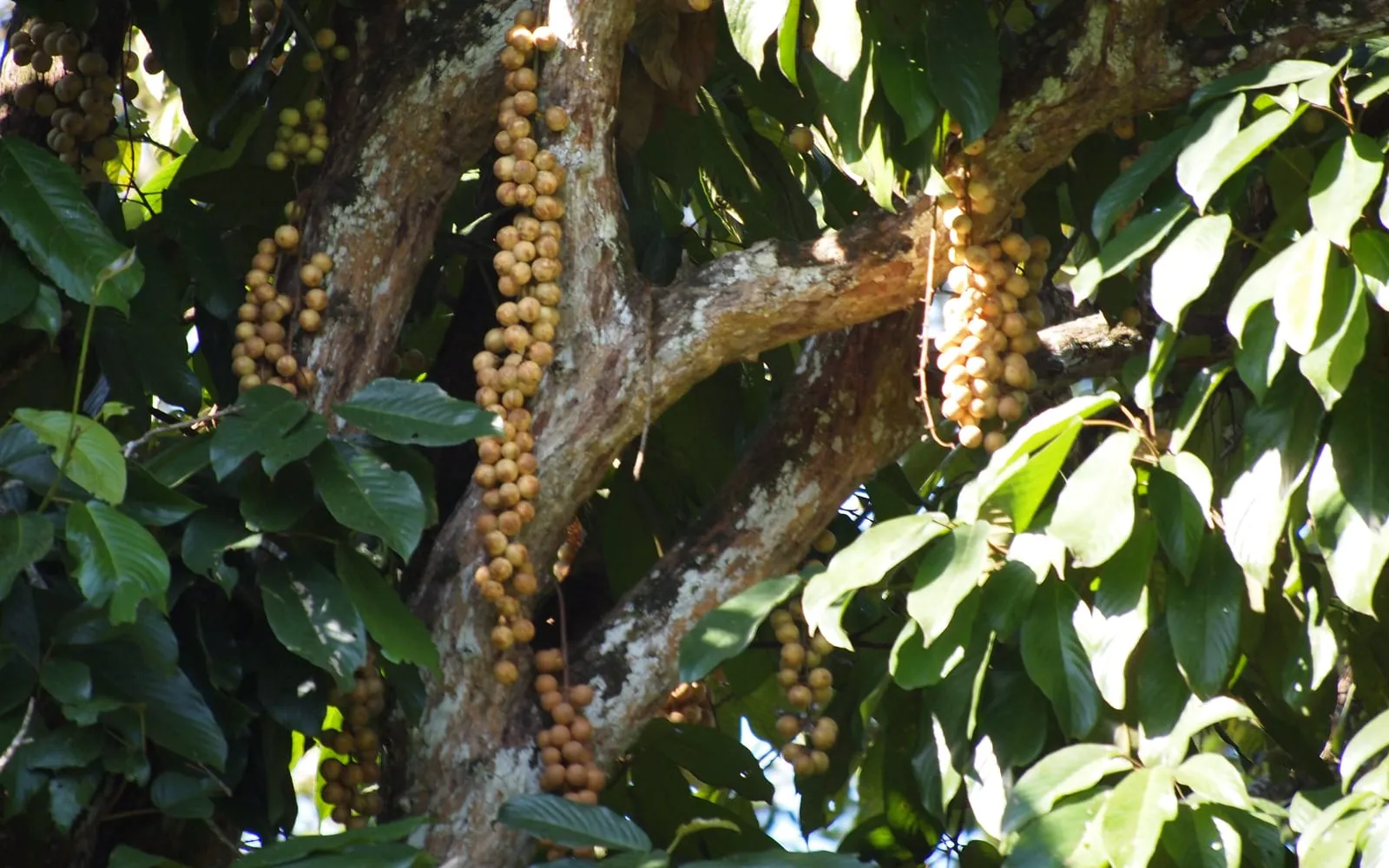
Rambai fruits off its own trunk, in ropes. Strings of dull yellow-brown fruit hang straight from the bark of the trunk and the heaviest limbs, some of them a metre long and carrying forty or fifty fruit apiece, so a laden tree looks as though someone has draped it.
Each fruit is small and covered in a fine velvet that comes away with the rind. Underneath are three to five translucent white segments around flattened seeds, sour and sweet at the same time, and closer in texture to a langsat than to anything with juice in it.
The species carries the name of James Motley, a mining engineer who collected plants around Banjarmasin in the 1850s and was killed there in the uprising of 1859. His specimens went home to Kew and this tree was described from them.
Appearance and character
An upright evergreen with a dense rounded crown, 9 to 25 m where it has room, and slow enough in a pot to stay at head height for years.
Bark is grey-brown, smooth and lightly flaking, and it is the surface the whole crop is borne on. A trunk that has fruited for a few seasons carries knobbly scars where the old racemes were attached.
Leaves are alternate, obovate to elliptic and large at 15 to 35 cm, dark green above, paler beneath and softly hairy, with veins standing proud enough to feel through the blade.
Flowers are small, yellowish and sweetly scented, packed along drooping spikes that push out of the bark. Males and females grow on separate trees and the flowers give no other clue, since both sexes are the same small yellow star.
The fruiting ropes run 15 to 75 cm and hang from the same points year after year, which is why the bark under an old tree looks worn.
Fruit is oval and 2 to 5 cm, dull yellow to pale brown, with a rind thin enough to tear with a thumbnail and a nap of short hairs over it.
Inside sit three to five white segments, juicy and sharply sweet, each wrapped round a flat seed.
Where it is from
The tree grows wild in the lowland rainforest of Borneo, Sumatra and the Malay peninsula, on ground that stays damp all year and never sees a cool month.
Villages across the region have planted it for centuries. Malaysia, Brunei, Indonesia and southern Thailand all keep it in compounds and on smallholding edges, and it is one of the few Baccaurea to be planted deliberately rather than left standing when the forest is cleared.
Java calls it menteng, Malaysia rambai, and Thai markets label it mafai-farang, the foreign mafai, to separate it from the native Baccaurea ramiflora that Thailand grows on a far larger scale.
Households eat it fresh over the few weeks it is in season and turn the rest into jam or a country wine.
International trade has never touched it. The rind bruises, the flesh ferments within days, and the harvest window across the whole region is about a month long.
Anyone outside the tropics will meet neither the fruit nor the plant without going to look for it.
How it grows
Seed comes out of a fruit you have just eaten, and it goes into compost the same day. Baccaurea seed is recalcitrant, which means it dies as it dries rather than resting, and a few days in a bag is fatal.
Bottom heat at 25 to 30 deg C brings seedlings up over three to eight weeks. Use an acid, open, moisture-holding mix.
Sow half a dozen at least. The tree is dioecious, roughly half of any batch turns out male, and there is no way to sex a seedling.
Keep young plants shaded for the first two or three years, then give them the brightest position under glass. The leaves scorch while they are soft and tolerate full sun once they have hardened.
Nothing below 15 deg C at any point in the year, and growth only above about 20 deg C.
Water two or three times a week without a break, and never let the compost dry out.
Rainwater only. This species yellows on hard water faster than most, and the chlorosis is slow to reverse once it has started.
Feed monthly through the growing half of the year with an ericaceous liquid feed carrying iron.
Six to eight years from seed to first fruit, and that assumes the warmth and humidity have held every winter in between.
Through the seasons
Winter is what the plant is likely to die of. Hold 15 deg C as a floor, keep the air as damp as the house allows, water steadily and feed nothing at all.
Spring pushes a flush of soft leaves, and feeding starts as they open.
Early summer is when a mature female sends racemes out of the bark, and the first sign is a line of green buds along a trunk that looked bare the week before.
Midsummer swells the ropes, and the tree drinks heavily while it does.
Late summer is harvest in the native range, taken over about three weeks.
Autumn ends the feeding while the warmth and humidity carry on unchanged.
Care difficulty
Difficult on the ordinary wet-tropics grounds, with a sex problem stacked on top of them.
Heat has to be unbroken. There is no cool rest in this species and a night at 10 deg C costs leaves that will not be replaced until spring.
Humidity has to stay high in January as well as July, and a heated glasshouse in midwinter is drier than the tree has ever met.
Compost and water both have to be acid, or the leaves go yellow between the veins and stay that way.
Half of any batch of seedlings is male, they take years to say so, and a grower with room for one tree has even odds of a plant that flowers every summer and sets nothing.
Getting hold of seed at all is the obstacle most people never get past, since it cannot survive the post.
Watering
Two or three soakings a week, every week of the year, keeping the compost evenly damp rather than wet.
There is no dry rest. A rambai allowed to dry out drops its leaves and sulks for a season.
Drainage still has to be free, because damp compost is the target and waterlogged compost is root rot.
Humidity comes from damped gravel, grouped plants and a misting line, rather than from hand-spraying that raises it for ten minutes and no longer.
Rainwater in the can. Iron shortage follows hard water quickly in this genus.
Ease back slightly through winter without letting the surface go dry, and use water warmed to glasshouse temperature.
Warning signs, diseases and pests
Yellowing between green veins is iron shortage on hard water or compost that is not acid enough.
Brown leaf edges mean dry air, which is the standard cool winter problem.
Leaf drop after a cold spell is chill damage below 12 deg C.
Fine webbing on the leaves is spider mite, which arrives when humidity falls.
Brown limpets on the trunk and branches are scale.
White fluff in the leaf axils is mealybug.
Wilting in damp compost is root rot.
A mature tree that flowers and never fruits is male.
Bitter fruit means the skin was eaten. Peel it.
Growing environment
A heated humid glasshouse, since nothing else holds the conditions through a temperate winter.
A floor of 15 deg C, with 25 to 32 deg C for growth.
High humidity in every month rather than only in summer.
Shade while young and full glasshouse light once hardened.
Rich, acid, moisture-retentive compost that drains freely, at pH 5.0 to 6.0.
Rainwater rather than tap water.
Neighbours. A group of tropical plants holds humidity around itself in a way a lone specimen on an open bench cannot.
Feeding
An ericaceous liquid feed with iron in it, monthly from April to September.
Sequestered iron at the first sign of green veins standing out against a paler leaf, rather than waiting to see whether it gets worse.
Nothing from October onwards, since feed given to a tree that has stopped growing sits in the compost and raises the salt level around the roots.
Leaf mould as a spring top-dressing, which suits the surface roots better than anything dug in.
Repot rarely. The roots resent disturbance enough to cost a season’s growth.
Keep the strength moderate. This is a forest tree used to a slow trickle rather than a feed.
Troubleshooting
Why does the fruit hang off the trunk? Cauliflory. The flowers and fruit are carried on the trunk and main limbs in drooping ropes up to 75 cm long, which puts the crop within reach of animals that walk rather than fly.
Do I eat the skin? No. It is thin, velvety and bitter. Tear it with a thumbnail and eat the white segments inside.
Do I need two trees? Yes. Only females fruit, so raise several seedlings and expect about half to be male.
How long until it fruits? Six to eight years from seed, and only under warmth and humidity that have not lapsed.
The leaves are yellow between the veins. Iron shortage from hard water. Switch to rainwater, check the compost is still acid, and give sequestered iron.
The leaf edges are brown all winter. Dry air. This species wants high humidity in every month, and a heated glasshouse in January is a desert by its standards.
Where do I get one? With great difficulty. The seed dies within days of leaving the fruit, so it cannot be posted, and a specialist tropical nursery is the only route.
What is the difference from ketupa? Ketupa is Baccaurea dulcis, sweeter and rounder, on shorter racemes held tight against the bark. Rambai is the one with the long hanging ropes and the sour edge.
Rambai problem guides
Not sure what is wrong? See the common vegetable pests guide.