
Edible
Indian Gooseberry
Phyllanthus emblica
Also known as Amla, Amalaki, Emblic, Nelli
How to grow Indian gooseberry, Phyllanthus emblica. The intensely sour amla behind chyawanprash and triphala, the leaves that look like a fern and are not, and the cold it will take.
At a glance
- Difficulty
- Moderate
- Water
- Weekly in growth, nearly dry when leafless
- Light
- Full sun
- Temperature
- Minimum around minus 2 deg C. It takes a light frost when dormant
- Humidity
- Low to moderate
- Hardiness
- USDA 9-11, RHS H1c, hardy to -2 C
- Type
- Tender to half-hardy deciduous tree
- Height
- 8-18 m in the open, 1.5-2 m in a pot
- Native to
- the Indian subcontinent, South East Asia
- Best month
- April, October and November in the Northern Hemisphere, October, April and May in the Southern Hemisphere
Dry subtropical India, and among the hardiest fruit on this shelf. A mature tree takes a light frost and a long dry season, and it needs that dry period to flower. The fruit is borne on the previous year's wood.
Hardiness zones describe winter cold alone. Summer heat, humidity, rainfall and the length of the growing season decide as much, so treat the range as the outer limit rather than as a recommendation.
Every month named in this guide is for the temperate Northern Hemisphere. If you garden in the Southern Hemisphere, shift each one by six months, so April becomes October. Closer to the equator the wet and dry seasons matter more than the calendar, and the shift stops being a useful guide.
Not known to be toxic
- Safe to eat
- The fruit, though it is very sour raw
Indian gooseberry is not toxic and nothing in it is listed as harmful to people or to cats and dogs. The fruit is eaten raw, pickled, candied and juiced across India, and it is a principal ingredient of chyawanprash and one of the three fruits in triphala. Two practical points rather than toxicological ones. The fruit is extremely sour and astringent and is hard on tooth enamel eaten raw in quantity. Amla is a traditional remedy with a long record of use, and concentrated extracts and supplements have been reported to lower blood glucose and to interact with blood-thinning medication, so anyone taking either should treat the supplements with the same care as any other active preparation. As a food it raises no concern.
Sources: ASPCA toxic and non-toxic plants, RHS potentially harmful garden plants
About
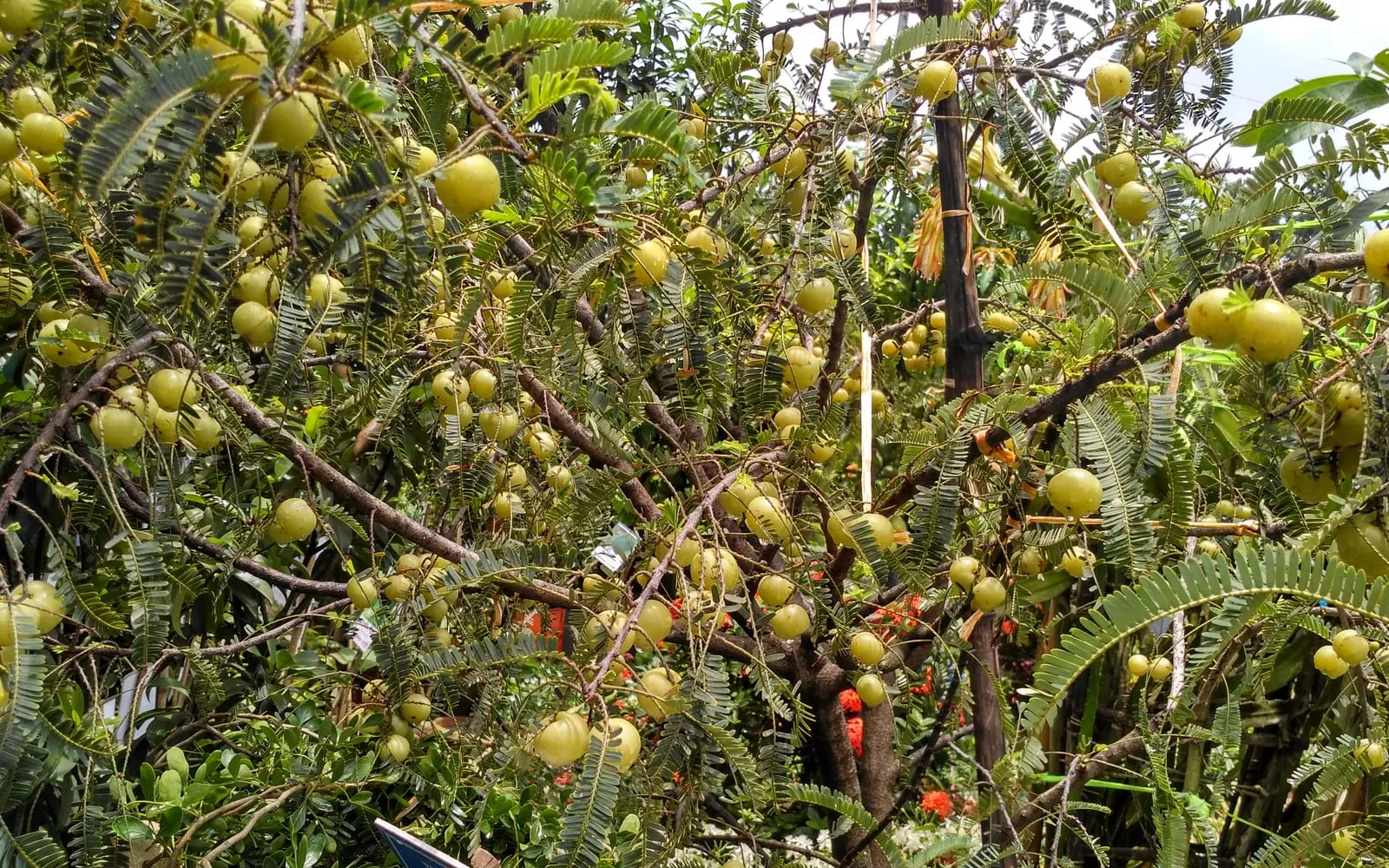
Amla is the most sour thing in this collection and one of the most important plants in Indian medicine. The fruit is pale green, translucent, hard and divided into faint segments, and biting into one raw is a memorable experience that most people do not repeat.
It is nearly always processed. Pickled in oil and salt, candied into a sweet, juiced, or dried and powdered, and it is the principal ingredient of chyawanprash and one of the three fruits in triphala.
The tree looks like it has fern fronds and does not. What appears to be a pinnate leaf is a whole branchlet carrying dozens of tiny separate leaves, which is a Phyllanthus habit and a useful identification feature for one.
Appearance and character
An upright deciduous tree with a spreading crown, 8 to 18 m in the open.
Bark is smooth, pale grey-green to fawn, and flakes off in thin irregular patches to leave a mottled surface.
The foliage is the identifying puzzle. Slender green branchlets carry two rows of small oblong leaves 1 to 2 cm long, and the whole branchlet looks exactly like a single pinnate leaf. The branchlets are shed whole, which reinforces the illusion.
Flowers are tiny, greenish yellow, and clustered in the axils along the branchlets, easy to overlook.
Fruit is round, 2 to 3.5 cm, pale yellow-green, translucent, smooth and hard, with six faint vertical furrows dividing it into segments.
Flesh is crisp, juicy and intensely sour and astringent, with a hard six-ribbed stone at the centre.
The tree is leafless for part of the dry season and through a cool winter.
Where it is from
Indian gooseberry is native to the Indian subcontinent and South East Asia, growing in dry deciduous forest across India, Sri Lanka, Nepal and into Thailand and southern China.
Its medicinal position in India is central. Amalaki is one of the three fruits in triphala, the most widely used Ayurvedic preparation, and it is the principal ingredient of chyawanprash, the spiced fruit paste taken as a tonic across northern India.
The tree also carries religious weight, and Amla Navami is a festival at which the tree is worshipped.
India grows it commercially, chiefly in Uttar Pradesh, for pickles, preserves and the supplement trade, and the fruit is a familiar winter market item.
It has been planted in South East Asia, tropical Africa and the Caribbean.
Temperate markets see amla as frozen fruit and pickles in South Asian groceries, and as powder in health food shops.
How it grows
Clean the stone out of a ripe fruit and soak it before sowing, since the shell is hard and dry seed sits for a long time. At 20 to 28 deg C expect three to eight weeks, and expect them to come up raggedly over that whole period rather than together.
Buy a grafted plant if the fruit is the point. Seedlings take six to eight years and vary in what they produce, while a graft fruits in four or five.
Any open compost will do, and this is a tree of dry stony hillsides that puts up with poor and alkaline ground where most fruit sulks.
Full sun, and a floor of about minus 2 deg C. A dormant amla shrugs off a light frost, which makes it one of the few plants here that does not need a heated house.
Water weekly while it is in leaf and leave it almost dry once the branchlets have dropped.
Humidity low to moderate. Damp still air suits it far less than the wet-tropics fruit it sits beside on a bench.
A monthly feed at half strength from April to September.
Prune while it is bare, when you can see what you are doing.
Expect fruit in autumn. Amla ripens late and hangs on the tree well past the point where most things have finished.
Through the seasons
Winter is dormancy. The tree sheds its branchlets. Hold above about minus 2 deg C, keep the compost nearly dry, and feed nothing.
Late winter is the pruning window.
Spring brings new branchlets and then the tiny flowers.
Early summer is fruit set.
Midsummer is fruit swell.
Autumn is harvest, which is late compared with the rest of these.
Late autumn is leaf fall and the return to dormancy.
Care difficulty
Moderate, and among the more practical plants in this collection for a cool climate.
Cold tolerance is good. It takes a light frost when dormant and needs only frost-free winter quarters in a pot.
The deciduous habit suits a cool winter.
Soil tolerance is wide, including poor, dry and alkaline ground.
Dry air is tolerated, unlike almost everything else here.
Fruiting takes four to five years on a grafted plant and six to eight from seed.
The autumn ripening is convenient, since the fruit does not need the last weeks of summer heat that a tropical fruit demands.
The disappointment is culinary. The fruit is too sour for most people raw and is a raw material rather than a dessert.
Watering
Water weekly in growth, giving a thorough soak and letting the compost dry down.
Keep it nearly dry through winter dormancy.
Water steadily during fruit swell.
Drain fully.
Tap water is fine, including hard water.
Keep humidity low to moderate.
An established plant tolerates a dry spell well.
Warning signs, diseases and pests
Branchlets shed whole in autumn is normal. That is how this genus drops its foliage.
Wilting in damp compost during dormancy is root rot.
Orange pustules on the leaves in humid conditions are rust. Improve airflow.
Brown limpets on the stems are scale.
White fluff in the leaf axils is mealybug.
Fine webbing on the foliage is spider mite in dry heated air.
Blackened tips after a hard frost are cold damage.
Fruit dropping small is irregular watering.
Extremely sour fruit is the species rather than a fault.
Growing environment
A cool greenhouse or conservatory, standing outdoors for the summer.
Winter above about minus 2 deg C, dry, with the plant leafless.
Summer at 20 to 35 deg C.
Full sun.
Low to moderate humidity.
Free-draining compost of moderate fertility, tolerant of lime.
pH from 6.0 to 8.5.
A pot of 35 to 45 cm.
Feeding
A balanced liquid feed once a month while it is in leaf, mixed at half the strength on the bottle.
High potash once the fruit is swelling.
Nothing after August. The wood has to ripen before the branchlets drop, and late feeding keeps it green into the cold.
Nothing at all through the dormant months.
Repot or top-dress in late winter while the framework is bare and easy to work around.
A light hand throughout, which is the general rule for a species that grows wild on thin dry ground and fruits worse for being indulged.
Magnesium where the foliage yellows between the veins.
Troubleshooting
Can I eat it raw? You can and most people do not want to twice. Amla is intensely sour and astringent. It is pickled, candied, juiced or dried and powdered instead.
Are those fern fronds? No. What looks like a pinnate leaf is a whole branchlet carrying two rows of tiny separate leaves, which is a Phyllanthus habit. The branchlets are shed whole in autumn.
What is chyawanprash? A spiced fruit paste taken as a tonic across northern India, of which amla is the principal ingredient.
What is triphala? An Ayurvedic preparation of three fruits, of which amla is one, and the most widely used formulation in that tradition.
How hardy is it? One of the hardier plants in this collection. It takes a light frost when dormant.
How soon will it fruit? Four to five years on a grafted plant, six to eight from seed, and the fruit ripens in autumn rather than summer.
Can I grow it in chalky soil? Yes. It tolerates poor, dry and alkaline ground well.
Should I take amla supplements? As a food it raises no concern. Concentrated extracts have been reported to lower blood glucose and to interact with blood-thinning medication, so anyone on either should treat them as active preparations.