
Edible
West Indian Gherkin
Cucumis anguria
Also known as Burr cucumber, Maxixe, Bur gherkin, Gooseberry gourd
How to grow the West Indian gherkin, Cucumis anguria. Sowing, heat, picking small spiny fruits and growing it when cucumbers struggle.
At a glance
- Difficulty
- Easy
- Water
- Twice a week, and it tolerates a dry spell
- Light
- Full sun
- Temperature
- 20-30 deg C, and it stops below 12
- Humidity
- Moderate, and it copes with dry air better than cucumber
- Hardiness
- USDA 10-11, RHS H1b, hardy to 5 C
- Type
- Tender annual, trailing or lightly climbing
- Height
- 2-3 m of trailing growth
- Native to
- southern and eastern Africa
- Best month
- May and August in the Northern Hemisphere, November and February in the Southern Hemisphere
Heat and humidity that stop a cucumber suit this one, and it carries useful resistance to root-knot nematode and to the mildews. Nothing below 12 deg C. It has naturalised across the Caribbean, Central America and parts of Australia, where it climbs into scrub.
Hardiness zones describe winter cold alone. Summer heat, humidity, rainfall and the length of the growing season decide as much, so treat the range as the outer limit rather than as a recommendation.
Every month named in this guide is for the temperate Northern Hemisphere. If you garden in the Southern Hemisphere, shift each one by six months, so May becomes November. Closer to the equator the wet and dry seasons matter more than the calendar, and the shift stops being a useful guide.
Edible, with limits
- Safe to eat
- The young fruit and the young leaves and shoots after cooking
- Do not eat
- Any fruit that tastes bitter, and the wild bitter-fruited form
- Harm from
- Eating it
- Affects
- People
Cultivated West Indian gherkin is a vegetable and is safe to eat. The wild form of the same species, sometimes separated as var. anguria or var. longipes, produces bitter fruit loaded with cucurbitacins, and seed of uncertain origin can give plants of that type. The rule for the whole family applies here. Taste a small piece of raw flesh before pickling or cooking, and if it is bitter, throw the fruit away rather than trying to cook the bitterness out, since heat does not destroy cucurbitacins. Neither the RHS nor the ASPCA lists Cucumis anguria. The soft spines on the fruit are harmless and rub off under a tap.
Sources: RHS potentially harmful garden plants, ASPCA toxic and non-toxic plants
About
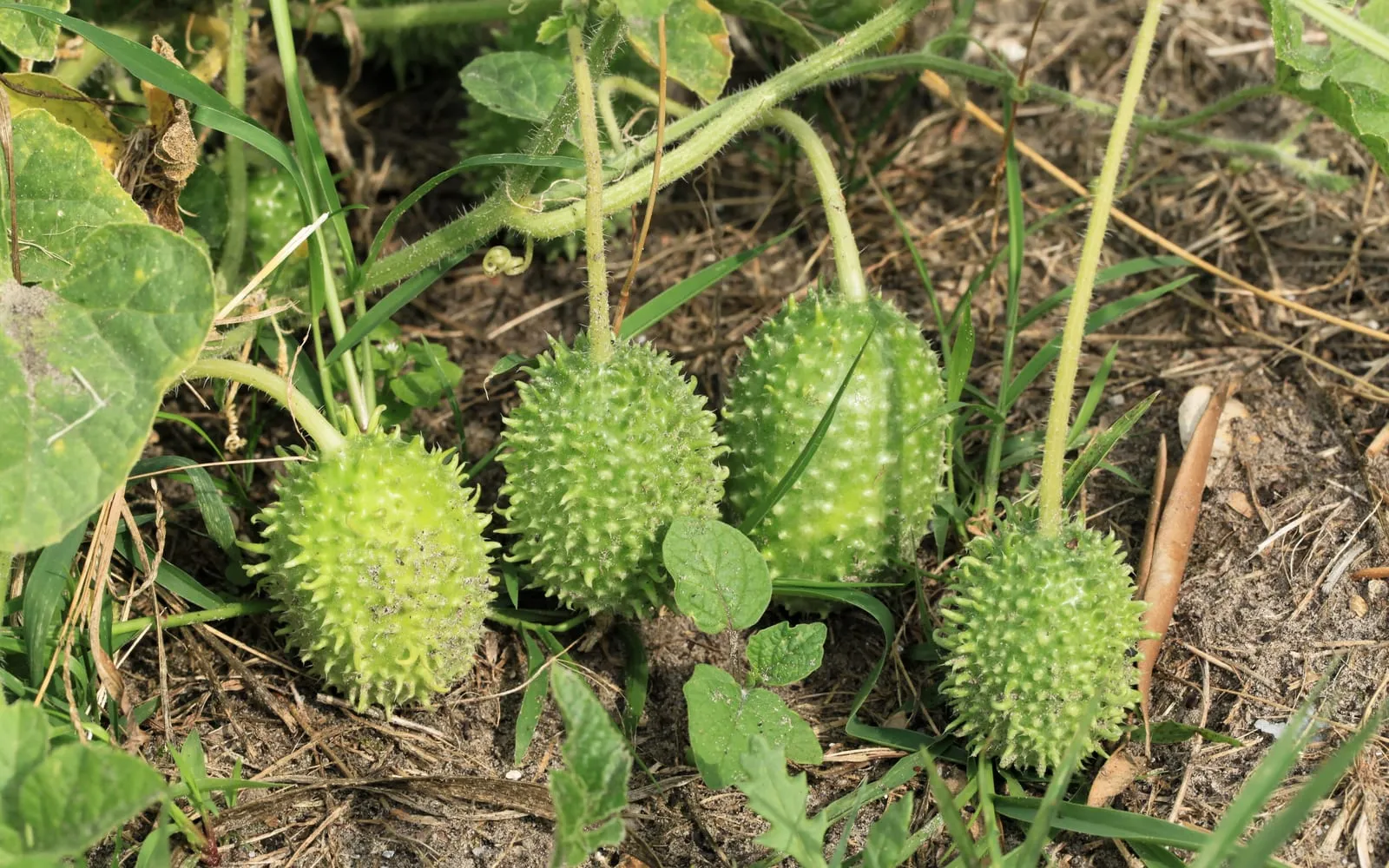
The West Indian gherkin is a small oval cucumber relative, 4 to 8 cm long, pale green and covered in soft fleshy spines that give it the look of a very approachable hedgehog. Brazil grows it in quantity as maxixe, and it is the gherkin of Caribbean pickling.
The name is a piece of history rather than geography. The plant is African, from the dry country of southern and eastern Africa, and it reached the Caribbean in the holds of slave ships. European botanists met it there and named it for where they found it.
In a cool summer it is a better bet than an outdoor cucumber. The plant is tougher, resists mildew for longer, tolerates a dry week, and keeps setting fruit into September. The flavour is cucumber with a little more bite, and the texture stays crisp through pickling.
Appearance and character
A slim trailing annual, 2 to 3 m, happy to run along the ground or scramble a short way up netting.
Leaves are the giveaway. Each is 4 to 10 cm across and cut deeply into three to five narrow lobes, giving a lacy outline nothing like the broad triangular leaf of a cucumber.
Tendrils are simple and unbranched.
Flowers are small and yellow, about 1.5 cm, with males in small clusters and females singly, each with a tiny spiny ovary behind the petals.
Fruit is oval to egg-shaped, 4 to 8 cm long, pale to mid green, covered in soft fleshy spines set on low bumps. The spines bend under a finger and wash off.
Cut across, the flesh is pale, crisp and watery with small soft seeds, and the taste is clean cucumber with a faint sourness.
Left on the plant the fruit yellows, the spines harden and the flesh goes spongy. At that point it is seed rather than food.
Where it is from
Cucumis anguria is native to southern and eastern Africa, where the wild bitter-fruited form still grows across Namibia, Botswana, Zimbabwe and Mozambique in dry bushland.
Domestication removed the bitterness. The cultivated non-bitter form is treated as var. anguria and is not known in the wild.
It crossed the Atlantic with the transatlantic slave trade in the sixteenth and seventeenth centuries, and it established itself in Brazil, the Caribbean and the southern United States.
Brazil made it a national vegetable. Maxixe is sold in every market in the north east and cooked in the Bahian dish maxixada, and Brazil grows more of it than anywhere else.
Botanists in the eighteenth century, meeting it only in the Americas, assumed a New World origin, and the English name has carried that mistake ever since.
How it grows
Sow in May at 20 deg C, two seeds to a 9 cm pot, 1.5 cm deep, thinning to one.
Germination is quick and even, usually within a week.
Plant out after the last frost, 60 to 75 cm apart, in the sunniest spot available. It crops outdoors in an ordinary cool summer where a cucumber would struggle.
Let it trail, or give it low netting to scramble over, which keeps the fruit clean and makes picking easier.
Water moderately. It is more drought-tolerant than cucumber and dislikes sitting wet.
No hand pollination is needed outdoors, since bees work the flowers readily.
Harvest from late July at 4 to 6 cm, while the spines are soft and the fruit is firm.
Pick every two or three days. A fruit that yellows on the plant stops the whole crop.
Save seed easily from one fruit left to yellow and soften, though seed from a mixed planting may cross with other Cucumis in the garden.
Through the seasons
May is for sowing indoors in gentle warmth.
Early June is planting out once the frosts have finished.
Late June and July are for spreading growth and the first flowers.
Late July brings the first pickings.
August is the heaviest cropping month, and it wants picking every two or three days.
September carries on, often after outdoor cucumbers have given up to mildew.
October ends it with the first frost.
Winter is nothing. Sow again from saved seed in May.
Care difficulty
Easy, and easier than an outdoor cucumber in a cool summer.
Germination is quick and reliable at ordinary spring warmth.
The plant resists powdery mildew far better than cucumber and keeps going into September.
It tolerates a dry spell, which cucumber does not.
Slugs on the young plant are the main risk.
Picking often is the whole technique.
Watering
Water twice a week from planting out.
Let the surface dry between waterings, since the plant dislikes constant damp.
Increase during a hot dry spell while fruit is setting.
Water at the root rather than over the leaves.
Mulch to hold moisture and keep the fruit off bare soil.
Reduce in late September as growth slows.
Warning signs, diseases and pests
A young plant grazed off at the stem is slug damage.
Curled tips with sticky residue are aphids.
White powder on the leaves in September is powdery mildew, arriving later than it would on a cucumber.
Fruit yellowing on the plant means picking has fallen behind.
Hollow or spongy flesh in a cut fruit means it was left too long.
A bitter fruit should be discarded, and if a whole plant produces bitter fruit, pull it out and buy fresh seed.
Plenty of leaf and no fruit means overfeeding with nitrogen or too much shade.
Growing environment
An open sunny bed outdoors, or a polytunnel for an earlier and longer crop.
Full sun.
Light free-draining soil of moderate fertility.
Minimum 12 deg C, with 20 to 30 deg C for real growth.
Room to trail, about a square metre per plant.
Low netting or a mulch to keep the fruit off soil.
Shelter from strong wind.
Feeding
Dig in garden compost before planting.
Feed a general liquid feed fortnightly once the first fruit sets.
Avoid heavy nitrogen, which produces a lacy carpet of leaf and little fruit.
A high-potash tomato feed from August keeps the crop coming.
Mulch in June.
Stop feeding at the end of September.
Troubleshooting
Is this the gherkin in a jar of pickles? Usually not. Commercial pickled gherkins are small cucumbers, Cucumis sativus, and this is a different species that pickles at least as well.
Are the spines a problem? No. They are soft and fleshy and rub off under a running tap.
Why is it called West Indian if it comes from Africa? European botanists first met it in the Caribbean, where enslaved Africans had brought and grown it, and the name stuck.
When do I pick? At 4 to 6 cm, while the fruit is firm and the spines still bend. Every two or three days.
My fruit went yellow and spongy. It was left too long. Yellow fruit is seed stock rather than food, and leaving it on the plant slows everything else down.
Can I grow it outdoors in a cool climate? Yes, in most of one. It is tougher than an outdoor cucumber and holds off mildew longer.
Is maxixe the same thing? Yes. Maxixe in Brazil, burr gherkin in the Caribbean, all Cucumis anguria.
Will it cross with my cucumbers? No. Cucumis anguria will not cross with Cucumis sativus, so you can grow both and save seed from each.
West Indian Gherkin problem guides
Not sure what is wrong? See the common vegetable pests guide.