
Edible
Horned Melon
Cucumis metuliferus
Also known as Kiwano, African horned cucumber, Jelly melon, Blowfish fruit
How to grow the horned melon, Cucumis metuliferus. The orange spiked fruit with lime-green jelly inside, how to tell when it is ripe, and how to eat something that resists being eaten.
At a glance
- Difficulty
- Moderate
- Water
- Once or twice a week, less than any other cucurbit here
- Light
- Full sun
- Temperature
- 20-30 deg C, nothing below 12
- Humidity
- Low to moderate. It comes from dry country
- Hardiness
- USDA 10-11, RHS H1b, hardy to 5 C
- Type
- Tender annual climber
- Height
- 3 m in a season
- Native to
- southern and central Africa
- Best month
- May in the Northern Hemisphere, November in the Southern Hemisphere
Drought and poor sandy soil are taken without complaint, which follows from a semi-arid origin, and heavy feeding gives leaf at the expense of fruit. Nothing below 12 deg C. It needs about 120 frost-free days, so outside the subtropics it is a glasshouse crop.
Hardiness zones describe winter cold alone. Summer heat, humidity, rainfall and the length of the growing season decide as much, so treat the range as the outer limit rather than as a recommendation.
Every month named in this guide is for the temperate Northern Hemisphere. If you garden in the Southern Hemisphere, shift each one by six months, so May becomes November. Closer to the equator the wet and dry seasons matter more than the calendar, and the shift stops being a useful guide.
Skin irritant
- Safe to eat
- The ripe green pulp and the seeds within it
- Do not eat
- Unripe fruit, which is bitter, and the spines, which puncture
- Harm from
- Eating it and handling it
- Affects
- People
Ripe horned melon is a fruit and is safe to eat, seeds and all. Two cautions. The fruit is bitter and unpleasant before it colours, and unripe cucurbits of any kind can carry enough cucurbitacin to upset a stomach, so wait for full orange. The spines are stiff and sharp enough to draw blood, and a fruit is best handled with the palm rather than gripped. Wild populations in southern Africa include bitter-fruited forms that are not eaten, which is the same pattern seen in its relatives. Neither the RHS nor the ASPCA lists Cucumis metuliferus. There is no reason to give it to a cat or a dog and no evidence it harms them.
Sources: RHS potentially harmful garden plants, ASPCA toxic and non-toxic plants
About
The horned melon is the orange fruit covered in blunt spikes that appears in supermarket fruit displays looking like a prop. Cut it open and the inside is lime-green jelly holding hundreds of soft flat seeds, tasting of cucumber with a squeeze of lime and a suggestion of banana.
It is African, from the dry savannah of southern and central Africa, where it has been gathered for water and food for a very long time. The Kalahari populations of Botswana and Namibia use it in both roles.
New Zealand growers made it a commercial fruit in the 1980s and gave it the trade name kiwano, which is why a plant from the Kalahari usually reaches European shops from Auckland or from a Spanish greenhouse.
Growing it here works better than most people expect. The plant is wiry and undemanding, wants less water than a cucumber, and will set fruit in a polytunnel or against a hot wall.
Appearance and character
A wiry annual climber to about 3 m, thinner and tougher in build than a cucumber, with bristly angular stems that catch on skin.
Leaves are 5 to 12 cm across, roughly triangular with three to five lobes, harsh on both surfaces.
Tendrils are simple and unbranched.
Flowers are small and pale yellow, about 1 cm, with males in small clusters and females singly. Both are easy to miss.
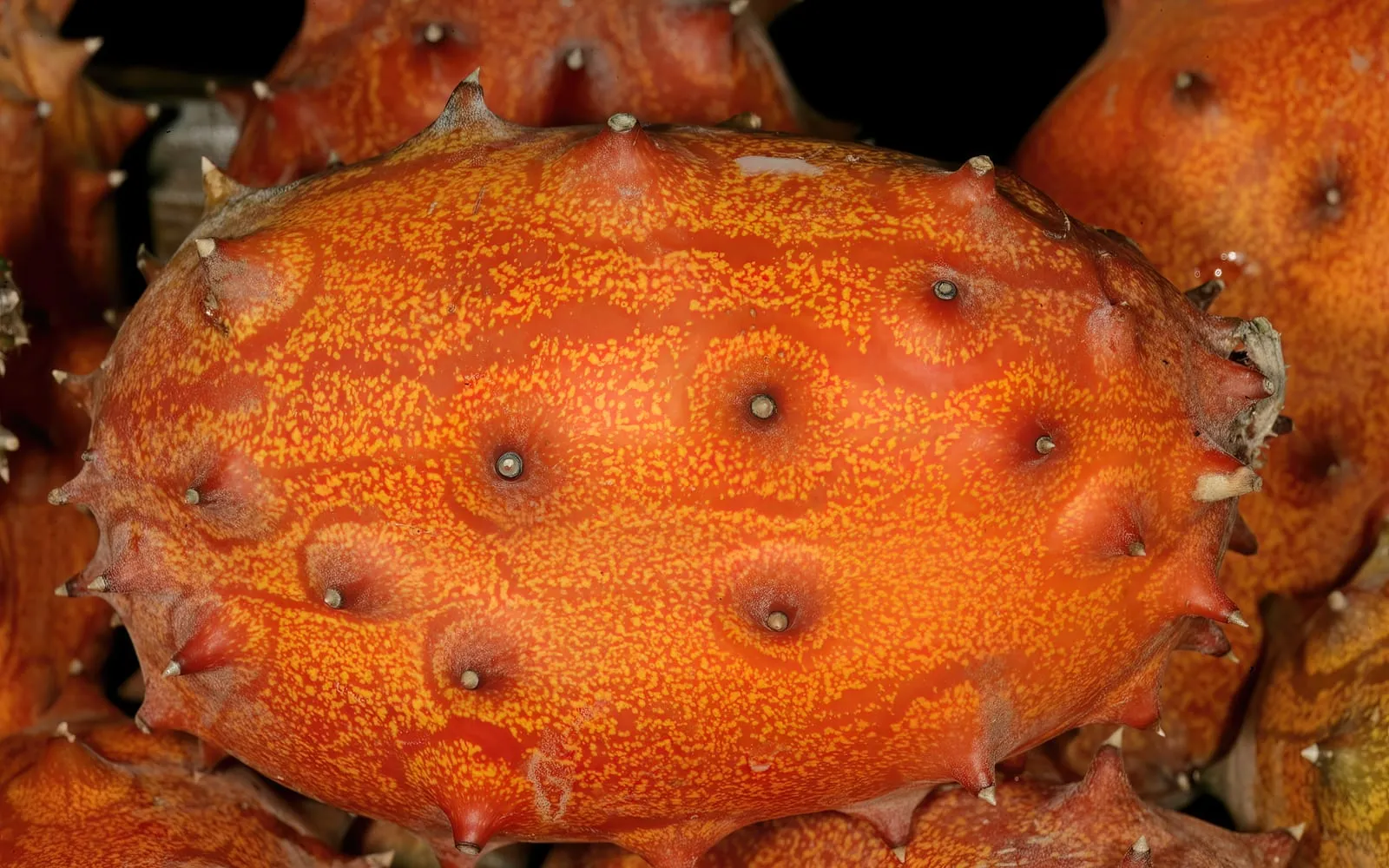
The fruit starts green with soft pale spines and swells to an oval 8 to 12 cm long, covered in conical spikes about 1 cm high set in rows.
Ripening turns it a strong orange to golden yellow, the skin hardens, and the spikes stiffen into something that will scratch.
Inside, a thin firm rind encloses a mass of bright green gelatinous pulp divided into chambers, each seed suspended in its own sac of jelly.
A ripe fruit keeps for months at room temperature without refrigeration, which is what made it worth carrying across a dry country.
Where it is from
Cucumis metuliferus grows wild across southern and central Africa, from South Africa and Namibia north through Zimbabwe and Zambia into Kenya and Nigeria, usually in sandy bushland and disturbed ground.
San communities in the Kalahari have gathered it for water, food and seed for millennia, and it is one of the few fruits available in that landscape in the dry season.
Farmers in Zimbabwe and Zambia grow it as a garden crop, eaten fresh or with the pulp dried into a paste.
New Zealand growers introduced it to world markets in the 1980s under the name kiwano, selecting for size and appearance, and Israel, Portugal, Spain and Chile followed.
Its main commercial value now may be underground. The species resists root-knot nematode strongly and is used as a rootstock and a breeding parent for melons and cucumbers.
How it grows
Sow in May at 20 to 22 deg C, two seeds to a 9 cm pot, 1.5 cm deep.
Germination takes one to two weeks and is reliable in warmth.
Plant out after the last frost into a polytunnel, a greenhouse border, or the hottest, driest, best-drained bed you have.
Train up netting or strings. The vine is light and climbs willingly.
Water sparingly. This is a dry-country plant and the commonest mistake is treating it like a cucumber.
Give sharp drainage. Heavy wet soil rots the roots faster than anything else will kill it.
Hand-pollinate under glass with a stripped male flower, since the flowers are small and insects often ignore them.
Thin to five or six fruit per plant for good size, or leave it and take more, smaller ones.
Harvest when the fruit is fully orange all over and comes away with a light twist. A green one is bitter and will not ripen properly off the vine.
Store at room temperature, where a sound fruit keeps for several months.
Through the seasons
May is for sowing indoors in warmth.
Early June is planting out under cover or against a hot wall.
July is climbing growth and the first small flowers.
August brings fruit set and swelling, and the point to hand-pollinate under glass.
September is when the fruit begins to turn from green to orange.
October is harvest, and any fruit still green when the frost arrives has missed the season.
Winter is storage. A ripe fruit sits on a shelf for months.
Care difficulty
Moderate, and the difficulty is ripening rather than growing.
The plant itself is tough, wiry and untroubled by much.
Sharp drainage is the one non-negotiable requirement, and heavy wet soil kills it.
Underwatering suits it and overwatering does not, which reverses the habit most cucurbit growers have.
Colouring the fruit needs a warm September, which is why a polytunnel makes the difference.
Hand pollination is worth doing under glass, since the flowers are small enough that insects overlook them.
Watering
Water once or twice a week, and less than you would water a cucumber.
Let the soil dry between waterings.
Increase slightly while fruit is swelling in August.
Water at the root in the morning.
Reduce sharply from mid-September, which helps the fruit colour and hardens the skin.
Never leave it standing in wet soil, which is the quickest way to lose the plant.
Warning signs, diseases and pests
Wilting in damp soil is root rot, and it is the commonest cause of death.
White powder on the leaves in September is powdery mildew, which arrives late.
Curled tips with sticky residue are aphids.
Fine speckling with webbing is red spider mite under dry glass.
Small fruit yellowing and dropping was not pollinated.
Fruit that stays green into October has run out of warmth, and it is bitter rather than merely unripe.
Soft patches on a stored fruit mean the skin was damaged at harvest.
A plant that grows and grows without flowering has too much nitrogen.
Growing environment
A polytunnel, greenhouse or a hot, sheltered, well-drained bed outdoors.
Full sun.
Light sandy soil, or a container of gritty compost.
Minimum 12 deg C, with 20 to 30 deg C for growth.
Low to moderate humidity, which suits it and slows mildew.
Support of 2 to 3 m.
Sharp drainage above everything else.
Feeding
Work in a light dressing of compost before planting. It does not want rich soil.
Feed a high-potash tomato feed fortnightly once fruit sets.
Avoid nitrogen after midsummer.
Skip the manure. A plant fed like a courgette makes stems and no fruit.
Mulch with grit or gravel rather than compost, which suits both the drainage and the plant.
Stop feeding at the end of September.
Troubleshooting
How do I know when it is ripe? The whole fruit turns deep orange or golden yellow and the stalk parts with a light twist. A green fruit is bitter and does not improve much off the plant.
How do I eat it? Cut it in half across, and either squeeze the jelly out or scoop it with a spoon. The seeds are eaten with the pulp. It goes well in salads and over yoghurt, and it makes a good sorbet.
What does it taste like? Cucumber with lime, and a hint of banana. It is refreshing rather than sweet, and it is more about texture than flavour.
Are the spikes dangerous? They are sharp enough to scratch. Handle a ripe fruit on the palm rather than gripping it, and cut it on a board.
Do I eat the seeds? Yes. Each one sits in its own sac of jelly and there is no practical way to separate them, which is the point.
Mine rotted at the root. Too much water, or heavy soil. It comes from dry sandy bushland and it wants sharp drainage and less water than a cucumber.
Can I grow it outdoors? In a hot summer, on a well-drained bed, you may ripen a few. A polytunnel makes it much more likely.
Is kiwano a different fruit? No, it is the trade name New Zealand growers gave this species in the 1980s.
How long will a picked one keep? Several months at room temperature if the skin is undamaged. Refrigeration harms it rather than helping.
Horned Melon problem guides
Not sure what is wrong? See the common vegetable pests guide.