
Edible
Wild service tree
Sorbus torminalis
Also known as Chequer tree, Chequers, Griping medlar, Sorb tree
How to grow wild service tree, Sorbus torminalis. A scarce British native, an ancient woodland indicator, and fruit that has to rot before you can eat it.
At a glance
- Difficulty
- Moderate
- Water
- First three summers, then none
- Light
- Full sun to light shade
- Temperature
- Fully hardy to -20 deg C
- Hardiness
- USDA 5-8, RHS H6, hardy to -25 C
- Type
- Deciduous tree, living two centuries or more
- Height
- 15-25 m in woodland, less in the open
- Native to
- Britain, Europe, North Africa, Western Asia
- Best month
- October and November in the Northern Hemisphere, April and May in the Southern Hemisphere
The tree grows well across a wide temperate range and fruits only in the warmer part of it, needing summer heat to ripen and autumn frost to soften the fruit afterwards. Regeneration from seed is rare outside its warmest districts, which is why established trees so often stand alone.
Hardiness zones describe winter cold alone. Summer heat, humidity, rainfall and the length of the growing season decide as much, so treat the range as the outer limit rather than as a recommendation.
Every month named in this guide is for the temperate Northern Hemisphere. If you garden in the Southern Hemisphere, shift each one by six months, so October becomes April. Closer to the equator the wet and dry seasons matter more than the calendar, and the shift stops being a useful guide.
Not known to be toxic
- Safe to eat
- The bletted fruit
- Do not eat
- The seeds, in large chewed quantity
The flesh is food. The pips contain amygdalin, which releases hydrogen cyanide when the seed coat is broken by chewing, and the same compound occurs in apple and pear seed. Swallowing a few pips whole does nothing, because an intact seed passes through undigested. The quantity needed to cause harm runs to a large cupful of thoroughly chewed seed, so treat this as a reason not to feed cores to a dog rather than as a hazard to the person eating the fruit. Discard the core when juicing in quantity, since a juicer breaks every seed at once. Leaves and wood carry the same compound at low levels and no part of the tree is a grazing risk in a garden.
Sources: RHS potentially harmful garden plants, ASPCA toxic and non-toxic plants
About
Few trees in the European flora are as overlooked as this one. It is native, it lives for centuries, it has better autumn colour than most planted maples, and hardly anyone can name it.
Botanists use it as an ancient woodland indicator. It sets seed poorly in a cool temperate climate and spreads mainly by root suckers, so a stand of wild service usually means woodland that has been continuously wooded for a very long time.
The fruit is the reason it was once planted near villages. It is inedible until bletted, meaning left until frost and time break the flesh down to a soft brown pulp. At that point it tastes of dates and overripe apricot, and it was fermented into a drink that gave many an English pub the name The Chequers.
As a garden tree it needs space and patience, and it repays both.
Appearance and character
An upright tree with a rounded domed crown, developing a straight clean trunk in woodland and a broader shape in the open.
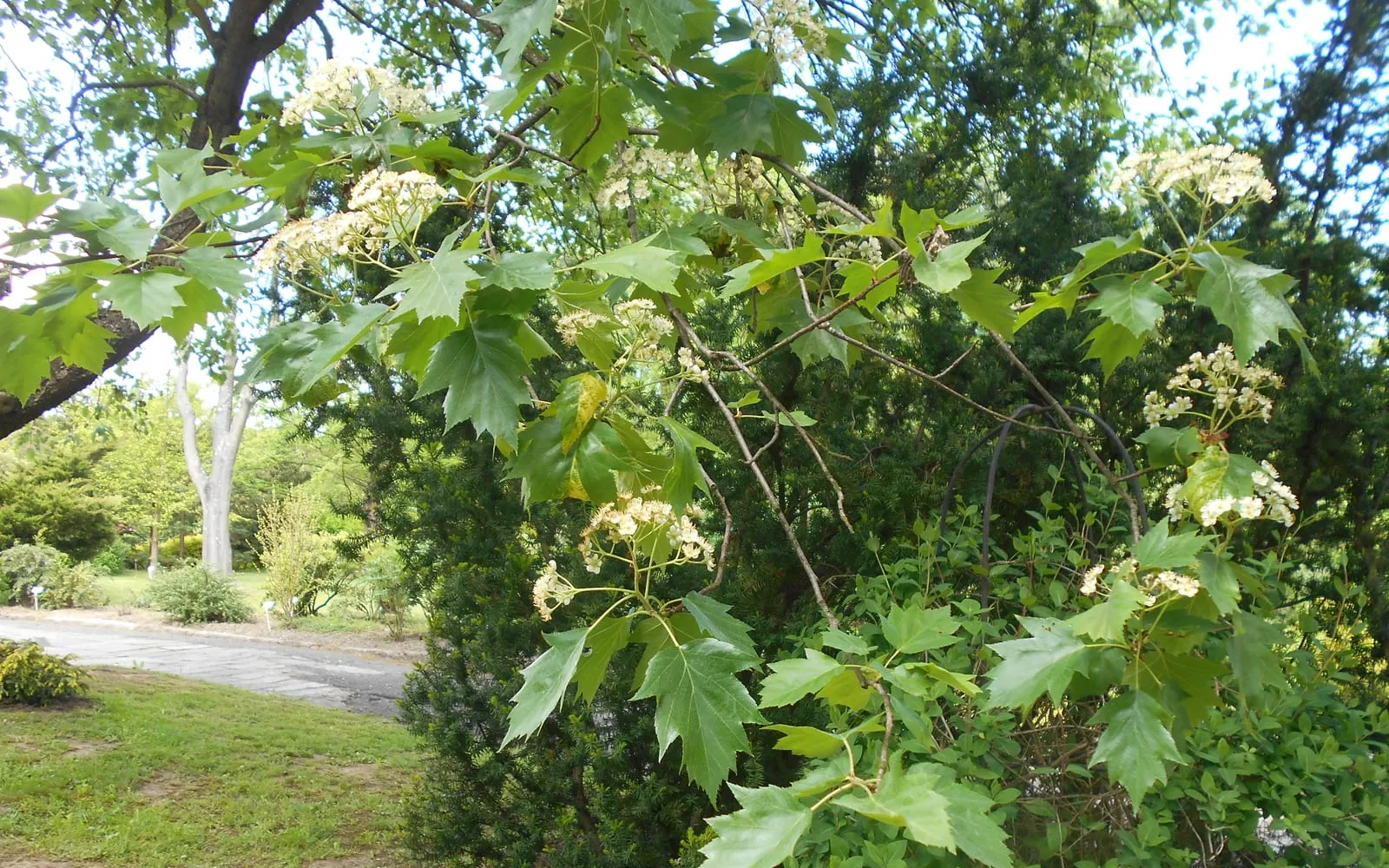
Leaves are the identifying feature and look more like a maple than a whitebeam, with five to nine pointed lobes cut deeply towards the base and shallowly towards the tip. They are 6 to 12 cm long, glossy dark green, and turn coppery red to deep crimson in autumn.
Bark starts smooth and grey and cracks with age into small squarish plates that flake away, which is one origin suggested for the chequers name.
Flowers open in May and June in flat white clusters 8 to 12 cm across, with a strong scent that draws a great many insects.
Fruit is oval, 1 to 1.5 cm, brown speckled with paler lenticels, looking more like a tiny russet pear than a berry.
Where it is from
Sorbus torminalis is native across southern and central Europe, North Africa and into western Asia, and Britain sits at the northern edge of its range.
In Britain it grows on heavy clay and limestone in old woodland across southern England, scarce and scattered, with strongholds in the Weald, the Chilterns and the Wye Valley.
Its scarcity is partly climatic. Cool summers are marginal for ripening seed, so regeneration happens mostly through suckering, which keeps populations local and slow to spread.
The fruit was gathered and sold in English markets into the nineteenth century, sold in bunches to be bletted at home.
The species name torminalis refers to colic, since the bletted fruit was used as a remedy for stomach complaints.
How it grows
Buy a young tree from a nursery specialising in native trees. It is not a common line and may need ordering ahead.
Plant bare-root between November and March, into heavy clay or chalky ground, both of which suit it better than light sand.
Stake for the first three years and guard the trunk against rabbits and deer, which will strip a young stem.
Give it room. This is a full-sized forest tree and it is a poor choice for a small garden.
Water through the first three summers. It establishes more slowly than most trees and a dry spell in the first two years is the usual cause of failure.
Prune only to remove dead or crossing wood, in late summer rather than winter, which reduces the risk of silver leaf and canker.
Expect flowers from about year ten and useful fruit later still.
Through the seasons
Spring is slow. The tree comes into leaf late, often not until May, which is normal.
Flowering follows in late May and June, heavily scented and worked by hoverflies and beetles as well as bees.
Through summer the crown is dense and dark green, and it casts heavy shade.
October brings the autumn colour, coppery through to deep crimson, and it is the best few weeks the tree has.
Fruit ripens brown in October and November and hangs after leaf fall. Picked then it is hard and astringent and completely inedible.
Blet it. Lay the fruit in a single layer in a cool shed until it goes soft and dark brown, which takes two to six weeks, or leave it on the tree until after several hard frosts.
Care difficulty
Moderate, and the difficulty is establishment and patience rather than any ongoing work.
Young trees are slow, sensitive to drought in their first three summers, and attractive to rabbits and deer.
Once established the tree is trouble-free and long-lived, needing nothing beyond occasional pruning.
The wait is the real cost. Flowers take around a decade and a worthwhile crop of fruit longer, which rules it out for anyone wanting a quick return.
Bletting the fruit is a technique rather than a difficulty, though it is unfamiliar enough that most people give up before learning it.
Watering
Water weekly through the first three summers, 20 litres at a time, which is longer than most trees need.
Drought in the establishment years is the commonest cause of a young wild service tree failing.
After the third year the tree finds its own water and needs nothing further.
Mulch generously in spring with compost or bark, over a wide circle, keeping it clear of the trunk.
It grows naturally on clay that dries hard in summer, so an established tree copes with drought well once the roots are down.
Warning signs, diseases and pests
Shoot tips blackened and hooked, dead leaves clinging. Fireblight. Cut 60 cm into clean wood, burn the prunings, disinfect tools between cuts.
Orange spots on the upper leaf surface with matching swellings below. Rust, which alternates with juniper. Remove affected leaves. It rarely does lasting harm.
Dark leaf spots and early leaf fall. Leaf spot in a wet summer, cosmetic.
Curled sticky shoot tips. Aphids on young growth, which the tree outgrows.
Bark stripped near the base, or side shoots browsed off. Rabbits or deer. Guard young trees from planting, since a stem ringed in a hard winter is lost.
Branches dying back, honey-coloured toadstools at the base. Honey fungus. Fatal, and there is no treatment.
Growing environment
Full sun in the open, or light shade in woodland, which is where the tree grows naturally as a canopy component.
Heavy clay and limestone are its preferred ground, and it grows well on soil that frustrates other fruit trees.
It needs good drainage despite tolerating clay, and will not accept waterlogging.
Shelter is helpful when young, and the mature tree handles wind well.
Space is the requirement most gardens cannot meet. A mature specimen reaches 20 m with a crown to match, so plant it in a paddock, a large garden or a wood rather than a suburban plot.
Feeding
No fertiliser is needed. The tree grows on unimproved woodland clay in the wild.
Mulch with compost through the first three or four years, which does more for establishment than any feed.
Avoid nitrogen, which produces soft growth and increases fireblight risk in a species already prone to it.
Leave leaf litter to accumulate under the crown once the tree is established, since that is how it feeds itself in woodland.
A container is unsuitable for anything beyond the first year or two, given the eventual size.
Troubleshooting
Young tree failing in its second summer. Drought. This species needs three years of watering rather than the usual two.
No flowers after eight years. Normal. Flowering typically starts around year ten.
Fruit hard and mouth-drying in November. Not yet bletted. Store it in a cool shed until it turns soft and dark brown.
Suckers appearing several metres from the trunk. Natural spread, and how the species reproduces across most of its range. Mow them off in grass, or lift one to grow on.
Leaves scorched at the edges in July. Drought or wind on a young tree. Water deeply and mulch.
Tree growing very slowly. Expected for the first decade. Growth accelerates once the root system is established.