
Outdoor plant
Hogweed
Heracleum sphondylium
Also known as Common hogweed, Cow parsnip, Keck
How to identify common hogweed, Heracleum sphondylium. Telling it from giant hogweed, why its sap can still blister skin in sunlight, and its value to pollinators.
At a glance
- Difficulty
- Easy
- Water
- None needed in open ground
- Light
- Full sun to partial shade
- Temperature
- Fully hardy, to about -30 deg C
- Hardiness
- USDA 3-8, RHS H7, hardy to -30 C
- Type
- Biennial or short-lived perennial, dying after flowering
- Height
- 1-2 m in flower
- Native to
- Europe and western Asia, and native throughout Britain
- Best month
- June in the Northern Hemisphere, December in the Southern Hemisphere
Cold and drought are both irrelevant to it. The reason to handle it carefully is chemical rather than climatic, since the sap contains furanocoumarins that react with sunlight and blister skin, mildly compared with giant hogweed but enough to matter when strimming on a bright day. It is naturalised across North America, where it is sometimes confused with the native cow parsnip, Heracleum maximum, which has the same effect on skin.
Hardiness zones describe winter cold alone. Summer heat, humidity, rainfall and the length of the growing season decide as much, so treat the range as the outer limit rather than as a recommendation.
Every month named in this guide is for the temperate Northern Hemisphere. If you garden in the Southern Hemisphere, shift each one by six months, so June becomes December. Closer to the equator the wet and dry seasons matter more than the calendar, and the shift stops being a useful guide.
Skin irritant
- Do not eat
- The sap in the stems, leaves and flower heads
- Harm from
- Handling it
- Affects
- People
Common hogweed is far less dangerous than its giant relative and it is not harmless. The sap contains furanocoumarins, the same class of compound that makes giant hogweed notorious, at much lower concentration. Skin contaminated with sap and then exposed to sunlight can develop phytophotodermatitis, a delayed burn-like reaction producing redness, blistering and long-lasting brown pigmentation. Reactions to common hogweed are usually mild and localised, and they are common enough among strimmer operators and hedge cutters to be worth taking seriously. The risk rises with the amount of sap, the strength of the sunlight and individual susceptibility. Wear gloves, long sleeves and eye protection when cutting it, avoid strimming it on a bright day, and if sap gets on skin wash it off with soap and water and keep the area covered and out of sunlight for at least forty-eight hours. Seek medical advice for extensive blistering or any sap in the eye. The plant is not listed by the ASPCA as toxic to cats or dogs, and grazing animals eat it without harm. Young shoots have a history of being eaten as a cooked vegetable, which is a practice for people who can tell it from hemlock with certainty and is not recommended here.
Sources: RHS potentially harmful garden plants, ASPCA toxic and non-toxic plants
About
Most people who think they have found giant hogweed have found this instead.
Common hogweed is native, abundant and harmless enough that cattle eat it. It grows on verges, in rough grass and along hedge banks throughout Britain, flowering from June right through to September, and it is the coarse white umbellifer of high summer in the way cow parsley is the fine one of May.
The distinction matters because the response to the two plants is completely different. Giant hogweed is listed under Schedule 9 of the Wildlife and Countryside Act 1981, causes severe burns, and needs specialist removal. Common hogweed needs gloves and nothing else.
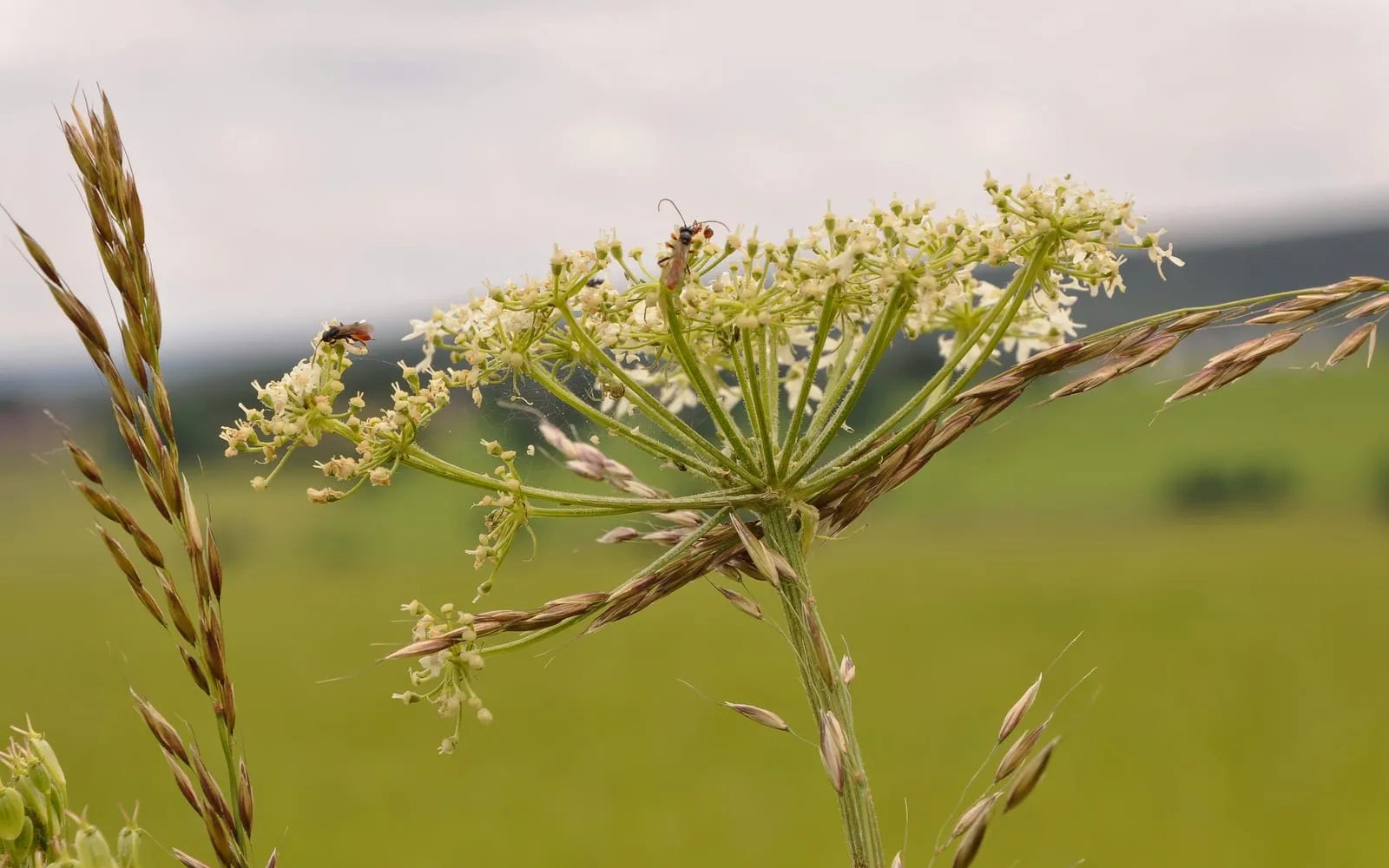
It is also one of the best insect plants in the British flora. An umbel in July carries soldier beetles, hoverflies, solitary bees and flies in numbers that few garden plants match.
Respect the sap. It is mildly phototoxic, and people who strim it bare-armed on a sunny day sometimes regret it.
Appearance and character
A coarse biennial or short-lived perennial reaching 1 to 2 m in flower.
The stem is thick, hollow, strongly ridged or grooved, and covered in stiff bristly hairs. Running a hand down it, which is best done gloved, it feels rough.
Leaves are large, up to 60 cm, divided into broad coarsely toothed and lobed segments. They are hairy, rough and downy underneath, and blunt or rounded at the lobe tips rather than sharply pointed.
Flowers open from June to September in broad flat umbels 5 to 20 cm across, dull white to creamy, sometimes pink-tinged. The outer petals of the outer flowers are noticeably enlarged and deeply notched, which gives the umbel a ragged edge.
The smell is strong and rather pig-like or piggy when the plant is cut, which is where the name comes from.
Seeds are flat, broadly oval, winged and pale brown, sitting in dry umbels through autumn and winter.
The whole plant reads as coarse. Cow parsley is lacy and fine, hemlock is smooth and ferny, hogweed is rough, hairy and blunt.
Where it is from
Europe and western Asia, and native throughout Britain and Ireland.
It grows on roadside verges, hedge banks, rough grassland, woodland edges, riverbanks and waste ground, on most soils and best on fertile moist ground.
Like cow parsley it has benefited from nitrogen enrichment of verges and field margins, and it has become more dominant over the last few decades at the expense of finer grassland plants.
The genus name honours Hercules, and sphondylium refers to the vertebra-like segments of the stem.
Giant hogweed, Heracleum mantegazzianum, is a different species entirely, introduced from the Caucasus in the nineteenth century as an ornamental and now a serious problem. That plant has its own guide here.
How it grows
Nobody plants common hogweed deliberately in a conventional border, and it is worth keeping in a wild corner, an orchard or a meadow area for its insect value.
It germinates in autumn and spring, makes a leaf rosette, and flowers in its second or third year before dying.
It self-seeds freely. Cutting the umbels off as the flowers fade, before the seed ripens in late summer, is the whole of the control.
Cut it with a hook or shears rather than a strimmer, wearing gloves, long sleeves and eye protection, and preferably on an overcast day or in the evening.
Dig out unwanted plants with the taproot. A cut crown regrows.
Where the aim is a species-rich meadow rather than a hogweed stand, cut annually and remove the cut material to lower fertility.
In a wildlife area, leave a proportion standing. The dry stems are used by overwintering insects and the seeds are taken by birds.
Through the seasons
Winter leaves dry brown stems and umbels standing, which are worth leaving for insects. Rosettes are visible at ground level.
Spring brings vigorous rough leaves from March and stems extending through May.
Summer is the long flowering, from June to September, and the peak of its value to pollinators. Cut umbels off here if seeding is a problem.
Autumn ripens and drops the winged seed, and the plant dies after flowering.
Care difficulty
Easy. It looks after itself entirely and needs no cultivation of any kind.
The care required is on the gardener’s part rather than the plant’s. Gloves, covered arms and no strimming in bright sunshine.
Control by cutting before seed is straightforward but must be repeated, since a stand builds a seed bank.
Identification against giant hogweed is the one thing to get right, and the size difference alone settles it in most cases.
Watering
None needed.
It prefers moist fertile ground and tolerates dry conditions, going over earlier in a drought year.
Warning signs, diseases and pests
Blackfly cluster on the stems and umbels in summer, and leaf miners make pale blotches in the leaves. Neither matters.
The warnings that count are about identification and about sap.
Is it giant hogweed? Giant hogweed reaches 2 to 5 m, has a stem 5 to 10 cm thick with distinct purple blotches and stiff white bristles, leaves up to 1.5 m with sharply pointed jagged lobes, and umbels up to 60 cm across. Common hogweed is a quarter of the size, its stem is green and ridged without purple blotching, its leaf lobes are rounded and its umbels are much smaller. If it is taller than you and the leaves are as long as your arm, treat it as giant hogweed, do not touch it and read that guide.
Sap on skin. Wash immediately with soap and water, cover the area and keep it out of sunlight for at least forty-eight hours. A delayed red, burning, blistering reaction can appear a day or two later and may leave brown marks for months.
Sap in the eye. Irrigate with clean water and get medical advice the same day.
Skin reactions in strimmer operators are the common presentation. Cut by hand where you can, cover up, and avoid bright sunshine.
Growing environment
Full sun to partial shade, on almost any soil, best on moist and fertile ground.
It is a plant for a wild corner, a hedge bottom, an orchard or a rough grass area rather than for a border.
Give it space. A mature plant occupies close to a square metre and casts shade over smaller neighbours.
Keep it away from paths and play areas, since brushing past a cut stem is how sap reaches skin.
Its wildlife value is the argument for tolerating it. The open umbels feed short-tongued insects that cannot use tubular flowers, and the flowering season runs for four months.
Where a verge or meadow is dominated by it, an annual cut with the arisings removed will gradually reduce fertility and let finer species return.
Feeding
None, and enrichment is the thing to avoid. Nitrogen favours hogweed over finer grassland plants, so fertiliser drift and runoff both increase it.
Cutting and removing the material each year is the practical way to reduce fertility where a more diverse sward is wanted.
Troubleshooting
Is this giant hogweed? Check height and leaves first. Giant hogweed is 2 to 5 m with leaves up to 1.5 m and sharply pointed lobes, and its stem is thick with clear purple blotches and white bristles. Common hogweed is 1 to 2 m with rounded leaf lobes and a green ridged bristly stem. If in doubt, do not touch it.
I got a rash after cutting it. Phytophotodermatitis from the sap. Wash the skin, keep it covered and out of sunlight for two days, and see a doctor if blistering is extensive.
Can I strim it? Better not to, and never in bright sunshine bare-armed. Strimming sprays sap onto skin. Cut by hand with gloves, long sleeves and eye protection.
Can I eat the young shoots? They have a history of being eaten cooked. The lookalikes include hemlock, which is fatal, so this is only for people who can identify it with certainty, and the safer position is not to.
How do I stop it spreading? Cut the umbels off as the flowers fade and before the seed ripens, and repeat each year. Dig out plants with the taproot.
Is it poisonous to my dog or my horse? It is not listed as toxic to cats or dogs, and grazing animals eat it without harm. The hazard is skin contact for people.
Should I get rid of it entirely? Only if it is in the wrong place. It is native and one of the best pollinator plants in the British flora, so a stand in a wild corner earns its keep.