
Outdoor plant
Perennial Flax
Linum perenne
Also known as Blue flax, Chalk flax, Perennial blue flax
How to grow perennial flax, Linum perenne. Sky blue flowers that open at dawn and fall by lunchtime, a wiry plant for dry chalk, and a rare British native at one edge of its range.
At a glance
- Difficulty
- Easy
- Water
- None once established
- Light
- Full sun
- Temperature
- Fully hardy to minus 20 deg C
- Hardiness
- USDA 4-9, RHS H6, hardy to -20 C
- Type
- Short-lived hardy perennial
- Height
- 30-60 cm
- Native to
- Europe, the chalk and limestone grasslands of Britain and central Europe
- Best month
- April, May, June and July in the Northern Hemisphere, October, November, December and January in the Southern Hemisphere
Thin dry alkaline soil and full sun suit it, and rich damp ground kills it over a winter. Each sky-blue flower opens at dawn and drops its petals by midday, and the plant carries on producing them for weeks. It is short-lived even in the right place, so let it seed. Linum lewisii is the closely related North American species, grown for the same effect.
Hardiness zones describe winter cold alone. Summer heat, humidity, rainfall and the length of the growing season decide as much, so treat the range as the outer limit rather than as a recommendation.
Every month named in this guide is for the temperate Northern Hemisphere. If you garden in the Southern Hemisphere, shift each one by six months, so April becomes October. Closer to the equator the wet and dry seasons matter more than the calendar, and the shift stops being a useful guide.
Edible, with limits
- Safe to eat
- None. This is an ornamental rather than a crop
- Do not eat
- Seed and green tissue in quantity
- Harm from
- Eating it
- Affects
- People and horses
Perennial flax is not a food plant and should not be treated as one. Like other Linum species it contains cyanogenic glycosides in seed and green tissue, which release small amounts of hydrogen cyanide when the tissue is damaged. The quantities involved are not a hazard to a gardener handling the plant and are a real one to a grazing animal eating a great deal of it, and several wild Linum species have caused livestock poisoning. The seed is not the linseed sold as food, which comes from Linum usitatissimum, and it should not be eaten or used in its place. Keep the plant out of paddocks and away from anywhere livestock graze.
Sources: RHS on potentially harmful garden plants, British Horse Society on poisonous plants
About
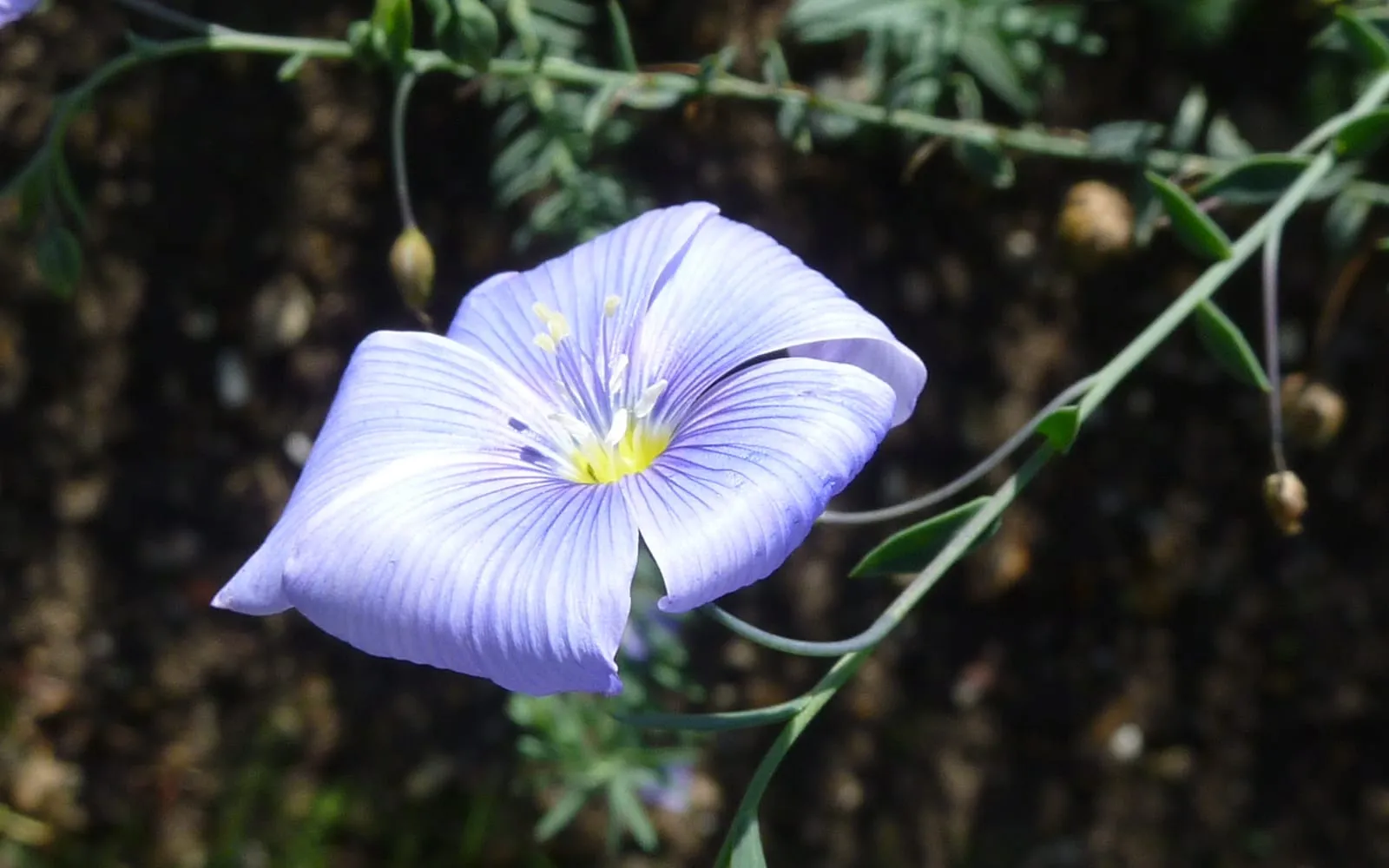
Perennial flax is grown for a colour that is hard to get any other way. The flowers are a clear pale sky blue, five-petalled and about 2.5 cm across, carried on fine arching stems above narrow blue-green foliage, and a good clump throws them for six or eight weeks from late spring.
Each flower lasts one morning. They open at dawn, drop their petals by early afternoon, and are replaced the following day, so the plant is never quite the same twice and never carries its full complement for long.
Britain has a native subspecies. Linum perenne subspecies anglicum grows on chalk and limestone grassland in a handful of eastern English counties and is scarce enough to be a conservation concern. The garden plant is the wider European species, which is common in cultivation and easy from seed.
Appearance and character
The plant makes a loose wiry clump of many slender stems rising from a woody base, each carrying narrow blue-green leaves arranged alternately and pressed close to the stem. Out of flower it is unremarkable and rather grassy.
The flowers are carried in loose sprays at the stem tips, five broad overlapping petals in pale sky blue with faint darker veining, occasionally white in named cultivars. They face outward and slightly downward on stems fine enough to move in any breeze.
The seed capsules are small round dry bolls about 6 mm across, splitting into segments to release flat brown seeds. They ripen from July and self-sow readily in the sharp drainage the plant prefers.
Where it is from
Linum perenne is a European species of dry calcareous grassland, growing from Britain east across central Europe into Russia and Siberia, always on thin free-draining soil in full sun.
The British native subspecies anglicum is restricted to chalk and limestone grassland in eastern England, chiefly in Cambridgeshire, Lincolnshire and the Yorkshire Wolds. Habitat loss has reduced it considerably and it is treated as a species of conservation concern.
Related blue flaxes from North America, particularly Linum lewisii, are sold under overlapping names, and garden plants labelled Linum perenne are sometimes that species instead. The two are similar and grow the same way.
How it grows
Perennial flax germinates readily from fresh seed, in autumn or spring, and young plants develop a taproot quickly. That taproot is why the species resents transplanting once it is more than a few weeks old.
The plant makes its clump in the first year and flowers from the second, though a spring sowing under glass will often flower in its first summer.
It is short-lived by the standards of border perennials. Three or four good years is normal, after which the clump becomes woody and sparse. The plant compensates by self-sowing, and a colony maintains itself in ground that suits it while the individual plants come and go.
Through the seasons
Sow in autumn or in early spring, in situ or in deep pots, and plant out while young. Do not attempt to move an established clump.
The plant comes into growth in March, sends up its flowering stems in May, and flowers from late May through June and July. Deadheading extends it a little, though the self-sown seedlings are usually welcome.
Cut the clump back after flowering to keep it tidy, or leave it to seed. It dies back to a woody base over winter and reappears in spring. Nothing needs doing to it between October and March.
Care difficulty
Easy in the right place and impossible in the wrong one. The right place is full sun on sharply drained poor soil, ideally alkaline, and the wrong one is anywhere that lies wet in winter.
Winter wet is what kills it, rather than cold. The plant is hardy to minus 20 deg C on a dry site and rots at the crown on a heavy soil in a mild wet December.
Accept that it is short-lived. Three or four years is a normal span, and the practical approach is to let it self-sow rather than to nurse an ageing clump.
Watering
Water new plants through their first summer while the taproot establishes, and then stop.
An established clump needs nothing in a cool summer. The plant is a dry grassland species with a taproot that finds its own water, and a well-meaning watering can does more harm than a drought.
Winter drainage is the thing to design for. Grit worked into the planting hole, a raised bed, a gravel garden or the top of a slope will all extend the plant’s life on ground that would otherwise be too heavy.
Warning signs, diseases and pests
Root and crown rot is what usually kills perennial flax, and it follows wet soil rather than any pathogen you could have prevented. A plant that collapses over winter and lifts with a black woody base was on the wrong ground.
Slugs take young plants and seedlings, which is worth a barrier around a newly planted clump.
Aphids gather on the growing tips in spring, distorting the fine stems. They wash off and rarely amount to anything.
Powdery mildew appears in a still humid summer as a white coating on the leaves, usually on a plant that is crowded or in too much shade. Give it air and sun.
Growing environment
Full sun. Perennial flax will not flower properly in shade and grows leggy and sparse trying.
Soil should be sharply drained, poor and preferably alkaline, from pH 6.5 to 8. A chalk or limestone garden suits it exactly, and a gravel garden or a raised bed reproduces the conditions elsewhere.
Cold is not an issue. The plant is fully hardy and grows wild into Siberia. The risk is winter wet, which is the single factor that decides whether a clump lasts one year or five.
Feeding
Feed nothing. Fertility produces soft growth, fewer flowers and a shorter life, which is the reverse of what anyone wants from this plant.
Do not mulch it with compost or manure. A gravel mulch is better, keeping the crown dry and suppressing weeds without adding richness.
If the ground is heavy, work grit into it before planting rather than adding organic matter, since the improvement wanted here is drainage rather than nutrition.
Troubleshooting
Why do the flowers only last a morning? Each flower opens at dawn and drops its petals by early afternoon. The plant produces new ones daily over six or eight weeks, so the display is continuous even though no individual flower is.
Why did my plant die over winter? Crown rot from wet soil, in nearly every case. Perennial flax is hardy to minus 20 deg C on a dry site and rots on heavy ground in a mild wet winter. Improve the drainage or grow it in a raised bed.
How long does it live? Three or four years is normal, after which the clump goes woody and sparse. It self-sows freely in ground that suits it, so a colony persists even as individual plants go.
Can I move an established clump? No, or not with much hope. The taproot resents disturbance and a moved plant usually sulks and dies. Raise replacements from seed instead.
Is the seed the same as linseed? No. Culinary linseed comes from Linum usitatissimum, the annual crop species. Perennial flax seed is not a food and should not be used as one.
Is it a British native? The subspecies anglicum is, growing on chalk and limestone grassland in eastern England and scarce enough to be a conservation concern. The usual garden plant is the wider European species.
Is it safe around animals? Keep it out of paddocks. Like other Linum species it contains cyanogenic glycosides in seed and green tissue, and several wild flaxes have caused livestock poisoning.
Perennial Flax problem guides
Not sure what is wrong? See the common vegetable pests guide.