
Outdoor plant
Cup and Saucer Vine
Cobaea scandens
Also known as Cathedral Bells, Mexican Ivy
How to grow cup and saucer vine, Cobaea scandens. Why the flowers open pale cream and darken to purple over several days, so one plant shows every shade at once, and why sowing seed on its edge rather than flat helps it germinate.
At a glance
- Difficulty
- Moderate
- Water
- Regularly through the growing season, never allowing it to dry out for long
- Light
- Full sun
- Temperature
- Frost-tender; grown as an annual outside a frost-free climate
- Hardiness
- USDA 9-11, RHS H2, hardy to 2 C
- Type
- Woody perennial climber grown almost everywhere as a half-hardy annual
- Height
- 4-8 m in a single season
- Native to
- Mexico, tropical America
Where winters stay frost-free it behaves as the woody perennial it naturally is, thickening at the base and returning each spring from old growth. Everywhere colder, and that is most of the range it is grown in, it is raised fresh from seed each year and treated as a half-hardy annual, reaching several metres of growth in a single season before the first frost cuts it down. The zone number describes survival of the root, not the show most gardeners grow it for.
Hardiness zones describe winter cold alone. Summer heat, humidity, rainfall and the length of the growing season decide as much, so treat the range as the outer limit rather than as a recommendation.
Not known to be toxic
Cup and saucer vine does not appear on the RHS index of potentially harmful garden plants, and the ASPCA does not list Cobaea scandens among either its toxic or its non-toxic plant records, so no documented poisoning risk exists for people, cats, dogs or horses. The seeds are large, flat and papery and are handled routinely by gardeners without reported ill effect, and the flowers and foliage carry no reputation for causing harm if chewed or brushed against. As with any plant absent from the major toxicity references rather than actively cleared by them, treating a large ingested quantity with the same caution given to any unfamiliar plant material remains sensible, but there is no specific documented hazard here to warn against.
Sources: RHS potentially harmful garden plants, ASPCA toxic and non-toxic plants
About
Cup and saucer vine is grown for speed as much as for its flowers. Sown under glass in early spring, a single plant can cover a fence, an obelisk or the side of a shed by midsummer, climbing by coiled tendrils that grip anything narrow enough to wrap around.
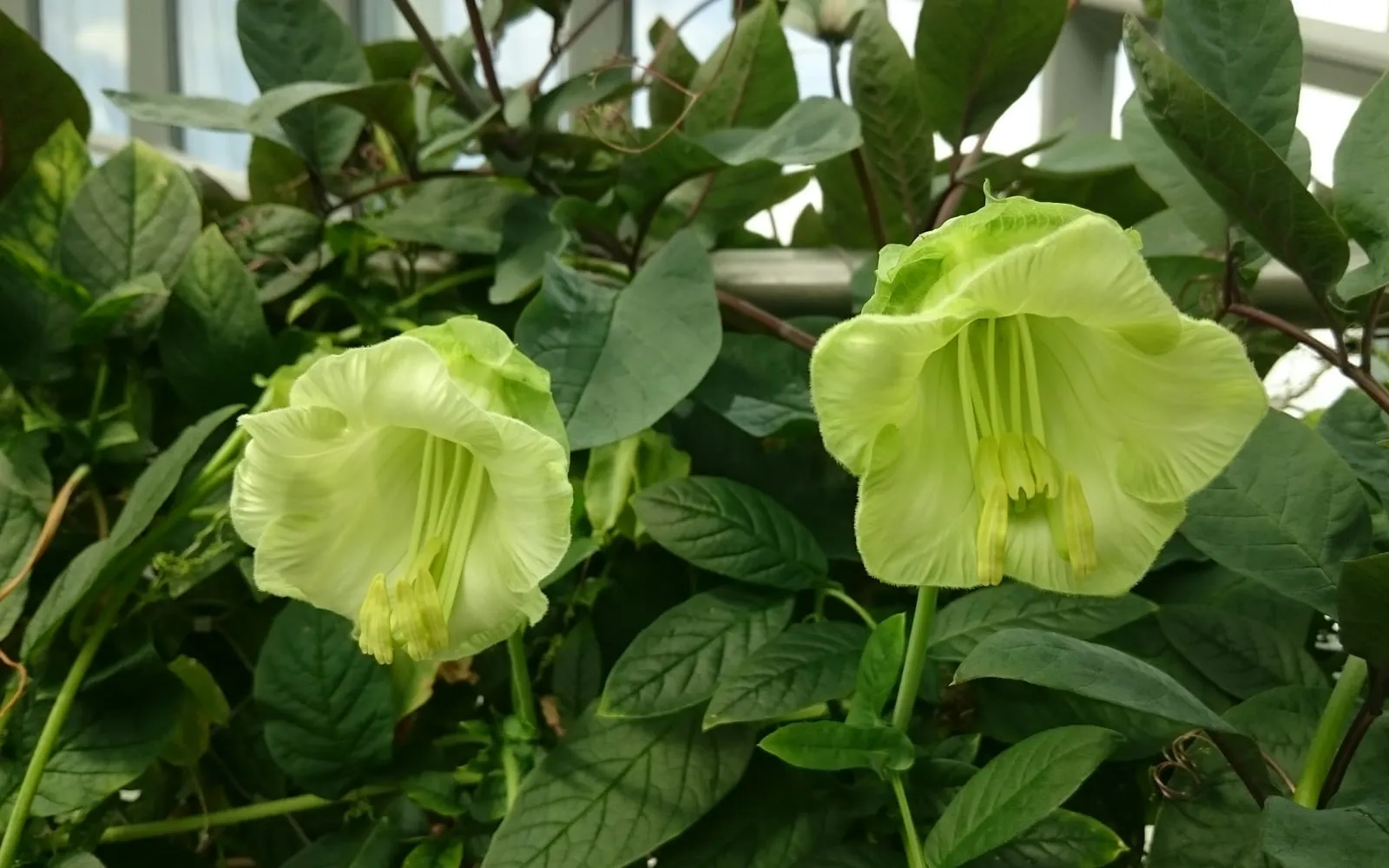
The flower gives the plant its name. Each large bell-shaped bloom sits inside a flat, saucer-like ring of green sepals, opening pale greenish-cream and deepening over several days to a rich purple, so a single plant in flower carries blooms at every stage of that colour change at once.
Treated almost everywhere as a half-hardy annual, it gives one season of rapid, generous growth and is then usually cleared away by autumn frost, though it survives as a genuine perennial in a climate that never freezes.
Appearance and character
A vigorous climber with soft, angled stems and pinnate leaves ending in branched tendrils, which coil tightly around wire, twine, netting or any other support no thicker than a pencil.
Flowers appear from midsummer, large and bell-shaped, around 5 to 8 cm across, held on long stalks that let them hang slightly away from the foliage. They open a pale greenish-cream and darken over four or five days to a deep violet-purple, so the plant shows several shades of the same flower simultaneously. A white-flowered form, sold as ‘Alba’, stays cream to pale green throughout rather than darkening to purple.
Growth is exceptionally fast once the plant is established outdoors, with stems capable of extending several centimetres a day in good conditions through the height of summer, which is the main reason it is grown at all in a climate too cold to keep it as a permanent perennial.
Seed pods that follow flowering are large, oval and contain big, flat, papery seeds, easily collected for the following year if a favourite plant keep it going.
Where it is from
Cobaea scandens is native to Mexico and parts of tropical America, growing as a woody perennial climber scrambling through forest margins and disturbed ground, using its tendrils to scale trees and shrubs towards the light.
In that frost-free native range it behaves as a true long-lived perennial, its base thickening into woody growth over years in the way a permanent climber does. The vast majority of gardens it is grown in worldwide are considerably colder than that native climate, which is why the plant is raised from seed each spring and grown as if it were an annual rather than kept from year to year.
Its speed and vigour, evolved to reach the forest canopy quickly ahead of competing growth, translate directly into the rapid coverage gardeners value it for over a single temperate summer.
How it grows
Sow seed indoors in early spring, setting each large seed on its edge in free-draining compost rather than flat, since the way it lies affects how easily it takes up water and germinates. Warmth speeds germination considerably, and young plants grow fast once they are up.
Harden off carefully before planting out once all danger of frost has passed, since the young growth is soft and frost-tender even though the plant grows so vigorously once established.
Choose a warm, sheltered position in full sun with a support already in place, since growth accelerates so quickly that a plant left without something to climb soon collapses into a tangled heap on the ground.
Plant in fertile, moisture-retentive soil enriched with garden compost, and provide netting, wire, trellis or twiggy sticks for the tendrils to grip, rather than a flat wall or fence they cannot climb unaided.
Pinch out the growing tip of a young plant once or twice early on to encourage bushier, more floriferous growth rather than a single long, sparsely branched stem.
Where the plant is being kept as a genuine perennial in a frost-free climate, cut back hard in late winter to keep growth manageable and to encourage strong new flowering shoots.
Through the seasons
Spring is sowing and raising young plants under cover, then hardening off and planting out once frost risk has passed.
Summer is the season of rapid growth and the main flowering display, with flowers opening cream and darkening to purple over several days each.
Autumn brings the first frost that ends the display in most gardens, though seed can be collected beforehand from any pods that have had time to mature.
Winter is dormant for the rare frost-free perennial specimen, and absent entirely for the great majority of plants grown as annuals and cleared away after the first hard frost.
Care difficulty
Moderate, and the difficulty sits almost entirely at the start of the season rather than through it. Raising strong plants from seed under cover, timing the move outdoors correctly and providing a support before the vigorous growth arrives all take a little planning. Once established outdoors in a warm, sheltered spot, the plant grows so strongly that it needs comparatively little further attention beyond regular watering and feeding through the height of summer.
Watering
Water regularly through the growing season, since the vine’s rapid growth rate demands a steady supply of moisture and a plant allowed to dry out for long checks its own growth noticeably.
Container-grown plants, a common way to grow it against an obelisk or a trellis on a patio, need particularly close attention in hot weather, since a pot dries out far faster than open ground under the same conditions.
Reduce watering only as growth naturally slows towards the end of the season, and stop altogether once frost has ended the display for the year in a climate where the plant is not being kept as a perennial.
Warning signs, diseases and pests
Aphids cluster readily on the soft, fast-growing shoot tips, distorting new growth and leaving a sticky residue. A strong jet of water or an insecticidal soap controls a light infestation without slowing the plant’s vigorous growth for long.
Whitefly can build up on the underside of the leaves, particularly on plants raised or overwintered under glass, rising in a small cloud when the foliage is disturbed. Yellow sticky traps and a soap spray help bring numbers down.
Spider mite favours the hot, dry conditions of a plant raised indoors before planting out, showing as fine pale speckling on the leaves. Raising humidity around young plants and moving them outdoors promptly once weather allows both help prevent it taking hold.
Slugs and snails are a real threat to young seedlings and newly planted specimens before they have grown clear of ground level, capable of destroying a promising plant overnight. Protect vulnerable young growth until it has climbed well up its support and is out of easy reach.
Growing environment
Full sun suits it best, giving the strongest growth and the most generous flowering through summer.
A sheltered position out of strong wind protects the soft, fast-growing stems, which can be damaged or torn from their support in an exposed spot.
Fertile, moisture-retentive soil enriched with organic matter at planting time supports the exceptional growth rate the plant is grown for.
A robust support installed before planting is essential, since growth accelerates too fast to add one afterwards without disturbing an established plant. An obelisk, a length of wire trellis, netting over a fence, or a large shrub it can scramble through all work well.
Feeding
Feed with a balanced liquid fertiliser while the plant is establishing early in the season, then switch to a high-potassium feed, the kind formulated for tomatoes, once flower buds begin to form.
Feed fortnightly through the main growing season, since the plant’s rapid growth and long flowering period both draw on a steady supply of nutrients that ordinary garden soil alone rarely sustains.
A container-grown plant needs feeding more consistently than one in open ground, since regular watering washes nutrients through free-draining compost relatively quickly.
Troubleshooting
My plant is growing fast but hasn’t flowered yet. Flowering typically starts in midsummer even on a vigorously growing plant, so a lack of flowers earlier in the season is usually just timing rather than a problem. Switching to a high-potassium feed once buds begin to form encourages a stronger display.
Can I keep the same plant going next year? Only in a climate that stays entirely frost-free. Everywhere colder, the top growth is killed by the first hard frost, and the simplest approach is to collect seed in autumn and raise a new plant the following spring.
The flowers seem to change colour on the same plant. That is normal. Each bloom opens pale greenish-cream and gradually darkens to deep purple over four or five days, so an actively flowering plant naturally carries several shades at once.
Slugs destroyed my seedlings. Young plants are vulnerable at ground level before they climb clear. Protect newly planted specimens until they have several tendrils gripping their support and are growing well above soil level.
Why has growth stalled in a container? Most likely the pot has become too small for the root system, or watering and feeding have not kept pace with the plant’s rapid growth rate. Move to a larger container and increase both watering and feeding frequency through the main growing season.