
Edible
Wild cranberry
Vaccinium oxycoccos
Also known as Small cranberry, Bog cranberry, Northern cranberry
How to grow wild cranberry, Vaccinium oxycoccos. The bog cranberry of the northern hemisphere, smaller in every part than the American one, and needing conditions few gardens have.
At a glance
- Difficulty
- Difficult
- Water
- Never let it dry, so most days in summer
- Light
- Full sun to very light shade
- Temperature
- Fully hardy to -35 deg C
- Hardiness
- USDA 2-6, RHS H7, hardy to -40 C
- Type
- Evergreen perennial, long-lived
- Height
- 5-10 cm high, spreading indefinitely
- Native to
- Britain, Northern Europe, Northern Asia, North America
- Best month
- September and October in the Northern Hemisphere, March and April in the Southern Hemisphere
A sphagnum bog specialist, and it declines wherever that habitat is drained or fed with nitrogen. It needs waterlogged acid peat with a pH near 4, permanently damp and low in nutrients, which is difficult to reproduce in a garden and impossible in ordinary soil.
Hardiness zones describe winter cold alone. Summer heat, humidity, rainfall and the length of the growing season decide as much, so treat the range as the outer limit rather than as a recommendation.
Every month named in this guide is for the temperate Northern Hemisphere. If you garden in the Southern Hemisphere, shift each one by six months, so September becomes March. Closer to the equator the wet and dry seasons matter more than the calendar, and the shift stops being a useful guide.
Not known to be toxic
- Safe to eat
- The berries
The berries are food and the plant carries no toxicity concern. Neither the RHS nor the ASPCA lists Vaccinium as harmful, and the ASPCA does not record the genus as toxic to cats or dogs. Eating a large quantity of any Vaccinium berry loosens the stomach, which is a property of the fruit rather than a poison. One caution belongs to foraging rather than to gardening. Several unrelated plants of the same heath and moorland ground carry dark berries and some are dangerous, so identify by the whole plant rather than by berry colour before eating anything wild.
Sources: RHS potentially harmful garden plants, ASPCA toxic and non-toxic plants
About
This is the cranberry that grows wild in Britain, on raised bogs and wet acid moor from Wales northwards. It is a different plant from the American cranberry sold as fruit, and it is smaller in every dimension.
The berries are excellent, sharper and more aromatic than the commercial sort, but they come in ones and twos rather than by the handful. Gathering enough for a sauce takes a long time on a wet hillside.
As a garden plant it is demanding in a way the American cranberry is not. It needs permanently saturated acid peat, rainwater only, and a pH low enough that most ericaceous composts are marginal.
The honest recommendation for most gardens is to grow Vaccinium macrocarpon instead. This one is for a bog garden, a sphagnum trough, or a gardener who wants the native species specifically.
Appearance and character
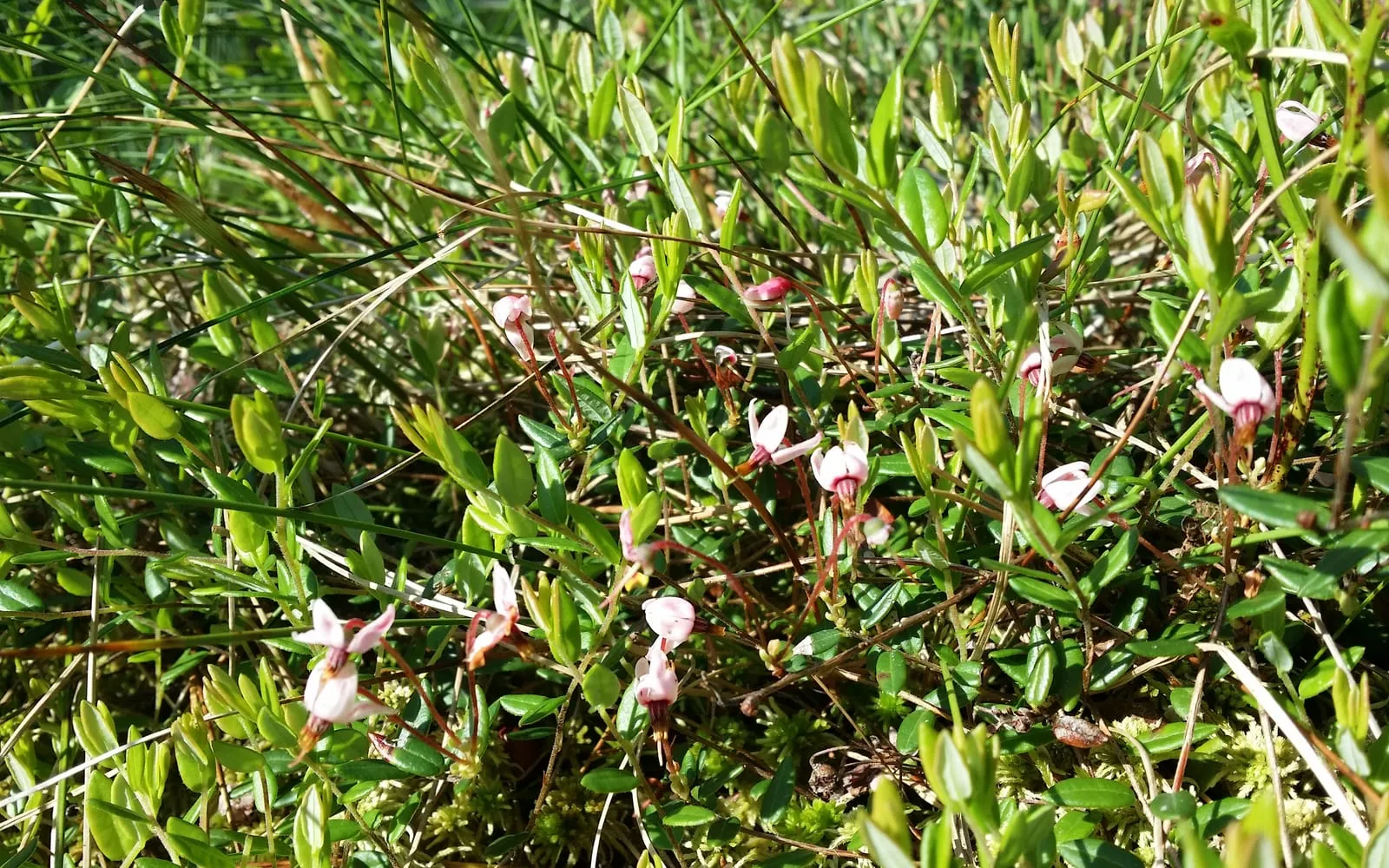
A tiny evergreen creeper with thread-like wiry stems, often less than a millimetre thick, weaving horizontally through sphagnum moss.
Leaves are minute, 3 to 8 mm, oval with a pointed tip, dark green above and distinctly blue-white beneath, with edges rolled under.
Flowers appear in June and July, pink, with four narrow petals bent sharply backwards and a protruding cone of stamens, held singly on long thin upright stalks.
Fruit is round to pear-shaped, 6 to 10 mm, ripening from pale speckled pink to deep red, often marked with darker spots.
The whole plant is so fine that it disappears into the moss and is usually found by spotting the berries rather than the foliage.
Where it is from
Vaccinium oxycoccos is native across the cool northern hemisphere, from Britain and Scandinavia through northern Asia to North America.
In Britain it grows on raised bogs, blanket bog and wet acid heath, with strongholds in Wales, northern England and Scotland, and it has been lost from many lowland sites through drainage.
Its habitat is sphagnum moss, where the plant roots in living moss that is permanently wet, strongly acid and almost devoid of nutrients.
Scandinavian and Russian communities have gathered it for centuries, and it is picked commercially from wild bogs in parts of Russia and the Baltic states.
The berries keep through winter without preserving because of their high benzoic acid content, which is how they served as a winter fruit before refrigeration.
How it grows
Source plants from a specialist nursery dealing in bog or native plants, and never dig them from the wild.
Build the conditions before buying. A container or sink with no drainage hole, filled with a mix of sphagnum moss, ericaceous compost and horticultural sand, standing permanently in a tray of rainwater.
Alternatively plant into a purpose-made bog garden with a lined base and an acid peat-substitute fill.
Plant into the surface and press the stems onto the moss. They root as they run.
Use rainwater exclusively. Tap water in a hard-water area will raise the pH and kill the plant within a couple of seasons.
Weed by hand and keep vigorous mosses and liverworts from smothering the stems.
Through the seasons
The plant is evergreen, and the tiny dark leaves take on a bronze cast through winter.
Growth resumes in April, with new stems running across the moss surface.
Flowering is in June and July, sparse and easy to miss unless you look closely.
Fruit swells through August and ripens from September into October, improving after the first frosts, which deepen the colour and sharpen the flavour.
Berries persist into winter and will still be good in December if birds have not found them.
Through the year the main task is water. The surface must never dry, and a hot week in July can kill a container plant that goes unwatched.
Care difficulty
Difficult, and the difficulty is that ordinary garden conditions are lethal to it.
It needs permanently wet, strongly acid, nutrient-poor ground, and any one of those missing will see it decline over a season or two.
Hard tap water is the commonest killer, and the symptoms take months to appear, which is why the cause is usually misdiagnosed.
Feeding is actively harmful. A plant adapted to bog nutrient levels will be scorched by a standard fertiliser.
Anyone wanting cranberries for the kitchen should grow the American species, which does the same job in a pot of ericaceous compost with far less trouble.
Watering
Rainwater only, and never let the surface dry.
Stand a container permanently in a tray or saucer of rainwater, topped up so the compost stays saturated rather than merely damp.
Collect and store rainwater deliberately for this plant. Running out in a dry August and reaching for the tap is how most losses happen.
In a bog garden, check the water level through summer and top up from a butt.
Overhead watering with rainwater in hot weather also helps, since the plant grows naturally in humid moss.
Warning signs, diseases and pests
Stems shrivelling and browning from the tips in summer. Drying out. Fine stems have almost no reserves and a single dry day can do lasting damage.
Leaves pale yellow with darker veins, growth stalled. Lime from tap water or from compost. Flush with rainwater, repot into an acid mix, and switch water source permanently.
General yellowing and no new growth. pH drift upwards. Test the water in the saucer, since it concentrates as it evaporates.
Grey fuzz on ripening berries. Grey mould in a wet still autumn. Thin surrounding growth to improve airflow.
Fine stems disappearing under vigorous moss or liverwort. Competition. Weed by hand, which is slow but necessary.
Berries gone in October. Birds. Net a container if the crop matters.
Growing environment
Full sun or very light shade. In the wild it grows in the open on bog surfaces.
Soil must be acid peat or a peat substitute at pH 3.5 to 5, permanently saturated and very low in nutrients.
Living sphagnum moss over the surface reproduces the natural habitat better than anything else and is worth sourcing.
Cold is no problem at all, and the plant is hardy to -35 deg C.
A sealed container standing in rainwater is the most practical way to grow it in an ordinary garden, since a genuine bog is rarely available.
Feeding
Do not feed it. The plant is adapted to bog conditions where nitrogen is scarce, and a normal fertiliser dose will scorch the roots.
Where growth has stalled and the pH is confirmed correct, a quarter-strength ericaceous feed once in June is the most to consider.
Sphagnum moss and rainwater between them supply what the plant needs.
Never use mushroom compost, lime, wood ash or any general-purpose fertiliser near it.
Chlorosis is a pH problem rather than a nutrient shortage, and treating it with feed makes matters worse.
Troubleshooting
Plant declining slowly over two seasons. Almost always tap water. The pH rises gradually and the damage is invisible until it is advanced.
Very few berries. Normal. This species crops lightly, and a small patch produces a handful rather than a bowl.
Stems long and leafy but no flowers. Too much shade, or too rich a medium. Move it into full sun and stop any feeding.
Moss growing over the plant. Competition in a habitat that suits both. Pull the moss back by hand around the stems.
Compost drying out in a hot spell. The saucer ran dry. Use a deeper reservoir and check daily in summer.
Wanting more fruit than this gives. Grow Vaccinium macrocarpon alongside it, which fruits far more heavily in the same conditions.
Wild cranberry problem guides
Not sure what is wrong? See the common vegetable pests guide.