
Edible
Culantro
Eryngium foetidum
Also known as Mexican coriander, Chadon beni, Recao, Ngo gai
How to grow culantro, Eryngium foetidum. The long spiny-edged leaf that tastes of coriander turned up, why it needs shade to stop it bolting, and how to use it.
At a glance
- Difficulty
- Moderate
- Water
- Two or three times a week. Drying out makes it bolt
- Light
- Part shade. Full sun makes it bolt
- Temperature
- Killed by frost. It needs warmth to grow at all
- Hardiness
- USDA 10-11, RHS H1b, hardy to 8 C
- Type
- Tender biennial, grown as an annual where frost comes
- Height
- 15-40 cm, taller in flower
- Native to
- tropical America
- Best month
- July and August in the Northern Hemisphere, January and February in the Southern Hemisphere
Shade is the requirement that surprises people, since full sun sends it straight into flower and the leaf goes tough. Grown under 30 to 50 per cent shade it stays in rosette and crops for months. Nothing below 10 deg C. The flavour is coriander at several times the strength, and it survives long cooking where coriander leaf does not.
Hardiness zones describe winter cold alone. Summer heat, humidity, rainfall and the length of the growing season decide as much, so treat the range as the outer limit rather than as a recommendation.
Every month named in this guide is for the temperate Northern Hemisphere. If you garden in the Southern Hemisphere, shift each one by six months, so July becomes January. Closer to the equator the wet and dry seasons matter more than the calendar, and the shift stops being a useful guide.
Not known to be toxic
- Safe to eat
- The leaves
Non-toxic. Culantro is a culinary herb used in quantity across the Caribbean, Latin America and south-east Asia, and it appears on neither the RHS list of potentially harmful garden plants nor the ASPCA list. The leaves are eaten cooked and raw. The specific name foetidum refers to the strong smell of the crushed leaf rather than to anything harmful. As with every member of the carrot family in this wave, the identification point stands: the Apiaceae also contains hemlock and hemlock water-dropwort, and a plant raised from a labelled seed packet is safe where a wild umbellifer is not.
Sources: RHS potentially harmful garden plants, ASPCA toxic and non-toxic plants
About
Culantro tastes like coriander with the volume turned up, and it is a different plant entirely. Coriander is Coriandrum sativum, a soft ferny annual. Culantro is Eryngium foetidum, a flat rosette of long spiny-edged leaves, and the same family is all they share.
It is the backbone herb of Caribbean and Latin American cooking, where it is chadon beni in Trinidad, recao in Puerto Rico and culantro across Central America. Vietnamese cooking uses it as ngo gai, torn into pho. It holds its flavour through long cooking in a way coriander does not, which is what it is for.
Growing it in a cool climate means fighting the same enemy as coriander, which is bolting. Culantro flowers under long days, heat and dry soil, and a bolted plant is finished. Shade, damp soil and a warm greenhouse are the answer.
Appearance and character
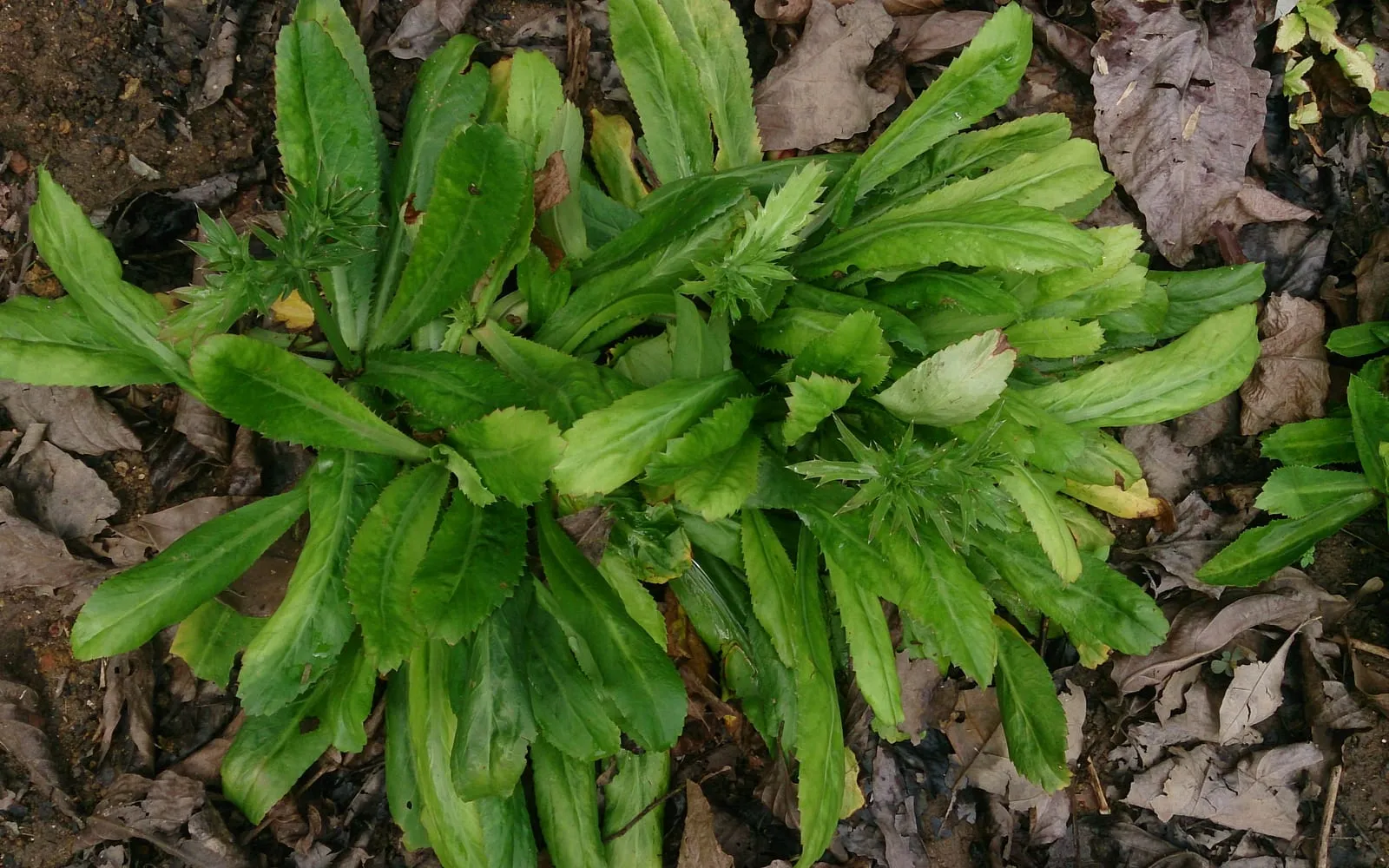
A flat ground-hugging rosette, 15 to 30 cm across, of long strap-shaped leaves.
Leaves are 10 to 25 cm long and 2 to 4 cm wide, deep glossy green, with sharply toothed spiny margins. They are tougher than they look and the spines catch on skin.
Flowering stems rise 30 to 60 cm, branching, with much smaller spiny bracts.
Flowers are tiny and greenish-white in dense cylindrical heads, each surrounded by a ruff of narrow spiny bracts, which is the eryngium family character.
The scent is the point. Crushed leaves smell strongly of coriander, more pungent and more persistent, and the specific name foetidum reflects how insistent it is.
Nothing about the plant looks like coriander, which is the commonest source of confusion when a recipe calls for it.
Where it is from
Culantro is native to tropical America, from Mexico through Central America into northern South America and the Caribbean.
Its use across that region is central rather than incidental. It is chadon beni in Trinidad and Tobago, recao in Puerto Rico where it goes into sofrito, and culantro across Central America, used in stews, marinades and sauces.
It spread to Asia with trade and was adopted quickly. Vietnam uses it as ngo gai in pho and in fresh herb plates, and it is used in Thailand, Laos and across south-east Asia.
West Africa and India both grow it now, and it is a common market herb in tropical countries far from its origin.
Outside the tropics it is uncommon and available mostly as seed, with fresh leaves sold in Caribbean and Southeast Asian shops.
How it grows
Sow indoors from March at 20 to 25 deg C. Surface sow and press the seed in, since it needs light.
Germination is slow, taking three to four weeks, and it is uneven. Do not give up early.
Prick out into small pots and grow on somewhere warm and shaded from direct sun.
Plant out or pot on into 15 cm pots. Culantro does better in a pot in a greenhouse than in a cool open bed.
Give it shade. This is the key point and it reverses the usual advice for a tender herb. Long days and strong sun send it to flower, and a shaded position extends the leaf harvest by weeks.
Keep it damp. Drying out triggers bolting as reliably as heat does.
Remove flower stems as they appear, which buys more leaf.
Harvest outer leaves from the rosette, leaving the centre to grow. A plant crops for several months if it is kept from flowering.
Treat it as an annual. It is biennial in the tropics and will not survive a frost.
Through the seasons
Winter there is nothing outdoors. Plants kept above 12 deg C indoors survive and grow slowly.
Spring is sowing, from March in warmth. Be patient with germination.
Early summer is establishment. Keep the plants shaded and damp.
Midsummer is the main harvest and the most difficult period, since long days push it towards flowering. Shade and water are what hold it back.
Late summer is often the best picking, as the days shorten and the plant settles.
Autumn ends outdoor plants at the first cold night. Bring one indoors if you want to keep it going.
Care difficulty
Moderate, and the two problems are germination and bolting.
Germination is slow and uneven, taking three to four weeks at 20 to 25 deg C. Plenty of people conclude the seed is dead at week two.
Bolting is the ongoing battle. Culantro flowers under long days, and heat and dry soil accelerate it. Shade and consistent moisture are the practical controls, and removing flower stems as they appear buys more time.
Shade is the counter-intuitive part. Most tender herbs want all the sun available. This one crops far better with protection from direct midday sun.
It is tender and will not take frost, so it is an annual outdoors here.
Given warmth, shade and damp soil it crops steadily from June to October and one plant supplies a household, because the flavour is strong.
Watering
Keep the soil evenly damp. Drying out is one of the main triggers for bolting.
Water two or three times a week in summer, more for a pot.
Water in the morning at the base.
Mulch around plants in the ground to hold moisture and keep the roots cool, which also delays flowering.
A container needs watering daily in a warm greenhouse.
Reduce watering in autumn as growth slows.
Warning signs, diseases and pests
A flower stem rising from the centre of the rosette is bolting, and it is the main thing to watch for. Cut it out, increase the shade and keep the soil damp.
Slugs take young plants quickly. Protect new plantings.
Damping off kills seedlings in cold wet compost. Sow into warm fresh compost.
Aphids gather under glass. Rub them off.
Pale stretched leaves mean too little light, which is a different problem from too much sun. Part shade is the target rather than deep shade.
Leaves that go tough and lose flavour usually mean the plant has bolted.
Scratches on your hands come from the spiny leaf margins.
Growing environment
Part shade, which is unusual for a tender herb and is what the plant wants. A position with morning sun and afternoon shade, or dappled light, is ideal.
Warmth. It needs 20 deg C or more for real growth and it dies at the first frost.
Moisture-retentive fertile soil with organic matter worked in.
pH from 5.5 to 7.
A greenhouse with some shading, a conservatory or a shaded patio pot all suit it. A hot sunny bed does not.
It grows well as an understorey plant beneath taller crops in a greenhouse, which provides the shade it wants.
Feeding
Feed a container plant with a balanced liquid feed every three weeks through the growing season, since leaf is the crop.
In good soil with compost worked in, feeding is unnecessary.
Avoid heavy nitrogen, which gives soft growth without more flavour.
Mulch rather than feed in the ground, which holds moisture and delays bolting at the same time.
Refresh a container with fresh compost each year.
Troubleshooting
Is it the same as coriander? No. Coriander is Coriandrum sativum, a soft ferny annual. Culantro is Eryngium foetidum, a flat rosette of long spiny-edged leaves. They share a family and a flavour compound, and the culantro flavour is stronger and survives long cooking.
It flowered almost immediately. Bolting from long days, heat or dry soil. Move it into part shade, keep it damp, and cut the flower stems out as they appear.
Nothing germinated. It is slow. Germination takes three to four weeks at 20 to 25 deg C, and it is uneven. Wait longer.
How much do I use? Far less than coriander. Culantro is several times stronger, and one or two leaves will do what a handful of coriander does.
Can it survive the winter? Not outdoors. It is tender and biennial. Keep a plant above 12 deg C indoors and it will carry on slowly.
The leaves scratched me. The margins are spined. Handle it with a little care.
Should it be in sun? No, and this is the point people get wrong. Part shade gives a longer crop, because sun and long days push it into flower.