
Edible
Bilberry
Vaccinium myrtillus
Also known as Whinberry, Whortleberry, Blaeberry
How to grow bilberry, Vaccinium myrtillus. The wild blueberry of European moorland, why the fruit stains and the shop blueberry does not, and its slow spread.
At a glance
- Difficulty
- Moderate
- Water
- Weekly in dry spells, using rainwater
- Light
- Partial shade to full sun. It grows naturally under birch and pine
- Temperature
- Fully hardy to about -30 deg C
- Hardiness
- USDA 3-7, RHS H7, hardy to -35 C
- Type
- Deciduous shrub, long-lived and slowly spreading
- Height
- 30-60 cm
- Native to
- Northern and central Europe, Britain
- Best month
- July in the Northern Hemisphere, January in the Southern Hemisphere
Cool, wet, acid and high is the requirement, and the plant tracks that combination up the mountains as the latitude falls. Hot dry summers kill it. Cultivation has never worked well, which is why every bilberry sold has been picked from the wild.
Hardiness zones describe winter cold alone. Summer heat, humidity, rainfall and the length of the growing season decide as much, so treat the range as the outer limit rather than as a recommendation.
Every month named in this guide is for the temperate Northern Hemisphere. If you garden in the Southern Hemisphere, shift each one by six months, so July becomes January. Closer to the equator the wet and dry seasons matter more than the calendar, and the shift stops being a useful guide.
Not known to be toxic
- Safe to eat
- The berries
The berries are food and the plant carries no toxicity concern. Neither the RHS nor the ASPCA lists Vaccinium as harmful, and the ASPCA does not record the genus as toxic to cats or dogs. Eating a large quantity of any Vaccinium berry loosens the stomach, which is a property of the fruit rather than a poison. One caution belongs to foraging rather than to gardening. Several unrelated plants of the same heath and moorland ground carry dark berries and some are dangerous, so identify by the whole plant rather than by berry colour before eating anything wild. Deadly nightshade, which is lethal, grows on chalk and woodland edge rather than acid moor, and its berries sit singly in a green star-shaped calyx on a plant a metre or more tall, which no Vaccinium resembles.
Sources: RHS potentially harmful garden plants, ASPCA toxic and non-toxic plants
About
The bilberry is the wild blueberry of European moorland, and anyone who has picked them in July knows the difference immediately. The flesh is stained deep purple right through, so the juice colours your fingers, your mouth and anything else it touches. A shop blueberry has pale green flesh and stains nothing.
The flavour follows the colour. Bilberries are sharper, more aromatic and far more intense than cultivated blueberries, which is why they remain worth picking despite being a fraction of the size.
Growing them in a garden is a slower business than growing blueberries. The plant spreads by underground rhizomes rather than by making a bush, it takes years to establish, and it fruits modestly even when happy.
What it needs is acid soil, light shade and patience. It is a plant for a woodland edge bed rather than a fruit cage.
Appearance and character
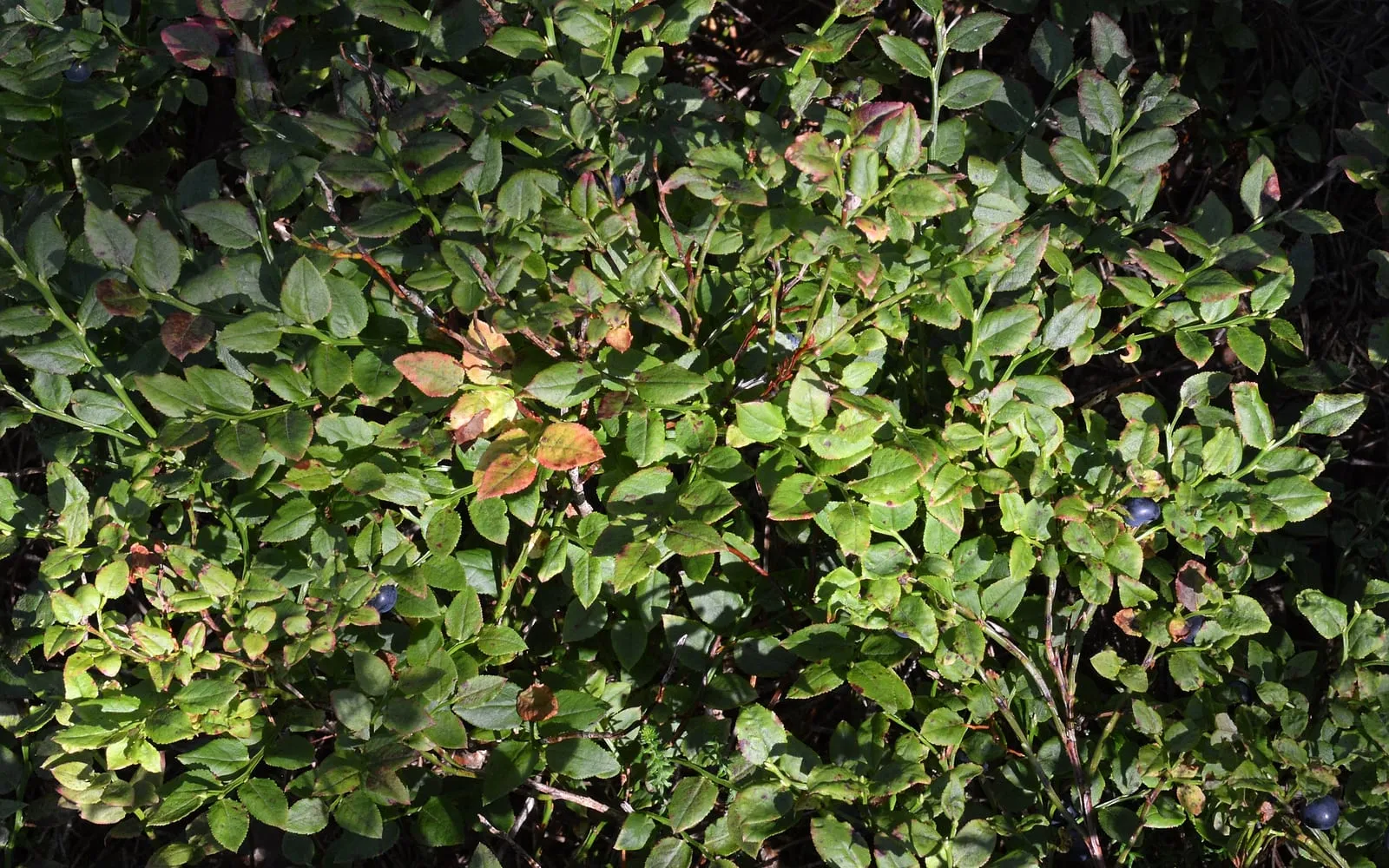
A low deciduous shrub, 30 to 60 cm, spreading slowly by rhizomes into a loose colony rather than forming a single bush.
Twigs are the identifying feature. They are bright green, sharply angled and almost winged, quite unlike the round brown twigs of a blueberry.
Leaves are small, oval, bright green and finely toothed, turning red before falling.
Flowers appear in April and May, solitary in the leaf axils, waxy and globular, greenish-pink and about 5 mm across.
Fruit is a round blue-black berry with a grey bloom, 6 to 10 mm, ripening in July and August. The flesh is deep red-purple throughout.
Berries sit singly rather than in the clusters a cultivated blueberry carries.
Where it is from
Bilberry is native across northern and central Europe and through northern Asia, and it is common in Britain on acid moorland, heath and open woodland.
It is a plant of poor acid ground, growing under birch, oak and pine and across open moor above the tree line, often as the dominant ground cover.
The names change every fifty miles. Whinberry in the west Midlands and Wales, whortleberry in the south-west, blaeberry in Scotland, hurts in parts of southern England.
Picking them is an old tradition with its own day in some places, and the wooden bilberry comb used to strip the fruit is a recognised regional tool.
It has never been cultivated commercially anywhere, because the yield per plant is too low and the fruit too soft to handle.
How it grows
Buy container-grown plants from a specialist nursery. Seed is slow and unreliable.
Plant in autumn or spring into acid soil, or into a raised bed of ericaceous compost mixed with composted bark and leaf mould.
Choose partial shade rather than full sun. The plant grows naturally under a light tree canopy and appreciates the same in a garden.
Space at 40 to 50 cm and let the colony spread.
Mulch generously with leaf mould, pine needles or composted bark, which is how the plant feeds in the wild.
Water with rainwater. Hard tap water raises the pH and the plant declines.
Leave it alone. Bilberry needs no pruning beyond removing dead wood.
Expect a small crop in the third year and a useful one from the fifth.
Harvest in July and August by hand, or with a bilberry comb over a large colony.
Through the seasons
Spring brings the small waxy flowers in April and May. Mulch now with leaf mould and top up the acidity.
Summer swells the fruit. Water with rainwater in dry spells, especially on a young plant.
July and August are the harvest, picking over the colony as the berries ripen in succession.
Autumn turns the leaves red before they fall.
Winter needs nothing at all. The plant is fully hardy and the green twigs stay conspicuous.
Care difficulty
Moderate, and the difficulty is establishment rather than maintenance.
Acid soil at pH 4 to 5.5 is essential, and so is rainwater in a hard-water area.
Bilberry is slower to establish than any blueberry and slower to crop. A plant that sits and sulks for two years is behaving normally.
Yields are modest by nature. A colony gives handfuls rather than punnets, and no amount of feeding changes that.
The plant needs the low-nutrient conditions it evolved in, so overfeeding does active harm.
Once settled, it is long-lived, fully hardy, needs no pruning and has few problems.
Watering
Water weekly with rainwater during dry spells, particularly for the first two or three years.
An established colony in soil that holds moisture rarely needs watering.
Use rainwater rather than tap water in a hard-water area, since alkalinity is the commonest cause of decline.
Mulch each spring with leaf mould, composted bark or pine needles to hold moisture and maintain acidity.
Container plants need closer attention, since bilberry has fine shallow roots that dry out quickly.
Warning signs, diseases and pests
Yellowing leaves with green veins mean the pH has risen, usually from hard tap water. Switch to rainwater and mulch with composted bark.
Vine weevil grubs destroy container-grown roots. Apply nematodes in late summer.
Grey mould spoils fruit in a wet summer where air movement is poor.
Birds take the berries as they ripen, and netting a spreading colony is awkward.
A plant that makes no growth for two years is establishing rather than failing.
Very few berries on a healthy plant usually means too much shade, or too much feeding.
Growing environment
Partial shade suits it best, matching its natural place under a light canopy. It tolerates full sun where the soil stays moist.
Acid soil at pH 4 to 5.5 is essential. Use ericaceous compost, composted bark and leaf mould rather than trying to acidify ordinary soil.
Free-draining but moisture-retentive ground. Bilberry dislikes both drought and standing water.
Low fertility is what the plant is adapted to, and rich ground gives leafy growth and no fruit.
Fully hardy, so no winter protection is needed.
A woodland edge bed, the foot of a birch, or a peat bed alongside rhododendrons all suit it. A conventional fruit bed does not.
Feeding
Bilberry needs almost no feeding and is easily harmed by too much.
Mulch each spring with leaf mould or composted bark, which is the only feeding most plants need.
Use an ericaceous feed at half strength once in spring if growth has stalled, and not otherwise.
Avoid all general fertilisers, which are too rich and raise the pH.
Avoid nitrogen in particular, which gives soft leafy growth at the expense of fruit.
Troubleshooting
Yellow leaves with green veins. The pH has risen. Water with rainwater and mulch with composted bark or pine needles.
It has not grown in two years. Normal. Bilberry establishes slowly and spreads by rhizome rather than bulking up as a bush.
Hardly any berries. Too much shade, too much feeding, or a plant still too young. Expect a useful crop from the fifth year.
How do I tell it from a blueberry? The twigs are green and sharply angled, the berries sit singly rather than in clusters, and the flesh is stained purple right through.
Is that dark berry on the moor safe? Bilberry is, and identify by the whole plant rather than the berry. Check for the angled green twigs and small bright leaves.
The fruit stains everything. That is the point of a bilberry and the way to tell it from a shop blueberry.
Can I grow it in a pot? Yes, in ericaceous compost, watered with rainwater and never allowed to dry out.
Does it need pruning? No. Remove dead wood and leave the rest alone.
Bilberry problem guides
Not sure what is wrong? See the common vegetable pests guide.