
Edible
Lingonberry
Vaccinium vitis-idaea
Also known as Cowberry, Mountain cranberry, Partridgeberry, Foxberry
How to grow lingonberry, Vaccinium vitis-idaea. An evergreen dwarf shrub that crops twice a year, spreads by runners, and needs acid soil and nothing else.
At a glance
- Difficulty
- Easy
- Water
- Weekly in summer, more in a container
- Light
- Full sun to part shade
- Temperature
- Fully hardy to -40 deg C
- Hardiness
- USDA 2-6, RHS H7, hardy to -45 C
- Type
- Evergreen perennial, long-lived, spreading by rhizome
- Height
- 10-30 cm, spreading indefinitely
- Native to
- Britain, Northern Europe, Northern Asia, North America
- Best month
- July, September and October in the Northern Hemisphere, January, March and April in the Southern Hemisphere
Among the hardiest fruiting plants of any kind, cropping inside the Arctic Circle under snow for half the year. Heat is the limit rather than cold. It needs acid peaty ground that stays damp and cool, and it thins out in summers that run hot.
Hardiness zones describe winter cold alone. Summer heat, humidity, rainfall and the length of the growing season decide as much, so treat the range as the outer limit rather than as a recommendation.
Every month named in this guide is for the temperate Northern Hemisphere. If you garden in the Southern Hemisphere, shift each one by six months, so July becomes January. Closer to the equator the wet and dry seasons matter more than the calendar, and the shift stops being a useful guide.
Not known to be toxic
- Safe to eat
- The berries
The berries are food and the plant carries no toxicity concern. Neither the RHS nor the ASPCA lists Vaccinium as harmful, and the ASPCA does not record the genus as toxic to cats or dogs. Eating a large quantity of any Vaccinium berry loosens the stomach, which is a property of the fruit rather than a poison. One caution belongs to foraging rather than to gardening. Several unrelated plants of the same heath and moorland ground carry dark berries and some are dangerous, so identify by the whole plant rather than by berry colour before eating anything wild.
Sources: RHS potentially harmful garden plants, ASPCA toxic and non-toxic plants
About
Lingonberry is the sauce that comes with meatballs in Sweden, and it grows wild on British moorland under the name cowberry. Most people who have eaten it have no idea it is native right around the northern hemisphere.
The plant is a low evergreen mat, glossy and neat all year, spreading by underground runners into a dense carpet. It works as ground cover in an acid bed as much as it does as a fruit crop.
It crops twice. A light picking comes in July and the main one in September and October, which is unusual among fruiting shrubs and useful in a small garden.
The berries are sharp and firm, closer to cranberry than to blueberry, and they sweeten after frost. They keep for months in the fridge because of their natural benzoic acid.
Appearance and character
A low evergreen shrub forming a dense mat, with short upright shoots rising from underground rhizomes that run just below the surface.
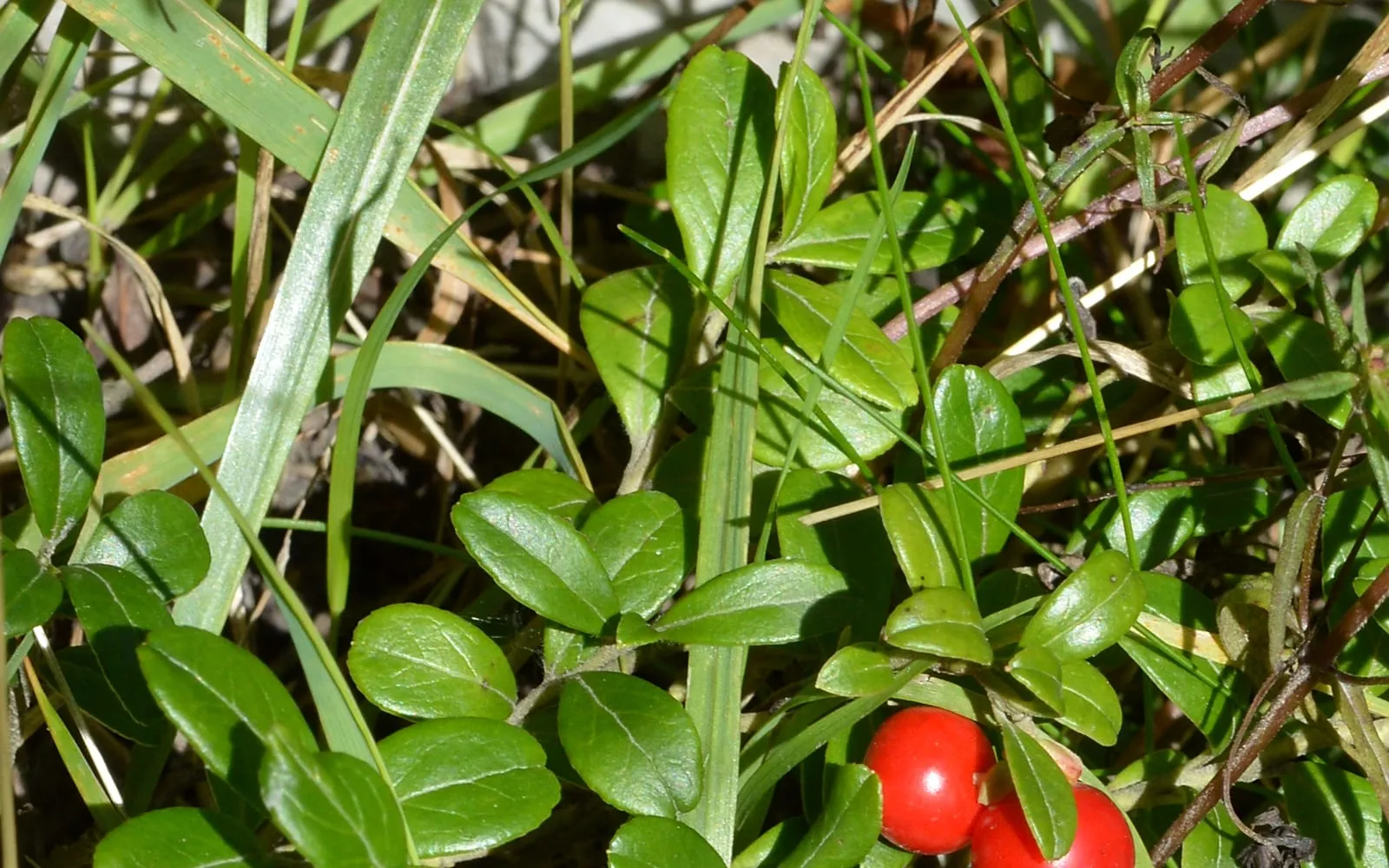
Leaves are 1 to 3 cm, oval, thick and leathery, glossy dark green above and paler beneath with scattered dark glandular dots. The leaf edges roll under slightly.
Flowers are small bells, 5 to 8 mm, white flushed pink, hanging in short clusters at the shoot tips. The first flush opens in May and a second follows in July.
Fruit is round, 6 to 10 mm, glossy and bright red, held in clusters above the foliage where the birds can see it as clearly as you can.
The plant looks presentable in every month of the year, which few fruiting plants manage.
Where it is from
Vaccinium vitis-idaea grows right around the northern hemisphere, from Britain and Scandinavia across Siberia to Alaska and Canada.
In Britain it is native to upland heath and moorland, common in Scotland and northern England and scarce further south.
It grows on acid, peaty, well-drained ground, often under heather or in open pine and birch woodland, and tolerates extreme cold and thin soil.
Sweden and Finland harvest enormous quantities from the wild each year under the right of public access, and the crop supports a real industry.
The two-crop habit comes from the wild plant and is not a breeding artefact. Named garden varieties such as ‘Koralle’ and ‘Red Pearl’ were selected in Germany and the Netherlands for larger fruit.
How it grows
Buy container-grown plants of a named variety. ‘Koralle’ is the standard for fruit and ‘Red Pearl’ crops heavily.
Plant into acid soil at pH 4 to 5.5, or into a container of ericaceous compost with added composted bark for structure.
Space at 30 to 40 cm and let the runners knit into a mat. A raised bed of ericaceous compost is ideal.
Full sun gives the best crop, and part shade is tolerated with a lighter one.
Water with rainwater. Tap water in a hard-water area raises the pH and causes slow decline.
Mulch with composted bark or pine needles in spring, which keeps the soil acid, holds moisture and suppresses weeds.
Through the seasons
The plant is evergreen and holds its glossy leaves through winter, taking on a bronze tint in hard weather.
May brings the first flush of flowers, and June sets the first crop.
July gives a light picking from that first flush, which is worth taking even though it is small.
The second flush of flowers opens in July, and this sets the main crop.
September and October bring the main harvest. Pick when the berries are fully red and firm, and expect them to improve after the first frost.
Trim over the mat lightly in early spring if it has become congested, and remove any old woody shoots at the base.
Care difficulty
Easy, provided the soil is acid. That single condition governs everything.
On acid ground or in a pot of ericaceous compost the plant is hardy, evergreen, long-lived and close to trouble-free.
On alkaline soil it will not survive, and no amount of care compensates.
Hardiness is exceptional, to -40 deg C, so it suits the coldest and most exposed gardens anywhere.
Vine weevil in containers is the main pest, and rainwater discipline is the main habit to establish.
Watering
Water weekly through the growing season, more often in a container or in hot weather.
Use rainwater wherever possible. Lime in tap water accumulates in the root zone and causes the yellowing that eventually kills the plant.
The soil should stay damp rather than wet. Unlike cranberry, lingonberry wants free drainage as well as moisture.
Mulch with composted bark or pine needles, which reduces watering considerably.
A container needs checking every few days in summer, since a shallow-rooted mat dries out quickly.
Warning signs, diseases and pests
Leaves yellowing between the veins, growth stalling. Lime-induced chlorosis from tap water or alkaline soil. Switch to rainwater, apply chelated iron and mulch with composted bark.
Plant wilting despite damp compost, roots eaten away. Vine weevil grubs, most likely in a container. Drench with nematodes in late summer.
Grey furry mould on ripening berries. Grey mould in wet still weather. Thin the mat to improve airflow.
Berries disappearing in September. Birds. The fruit is held above the foliage and is conspicuous, so net if the crop matters.
Growth checked, foliage dull. Drying out. The mat is shallow-rooted and suffers quickly in drought.
Weeds threading through the mat. Hand-weed, since hoeing damages the shallow rhizomes.
Growing environment
Full sun gives the heaviest crop. Part shade suits the plant well and reduces fruiting somewhat.
Acid soil is essential, at pH 4 to 5.5. This is the condition that decides whether the plant can be grown at all.
Drainage must be good. It grows on peaty slopes rather than in standing water, which separates it from cranberry.
Cold is irrelevant. Hardiness to -40 deg C makes it one of the toughest edible plants available.
A raised bed of ericaceous compost, a large trough, or an existing acid border under rhododendrons all suit it. It also makes excellent evergreen ground cover beneath taller ericaceous shrubs.
Feeding
Feed sparingly. A half-strength ericaceous fertiliser once in spring is all it needs.
The plant evolved on nutrient-poor upland soil and is easily scorched by a standard fertiliser dose.
Mulch with composted bark, pine needles or leaf mould each spring, which feeds the soil slowly and maintains acidity.
Never use lime, mushroom compost, wood ash or general-purpose fertiliser near it.
Yellowing is usually a pH problem rather than hunger, so check the water source before reaching for feed.
Troubleshooting
Leaves yellow with green veins. Alkaline conditions, and nearly always tap water. Switch to rainwater and treat with chelated iron.
Very few berries. Too much shade, or a single plant. Lingonberry is partly self-fertile and crops better with two different varieties.
Only one crop instead of two. A cold spring can lose the first flush. The second and larger one usually follows normally.
Mat thinning in the centre. Congestion and age. Trim over in spring and top-dress with ericaceous compost to encourage new rooting.
Plant spreading beyond its bed. Rhizomes running. Slice around the edge with a spade each spring.
Fruit very sharp. Correct for the species. Pick after a frost and cook with sugar, as Scandinavia does.
Lingonberry problem guides
Not sure what is wrong? See the common vegetable pests guide.