
Edible
Safflower
Carthamus tinctorius
Also known as False saffron, Bastard saffron, Kusum, Kardi, Dyer's saffron
How to grow safflower, Carthamus tinctorius. A spiny thistle that dyed Egyptian cloth, the fake saffron in a spice jar, and a taproot that goes down three metres.
At a glance
- Difficulty
- Moderate
- Water
- Very little. The taproot goes down three metres
- Light
- Full sun
- Temperature
- Tolerates heat well and wants a dry ripening
- Hardiness
- USDA 4-10, RHS H4, hardy to -7 C
- Type
- Hardy annual
- Height
- 60-150 cm
- Native to
- the Fertile Crescent, the eastern Mediterranean
- Best month
- April, May and September in the Northern Hemisphere, October, November and March in the Southern Hemisphere
A taproot reaching two to three metres makes it one of the most drought-tolerant oilseeds there is, and it is grown across the dry plains of India, the American west, Australia and Kazakhstan. Rain is the enemy rather than the requirement. Water on an open flower head brings botrytis and rots the seed in place, so it needs a dry flowering and a dry ripening, which is exactly what a maritime summer denies it.
Hardiness zones describe winter cold alone. Summer heat, humidity, rainfall and the length of the growing season decide as much, so treat the range as the outer limit rather than as a recommendation.
Every month named in this guide is for the temperate Northern Hemisphere. If you garden in the Southern Hemisphere, shift each one by six months, so April becomes October. Closer to the equator the wet and dry seasons matter more than the calendar, and the shift stops being a useful guide.
Skin irritant
- Safe to eat
- The seed, pressed for oil, and the dried florets as a colouring
- Do not eat
- None, though the spines cause mechanical injury
- Harm from
- Eating it and handling it
- Affects
- People
Safflower is not poisonous. The oil is a common cooking oil, the dried florets are used as a food colouring and a tea, and the seed is a standard component of wild bird food. Two practical cautions apply. Safflower belongs to the Asteraceae, and people sensitive to that family, which includes ragweed, chrysanthemum, chamomile and marigold, can react to it, with occupational allergy documented in workers handling the plant and the seed. Second, the plant is armed. Mature leaves and bracts carry stiff spines that puncture skin readily, so wear gloves and long sleeves when harvesting. Safflower florets are sold as a saffron substitute and are not saffron, which comes from Crocus sativus. Adulteration of saffron with safflower is common and is a fraud rather than a safety problem.
Sources: RHS on potentially harmful garden plants, Food Standards Agency on food allergy and intolerance
About
Safflower has been grown for at least four thousand years, and for most of that time nobody wanted the seed. The crop was a dye plant. Its florets yield two pigments, a yellow that dissolves in water and a red called carthamin that does not, and Egyptian, Indian and Chinese dyers used both. Safflower-dyed textiles survive from Egyptian tombs, and garlands made of the flowers were found in the tomb of Tutankhamun.
The oil came later. Safflower seed is around 35 per cent oil, high in linoleic acid, pale and almost flavourless, and it became a commercial oilseed in the twentieth century. India, the United States and Mexico grow most of it, and it is also a standard component of wild bird food because squirrels dislike it.
The plant itself is a thistle in everything but name, spiny and upright, with a taproot that reaches three metres and makes it one of the most drought tolerant crops in agriculture.
Appearance and character
The plant is stiff and upright with strong branching in the top third, carrying alternate leaves that are oblong, sharply toothed and, in most varieties, armed with spines that get worse as the plant matures.
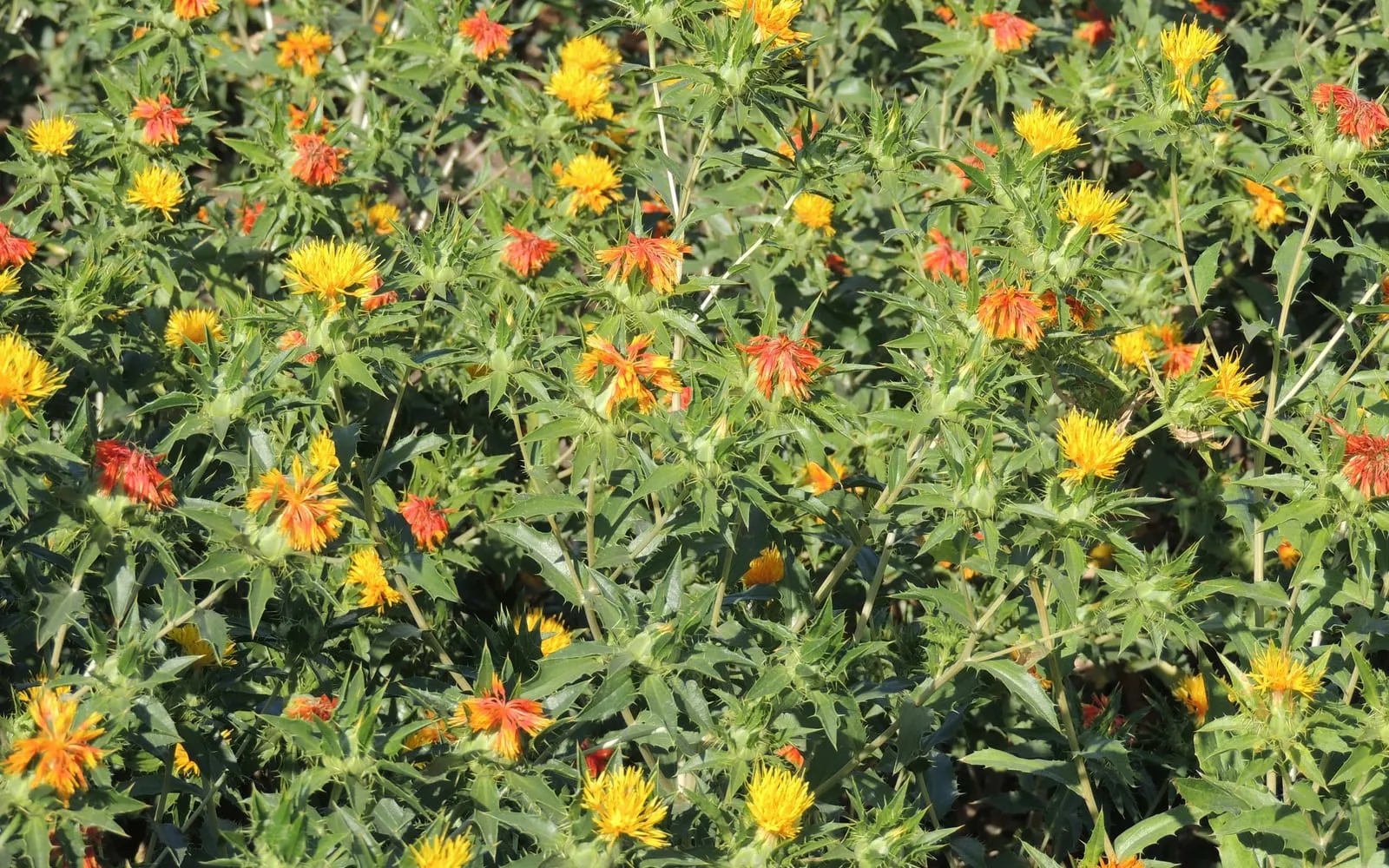
The flower heads sit at the branch tips, 2 to 4 cm across, surrounded by spiny bracts and packed with narrow tubular florets in orange, yellow, red or cream. They look like a small artichoke that has opened into a shaving brush.
The seed is white to cream, angular and about 6 mm long, resembling a small elongated sunflower seed without the stripes. Each head produces fifteen to thirty of them.
Where it is from
Safflower was domesticated in the Fertile Crescent from the wild Carthamus palaestinus, and cultivation is documented in Egypt from at least 1600 BC. Egyptian textiles dyed with it survive, and the garlands in Tutankhamun’s tomb were made from its flowers.
It spread east into Persia, India and China as a dye and a medicinal plant, and it became embedded in Indian agriculture as kardi, grown for oil and for the young leaves, which are eaten as a vegetable.
Its use as a dye collapsed when synthetic dyes arrived in the nineteenth century. The crop survived by becoming an oilseed in the twentieth, and modern production is concentrated in India, the United States, Mexico and Kazakhstan.
How it grows
Safflower germinates in cool soil and spends its first weeks as a flat rosette close to the ground while it drives its taproot down. That taproot is the whole basis of the plant, reaching two to three metres and finding water and nutrients far below where other annual crops can go.
Stem extension follows, and the plant branches into a candelabra shape. Flowering starts about fourteen weeks after sowing and continues for several weeks, with heads opening in sequence up the plant.
The crop self-pollinates with a good deal of insect visitation, and the seed fills over about a month. Ripening wants dry weather, and this is where a crop in a wet climate meets its difficulty, since rain on an open head brings botrytis into the developing seed.
Through the seasons
Sow in April, once the ground is workable, at 3 cm deep in rows 30 to 45 cm apart. Thin to 15 cm. Safflower dislikes transplanting because of the taproot, so sow it where it will grow.
The rosette stage lasts through May, which looks like nothing is happening. Growth accelerates in June, and the plant branches and comes into bud through July.
Flowering is from late July into August. For dye or colouring, pick the florets as they open and dry them in shade. For seed, harvest in September when the heads have dried and browned, cutting the plants with gloves on and threshing the heads once dry.
Care difficulty
The plant is easy and the harvest is unpleasant. Safflower germinates readily, needs no watering, tolerates poor alkaline soil, and grows itself through the summer with no attention.
The spines are the practical objection. A mature plant is armed on every leaf margin and around every flower head, and cutting a row of it without gloves and long sleeves is a mistake you make once. Spineless varieties exist and are worth seeking out.
The risk is rain at flowering and ripening. An open flower head that gets wet develops botrytis, and the seed inside rots. A dry ripening month gives a good crop and a wet one gives very little, which is why the crop belongs to the dry plains of India, the American west, Australia and Kazakhstan.
Watering
Water at sowing and then leave it. Safflower’s taproot reaches two to three metres and it is among the most drought tolerant crops grown anywhere.
There is no stage at which the crop needs watering, and watering during flowering works directly against you by keeping the heads damp.
Waterlogging is fatal and the plant is intolerant of wet feet at every stage. Free-draining ground is the single most important thing to give it.
Warning signs, diseases and pests
Botrytis in the flower heads is the disease that costs a crop in a wet climate. Rain settles into the open head, grey mould develops among the florets, and the developing seed rots. Nothing can be done once it has started, and the prevention is site and season rather than treatment.
Rust produces orange-brown pustules on leaves and stems, and it can be serious in a humid summer.
Root rot follows wet soil and kills plants outright, showing as sudden wilting with a brown taproot.
Aphids colonise the flower heads, where the spiny bracts make them hard to reach. Birds work over ripening heads, and slugs take seedlings in a wet spring.
Growing environment
Full sun and free drainage on the deepest soil available. The taproot wants depth, and a shallow bed over hardpan gives a much smaller plant.
Soil should be neutral to alkaline, from pH 6.5 to 8, and safflower tolerates salinity and drought that stop most crops. Poor ground is acceptable.
Heat and dryness at flowering and ripening are what the crop wants, and rain at exactly that point is what a maritime summer delivers. A sheltered sunny bed or a polytunnel improves the odds considerably.
Feeding
Feed lightly. Safflower’s taproot scavenges nutrients from well below the topsoil and the plant needs less than its size suggests.
One dressing of a balanced granular feed at around six weeks is enough on tired ground, and nothing at all on a bed that grew a fed crop last year.
Heavy nitrogen produces a tall soft plant that lodges and delays ripening, which in a short season is the wrong direction entirely.
Troubleshooting
Is safflower the same as saffron? No. Saffron is the dried stigmas of Crocus sativus, and safflower is a thistle in the daisy family. Safflower florets are sold as a saffron substitute and are used to adulterate real saffron, which is a common fraud.
Can I dye with it? Yes, and it was the plant’s main use for millennia. The florets carry a water-soluble yellow and a red pigment called carthamin, which is extracted by first washing the yellow out and then working the red out in an alkaline solution.
Why is it so spiny? Most varieties carry stiff spines on the leaf margins and around the flower heads, which get worse as the plant matures. Spineless varieties have been bred and are the ones to grow if you plan to handle the crop.
Will it set seed where I am? The plant grows easily almost anywhere. Getting seed depends on a dry flowering and a dry ripening, since rain on an open head brings botrytis and rots the seed, so a dry-summer climate crops reliably and a wet one rarely does.
Is safflower seed in birdseed? Yes, and it is often sold separately because squirrels dislike it, which makes it a way of feeding birds without feeding everything else.
What is safflower oil used for? Cooking, mostly. It is pale, almost flavourless and high in linoleic acid. High-oleic varieties have also been bred for frying and for industrial use.
Can I eat the leaves? Young leaves are eaten as a vegetable in India before the spines harden. Once the plant is mature they are not worth attempting.
How deep does the root go? Two to three metres in open ground, which is why it survives droughts that finish other annual crops and why it dislikes being transplanted.
Safflower problem guides
Not sure what is wrong? See the common vegetable pests guide.