
Edible
Flax
Linum usitatissimum
Also known as Linseed, Common flax, Lin
How to grow flax, Linum usitatissimum. One plant that gives linen and linseed oil, a field of blue that lasts one morning, and a founder crop still grown across Europe and North America.
At a glance
- Difficulty
- Easy
- Water
- Rain-fed in a temperate climate. Water through a dry May
- Light
- Full sun
- Temperature
- Cool suits it. It germinates at 5 deg C and dislikes heat at flowering
- Hardiness
- USDA 4-9, RHS H5, hardy to -10 C
- Type
- Hardy annual
- Height
- 50-120 cm
- Native to
- the Fertile Crescent, the eastern Mediterranean
- Best month
- March, April and August in the Northern Hemisphere, September, October and February in the Southern Hemisphere
One species does two jobs. Fibre flax is sown thickly to force a tall unbranched stem and pulled rather than cut so the fibre runs the full length, and linseed is sown thinly to encourage branching and seed. Fibre flax is then retted, rotting the stem in water or dew until the fibre releases, which is the step that decides the quality of the linen. It wants a cool moist growing season and dislikes heat at flowering.
Hardiness zones describe winter cold alone. Summer heat, humidity, rainfall and the length of the growing season decide as much, so treat the range as the outer limit rather than as a recommendation.
Every month named in this guide is for the temperate Northern Hemisphere. If you garden in the Southern Hemisphere, shift each one by six months, so March becomes September. Closer to the equator the wet and dry seasons matter more than the calendar, and the shift stops being a useful guide.
Edible, with limits
- Safe to eat
- The seed, whole or ground, and the pressed oil
- Do not eat
- Large quantities of raw seed, and immature green seed pods
- Harm from
- Eating it
- Affects
- People, dogs, cats and horses
Linseed is safe in the quantities people eat it and is sold widely as a food. The seed contains cyanogenic glycosides, chiefly linustatin and neolinustatin, which release small amounts of hydrogen cyanide when the tissue is damaged. Normal dietary amounts are not a concern, the compounds are reduced by heating and baking, and pressed linseed oil contains essentially none. Very large quantities of raw ground seed have caused reported cases of cyanide effects, and food safety authorities have advised moderation in raw consumption rather than avoidance. Ground linseed also swells considerably in water and should be taken with plenty of fluid. In horses, linseed is a traditional feed given boiled rather than raw for the same reason, and unboiled linseed mashes are avoided by convention. Green immature seed pods carry the highest levels and are the part to keep livestock away from.
Sources: RHS on potentially harmful garden plants, British Horse Society on poisonous plants
About
Flax gives two entirely different products from one plant. Grown tall and dense and pulled before the seed ripens, the stems yield the bast fibre that becomes linen. Grown shorter and branched and left to ripen, the seed capsules yield linseed, pressed for an oil that dries hard on exposure to air.
That drying property built industries. Linseed oil is the binder in traditional oil paint, the medium that made European easel painting possible, and it is the oil in putty, in wood finishes, and in linoleum, whose name is a compound of linum and oleum.
It is a founder crop, domesticated in the Near East around 9000 BC, and it grew across northern Europe for linen for centuries. Most of the modern crop is linseed, sown as a break crop, and a field of it in June is a startling pale blue for about three weeks.
Appearance and character
The plant is fine and wiry, with a single slender stem that branches only near the top in fibre types and more freely in seed types. The leaves are narrow, grey-green, and carried alternately up the stem.
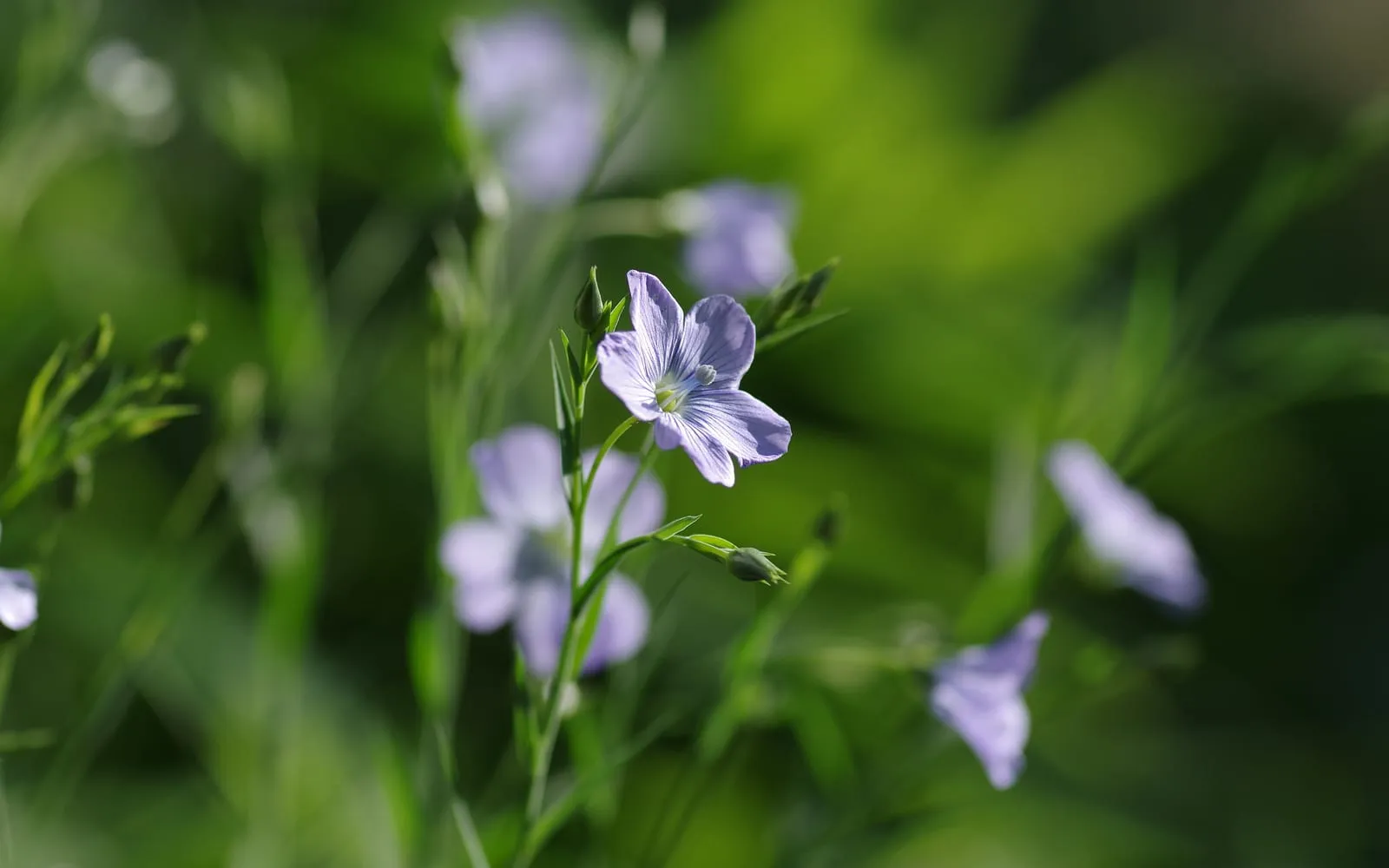
The flowers are the reason people notice a flax field. Five petals, pale sky blue in most varieties and occasionally white, about 2 cm across, on fine stalks. Each individual flower opens in the morning and drops its petals by the afternoon, so a field is blue for a few hours a day over several weeks and never looks the same twice.
The seed capsule is a round dry boll about 8 mm across, containing up to ten seeds. The seeds are the flat, pointed, glossy brown or gold ones sold as linseed, and they become slippery when wet because the coat releases mucilage.
Where it is from
Flax was domesticated in the Fertile Crescent from wild Linum bienne, which grows around the Mediterranean and into western Europe. It is one of the eight founder crops, and it is among the earliest, with domesticated forms in the Near East by around 9000 BC.
Fibre came first. Dyed flax fibres found in a cave in Georgia have been dated to around 30,000 years ago, long before farming, which shows that people were using wild flax for cordage and cloth in the Palaeolithic.
The crop spread across Europe and into Egypt, where linen became the standard cloth and where mummy wrappings preserve it. Ireland, Belgium and northern France built linen industries on it, and northern France remains the world’s leading producer of fibre flax.
How it grows
Flax germinates in cool soil and grows quickly into a slender upright plant. Seed rate decides the crop, and this is the most important choice a grower makes. Sown thickly, the plants compete, grow tall and refuse to branch, giving long unbranched stems full of usable fibre. Sown thinly, they branch, flower more and set more seed.
Flowering starts around eight weeks after sowing and runs for several weeks, with each flower lasting one morning. The plant is largely self-pollinating.
For fibre, the crop is pulled rather than cut, roots and all, at the point where the lower stem has yellowed but the seed is not ripe. For seed, it is left to mature until the capsules rattle.
Retting is the step that separates fibre flax from a pile of stems. The pulled crop is left in the field to be wetted by dew and rain, or steeped in water, so that bacteria and fungi rot the pectin binding the fibre to the woody core. Judging when to stop is the skill of the whole process.
Through the seasons
Sow in March or April as soon as the ground is workable, broadcast thickly for fibre or at about 15 cm rows for seed, and rake in shallowly. Flax dislikes a rough seedbed.
The crop grows through May and comes into flower in June, when it is at its most conspicuous. Flowering continues for two or three weeks.
For fibre, pull the crop in late July when the bottom third of the stem has yellowed, and ret it. For seed, harvest in August when the capsules are brown and rattle, cut the plants, dry them under cover, and thresh the capsules to release the seed.
Care difficulty
Growing flax is easy. It germinates in cold soil, needs no feeding worth mentioning, has few pests in a garden, and produces a beautiful crop with almost no attention.
Turning it into linen is a different matter and takes several distinct operations, each of which has to be judged rather than measured. Retting, breaking, scutching and hackling all have to go right, and over-retting turns good fibre into weak fibre with no way back.
For seed the whole thing is simple. Sow, wait, cut, thresh. The result is linseed, which keeps well, mills easily, and needs no processing beyond grinding.
Watering
Rain-fed in a temperate climate in most years. Flax has a shallow root system and it prefers a steady supply to a deep one, which is why it does well in the damp maritime climate of northern France, Belgium and Ireland.
Water through a dry May, when the plant is building the stem length that carries either the fibre or the crop. Drought then gives a short thin stand.
Waterlogging causes yellowing and stunting. The plant wants moisture retention rather than standing water, which is a distinction a heavy soil in a wet spring does not always respect.
Warning signs, diseases and pests
Flax flea beetle attacks seedlings, chewing small round holes through the leaves and setting the crop back at the stage it can least afford. A warm quick start outgrows it.
Pasmo shows as brown or greyish blotches on leaves and stems, often in bands, spreading in wet weather and weakening the stems so the crop lodges. Rust produces orange pustules on stems and leaves that turn black later in the season.
Lodging is what ruins a fibre crop. Flattened flax retts unevenly, tangles, and cannot be pulled cleanly. Sow at the right rate, keep nitrogen low, and choose a sheltered site.
Slugs take seedlings in a wet spring, aphids gather on the growing tips, and birds work over the ripening capsules on a small patch.
Growing environment
Full sun and a cool moist growing season. Flax does its best work in a maritime climate and suffers in a hot dry summer, when the flowering period shortens and the seed shrivels.
Soil should be deep, moisture-retentive and near neutral, from pH 6 to 7. A medium loam is ideal. Very light sand dries out too fast for a shallow-rooted plant and heavy clay caps over the fine seed.
Shelter helps a fibre crop considerably, since the whole value of it depends on long straight unlodged stems.
Feeding
Feed flax sparingly. A fed crop grows soft, lodges, and produces coarse weak fibre, which is the opposite of what a linen crop is for.
One light dressing of a balanced granular feed in spring is enough on tired ground, and nothing at all on a bed that grew a fed crop last year.
Flax is traditionally grown as a break crop between cereals for that reason, taking what fertility remains rather than needing its own.
Troubleshooting
Are flax and linseed the same plant? Yes, the same species grown differently. Fibre flax is sown thickly and pulled before the seed ripens. Linseed is sown more thinly, branches, and is left to mature for the seed.
Why is the field only blue in the morning? Each flower opens at dawn and drops its petals by early afternoon. New flowers open the next day over a period of two or three weeks, so a field is blue for a few hours daily and never twice the same.
How do I make linen from my crop? Pull the plants when the lower stems yellow, ret them by leaving them on grass to be dewed and rained on for two or three weeks, dry them, then break the woody core, scutch the fragments away, and comb the fibre through a hackle. Each step needs judgement, and over-retting weakens the fibre irreversibly.
Is linseed safe to eat? Yes, in normal quantities. The seed contains cyanogenic glycosides that release small amounts of cyanide, which heating reduces and which pressed oil does not contain. Very large amounts of raw ground seed have caused reported problems, so moderation rather than avoidance is the advice.
Why is linseed slippery in water? The seed coat releases mucilage, a polysaccharide gel, which is why soaked linseed thickens and why ground linseed is used as an egg substitute in baking.
Can I give it to my horse? Boiled linseed is a traditional horse feed and the convention of boiling it exists for the same reason as the note above. Raw linseed mashes are avoided, and green seed pods are the part to keep animals away from.
Why is linoleum called that? From linum and oleum, flax and oil. It is made by oxidising linseed oil into a solid and mixing it with cork dust and resin on a jute backing.
Can I sow linseed from a health food shop? Often, yes. Whole brown or golden linseed frequently germinates. Ground linseed will not.
Flax problem guides
Not sure what is wrong? See the common vegetable pests guide.