
Edible
Plantain
Musa paradisiaca
Also known as Cooking banana, Platano, Matoke
How to grow plantain, Musa paradisiaca. The cooking banana that is starchy rather than sweet, how to tell it from a dessert banana, and why the lawn weed of the same name is a different plant entirely.
At a glance
- Difficulty
- Moderate
- Water
- Daily or every other day through summer
- Light
- Full sun with shelter
- Temperature
- Growth stops below 15 deg C and frost kills the top growth
- Humidity
- High
- Hardiness
- USDA 9-11, RHS H1b, hardy to 5 C
- Type
- Tender evergreen perennial, each pseudostem monocarpic
- Height
- 3-9 m, taller than most dessert bananas
- Native to
- South East Asia, India
- Best month
- May, June and July in the Northern Hemisphere, November, December and January in the Southern Hemisphere
Ten to fourteen months without frost is what one bunch costs, and a cold snap that kills the pseudostem sets the plant back a full year even where the corm survives. Wind is the other hazard, since the leaves shred and the whole plant blows over. Fusarium wilt tropical race 4 is spreading through the growing regions and there is no treatment for it.
Hardiness zones describe winter cold alone. Summer heat, humidity, rainfall and the length of the growing season decide as much, so treat the range as the outer limit rather than as a recommendation.
Every month named in this guide is for the temperate Northern Hemisphere. If you garden in the Southern Hemisphere, shift each one by six months, so May becomes November. Closer to the equator the wet and dry seasons matter more than the calendar, and the shift stops being a useful guide.
Not known to be toxic
- Safe to eat
- The fruit cooked at every stage of ripeness, plus the flower bud and stem core
Plantain is not toxic and Musa is listed as non-toxic to cats, dogs and horses by the ASPCA. The fruit is eaten green as a starchy vegetable, half ripe as a fried snack, and fully ripe as a sweet dish, and the male flower bud and the tender core of the pseudostem are vegetables in their own right. Raw green plantain is unpleasant and hard to digest rather than harmful, being heavily starchy in the way a raw potato is. The sap from cut stems and green fruit stains skin and cloth a persistent rusty brown, which is why cooks in West Africa and the Caribbean oil their hands before peeling green plantain.
Sources: ASPCA toxic and non-toxic plants, RHS potentially harmful garden plants
About
Plantain is a banana bred for the pot rather than the fruit bowl. The fruit is larger, more angular and far starchier, it stays firm when cooked, and it is eaten at every stage from hard green to black.
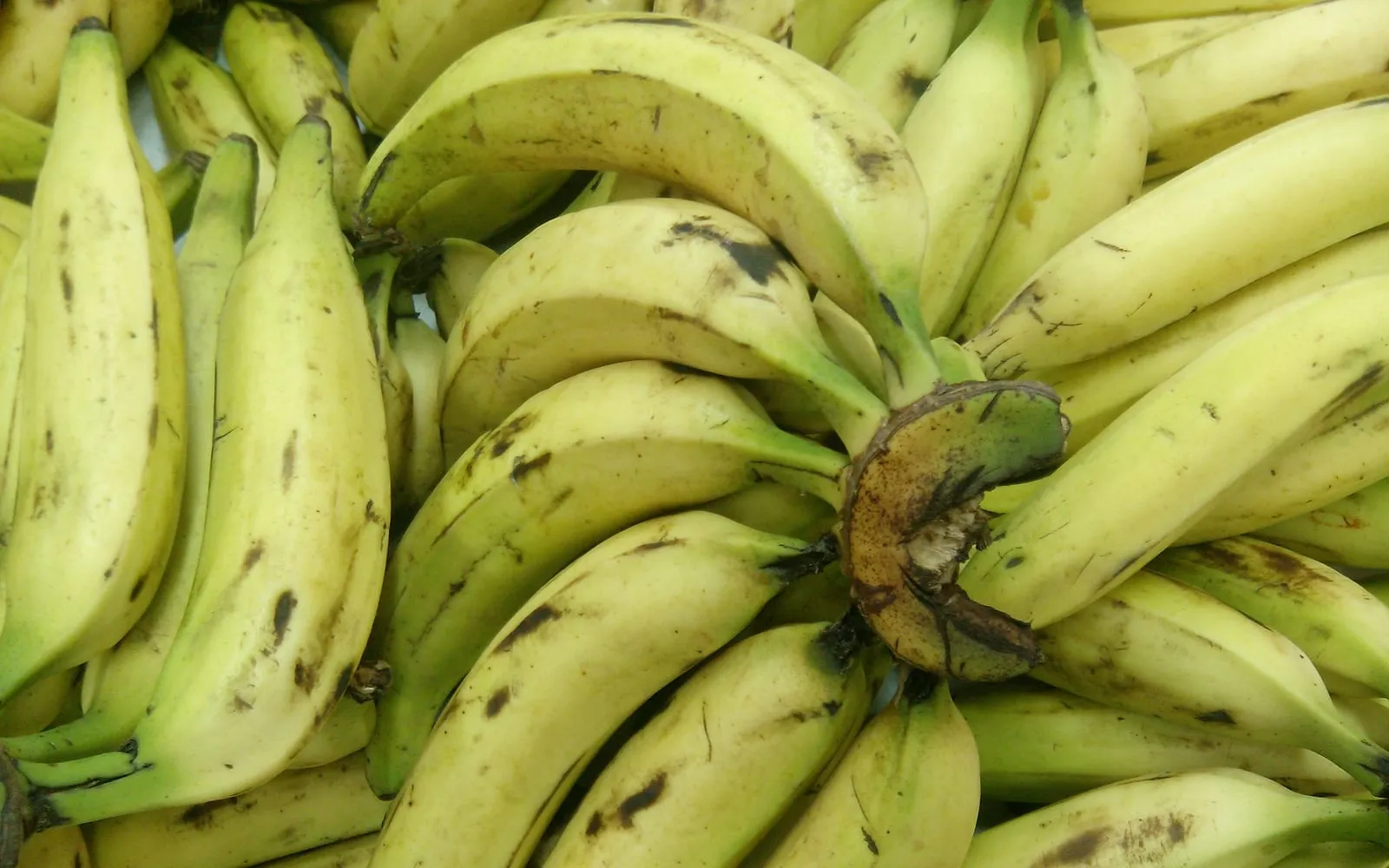
Telling one from a dessert banana in a shop is a matter of size and skin. A plantain is longer, thicker, more sharply ridged, and the skin is tough enough to need a knife rather than a thumb. A ripe one goes black rather than yellow and is at its sweetest then.
English has one more confusion to clear. Plantain is also the name of Plantago, the flat rosetted weed in every temperate lawn, which is an unrelated plant that shares nothing with this one but a word.
Appearance and character
A pseudostem 3 to 9 m tall, generally taller and more robust than a dessert banana, made of rolled leaf sheaths from an underground corm.
Leaves are huge, up to 3 m long, and tear into strips in wind exactly as a banana’s do.
The flower spike emerges from the crown and hangs down, with tiers of female flowers becoming hands of fruit and a purple male bud at the tip. Plantain often keeps producing male flowers long after a dessert banana has stopped.
Fruit is long, angular in cross-section rather than round, with pronounced ridges and a thick skin. A single finger can be 30 cm.
Ripening runs green to yellow to black. Green fruit is starchy and firm and used as a vegetable, yellow fruit fries into sweet-edged slices, and black fruit is sweet enough for a dessert while still holding its shape.
Flesh is cream to pale orange, dense and dry compared with a dessert banana.
The corm below ground carries the plant from year to year and throws suckers.
Where it is from
Plantains are hybrids of Musa acuminata and Musa balbisiana, arising in South and South East Asia and carried west and south by human hands.
The plantain subgroup that dominates African cooking reached the continent early, perhaps two or three thousand years ago, and diversified there into hundreds of local forms. Central Africa now grows a large share of the world crop and eats almost all of it.
West Africa, the Congo basin and the East African highlands each built a distinct cuisine on it. Matoke in Uganda is steamed green plantain, fufu across West Africa is pounded, and the Caribbean and Latin America gave the world tostones and maduros.
The Spanish and Portuguese carried plantains across the Atlantic in the sixteenth century, and the plant became a staple in Colombia, Venezuela, Peru and the islands.
Temperate markets get plantain through Caribbean, West African and South Asian food shops, and it is now common in supermarkets in cities with those communities.
Musa paradisiaca is a hybrid name. Modern botanists write it Musa x paradisiaca or refer to the AAB genome group, and the app uses the older form.
How it grows
Start with a sucker or a young plant, since plantains set no viable seed.
Plant into the biggest pot available, in deep rich compost that holds moisture without going stagnant.
Give it heat and light. A minimum of 15 deg C for growth and full sun.
Water heavily. Plantain is thirstier than a dessert banana and wilts fast when short.
Feed weekly from May to September, high in nitrogen early and high in potash from midsummer.
Shelter it from wind, which shreds the leaves.
Reduce suckers to one or two followers so the parent stem builds bulk.
Overwinter above 12 deg C under glass, much drier, and expect growth to stop.
Accept that fruit in a cool climate is a long shot outdoors and a real possibility in a heated conservatory with eighteen months of warmth.
Cut the fruited pseudostem to the ground once the bunch is taken, and let the strongest sucker take over.
Through the seasons
Winter is dormancy under cover above 12 deg C, watered lightly and not fed at all.
Spring is when growth restarts. Repot or top-dress, thin the suckers, and begin feeding with the first new leaf.
Early summer brings a leaf every week or so in warm conditions.
Midsummer is peak growth, heaviest watering and weekly feed.
Late summer may bring the flower spike on a plant carrying thirty or more leaves.
Autumn is the taper. Stop feeding, reduce water, and get any outdoor plant under cover well before the first frost.
Care difficulty
Moderate, with the same three demands as a dessert banana and each of them larger.
Water first. Plantain in growth needs daily attention in warm weather.
Food second. Weekly feeding through the season is the floor rather than the ceiling.
Heat third. Growth stops below 15 deg C and fruit needs a long hot run.
Size is the practical obstacle. Plantains are bigger than dessert bananas and few greenhouses have the head room.
Black Sigatoka, the leaf-streak disease that dominates commercial plantain growing in the tropics, is a field problem rather than a glasshouse one. It takes a third of the crop off an unsprayed plantation and forces fungicide programmes running to forty or fifty applications a year, which is the reason the crop is hard where it feeds people.
As a foliage plant in a large conservatory it is spectacular and easy enough, provided it is fed and watered like the glutton it is.
Watering
Water daily or every other day in summer, keeping the compost consistently damp.
Give a lot each time. A large plant in warm weather can take several litres a day.
Keep humidity high with grouping, misting or damping down the greenhouse floor.
Cut watering right back below 15 deg C, because a cold wet corm rots.
Water outdoor plants even through summer rain, since the leaf area transpires faster than rainfall replaces it.
Use rainwater where the supply is very hard.
Never leave a pot standing in water in cold weather.
Warning signs, diseases and pests
Torn leaves are wind damage and are normal.
Brown crisp margins mean dry air or dry compost.
Pale small new leaves mean underfeeding, which is the commonest fault on plantain.
Dark streaks running along the leaf between the veins, widening into brown blotches with yellow halos, are Sigatoka leaf spot. It is a tropical field problem rather than a glasshouse one.
Fine webbing and stippling under the leaves is spider mite in dry heated air.
Blackened collapsed leaves after a cold night are frost damage. The corm often survives if it stays dry.
A sour smell and a soft pseudostem at the base in winter is corm rot.
Older leaves yellowing progressively upward, with the base of the pseudostem splitting, is Fusarium wilt. There is no treatment.
A pseudostem dying after fruiting is the normal cycle.
Growing environment
A heated greenhouse or a large conservatory. There is no outdoor fruiting option in a cool climate.
Minimum 12 deg C to hold, 15 deg C to grow, 25 to 30 deg C to fruit.
Full sun with shelter from wind.
High humidity.
Deep rich free-draining compost with plenty of organic matter, in the largest container available.
pH from 5.5 to 7.0.
Head room of three metres or more for a full-sized cultivar, less for a dwarf.
A wide pot, since the corm spreads sideways as it suckers.
Feeding
Feed weekly from May to September without fail.
Use a high-nitrogen feed early to build the leaf canopy, then switch to a high-potash feed from midsummer.
Top-dress with rich compost or well-rotted manure each spring.
Stop feeding at the end of September.
Give nothing over winter.
Add magnesium if the older leaves yellow between the veins during active growth.
Underfeeding shows faster on plantain than on almost anything else in this collection.
Troubleshooting
How is a plantain different from a banana? It is a cooking cultivar of the same hybrid group. The fruit is larger, more angular, much starchier and firmer, and it is eaten cooked at every stage from green to black rather than raw.
Is this the same as the weed in my lawn? No. The lawn plantain is Plantago, an unrelated rosette-forming perennial. The two share a name and nothing else.
Can I eat plantain raw? Green plantain raw is unpleasant and hard to digest, much like a raw potato. Fully ripe black plantain can be eaten raw and is sweet, though it is still better fried.
Why does peeling green plantain stain my hands? The sap contains tannins that oxidise to a rusty brown on contact and do not wash out easily. Oil your hands first, which is standard practice in West African and Caribbean kitchens.
Which stage do I use for what? Green for boiling, pounding and frying into tostones. Yellow for sweet fried slices. Black for desserts, where it holds its shape better than a banana would.
Will it fruit in a cool climate? Only in a heated conservatory, and it needs eighteen months of warmth, heavy feeding and around three metres of head room.
The stem died after fruiting. Normal. Cut it down and let the strongest sucker take over.
The leaves are pale and small. Underfeeding. Plantain is a very hungry plant and needs a weekly feed all season.
Plantain problem guides
Not sure what is wrong? See the common vegetable pests guide.