
Disease
Black Sigatoka
Pseudocercospora fijiensis
Also called Black leaf streak, Mycosphaerella fijiensis
Dark streaks spreading across a banana leaf and coalescing into dead patches, cutting the leaf area a plant has left to ripen its fruit. The most damaging foliar disease of banana worldwide, controlled mainly by frequent fungicide spraying that few smallholder growers can afford or justify.
At a glance
- Type
- Disease
- Cause
- Fungus
- Severity
- Destroys the crop or display
- Affects
- Herbs and edibles
- Active
- May to October
- Established in
- Africa, Asia, Central and South America and Pacific Islands
What you are seeing
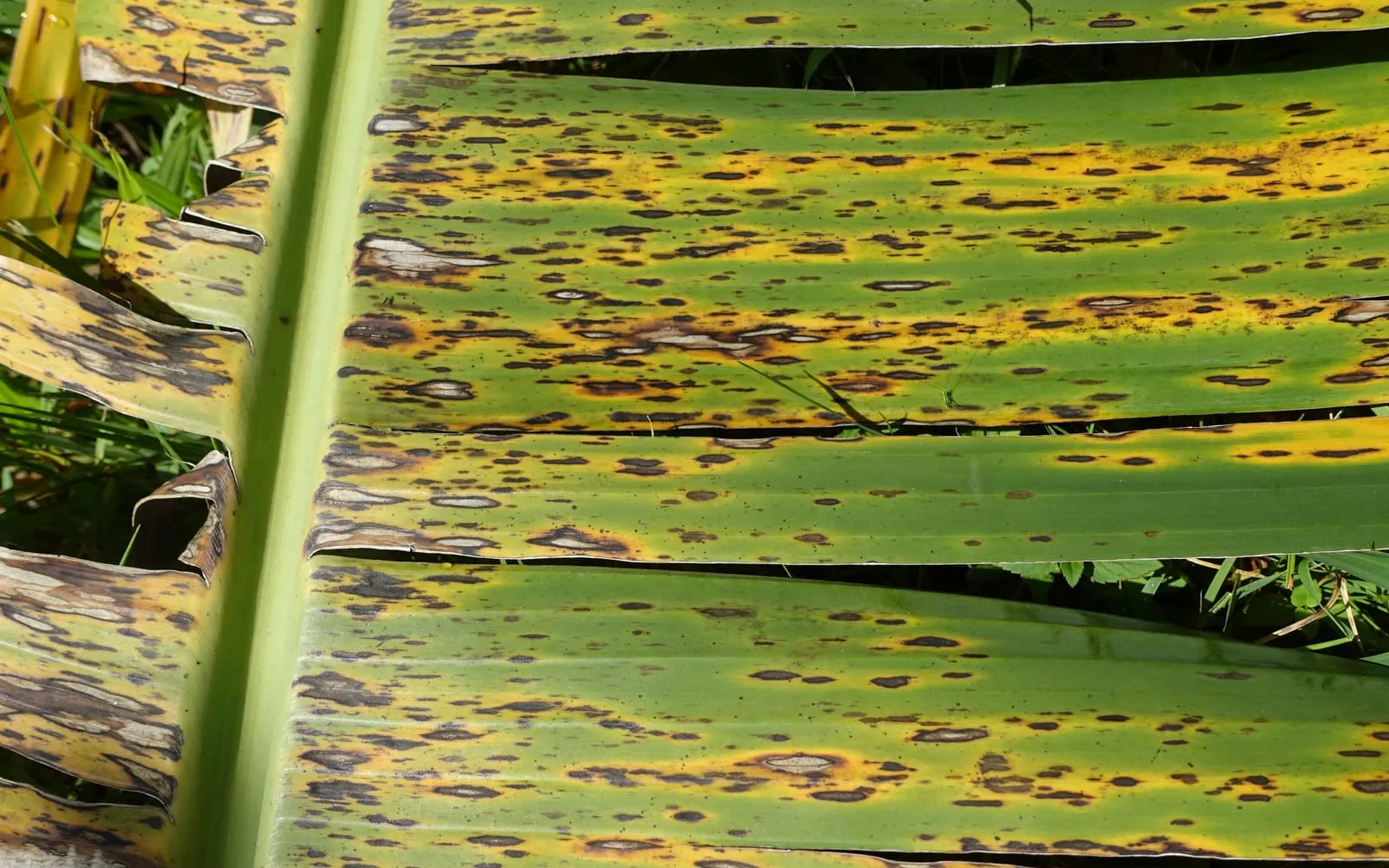
- Small, pale yellow to light green streaks appearing on the underside of younger leaves, running parallel to the leaf veins
- Streaks lengthening and darkening to brown and then black as they age, developing a yellow halo around each one
- Streaks coalescing into large, irregular dead patches that can destroy most of a leaf's functioning surface within weeks in warm humid weather
- Premature death of leaves from the oldest outward, leaving a plant with only its youngest few leaves still functioning by the time the fruit is filling
- Reduced bunch size, delayed and uneven ripening, and fruit that ripens prematurely and unevenly after harvest because the plant had too little healthy leaf area to fill it properly
What you are looking at
Small, pale yellow to light green streaks appearing on the underside of a banana plant’s younger leaves, running parallel to the leaf veins. Over the following days and weeks each streak lengthens and darkens, passing through brown to black and developing a yellow halo around it, and in warm humid conditions individual streaks coalesce into large, irregular dead patches that can destroy most of a leaf’s functioning surface within weeks.
Because the disease kills leaves from the oldest outward, a heavily affected plant can be left with only its youngest few leaves still working by the time its fruit is filling out, and a plant photosynthesising through a fraction of its normal leaf area produces a smaller bunch, ripens it more slowly and unevenly, and often continues ripening unevenly after harvest.
The most damaging leaf disease banana growers face
This fungus is endemic across nearly all of the world’s major banana and plantain-growing regions, having spread from its origin in South-East Asia and Fiji, the source of the disease’s common name, through repeated introductions since the 1960s. It reached the Americas in Honduras in 1972 and arrived in the Caribbean through two separate introductions, in 1990 and 2003, and continues moving along banana-growing corridors wherever infected leaf material travels. Global yield losses attributed to this single disease commonly exceed a third of production where it is present and uncontrolled, and the cost of controlling it, mostly through frequent fungicide spraying, can account for more than a quarter of a commercial plantation’s total production cost.
That cost structure is the disease’s real difficulty. Fungicide rotation works, but weekly or near-weekly application is only realistic for large commercial operations, and resistant fungal strains have already emerged in several regions under sustained spraying pressure. For the smallholder growers who produce a large share of the world’s banana and plantain crop, cultural measures and, where a suitable variety exists, resistance bred into the plant itself matter more than any spray programme. It has not been found in mainland Europe or North America, where banana is not grown commercially at meaningful scale, and Australia and New Zealand both maintain strict quarantine on banana planting material specifically because of diseases like this one.
What to do about it
Remove and destroy heavily infected leaves regularly, which reduces local spore load and is valuable wherever fungicide is unaffordable or unavailable.
Space plants at recommended density rather than crowding them, and improve field drainage, both of which reduce the humidity that favours infection and spread.
Use certified, disease-free planting material, since infected suckers moved between farms and regions are one of the main ways this disease has spread internationally.
Grow a resistant or tolerant variety where one suits the local market, particularly on a smallholding that cannot sustain a commercial spray programme.
Favour a resistant variety and leaf pruning over spraying wherever the market allows it, particularly on a smallholding. Reserve fungicide rotation on a monitored schedule for a commercial planting where those measures alone are not enough, checking current local resistance management guidance given how widely resistant strains have already developed under heavy spraying.
Not established in Australia and New Zealand
Do not prune, spray or otherwise treat a suspected case. Doing so risks spreading an organism the country has kept out, and it disturbs the evidence needed to identify it. Photograph what you can see, leave the plant alone, and contact your national or state plant health authority. The control advice further down this page is written for regions where this problem is already established.
Endemic across nearly all of the world's major banana and plantain growing regions in Africa, Asia, the Pacific and Central and South America, having spread from its origin in South-East Asia and Fiji, which gives the disease its common name, through repeated introductions since the 1960s. It reached the Americas in Honduras in 1972 and the Caribbean in two separate introductions, in 1990 and 2003, and continues spreading along banana-growing corridors as infected leaf material moves. It has not been found in mainland Europe or North America, where banana is not grown commercially at any meaningful scale, and Australia and New Zealand both maintain strict quarantine on banana planting material and treat a suspected find as reportable.
What to do, in order
The steps below apply where this problem is already established.
Nothing available to a gardener will cure this once a plant has it. The steps below are about limiting the spread and deciding what to plant in its place.
Start here
Prevention, and the changes that stop the problem returning. Most of these pages should end at this tier.
- Remove and destroy infected leaves and leaf debris regularly
- Removing heavily infected leaves as soon as they are found, known as leaf pruning or deleafing, reduces the amount of infectious spore material in and around a planting and is one of the most widely recommended non-chemical measures, particularly valuable where fungicide is unaffordable or unavailable.
- Space plants to improve airflow and reduce humidity within the canopy
- Dense plantings keep humidity high within the canopy for longer after rain or dew, favouring infection and spread, and standard recommended spacing rather than crowding for a higher plant count measurably slows disease development.
- Use certified, disease-free planting material
- Moving infected suckers or planting material between farms and regions is one of the main ways this disease has spread internationally since the 1960s, and starting from certified, inspected material remains central to keeping a currently unaffected area free of it.
Then reach for a barrier
Netting, hand removal and water. Nothing here harms anything except the target.
- Improve field drainage
- Standing water and waterlogged ground keep humidity elevated at the base of the canopy and stress the plant, both of which favour disease development, so drainage improvements that keep the root zone from staying wet support the crop's own resistance alongside direct disease control.
Then bring in the predators
Encourage what already lives in the garden, and buy predators in where the problem is under glass and nothing will arrive on its own.
- Grow a resistant or tolerant banana or plantain variety where available
- Because effective host resistance in the main export varieties is limited, breeding and screening for tolerant varieties remains an active area of work, and adopting a resistant variety where one suits the local market is the most sustainable long-term control available, particularly for smallholder growers who cannot sustain a commercial spray programme.Resistant varieties, including several from international breeding programmes, are grown in parts of Africa, Asia and Latin America; check what is recommended and available locally, since dessert banana varieties widely grown for export, including Cavendish, have limited natural resistance.
Biological controls are live organisms and their sale and release are regulated country by country. An agent sold freely in one place may be unapproved in another, so buy from a licensed supplier where you live and never import or move one yourself.
Plants affected
Guides that name it among the problems to watch for. The list is the plants it is characteristic of rather than everything it will feed on.