
Edible
Hyacinth Bean
Lablab purpureus
Also known as Lablab, Dolichos bean, Ruby Moon, Sem, Egyptian bean
How to grow hyacinth beans, Lablab purpureus. Purple pods on a garden climber, an African staple, and a bean that has to be boiled twice before anyone eats it.
At a glance
- Difficulty
- Moderate
- Water
- Moderate. Water through flowering and pod set
- Light
- Full sun
- Temperature
- 20-30 deg C, and frost kills it
- Hardiness
- USDA 10-11, RHS H1b, hardy to 5 C
- Type
- Perennial vine, grown as a tender annual where frost comes
- Height
- 200-600 cm
- Native to
- east Africa, India as a secondary centre
- Best month
- May, June and September in the Northern Hemisphere, November, December and March in the Southern Hemisphere
Perennial and long-lived where frost never comes, and grown as an annual everywhere else, with most traditional cultivars flowering only on short days. Raw beans of many types carry enough cyanogenic glycoside to be dangerous and need boiling in two changes of water. It has naturalised widely and is a weed in parts of Australia and the Pacific.
Hardiness zones describe winter cold alone. Summer heat, humidity, rainfall and the length of the growing season decide as much, so treat the range as the outer limit rather than as a recommendation.
Every month named in this guide is for the temperate Northern Hemisphere. If you garden in the Southern Hemisphere, shift each one by six months, so May becomes November. Closer to the equator the wet and dry seasons matter more than the calendar, and the shift stops being a useful guide.
Toxic if eaten
- Safe to eat
- The young pods and mature seed, both thoroughly cooked, and the young leaves cooked
- Do not eat
- Raw seed and raw pods, and the mature dry seed of dark-seeded varieties in particular
- Harm from
- Eating it
- Affects
- People, dogs, cats and horses
Hyacinth bean is eaten daily across India and east Africa and it is poisonous raw. The seed contains cyanogenic glycosides that release hydrogen cyanide when the tissue is damaged, along with the lectins and protease inhibitors common to pulses, and dark-seeded types carry more than pale ones. Poisoning from insufficiently cooked lablab is documented, with vomiting, breathlessness, weakness and convulsions in serious cases. The established preparation is to soak the dry seed for several hours, boil it in plenty of water, throw that water away, and boil it again in fresh water. Young pods are eaten in India and are cooked rather than eaten raw. The plant is sold as an ornamental climber under names such as Ruby Moon, and gardeners who grow it for the purple pods should know that those pods are not a salad vegetable. Keep the seed away from children, dogs and grazing animals.
Sources: RHS on potentially harmful garden plants, British Horse Society on poisonous plants
About
Hyacinth bean leads two lives. In east Africa and across India it is a staple pulse and a vegetable, grown for dry seed, green pods and leaves, and it has been farmed for thousands of years. In Europe and North America it is an ornamental climber sold for its purple flowers and glossy magenta pods.
The gap between those two lives is a safety problem. A gardener who buys Ruby Moon for the colour has bought a plant whose raw seed contains cyanogenic glycosides, and the pods that look so good on a trellis need boiling twice with the water discarded before anyone eats them.
As a plant it is generous. A single vine will cover four metres of support in a season, flower from August into October, fix its own nitrogen, and tolerate drought and poor soil while doing it. In the tropics it is also a major forage and cover crop.
Appearance and character
The vine twines vigorously, with stems that are often deep purple, carrying large trifoliate leaves whose leaflets are broad and pointed. In the ornamental varieties the purple runs through stems, leaf veins and pods alike.
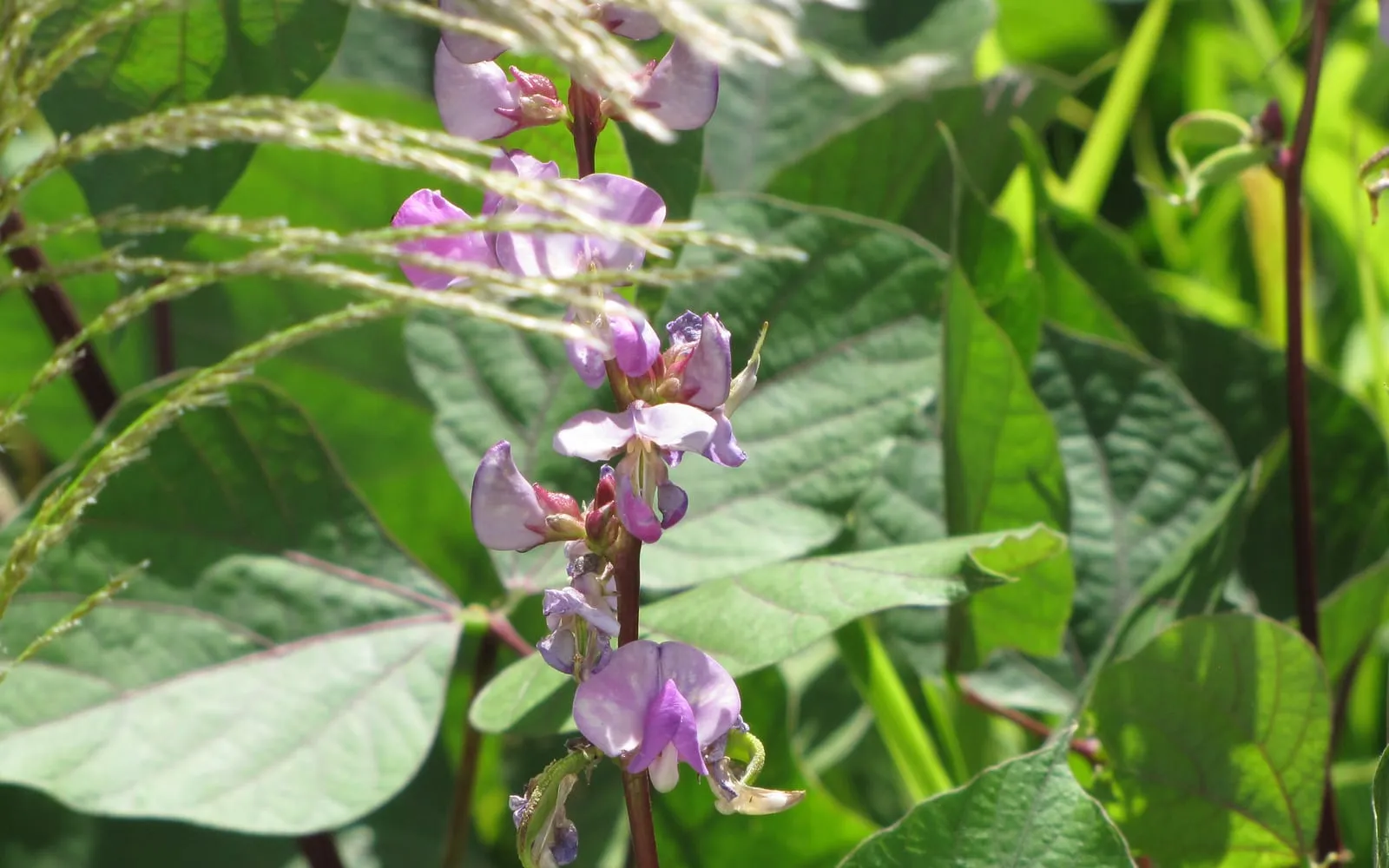
The flowers are carried in upright spikes standing clear of the foliage, which is unusual among beans and is where the hyacinth comparison comes from. They are typical pea flowers, purple, pink or white, and strongly scented in some varieties.
The pods are flat, curved, 5 to 15 cm long, with a distinct beak at the tip and a roughened edge. In ornamental varieties they are a glossy deep magenta that holds for weeks. Inside are three to six seeds, oval and flattened, with a conspicuous white ridge along the hilum that runs a third of the way round the seed.
Where it is from
Lablab was domesticated in east Africa, with the wild ancestor Lablab purpureus subspecies uncinatus growing across the region. Archaeological and genetic work places the domestication there, and India served as a strong secondary centre where a distinct set of varieties developed.
The crop reached India by around 1500 BC and became a significant pulse there, particularly in Karnataka and Tamil Nadu, where avarekai is a seasonal delicacy with its own festival.
It spread through the tropics as a food, a forage and a cover crop, reaching the Americas and south east Asia. European gardeners adopted it as an ornamental in the eighteenth century, and Thomas Jefferson grew it at Monticello, which is often cited in the American ornamental trade.
How it grows
Hyacinth bean germinates in warm soil and grows slowly for a few weeks before starting to climb. Once it is away it is fast, twining anticlockwise up any support it reaches and covering several metres in a season.
Nodules form on the roots and fix nitrogen, and the species associates with a broad range of rhizobia, so it nodulates readily on ground that has not grown it before.
Flowering is the difficulty at high latitude. Many cultivars are short-day plants that begin flowering only as nights lengthen in late summer, which leaves the pods racing the first frost. The ornamental cultivars sold in Europe generally flower from August, which works, and seed brought from India often does not.
Through the seasons
Sow indoors in April in deep pots, two seeds to a pot, at 18 to 20 deg C. Plant out at the end of May once frost has passed, against a trellis, an obelisk or a sunny wall, 45 cm apart.
Growth is slow in June and rapid through July, and the vine should be covering its support by the end of that month. Flower spikes appear in August and continue into October.
Harvest young pods in September for cooking, or leave the pods to dry on the vine for seed. The first frost blackens the whole plant, so collect what you want before the forecast turns.
Care difficulty
Easy to grow and easy to misuse. The vine establishes readily, climbs enthusiastically, fixes its own nitrogen and asks for little beyond warmth and a support.
The genuine difficulty is knowing what to do with what it produces. The pods are attractive and they are not a raw vegetable, and the dry seed requires soaking and two changes of boiling water. Anyone growing it as an ornamental should be clear about that before children start picking pods.
In a short season the vine will need its support up before it is planted out, since it grows faster than most people expect and a tangle on the ground is hard to unpick without breaking stems.
Watering
Water at planting and through establishment, then moderately. The plant is drought tolerant once its roots are down and does not want to be kept wet.
The period that repays watering is flowering and pod set in late summer, when drought causes flower spikes to abort.
In a container it needs far more, since a vigorous vine in a pot transpires heavily on a warm day. Waterlogging in open ground causes root rot, so free drainage matters.
Warning signs, diseases and pests
Aphids colonise the flower spikes, where the dense arrangement of buds makes them hard to dislodge and where their honeydew turns the whole spike sticky. A spike that has gone tacky and attracted ants is usually the sign.
Powdery mildew appears on the leaves late in the season as a white dusty coating, particularly on a plant grown against a wall where air movement is poor.
Red spider mite is a greenhouse problem, showing as fine pale speckling on the leaves and webbing at the growing tips in dry air.
Root rot follows waterlogging. Slugs take young plants. Frost is what ends the crop, blackening the entire vine in a single cold night, so watch the forecast from late September.
Growing environment
Full sun and warmth, with a substantial support. The plant will cover four to six metres in a good season, so a wigwam of canes is not enough and a trellis or an arch suits it better.
Soil should be free-draining and moderately fertile, at pH 5.5 to 7.5. The plant tolerates poor and dry ground and is used as a cover crop on exhausted soil in the tropics.
Shelter is worth arranging. A vine in full leaf carries a lot of wind, and an exposed trellis takes a beating in a September gale.
Feeding
Feed nothing in open ground. The plant fixes its own nitrogen, and fertiliser produces leaf at the expense of flower on a plant already inclined to grow.
In a container a high-potash feed every fortnight from the start of flowering helps, since a pot cannot supply what the roots would otherwise find.
Cut the vine at the base at the end of the season and leave the roots in the ground, so the nitrogen in the nodules stays where the next crop can use it.
Troubleshooting
Can I eat the purple pods? Only cooked, and never raw. Young pods are eaten across India after cooking. Raw pods and raw seed contain cyanogenic glycosides, and the ornamental cultivars sold in garden centres are the same species as the crop.
How do I prepare the dry seed? Soak it for several hours, boil it in plenty of water, throw that water away, then boil it again in fresh water until soft. Dark-seeded varieties carry more of the compounds than pale ones.
Is Ruby Moon a different plant? No. Ruby Moon is an ornamental selection of Lablab purpureus, the same species grown as a staple pulse in India and east Africa, and it carries the same preparation requirements.
Why has my plant not flowered? Day length. Many lablab varieties are short-day plants that begin flowering as nights lengthen, and seed brought from the tropics often flowers too late for a cool autumn. The ornamental cultivars sold in Europe generally flower from August.
How big does it get? Four to six metres in a season from a spring sowing. Give it a trellis or an arch rather than a wigwam, and put the support up before you plant.
Will it survive the winter? No. It is a perennial in the tropics and a tender annual here, and the first frost blackens the whole vine in a night.
Are the leaves edible? Young leaves are cooked and eaten in parts of Africa and Asia. Cook them rather than using them raw, as with every part of this plant.
Is it safe around pets? Keep the seed away from dogs, and keep the plant away from grazing animals. The cyanogenic glycosides that make raw seed dangerous to people apply to animals as well.
Hyacinth Bean problem guides
Not sure what is wrong? See the common vegetable pests guide.