
Disease
Panama disease
Fusarium oxysporum f. sp. cubense
Also called Fusarium wilt of banana, TR4, Tropical Race 4
Yellowing leaves collapsing one after another around a splitting pseudostem, caused by a soil fungus with no cure and no way back once it is in the ground. The original strain wiped the Gros Michel banana off supermarket shelves in the twentieth century; a new strain, Tropical Race 4, is doing the same to Cavendish, the variety that replaced it.
At a glance
- Type
- Disease
- Cause
- Fungus
- Severity
- Can kill the plant
- Affects
- Herbs and edibles
- Active
- All year
- Established in
- Asia, Africa, Australia and Central and South America
What you are seeing
- Yellowing starting on the oldest, lowest leaves and progressing upward, with leaves collapsing and hanging down around the pseudostem
- A pseudostem that splits vertically at the base as internal tissue collapses
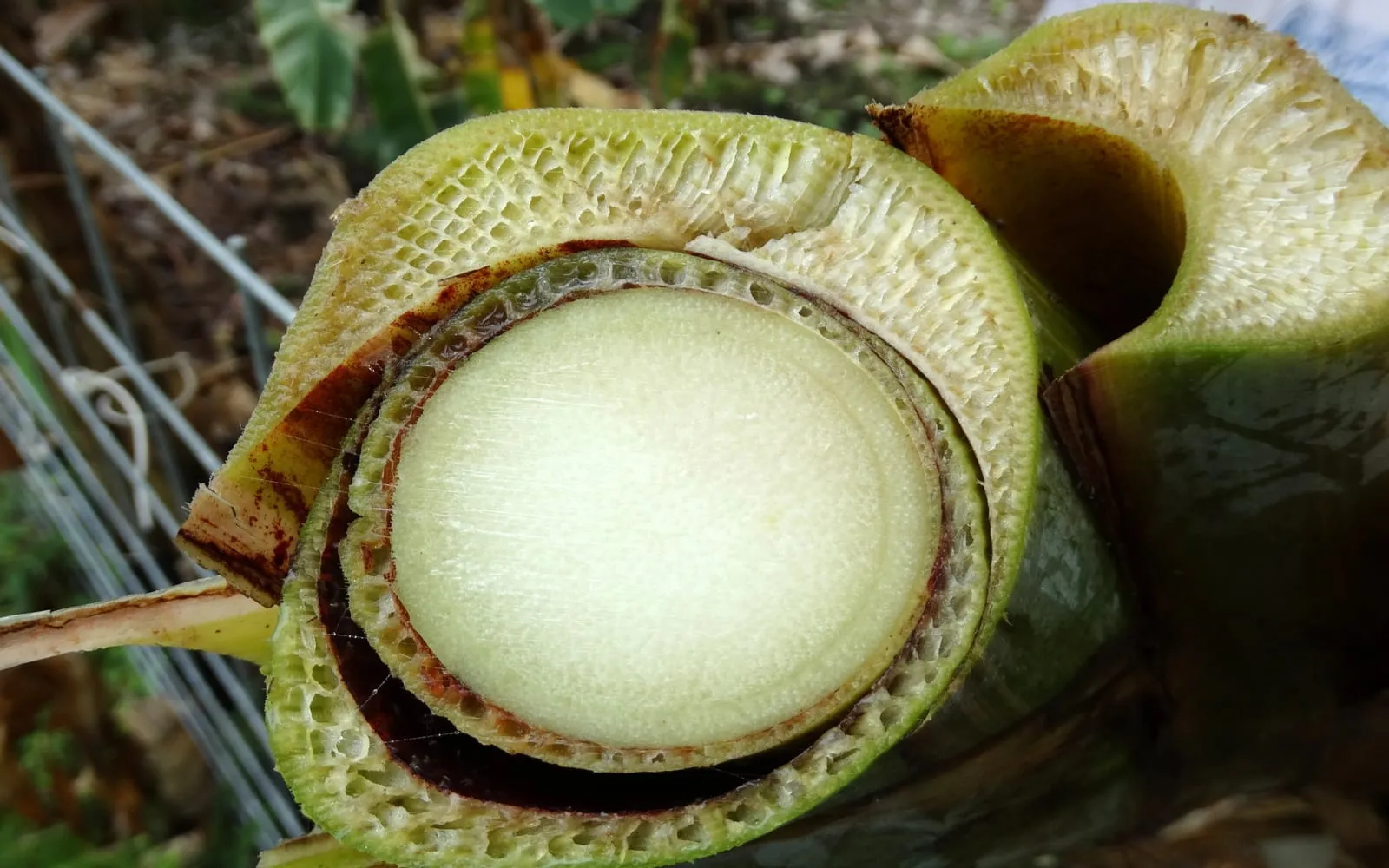
- Brown or reddish-brown discolouration of the vascular tissue, visible as streaking when the pseudostem is cut across
- Stunted, distorted new growth on a severely affected plant, sometimes with no fruit produced at all
- Symptoms appearing first in isolated plants within a plantation, then spreading outward in an expanding patch over successive growing cycles
- No recovery once symptoms appear, and death of the mat within one to a few growing cycles
Before you treat anything
None. This disease affects the plant's survival rather than the safety of any fruit harvested before symptoms appear.
What you are looking at
Yellowing that starts on the oldest, lowest leaves of a banana plant and works its way upward, each leaf collapsing and hanging down around the pseudostem as it dies. The pseudostem itself often splits vertically near the base as the internal tissue collapses, and cutting across it reveals brown or reddish-brown streaking through the vascular tissue, the clearest single diagnostic sign. New growth on a badly affected plant is stunted and distorted, sometimes producing no fruit at all, and there is no recovery once symptoms are visible. Within a plantation, the disease typically starts in isolated plants and spreads outward in an expanding patch over successive growing cycles.
One fungus, two crises a century apart
This fungus has already reshaped the global banana trade once, and current events suggest it may do so again. An older strain, known as Race 1, spread through Central American plantations in the early twentieth century and proved so destructive to Gros Michel, the dominant export banana of the time, that growers abandoned it commercially in favour of Cavendish, which resisted that strain. Cavendish has been the banana sold in most of the world’s supermarkets ever since, propagated as a genetically uniform clone across enormous monoculture plantations.
A newer strain, Tropical Race 4, attacks Cavendish just as effectively as Race 1 attacked Gros Michel, along with most other cultivars. First identified in Southeast Asia around 1992, it has since reached the Middle East, parts of sub-Saharan Africa, the Northern Territory and Far North Queensland in Australia, and Latin America, confirmed in Colombia in 2019, Peru in 2021 and Venezuela in 2023. The major Central American and Ecuadorian export belt supplying most of Europe and North America’s bananas remains free of it for now, and losing that fight would be a considerably larger crisis than the one Gros Michel growers faced last time, given how much of world banana production depends on a single susceptible variety today.
What to do about it
Plant only certified, disease-free tissue-culture material, since infected planting stock is a primary route the fungus travels by.
Practise strict biosecurity on tools, footwear, vehicles and irrigation water moving between plantings, particularly where entering from or travelling toward an area of unknown status.
Destroy a confirmed infected planting in place rather than moving material off site, and abandon that ground for banana growing indefinitely; there is no way to clear the fungus from infested soil.
Grow a resistant or tolerant cultivar where Tropical Race 4 is already present, accepting the trade-offs against Cavendish’s yield and market familiarity.
Report a suspected finding in an area currently free of the disease immediately rather than treating it as routine crop failure.
What it gets mistaken for
Frost blackens and collapses banana foliage overnight, uniformly and tied to a specific cold event, without the internal vascular streaking this disease produces.
Root and collar rot follows waterlogged soil and softens roots and the stem base without the reddish-brown streaking inside the pseudostem that marks this disease specifically; cutting across the stem is the fastest way to tell the two apart.
Not established in North America, New Zealand and Pacific Islands
Do not prune, spray or otherwise treat a suspected case. Doing so risks spreading an organism the country has kept out, and it disturbs the evidence needed to identify it. Photograph what you can see, leave the plant alone, and contact your national or state plant health authority. The control advice further down this page is written for regions where this problem is already established.
An older strain of this fungus, Race 1, is already effectively worldwide and is the reason Gros Michel, the dominant export banana of the early twentieth century, was abandoned commercially in favour of the Cavendish, which resisted it. A newer and far more aggressive strain, Tropical Race 4, attacks Cavendish and nearly every other banana cultivar as well, and its spread is the live emergency this page tracks. First identified in Southeast Asia around 1992, TR4 has since reached the Middle East, sub-Saharan Africa, the Northern Territory and Far North Queensland in Australia, and Latin America, confirmed in Colombia in 2019, Peru in 2021 and Venezuela in 2023. The major Central American and Ecuadorian export belt, the source of most bananas sold in Europe and North America, remains free of it for now, as do the Caribbean, the Pacific islands and New Zealand, all of which treat a suspected finding as a reportable emergency given that there is no way to remove the fungus from infested soil once it arrives.
What to do, in order
The steps below apply where this problem is already established.
Nothing available to a gardener will cure this once a plant has it. The steps below are about limiting the spread and deciding what to plant in its place.
Start here
Prevention, and the changes that stop the problem returning. Most of these pages should end at this tier.
- Plant only certified, disease-free tissue-culture plants
- Infected planting material is one of the main ways this fungus spreads into new areas, since the pathogen travels with the plant itself as well as in soil. Certified tissue-culture plants, grown under conditions that exclude the fungus, are the standard safeguard everywhere the disease is a live concern.
- Practise strict farm biosecurity on tools, footwear and vehicles
- Spores travel in contaminated soil clinging to boots, tools, vehicle tyres and irrigation water, and a single introduction can establish permanently, since the fungus survives in soil for decades even without a host present. Cleaning and disinfecting anything moving between plantings, and restricting movement into and out of an infected area entirely, is standard practice in affected regions.
- Destroy and quarantine an infected planting rather than attempting to save it
- There is no cure and no way to clear the fungus from infested soil. The standard response to a confirmed infection is destroying affected plants in place, without moving infected material off site, and abandoning that ground for banana cultivation indefinitely rather than replanting and hoping.
- Grow a resistant or tolerant cultivar where TR4 is present
- Several banana cultivars and hybrids show useful resistance or tolerance to Tropical Race 4, and breeding programmes are actively working on Cavendish-type replacements, though none yet matches Cavendish for yield, shipping quality and market acceptance at commercial scale.
Then reach for a barrier
Netting, hand removal and water. Nothing here harms anything except the target.
- Improve field drainage and avoid moving water between plantings
- Flood irrigation and standing water both help spread fungal spores through a plantation and between neighbouring ones. Drip irrigation and good drainage reduce how far and how fast an initial introduction spreads.
Then bring in the predators
Encourage what already lives in the garden, and buy predators in where the problem is under glass and nothing will arrive on its own.
- Rely on resistant planting material rather than a biological treatment
- No biological control has proven effective against this fungus once established in field soil. Resistant cultivars and strict exclusion remain the only practical strategies, which is why so much current research effort goes into breeding rather than treatment.
Biological controls are live organisms and their sale and release are regulated country by country. An agent sold freely in one place may be unapproved in another, so buy from a licensed supplier where you live and never import or move one yourself.
Plants affected
Guides that name it among the problems to watch for. The list is the plants it is characteristic of rather than everything it will feed on.