
Pest
Coconut rhinoceros beetle
Oryctes rhinoceros
Also called CRB
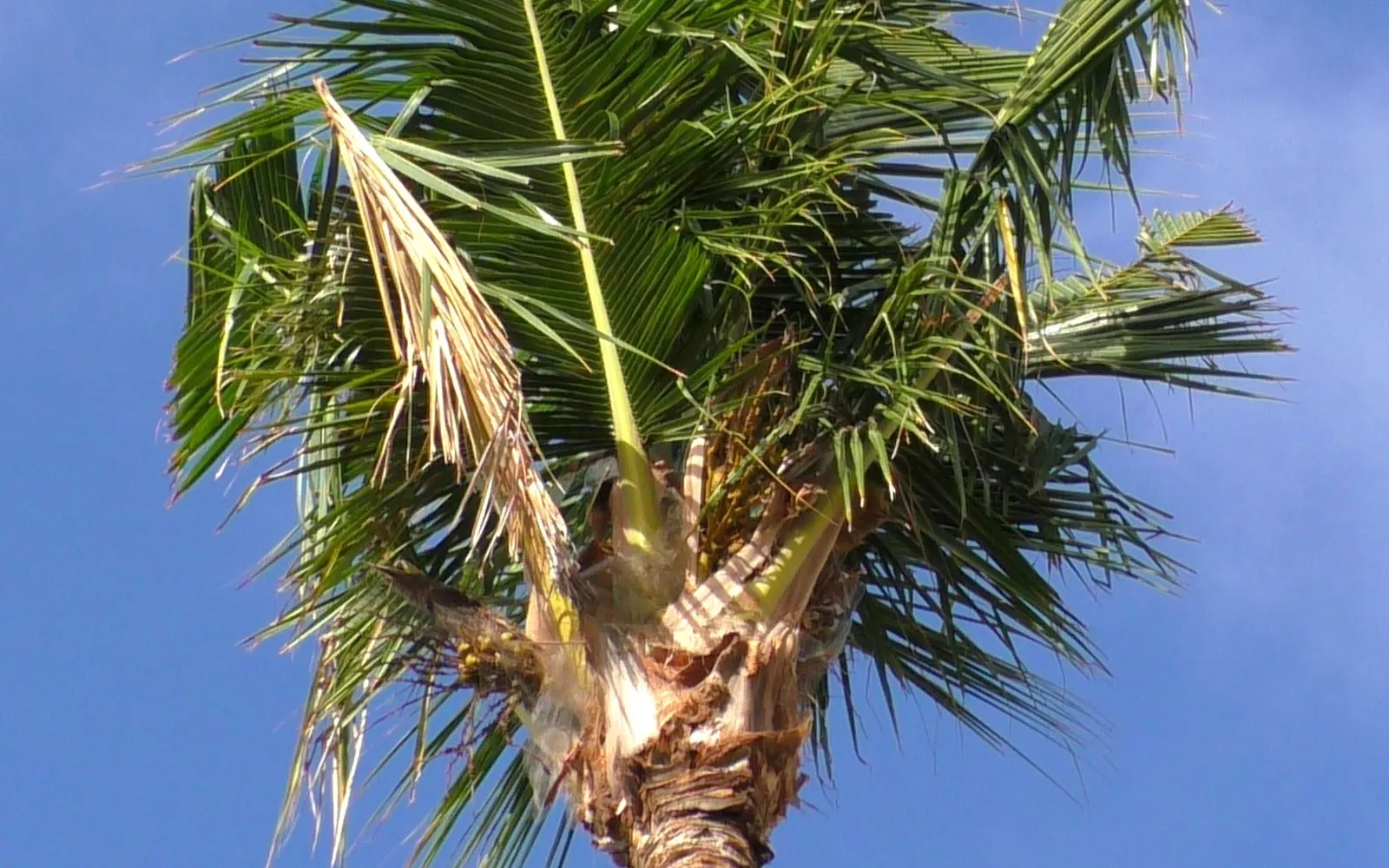
A row of clean, scalloped triangular holes running across an unfurled frond, cut by a large horned beetle while the leaf was still folded inside the crown. Native to Africa and tropical Asia, an increasingly serious invader of Pacific islands including Guam and Hawaii, and a threat to more than just coconut.
At a glance
- Type
- Pest
- Cause
- Insect
- Severity
- Destroys the crop or display
- Affects
- Herbs and edibles
- Active
- All year
- Established in
- Africa, Asia and Pacific Islands
What you are seeing
- Clean, V-shaped or triangular cuts with smooth, scalloped edges running in a row across an unfurled frond, formed while the leaf was still folded and damaged inside the crown weeks or months earlier
- Large bore holes, sometimes several centimetres across, at the base of fronds or in the crown itself, occasionally with fibrous chewed material pushed out
- A ragged, thinning crown as repeated attacks damage successive new fronds before they can unfurl properly
- Reduced coconut yield and, in young or repeatedly attacked palms, death of the growing point
- Large, black, heavily armoured beetles 3 to 5 cm long, with a single prominent curved horn on the head, occasionally found in the crown or breeding in rotting logs and compost heaps nearby
- Damage extending beyond coconut to banana, sugar cane, sisal and pineapple where those crops grow near an active population
Before you treat anything
None beyond general care handling a large biting beetle. The pest affects the palm rather than the safety of any fruit produced.
What you are looking at
A frond that unfurls with a row of clean, V-shaped or triangular cuts running across it, edges smooth and scalloped rather than torn. The damage looks fresh but was done weeks or months earlier, while the leaf was still tightly folded inside the crown and the beetle bored through several layers of young tissue at once. Look at the crown itself and there may be large bore holes, sometimes several centimetres across, with fibrous chewed material pushed out of them.
Repeated attacks on successive new fronds leave the crown looking ragged and thin, cut coconut yield noticeably, and in young or heavily attacked palms can kill the growing point outright. The beetle responsible is hard to mistake for anything else once seen: large, black, heavily armoured, 3 to 5 cm long, with a single prominent curved horn projecting from the head.
A long-standing Pacific invader still gaining ground
Native to Africa and tropical Asia, from India and Myanmar through Southeast Asia and southern China, this beetle has a long history of spreading through Pacific island nations over the twentieth century and continues adding new territory today. It reached Guam in 2007 and had spread across the whole island within five years, and it turned up on Oahu in Hawaii in 2013, where containment efforts continue rather than treating it as an accepted, permanent resident of the state.
It has not reached the North American mainland, mainland Europe, Australia or New Zealand, and all three treat a find as a serious biosecurity concern given the scale of damage already done to Pacific coconut production.
What to do about it
Remove and properly destroy rotting logs, decaying palm trunks and untended compost heaps near palms, since these are where adults breed.
Clean debris out of the crown regularly and check for fresh bore holes.
Hook adult beetles out of fresh bore holes with a stiff wire where an individual valuable palm is affected.
Set pheromone traps to monitor and reduce local adult numbers, particularly useful for tracking a new incursion.
Support coordinated regional biological control programmes using Oryctes rhinoceros nudivirus where these are already established, rather than expecting an individual planting to control the pest alone.
What it gets mistaken for
Mammal browsing tears or shreds leaf tissue unevenly rather than leaving the clean, symmetrical, scalloped cuts this beetle produces by feeding through a tightly folded young leaf in a single, precise bout.
Not established in North America, Australia and New Zealand
Do not prune, spray or otherwise treat a suspected case. Doing so risks spreading an organism the country has kept out, and it disturbs the evidence needed to identify it. Photograph what you can see, leave the plant alone, and contact your national or state plant health authority. The control advice further down this page is written for regions where this problem is already established.
Native to Africa and tropical and subtropical Asia, from India and Myanmar through Southeast Asia and southern China. It has a long history of invading Pacific islands, having spread through much of the region over the twentieth century, and continues to establish new footholds: Guam in 2007, spreading island-wide within five years, and the Hawaiian island of Oahu in 2013, where it remains under active containment rather than accepted as established across the state. It has not reached the North American mainland, mainland Europe, Australia or New Zealand, and all treat a find as a serious biosecurity matter given how much damage it has done to coconut production across the Pacific already.
What to do, in order
The steps below apply where this problem is already established.
Start here
Prevention, and the changes that stop the problem returning. Most of these pages should end at this tier.
- Remove and destroy breeding sites
- Adults lay eggs in rotting logs, decaying palm trunks, compost heaps and other decomposing organic matter, where the grubs develop for several months before emerging as adults. Clearing and properly composting or destroying such material, rather than leaving stacked logs or untended green waste near palms, removes the beetle's main breeding habitat.
- Inspect and clean the crown of the palm regularly
- Removing debris that accumulates in the crown, where it can rot and attract egg-laying females, and checking for early bore holes gives a chance to intervene, physically or with a targeted product, before the growing point is seriously damaged.
Then reach for a barrier
Netting, hand removal and water. Nothing here harms anything except the target.
- Hook out adult beetles from bore holes
- A stiff wire hooked into a fresh bore hole can physically remove an adult beetle lodged inside, a low-tech control still used on individual valuable palms in affected areas.
- Use pheromone traps to monitor and reduce local populations
- Aggregation pheromone traps draw in and capture adults, giving early warning of local activity and removing some of the population directly, particularly useful where a new incursion is being tracked and contained.
Then bring in the predators
Encourage what already lives in the garden, and buy predators in where the problem is under glass and nothing will arrive on its own.
- Support release of Oryctes rhinoceros nudivirus where available
- This virus, introduced into beetle populations deliberately, has reduced palm damage by a large margin in many Pacific island programmes by infecting and weakening or killing adults and larvae, though its effectiveness varies by the beetle population involved and needs coordinated, area-wide application to work.Used in coordinated biological control programmes across parts of the Pacific; not something an individual buys or releases independently, and some regional beetle populations, including those on Guam, have shown resistance to strains that work well elsewhere.
Biological controls are live organisms and their sale and release are regulated country by country. An agent sold freely in one place may be unapproved in another, so buy from a licensed supplier where you live and never import or move one yourself.
Plants affected
Guides that name it among the problems to watch for. The list is the plants it is characteristic of rather than everything it will feed on.