
Edible
Sweet Marjoram
Origanum majorana
Also known as Knotted marjoram, Marjoram
How to grow sweet marjoram, Origanum majorana. Why it is a tender annual wherever frost comes, telling it from oregano, and the knotted flower buds that give it its other name.
At a glance
- Difficulty
- Moderate
- Water
- When the soil is dry 3 cm down, which is rarely in a cool summer
- Light
- Full sun, and it needs all of it
- Temperature
- Damaged below about 0 deg C and killed by a hard frost
- Hardiness
- USDA 9-11, RHS H2, hardy to 0 C
- Type
- Tender perennial, grown as a half-hardy annual where frost comes
- Height
- 20-45 cm
- Native to
- the Mediterranean, western Asia
- Best month
- April and May in the Northern Hemisphere, October and November in the Southern Hemisphere
The sweetest and the tenderest of the group, damaged by a light frost and killed by a hard one, so it is grown as an annual anywhere with a winter. Its oil is dominated by sabinene hydrate rather than carvacrol, which is why it tastes of flowers where oregano tastes of pepper.
Hardiness zones describe winter cold alone. Summer heat, humidity, rainfall and the length of the growing season decide as much, so treat the range as the outer limit rather than as a recommendation.
Every month named in this guide is for the temperate Northern Hemisphere. If you garden in the Southern Hemisphere, shift each one by six months, so April becomes October. Closer to the equator the wet and dry seasons matter more than the calendar, and the shift stops being a useful guide.
Not known to be toxic
- Safe to eat
- Leaves and flowering tops
Non-toxic. Sweet marjoram is a culinary herb with a long record of safe use, it does not appear on the RHS list of potentially harmful garden plants, and the ASPCA lists the closely related oregano, Origanum vulgare, as causing no more than vomiting and diarrhoea in a dog or cat that eats a large quantity of it. Nothing here needs avoiding in the kitchen. As with every aromatic member of the mint family, the distilled essential oil is a separate matter: it is concentrated, it irritates skin undiluted and it should not be given to pets. The herb is food and the oil is not.
Sources: RHS potentially harmful garden plants, ASPCA toxic and non-toxic plants
About
Sweet marjoram is the gentler cousin of oregano, and in a cool climate it is an annual whether you intend it to be or not. It comes from the eastern Mediterranean, it will not survive a wet winter, and gardeners who treat it as a hardy perennial lose it in its first February.
The flavour is worth the trouble. Where oregano is peppery and slightly bitter, sweet marjoram is soft, floral and sweet, and it is the herb for eggs, mushrooms, buttered vegetables and anything you would spoil with something stronger. Heat destroys it, so it goes in at the end of cooking rather than the beginning.
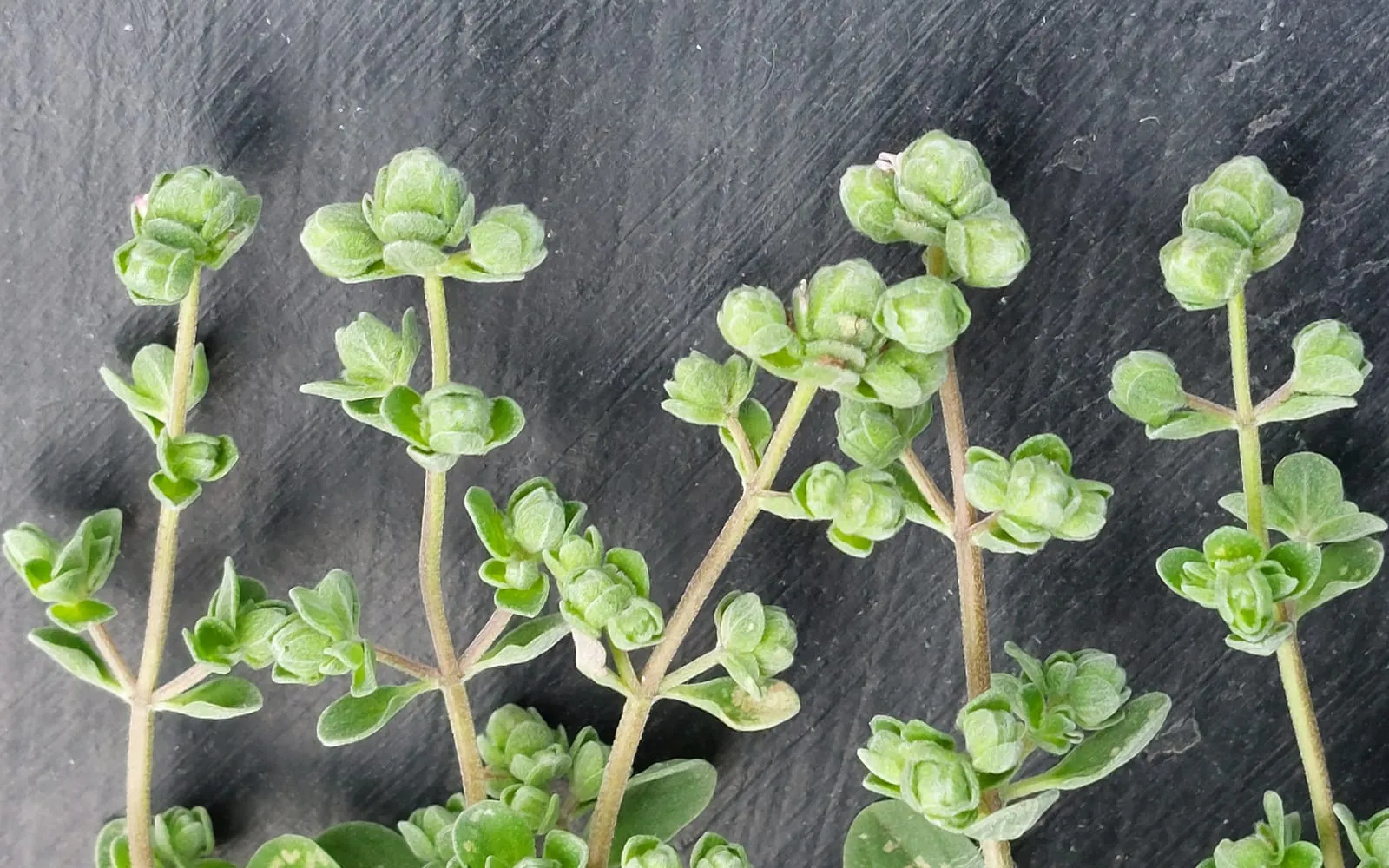
The other name, knotted marjoram, describes the flower buds. They gather into tight grey-green knots before opening, and no other herb in the garden does that.
Appearance and character
A low bushy mound, 20 to 45 cm, becoming woody at the base as the season goes on.
Leaves are small, oval, soft and velvety, grey-green rather than the true green of oregano, and they feel slightly furry between the fingers.
Flower buds gather into tight rounded knots at the shoot tips, each knot made of overlapping green bracts. Small white flowers push out of them from July.
Stems are square and thin, reddish where the sun catches them.
The scent is sweet and warm with a faint pine note, and it is much less harsh than oregano’s. Rub a leaf of each and the difference is obvious.
The whole plant is smaller, softer and greyer than oregano, and that combination separates the two reliably in a garden centre where the labels have been swapped, which happens often.
Where it is from
Sweet marjoram is native to Cyprus, southern Turkey and the eastern Mediterranean, on dry rocky hillsides and thin limestone soils.
Egypt grew it early and used it in embalming as well as cooking. The Greeks associated it with Aphrodite and planted it on graves, and a marjoram growing well on a burial was read as a sign the dead were content.
It came to Britain in the sixteenth century as a strewing herb, scattered on floors so that walking on it released the scent. Gerard’s Herball describes it as growing in gardens rather than wild.
Egypt still grows a large part of the world crop, along with France and Germany. Most dried marjoram sold in Europe is Egyptian.
The confusion with oregano is old and commercial. Dried oregano is often sold as marjoram and vice versa, and in North America the two names have been swapped for so long that a recipe calling for marjoram may well mean oregano.
How it grows
Sow indoors in March or April, in gentle warmth. The seed is very fine, so scatter it on the surface of moist compost, press it down and do not cover it, because it needs light to germinate.
Germination takes two weeks at around 18 deg C and the seedlings are tiny and slow for the first month. Do not rush them outside.
Prick out into small pots, grow on frost free, and plant out at the end of May once the nights are reliably above 8 deg C. A cold spell in early May checks the plants for weeks.
Space at 20 to 25 cm in a sunny bed with free-draining soil, or grow three plants in a 25 cm terracotta pot.
Pinch the tips at 10 cm to make it bush out. A single unpinched stem gives you a fraction of the leaf.
Harvest from July. Cut whole shoots rather than picking leaves, taking no more than a third of the plant at a time.
Treat it as an annual. A plant can be lifted and overwintered in a frost-free greenhouse, and few people find the result worth the space.
Through the seasons
Winter is when the plant dies, and there is no point pretending otherwise outdoors. Clear the bed and sow again in spring.
Spring is sowing time, indoors from March. Harden off through the second half of May.
Early summer is planting out and pinching. Growth is slow until the soil warms, then it accelerates through June.
Midsummer brings the knotted buds and then the flowers. Cut the plant back by a third as the buds form if you want leaf rather than flower, and harvest heavily from July.
Late summer is the time to cut a batch for drying. Sweet marjoram dries better than most herbs and keeps its scent for a year.
Autumn finishes it. The first real frost blackens the plant. Pull it out and compost it.
Care difficulty
Moderate, and the difficulty is climate rather than culture.
Cool summers are marginal for it. Sweet marjoram wants heat, sun and dry air, and a cool wet July gives a plant that sits still and rots at the base.
Drainage is the thing to get right. In heavy soil it will not last the season. Add grit, plant on a slight ridge, or grow it in a pot, which is the reliable answer here.
The seed is small and the seedlings are slow, so give them a proper start indoors rather than sowing direct. Direct-sown marjoram in cool ground rarely amounts to anything.
Once it is in and growing it asks for very little. No feeding, minimal watering, no staking and no pest of consequence.
The one certainty is the ending. It dies in the autumn, and planning around that is easier than fighting it.
Watering
Water sparingly. Sweet marjoram comes from thin dry limestone and the commonest way to kill it is kindness.
Water a bed only in a genuine dry spell, and then soak it thoroughly and leave it alone for a fortnight.
Water a pot when the compost is dry 3 cm down, which is every few days in July and once a week in a dull August.
Water in the morning at the base of the plant, so the foliage is dry by night. Wet leaves overnight in a crowded pot bring on grey mould.
Never let it stand in a saucer. Roots in cold standing water rot within days, and the first sign is a whole shoot wilting while the rest looks fine.
Cut watering back in September. A plant kept lush into autumn goes down to mould before the frost gets it.
Warning signs, diseases and pests
Root rot is the main killer, and cold wet soil is the cause. A plant wilts on a mild day, the base of the stem goes brown and soft, and it collapses. There is no treatment. Improve the drainage before replanting, or grow in a pot.
Grey mould covers dead flower knots and crowded stems in a wet summer with a fuzzy grey growth. Thin the plant, cut out affected shoots and improve airflow.
Aphids gather on the flowering tips in June. Rub them off.
Frost ends the plant. A light frost browns the tips, a hard one turns the whole plant black overnight.
Slugs take seedlings and young plants, and they will clear a newly planted row in one night in June.
Leggy pale growth with widely spaced leaves means too little light. Marjoram needs full sun and does not compromise.
A plant that is all flower and no leaf has not been cut back. Take a third off as the buds form.
Growing environment
Full sun. The most sheltered, warmest, sunniest spot you have is the right one, and a south-facing wall improves the plant noticeably.
Free-draining soil, and the poorer the better. Rich ground gives you soft growth with less scent, and it rots sooner.
Neutral to alkaline, around pH 7 to 8. Marjoram is a limestone plant and it grows happily on chalk.
A terracotta pot is the reliable option in a damp climate, because it dries faster than plastic and can be moved to follow the sun.
Shelter matters. Wind on a cool day sets the plant back, and an exposed site gives you a small plant that sits still all summer.
A greenhouse or conservatory gives you a much better plant than the open garden, and it will crop from June to October under glass.
Feeding
Do not feed it in the ground. Sweet marjoram grown lean is more aromatic than sweet marjoram grown fat, and fertiliser costs you the flavour you planted it for.
Feed a pot lightly, because compost in a container runs out. A half-strength balanced liquid feed once a month from June is plenty.
Add no nitrogen beyond that. Soft green growth is more vulnerable to mould, to aphids and to the first cold night.
Work grit rather than compost into heavy ground before planting. Drainage does more for this plant than nutrition ever will.
Use fresh compost each year rather than feeding an old pot harder.
Troubleshooting
It died over winter. It was always going to. Sweet marjoram is a tender perennial treated as an annual wherever frost comes. Sow again in March.
Is this marjoram or oregano? Marjoram has soft grey-green velvety leaves, tight knotted flower buds and a sweet scent. Oregano has firmer green leaves, open flower heads and a sharp peppery scent. If the label is wrong, trust the leaf.
A shoot wilted while the rest looked healthy. Root rot at the base of that stem. Cut it out and check the drainage. It usually takes the rest of the plant within a fortnight.
It has gone leggy and pale. Not enough sun. There is no fix beyond moving it, and a pot makes that possible.
The flavour is weak. Too much water, too much feed, too little sun, or picked after flowering. Cut the plant back and take the regrowth.
It flowered and stopped growing. Cut it back by a third. It will branch and crop again.
Can I dry it? Yes, and it is one of the best herbs for it. Cut whole stems just before the flowers open, hang them in a dry airy place out of the sun, and strip the leaves once brittle.