
Edible
Almond
Prunus dulcis
Also known as Sweet almond, Prunus amygdalus
How to grow almond, Prunus dulcis. Why it blossoms in February and rarely sets nuts in a cool damp spring, peach leaf curl, and the difference between sweet and bitter kernels.
At a glance
- Difficulty
- Difficult
- Water
- Weekly through summer while the crop swells
- Light
- Full sun, and against a south wall in a cool climate
- Temperature
- Wood hardy to -15 deg C. The February blossom is destroyed at -2 deg C
- Hardiness
- USDA 7-9, RHS H5, hardy to -20 C
- Type
- Deciduous tree, living 50 years or more
- Height
- 4-8 m, or 2 m fan-trained
- Native to
- Western and central Asia
- Best month
- March in the Northern Hemisphere, September in the Southern Hemisphere
Almond needs only 200 to 500 chill hours and flowers earlier than any other Prunus, so it sets a crop reliably in dry Mediterranean and continental climates and hardly ever in maritime ones. Wet spring air brings peach leaf curl and rots the nuts in the shell, so the requirement is a dry spring rather than a mild one.
Hardiness zones describe winter cold alone. Summer heat, humidity, rainfall and the length of the growing season decide as much, so treat the range as the outer limit rather than as a recommendation.
Every month named in this guide is for the temperate Northern Hemisphere. If you garden in the Southern Hemisphere, shift each one by six months, so March becomes September. Closer to the equator the wet and dry seasons matter more than the calendar, and the shift stops being a useful guide.
Poisonous if eaten
- Safe to eat
- The ripe kernel of a sweet almond variety
- Do not eat
- Bitter kernels, and the leaves, twigs and bark
- Harm from
- Eating it
- Affects
- People, cats, dogs and horses
Sweet almonds are food. Bitter almonds are a poison, and the difference is a single gene rather than anything you can see. Bitter kernels contain amygdalin, which the body converts to hydrogen cyanide, at concentrations roughly forty times higher than in a sweet almond. Estimates put a lethal adult dose at around fifty raw bitter kernels and a lethal dose for a child at closer to ten, and serious poisoning has followed far smaller quantities. Named varieties sold for eating are sweet-kernelled and safe. The risk sits with seedling trees, wild trees and trees of unknown origin, any of which may carry bitter kernels, and with imported bitter almonds sold for flavouring, which must be cooked or processed before use because heat drives off the cyanide. Taste is the practical test and it is a reliable one, since a bitter kernel is intensely, unmistakably bitter; spit it out rather than swallowing. Do not let children eat kernels from a tree whose variety you do not know. The rest of the tree carries the same cyanogenic chemistry as every Prunus, so leaves, twigs and bark are toxic to grazing animals and wilted foliage is the most dangerous of all, since cyanide release rises sharply as the leaf dies. Never leave prunings where horses, cattle or goats can reach them. The RHS lists Prunus species among plants harmful if eaten, and the ASPCA lists almond as toxic to cats, dogs and horses.
Sources: RHS potentially harmful garden plants, ASPCA toxic and non-toxic plants
About
An almond will grow perfectly well in a cool maritime climate and will hardly ever give you almonds. The tree is hardy enough, but it flowers in February, which is a month with frost in it and almost no flying insects, and a crop needs both to be absent and present respectively.
That leaves most almond trees in cool climates as ornamentals, and they are lovely ones. Pink-white blossom on bare black wood in late winter is worth the space on its own, and it comes weeks before anything else in the garden.
If you want nuts, grow a fan against a warm south wall, choose a variety chosen for self-fertility, a paintbrush for hand pollination, and fleece over the blossom on frosty nights. That combination works at the mild end of a maritime climate and is optimistic beyond it.
The other thing to know is peach leaf curl. Almond is in the same group as peach and gets it just as badly.
Appearance and character
A small deciduous tree, 4 to 8 m free-standing, with an open habit and ascending branches. Fan-trained against a wall it holds at about 2 m.
Bark is dark grey and smooth on young wood, cracking into small plates with age.
Leaves are long, narrow and finely toothed, 6 to 12 cm, glossy mid-green, appearing after the flowers.
Flowers open on bare wood in February and early March, 3 to 5 cm across, white to pale pink with darker pink at the base, five petals, borne singly or in pairs.
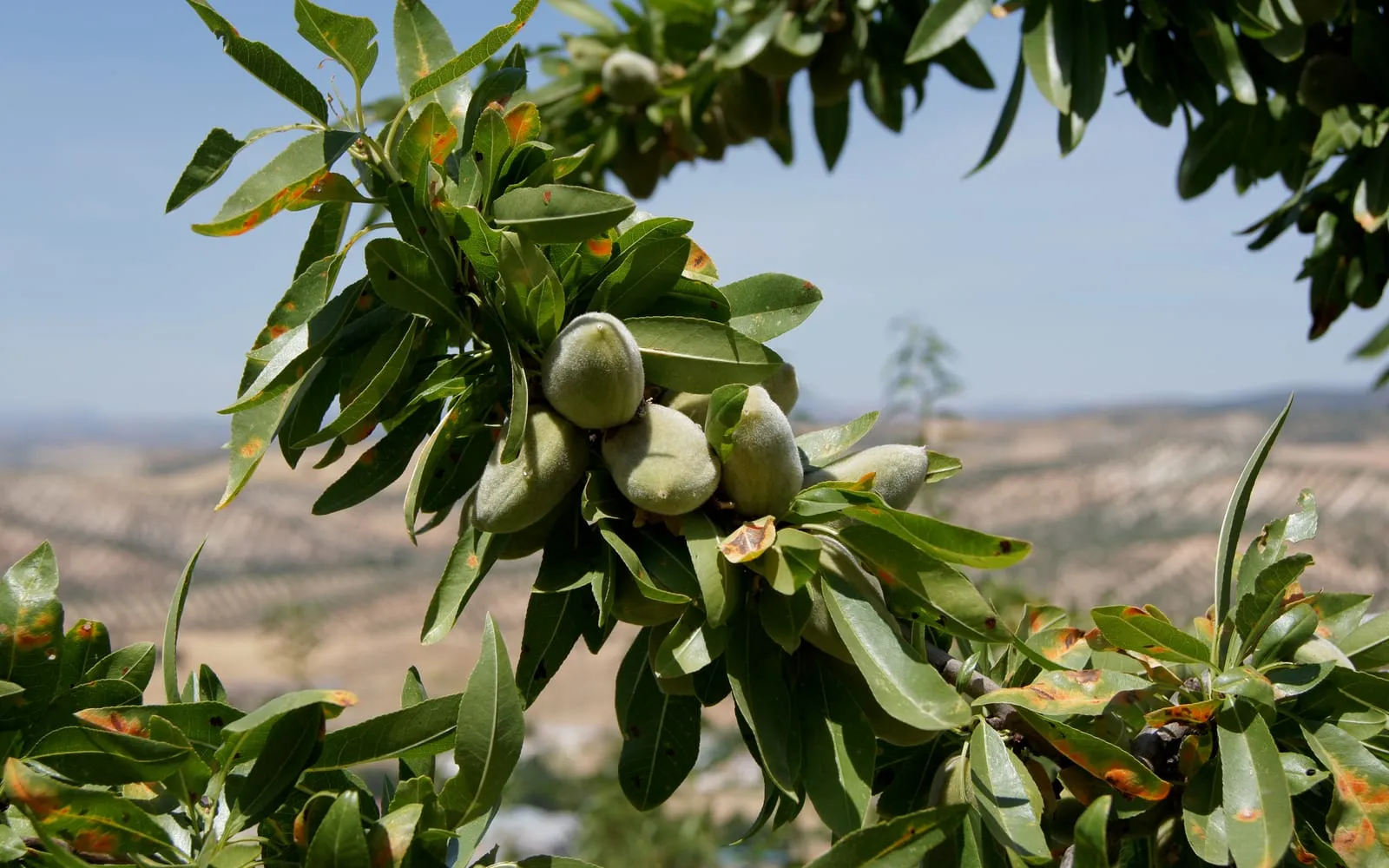
Fruit is a drupe, and the part everyone calls the nut is the seed inside the stone. The outer flesh is a thin grey-green leathery hull that splits along one side as it dries.
‘Robijn’ and ‘Ingrid’ are partially self-fertile and the sensible choices where the season is short. ‘Mandaline’ is another. Ornamental almonds are grown for blossom and crop poorly.
Where it is from
The almond is native to western and central Asia, and the wild ancestor is a bitter-kernelled tree of dry stony hillsides.
Domestication turned on a single mutation that switched off amygdalin production in the kernel, and every sweet almond descends from that change. It is one of the oldest deliberate selections in agriculture, dating back at least five thousand years.
It spread through the Mediterranean early and is mentioned throughout the Bible and in Greek and Roman writing.
The Romans brought it to Britain, where it has been grown for blossom rather than crop ever since, because the climate has never suited the fruit.
California now grows most of the world’s almonds, and the crop there depends on the largest managed pollination event on earth, with hives trucked in from across the continent each February.
How it grows
Buy a grafted tree on St Julien A rootstock for a fan, or Krymsk for a smaller tree. Seedling almonds may carry bitter kernels and should not be grown for eating.
Plant between November and March against a south or south-west facing wall in the warmest, most sheltered spot you have.
Free-draining soil is not negotiable. Almond dies on wet ground faster than almost any other fruit tree.
Space a fan at 4 m of wall and a free-standing tree at 6 m.
Train as a fan. Wall protection buys warmth for the blossom, shelter from rain that spreads leaf curl, and the option of covering the tree.
Cover from January to May with a polythene or clear plastic shelter open at the sides. This keeps rain off the buds and is the single most effective measure against peach leaf curl.
Hand pollinate. Move pollen between flowers with a soft brush in the middle of a mild day, and repeat every day or two while the blossom lasts. In February there are almost no bees.
Fleece the blossom whenever frost is forecast.
Harvest in September and October when the hulls split and start to dry. Remove the hull, dry the stones in an airy place for a week or two, then crack.
Through the seasons
Midwinter is for planting, for winter pruning if it must happen, and for getting the rain shelter up before the buds move. Aim for the end of January.
February and March are blossom, hand pollination and frost watch. Fleece on cold nights and pollinate on mild days.
Spring brings the leaves, and with them any leaf curl that got through. Pick off blistered leaves as they appear.
Summer swells the nuts. Water weekly and prune in dry summer weather rather than winter, which is the rule for all stone fruit.
Autumn is the harvest, from September, when the hulls split. Dry the stones thoroughly before storing.
Care difficulty
Difficult, and the difficulty is the calendar rather than the culture.
February blossom is the root of it. Frost kills the flowers outright, and even in a mild spell there are few pollinating insects about, so a full crop needs both luck and a paintbrush.
Peach leaf curl is the second problem and it is entirely predictable. Spores land in rain on swelling buds in late winter, and leaves emerge thickened, blistered and red before dropping. Keeping rain off the tree from January to May prevents it.
Drainage is the third. Almond will not tolerate winter wet and dies of root problems on heavy ground.
Bacterial canker and brown rot follow on stressed trees, particularly those pruned in winter.
None of this applies if you are growing the tree for blossom, in which case it is an easy and reliable small tree.
Watering
Water weekly through summer while nuts are swelling, around 20 litres for an established fan.
Water at the base and never over the foliage. Wet leaves spread leaf curl and brown rot.
A wall-trained tree needs more water than a free-standing one, because the wall keeps rain off the root run all year, not just in the months you want it to.
Mulch in late winter with compost over the root spread, kept off the trunk.
Reduce watering from September once the hulls begin to split, since wet at harvest spoils the kernels.
Never let the tree stand in wet soil over winter.
Warning signs, diseases and pests
Peach leaf curl produces thickened, puckered, red and white blistered leaves in spring, which then drop. It rarely kills a tree and it costs a year’s growth and crop. Shelter the tree from rain between January and May, remove affected leaves, and rake up fallen ones.
Frost-blackened blossom in February is the commonest cause of no crop. Fleece whenever a frost is forecast.
Blossom wilt browns the flowers and the spur behind them, and brown rot follows on the fruit with buff rings of pustules. Remove mummified fruit and affected spurs.
Bacterial canker sinks patches of bark with amber gum oozing from the edge, and kills branches. Prune only in dry summer weather, and cut well into clean wood.
Aphids curl the young shoot tips in spring and are usually controlled by predators.
Marginal leaf scorch that does not improve with watering, followed by scattered branch dieback and decline over one to a few years, is almond leaf scorch, caused by the same bacterium behind Pierce’s disease in grapevines and spread by sap-feeding insects including glassy-winged sharpshooter. There is no cure once a tree is infected, and it is a significant concern across California orchards rather than a risk in a cooler climate without the vector present.
No nuts despite good blossom usually means no pollination rather than any disease.
Empty or shrivelled kernels at harvest mean drought during the summer.
Growing environment
Full sun, and in a cool climate that means a south or south-west wall for a crop.
Deep, light, free-draining soil. Sandy loam is ideal and heavy clay is fatal.
Around pH 6.5 to 7.5, and it tolerates chalk better than most stone fruit.
Shelter from cold wind, which matters at flowering more than at any other time.
Avoid frost pockets absolutely. A tree that flowers in February cannot afford cold air pooling around it.
The warmer and drier the position, the better. Almond originates on dry stony hillsides and a hot dry summer is what ripens the crop.
Feeding
Almond needs modest feeding and suffers from too much nitrogen.
Mulch in late winter with well-rotted compost over the root spread, clear of the trunk.
Apply sulphate of potash at 20 g per square metre in February. Potash firms the wood, improves flowering and helps resist canker.
Avoid high-nitrogen feeds, which produce soft growth that canker and aphids exploit and delay ripening.
A wall-trained tree in a border benefits from a balanced spring feed, since the wall keeps rain and therefore nutrients off the root run.
Nothing further is needed on reasonable ground.
Troubleshooting
Masses of blossom and no nuts. Almost always pollination. Almond flowers in February when nothing is flying. Hand pollinate with a soft brush on mild days, and choose a partially self-fertile variety.
The blossom went brown overnight. Frost. Fleece the tree whenever a frost is forecast during flowering.
The leaves are thick, puckered and red. Peach leaf curl. Keep rain off the tree from January to May with an open-sided shelter, and remove affected leaves.
Gum is oozing from the trunk. Bacterial canker, or gummosis from stress. Prune only in dry summer weather, cut into clean wood, and check drainage.
The tree died over its first winter. Almost certainly wet roots. Almond needs sharp drainage and will not survive standing water.
The kernels taste intensely bitter. That is a bitter-kernelled tree, most likely a seedling. Do not eat them. Bitter almonds contain amygdalin at levels that cause cyanide poisoning.
Can I grow one from a supermarket almond? No. Those are usually pasteurised and will not germinate, and a seedling may carry bitter kernels in any case.
Do I need two trees? Most almonds need a pollination partner. Choose ‘Robijn’ or ‘Ingrid’ if you have room for only one, and hand pollinate regardless.
Almond problem guides
Not sure what is wrong? See the common vegetable pests guide.
- Peach leaf curl, which it suffers as badly as peach does
- Frost destroying the February blossom
- Bacterial canker on the trunk and branches
- Brown rot on the fruit and blossom wilt on the spurs
- Aphids curling the young shoots
- Almond leaf scorch, a fatal bacterial disease across California orchards
- Glassy-winged sharpshooter, the main vector across California