
Edible
Pomelo
Citrus maxima
Also known as Pummelo, Shaddock, Chinese grapefruit, Jabong
How to grow pomelo, Citrus maxima. The largest citrus and one of the three ancestral species, needing more heat than a temperate summer gives without glass.
At a glance
- Difficulty
- Difficult
- Water
- When the top few centimetres dry, so twice weekly in summer and monthly in winter
- Light
- Full sun, with as much heat as possible
- Temperature
- Minimum 7-10 deg C, with high summer heat needed
- Humidity
- Moderate to high
- Hardiness
- USDA 10-11, RHS H1b, hardy to -1 C
- Type
- Evergreen tree, long-lived
- Height
- 2.5-3 m in a container, 15 m in the tropics
- Native to
- South-east Asia
- Best month
- December, January and February in the Northern Hemisphere, June, July and August in the Southern Hemisphere
South-east Asia, and the largest and one of the most tender of the citrus. It is a true species rather than a hybrid, and it is a parent of the grapefruit, the orange and much else in the genus.
Hardiness zones describe winter cold alone. Summer heat, humidity, rainfall and the length of the growing season decide as much, so treat the range as the outer limit rather than as a recommendation.
Every month named in this guide is for the temperate Northern Hemisphere. If you garden in the Southern Hemisphere, shift each one by six months, so December becomes June. Closer to the equator the wet and dry seasons matter more than the calendar, and the shift stops being a useful guide.
Skin irritant
- Safe to eat
- The flesh
- Do not eat
- Peel oils, pith and leaves, for pets
- Harm from
- Eating it and handling it
- Affects
- Cats, dogs and horses
The fruit is food. The entry that matters is the veterinary one. The ASPCA lists citrus as toxic to cats, dogs and horses, on the strength of the essential oils and psoralens concentrated in the peel, the pith and the leaves rather than anything in the flesh. A pet that chews peel or foliage may vomit or develop a skin reaction, and citrus oil products marketed as pet deterrents have caused poisoning at concentrated doses. Sap and leaves can also irritate human skin, and the psoralens they carry are phototoxic, so a scratch from a thorn followed by strong sunlight sometimes produces a burn out of proportion to the wound. Wear sleeves when pruning a thorny plant on a bright day.
Sources: RHS potentially harmful garden plants, ASPCA toxic and non-toxic plants
About
Pomelo is the biggest citrus there is, reaching the size of a football, and one of the three wild species from which every other citrus descends. Grapefruit, sweet orange and Seville orange all carry pomelo in their parentage.
Most of that bulk is pith. The rind and the spongy white layer beneath it can be two or three centimetres thick, and the flesh inside is drier and milder than a grapefruit, sweet rather than sharp, with segments that separate cleanly.
Outside its climate it is a glasshouse plant. It needs high heat and a long season, and it makes a large vigorous tree, so it takes up more conservatory space than most people can offer.
Grown as a foliage plant it is impressive, with leaves twice the size of an orange’s and flowers to match.
Appearance and character
A large vigorous evergreen tree with a spreading crown and stout thorns on young shoots.
Leaves are very large, 10 to 20 cm, thick and leathery, dark green above and downy beneath, with a broadly winged stalk that looks like a second leaf.
Flowers are the largest of any citrus, 4 to 7 cm across, white and heavily scented.
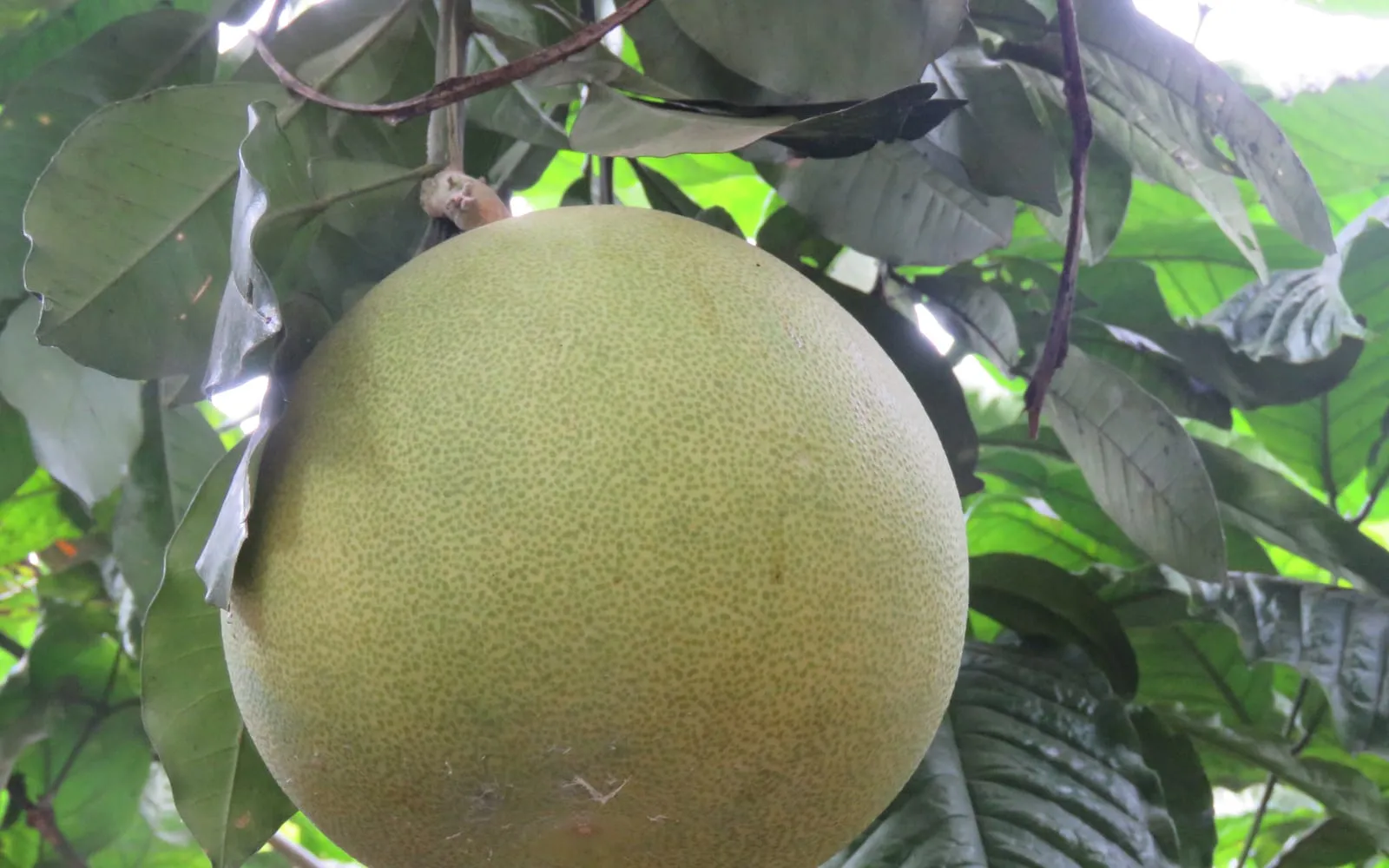
Fruit is round to pear-shaped and very large, 15 to 25 cm across, with a thick pale green to yellow rind and a deep spongy pith.
Flesh is pale yellow, pink or red depending on variety, in firm segments that separate cleanly and stay intact rather than bursting.
Where it is from
Citrus maxima is native to south-east Asia, in Malaysia, Indonesia and southern China, and it is one of the small number of true wild citrus species.
Genome studies confirmed it as a founding ancestor, and the sweet orange, the Seville orange and the grapefruit are all derived in part from it.
The English name shaddock comes from a Captain Shaddock, who is credited with carrying seed to Barbados in the seventeenth century, where its cross with sweet orange produced the grapefruit.
It remains a major fruit across south-east Asia and southern China, associated with Lunar New Year and the Mid-Autumn Festival.
Its equatorial origin explains the heat requirement, since it comes from a climate with no cool season at all.
How it grows
Grow it under glass outside the tropics. A large conservatory or heated greenhouse is required, and even then fruit is not guaranteed.
Buy a grafted plant, since seedlings take many years to fruit.
Pot into free-draining citrus compost in a large container, at least 50 cm, and expect to repot as it grows.
Keep the winter minimum at 7 to 10 deg C in bright light.
Stand it outside in high summer only, from mid-June to early September.
Water thoroughly and let the compost dry down, feeding fortnightly through the growing season.
Through the seasons
Flowering is mainly in spring, and the very large scented flowers are the plant’s best feature.
Fruit sets after flowering and takes six to nine months to develop, which is a long time on a large plant.
Move it outside in high summer for maximum heat, returning it under cover in early September.
Feed fortnightly with summer citrus feed from March to October.
Fruit ripens from December to February and is ready when the rind has turned from green to pale yellow and the fruit feels heavy.
Reduce water and switch to winter feed through the colder months.
Care difficulty
Difficult, on account of both heat and size.
The plant needs consistent warmth and high light, and cool winter light is the limitation that cannot be worked around cheaply.
Its eventual size makes it demanding of space. This is the largest citrus and it does not stay small in a pot for long.
The growing itself is straightforward, following the same rules as any citrus.
Anyone wanting citrus fruit from a conservatory would do better with a mandarin or a kumquat, and keep pomelo for the leaves and flowers.
Watering
Water thoroughly until it drains, then let the top few centimetres dry.
The very large leaves lose water fast, so a pomelo is thirstier in summer than any other citrus of comparable size.
Reduce water considerably in winter as growth slows.
Never leave the pot standing in water, since root rot remains the commonest killer.
Use rainwater where possible and mist the foliage in dry indoor air.
Warning signs, diseases and pests
Fruit failing to develop or ripen. Insufficient heat and light, which is the usual limitation in a cool summer.
Leaves yellowing between the veins. Iron shortage from hard water. Use sequestered iron and rainwater.
Large leaves dropping in winter. Overwatering, cold, or dry heated air.
Brown limpet bumps on stems and leaf ribs. Scale insects. Scrub off with soapy water.
White waxy fluff in leaf joints. Mealybug. Treat with horticultural soap.
Fine speckling with webbing. Red spider mite. Raise humidity and ventilate.
Blotchy yellow leaves with small, lopsided, bitter fruit that stays green at the base. Citrus greening, the world’s most destructive citrus disease and incurable once a tree is infected. Not established in Europe, Australia or New Zealand, where a sighting is reportable. Buy trees only from a certified, disease-free nursery.
Growing environment
Full sun with as much heat as can be arranged, under glass outside the tropics.
A winter minimum of 7 to 10 deg C with the brightest light available.
Free-draining citrus compost at pH 6 to 6.5.
High humidity suits it, matching its equatorial origin, and dry conservatory air brings mite problems.
Space is the practical constraint. A pot of 50 cm or more and real headroom are needed, and the plant will keep growing.
Feeding
Feed fortnightly with summer citrus feed from March to October.
Switch to winter citrus feed monthly through the cold months.
The plant is vigorous and responds to consistent feeding, though nitrogen should not be pushed hard.
Sequestered iron corrects hard-water yellowing, to which the large leaves show symptoms clearly.
Repot every two or three years, and top-dress in the years between.
Troubleshooting
No fruit under glass. Heat and light, and often the plant’s youth. Grafted trees take several years.
Fruit small for the species. Insufficient heat through the long development period.
Flesh dry and bland. Normal for a pomelo compared with a grapefruit, and part of its character.
Plant outgrowing the conservatory. Its nature. Prune in spring and expect to keep doing so.
Leaves scorching under glass in summer. Ventilate and shade during the hottest part of the day.
Confusion with grapefruit. They are different species. Pomelo is the larger, milder parent of the grapefruit.
Pomelo problem guides
Not sure what is wrong? See the common vegetable pests guide.
- Scale insects on stems and leaf ribs
- Mealybug in the leaf joints
- Red spider mite in dry winter air
- Sooty mould growing on the honeydew those pests leave
- Leaf drop from cold draughts, overwatering or a sudden move
- Root rot from standing in water, which kills more citrus than cold
- Citrus greening, absent from Europe, Australia and New Zealand but present across much of the Americas and Asia