
Edible
Wintergreen
Gaultheria procumbens
Also known as Checkerberry, Teaberry, American wintergreen, Boxberry, Partridge berry
How to grow wintergreen, Gaultheria procumbens. A creeping evergreen for acid shade, with red berries all winter and leaves that smell of liniment.
At a glance
- Difficulty
- Easy
- Water
- Weekly in dry spells, and it dislikes drying out
- Light
- Part shade to full shade
- Temperature
- Fully hardy to -30 deg C
- Hardiness
- USDA 3-7, RHS H7, hardy to -35 C
- Type
- Evergreen perennial shrublet, spreading by rhizome
- Height
- 10-15 cm, spreading slowly to 1 m
- Native to
- Eastern North America
- Best month
- October, November, December and January in the Northern Hemisphere, April, May, June and July in the Southern Hemisphere
Acid soil below about pH 5.5 is not negotiable, and on neutral or chalky ground the plant yellows and dies whatever the climate. Cold suits it and heat does not. The methyl salicylate that gives the flavour is close enough to aspirin that the oil is dangerous in quantity.
Hardiness zones describe winter cold alone. Summer heat, humidity, rainfall and the length of the growing season decide as much, so treat the range as the outer limit rather than as a recommendation.
Every month named in this guide is for the temperate Northern Hemisphere. If you garden in the Southern Hemisphere, shift each one by six months, so October becomes April. Closer to the equator the wet and dry seasons matter more than the calendar, and the shift stops being a useful guide.
Toxic if eaten
- Safe to eat
- The berries, in small quantity
- Do not eat
- The leaves in quantity, and the distilled oil above all
- Harm from
- Eating it and handling it
- Affects
- People, cats, dogs and horses
The whole plant contains methyl salicylate, which is closely related to aspirin and gives wintergreen its familiar smell. A few berries are harmless and have long been eaten as a woodland nibble, and the leaves have been used as a tea. The concentrated oil is a different matter entirely. Distilled wintergreen oil is one of the most dangerous substances in a domestic medicine cabinet, since a single teaspoon carries a salicylate dose equivalent to roughly twenty aspirin tablets and fatal poisonings of children are recorded. Never distil, concentrate or dose with it. The ASPCA lists Gaultheria procumbens as toxic to cats, dogs and horses, and cats are at particular risk because they metabolise salicylates poorly. Anyone advised to avoid aspirin should avoid the leaves and berries too.
Sources: RHS potentially harmful garden plants, ASPCA toxic and non-toxic plants
About
Crush a wintergreen leaf and the smell is instantly familiar, the sharp medicinal scent of muscle rub and old-fashioned chewing gum. Methyl salicylate is the compound, and this plant was the original commercial source of it.
As a garden plant it fills a difficult position. It is a low evergreen carpet for acid soil in shade, spreading slowly by underground runners, and it looks presentable in every month.
Its best season is winter. Glossy dark leaves take on a bronze-purple cast in cold weather, and the bright red berries hang on from October until well into spring.
Treat it as ground cover that happens to be edible rather than as a fruit crop. The berries are pleasant and sparse, and the plant is not going to fill a bowl.
Appearance and character
A creeping evergreen shrublet with wiry underground stems that send up short upright shoots at intervals, forming a loose mat.
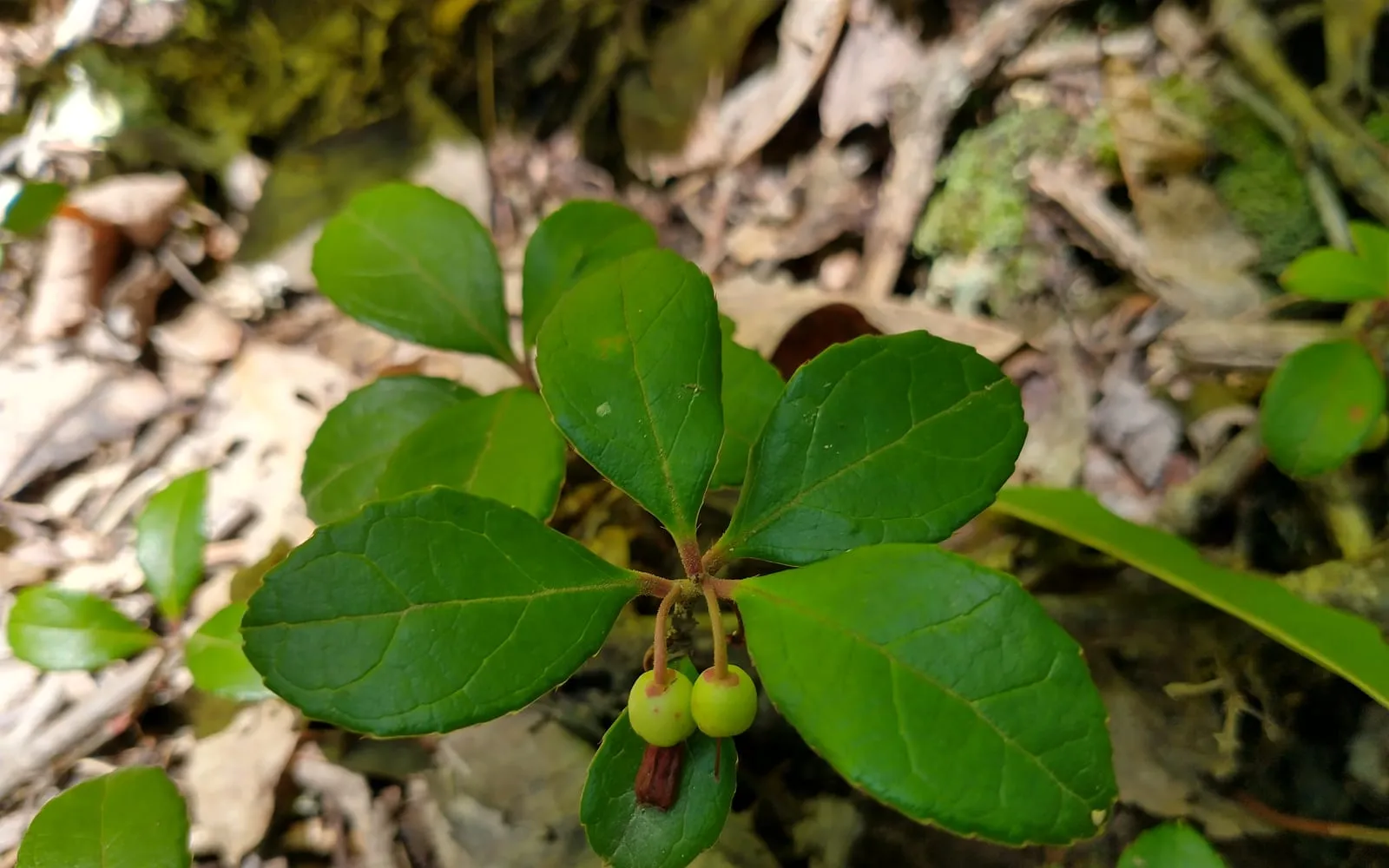
Leaves are clustered towards the top of each shoot, 2 to 5 cm, oval, thick and leathery, glossy dark green above and turning bronze-red through winter.
Flowers open in July and August, small white or pale pink bells 5 to 8 mm long, hanging singly beneath the leaves where they are easy to overlook.
Fruit is a bright scarlet berry 6 to 12 mm across, technically a fleshy calyx around a small capsule, holding on the plant right through winter.
The berries are mealy in texture with a strong wintergreen flavour, which people either enjoy or find medicinal.
Where it is from
Gaultheria procumbens is native to eastern North America, from Newfoundland south to Georgia and west to Minnesota.
It grows in acid woodland, on the floor of pine and oak forest, and on heath and sandy barrens, always in soil that is acid and rich in leaf litter.
Indigenous peoples of the region used the leaves as a tea and as a remedy for aches, and colonists adopted both uses. The name teaberry comes from that history.
Commercial extraction of oil of wintergreen from this plant was a real industry in the nineteenth century, and it supplied the flavour for confectionery and the active ingredient for liniments.
Synthetic methyl salicylate replaced it almost entirely, and most modern wintergreen flavouring has never been near the plant.
How it grows
Buy container-grown plants. It is slow from seed and named forms such as ‘Big Berry’ carry larger fruit.
Test the soil pH first. It needs acid conditions at pH 4.5 to 6 and will not survive on chalk.
Plant into moist humus-rich soil in part or full shade, or into a container of ericaceous compost.
Space at 30 cm and let the runners knit together. Expect slow spread rather than rapid cover.
Mulch with leaf mould, composted bark or pine needles, which maintains acidity and holds moisture.
Water with rainwater. Hard tap water raises the pH and the plant declines over a season or two.
Through the seasons
The plant is evergreen and holds its foliage all year, taking on bronze and purple tones from November.
New growth appears in spring, pale green against the darker older leaves.
Flowering is in July and August, small nodding bells that are easy to miss beneath the foliage.
Berries form in late summer and colour through September and October.
From October to March the plant is at its best, with red berries against dark foliage, and this is when it earns its place.
Birds take the remaining berries late in winter when other food has run out.
Care difficulty
Easy, provided the soil is acid and shaded. Those two conditions decide everything.
On the right ground it is long-lived, hardy to -30 deg C, evergreen and close to maintenance-free.
On alkaline soil it will not grow, and no amount of care compensates.
It dislikes drying out, so a position that bakes in summer is unsuitable even if the pH is right.
Pests are minimal, and vine weevil in containers is the only one worth watching.
Watering
Water weekly in dry spells, keeping the root zone damp rather than wet.
Use rainwater where possible, since lime accumulates in the root zone and causes yellowing.
The plant is shallow-rooted and suffers quickly in drought, browning at the leaf edges.
Mulch with leaf mould or composted bark, which reduces watering considerably.
A container needs checking every few days in summer, since the mat dries out fast.
Warning signs, diseases and pests
Leaves yellowing between the veins. Lime-induced chlorosis from tap water or alkaline soil. Switch to rainwater, apply chelated iron and mulch with an acid material.
Leaf edges browning and crisping. Drying out. Water and mulch, since this plant has little drought tolerance.
White powdery film on the foliage. Powdery mildew in still humid air. Thin surrounding planting to improve airflow.
Plant collapsing in a container with roots eaten away. Vine weevil grubs. Apply nematodes in late summer.
Dark spots on leaves in a wet season. Leaf spot. Remove affected leaves and expect no lasting harm.
Berries disappearing in February. Birds, once other food runs short.
Growing environment
Part shade to full shade. This is a woodland floor plant and it scorches in full sun.
Acid soil at pH 4.5 to 6 is essential, and this is the condition that decides whether it can be grown at all.
Moist humus-rich ground with good drainage, matching a forest floor with deep leaf litter.
Full hardiness to -30 deg C means cold is never the problem. Soil pH is.
It suits the front of an acid shade border, ground cover beneath rhododendrons and camellias, or a shaded trough of ericaceous compost.
Feeding
Feed sparingly or not at all. The plant grows on poor acid woodland soil in the wild.
A half-strength ericaceous feed once in spring is the most it wants.
Mulch annually with leaf mould, composted bark or pine needles, which supplies what it needs as it breaks down.
Never use lime, mushroom compost, wood ash or general-purpose fertiliser near it.
Yellowing is a pH signal rather than hunger, so check the water source before feeding.
Troubleshooting
Plant declining on chalky soil. It cannot grow there. Move it into a container of ericaceous compost.
Leaves yellow with green veins. Alkaline conditions, usually from tap water. Switch to rainwater and treat with chelated iron.
Very few berries. Too much shade even for this plant, or too dry in summer.
Slow spread. Normal. It is a slow coloniser and takes several years to knit together.
Foliage scorched and brown. Too much sun, or drought. Move it into deeper shade.
Tempted to distil the oil. Do not. Concentrated wintergreen oil is dangerous at very small doses and there is no safe home preparation.