
Edible
Wild strawberry
Fragaria vesca
Also known as Alpine strawberry, Woodland strawberry, Fraise des bois
How to grow wild strawberry, Fragaria vesca. Tiny fruit with more flavour than any garden variety, cropping from June to the first frost, and easy from seed.
At a glance
- Difficulty
- Easy
- Water
- Twice weekly in summer, more in containers
- Light
- Part shade to full sun
- Temperature
- Fully hardy to -25 deg C
- Hardiness
- USDA 4-9, RHS H6, hardy to -30 C
- Type
- Evergreen or semi-evergreen perennial, best replaced every three years
- Height
- 15-25 cm
- Native to
- Britain, Europe, Northern Asia, North America
- Best month
- June, July, August, September and October in the Northern Hemisphere, December, January, February, March and April in the Southern Hemisphere
Hardier and far less fussy than the garden strawberry, running about by seed and runner in light woodland shade. Most forms are day-neutral and fruit from early summer until frost. Heat above about 30 deg C stops flowering until the weather breaks.
Hardiness zones describe winter cold alone. Summer heat, humidity, rainfall and the length of the growing season decide as much, so treat the range as the outer limit rather than as a recommendation.
Every month named in this guide is for the temperate Northern Hemisphere. If you garden in the Southern Hemisphere, shift each one by six months, so June becomes December. Closer to the equator the wet and dry seasons matter more than the calendar, and the shift stops being a useful guide.
Not known to be toxic
- Safe to eat
- The fruit
The fruit is food and the plant carries no toxicity concern. Neither the RHS nor the ASPCA lists Fragaria as harmful, and the ASPCA records the strawberry as non-toxic to cats, dogs and horses. Leaves have a long history as a herbal tea. Strawberry is a recognised allergen for a minority of people, which is a sensitivity rather than a property of the plant. Wilted strawberry leaves are sometimes said to be unsafe, a claim that traces to confusion with wilted Prunus foliage and has no support for this genus.
Sources: RHS potentially harmful garden plants, ASPCA toxic and non-toxic plants
About
A wild strawberry is a fifth the size of a garden one and carries several times the flavour. Concentration is the reason. The same aromatic compounds sit in far less water.
It crops differently too. Instead of a three-week glut it produces a handful at a time from June until the frosts, which suits picking on the way past rather than harvesting into a bowl.
Alpine forms are the ones to grow. ‘Mignonette’, ‘Alexandria’ and ‘Baron Solemacher’ make no runners, stay as neat clumps, and come true from seed, so a packet of seed gives you fifty plants for the price of two.
The plant grows in dappled shade, which sets it apart from garden strawberries and makes it useful for edging a shady path or filling the front of a woodland border.
Appearance and character
A low rosette-forming perennial, evergreen in mild winters and dying back in cold ones.
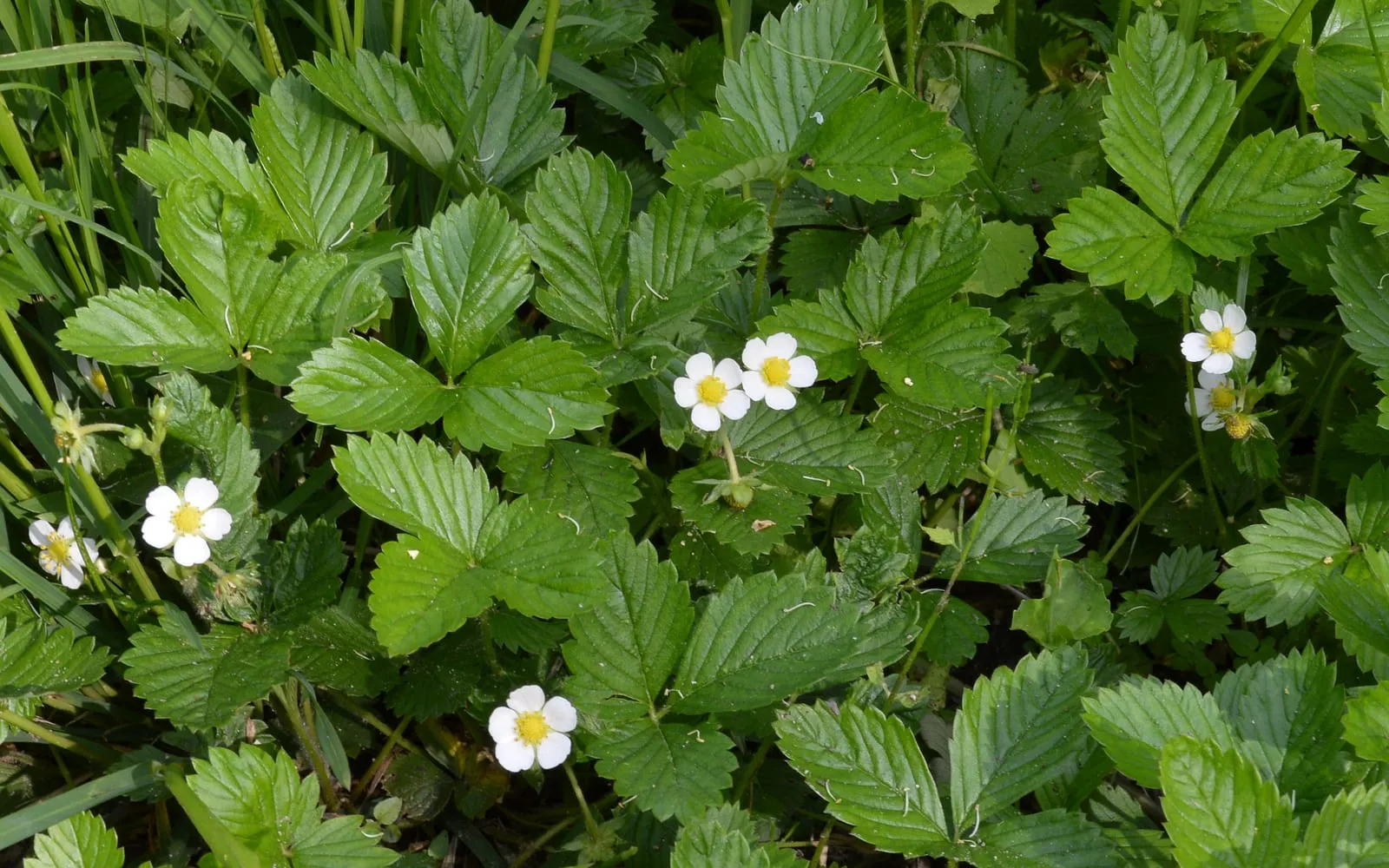
Leaves are in threes, each leaflet oval and coarsely toothed, bright green, softly hairy beneath, on thin upright stalks.
The wild species runs on long thin runners that root at intervals. Alpine cultivars have had that habit bred out and stay put.
Flowers are white with five petals and a yellow centre, 1 to 2 cm across, held on slender stalks above the leaves from May onwards.
Fruit is a slim cone 1 to 2 cm long, bright red, holding upright rather than drooping, and separating from the calyx with a light pull when ripe.
Where it is from
Fragaria vesca grows wild across Europe, including throughout Britain, and right around the northern hemisphere into Asia and North America.
Its habitat is woodland edge, hedge bank, clearing and grassy slope, generally in part shade on soil with leaf litter.
It was the strawberry of European gardens for centuries. Medieval and Tudor gardens grew this species, and the fruit was gathered from the wild long before that.
The modern garden strawberry appeared in eighteenth-century France as a chance cross between two American species, and it displaced the wild one within a generation because the fruit was so much larger.
Runnerless alpine forms were selected in the nineteenth century, and France kept growing them for the flavour under the name fraise des bois.
How it grows
Sow seed in late winter or early spring. Surface-sow onto damp compost, since the seed needs light, and keep it at about 18 deg C. Germination is slow and uneven, often taking three to six weeks.
Alternatively buy plants, though seed is far cheaper for the numbers most people want.
Plant out 25 to 30 cm apart in soil enriched with compost or leaf mould, in part shade or sun.
Set the crown at soil level. Buried crowns rot and exposed ones dry out.
Mulch with leaf mould or straw, which keeps the fruit clean and holds moisture.
Replace plants every three years from seed or runners, since cropping falls away as they age.
Through the seasons
Growth restarts in March, and the first flowers open in May.
Fruit begins in June and continues in small quantities until the first frosts, which is the plant’s great advantage over a garden strawberry.
Pick every couple of days through the season. Ripe fruit is fully red including around the shoulders and comes away easily.
Feed fortnightly with a high-potash liquid feed from June onwards to sustain the long cropping period.
In autumn, tidy dead leaves and remove runners from any species plants you want to keep in bounds.
Alpine forms hold their leaves through most winters and need no protection.
Care difficulty
Easy. It grows in shade, tolerates most soils, needs no support and has few serious pests.
Seed germination is the only fiddly part, and it is slow rather than difficult.
The long cropping season means feeding matters more than it does for a once-a-summer crop.
Slugs are the main enemy, and low-held fruit is within their reach in a way that raised strawberries are not.
Replacing the plants every three years is the routine that keeps yields up, and it costs nothing when they come from seed.
Watering
Water twice weekly through summer, keeping the root zone damp.
Containers and hanging baskets dry out fast and may need daily watering in hot weather.
Water at the base rather than over the plant, since wet fruit moulds quickly.
Mulch with leaf mould, straw or compost, which holds moisture and keeps fruit off the soil.
Consistency matters more than volume. Fruit splits and flavour dilutes after a soaking that follows a dry spell.
Warning signs, diseases and pests
Fruit holed and hollowed overnight. Slugs and snails. Mulch with something sharp, use traps, or pick them off after dark.
Grey furry mould on ripening fruit. Grey mould in wet weather. Pick affected fruit off and remove it, thin the leaves, and water at the base.
Plants wilting despite damp soil, roots eaten to stubs. Vine weevil grubs, most often in containers. Apply nematodes in late summer.
White powdery film on leaves, edges curling upwards. Powdery mildew. Improve airflow and water more evenly.
Fine mottling on leaves with webbing beneath. Red spider mite in hot dry conditions. Raise humidity and improve ventilation.
Fruit taken but not eaten cleanly. Birds. Netting works, though small fruit suffers less than large.
Growing environment
Part shade suits it best, which is where it grows in the wild. Full sun works with more watering and gives a slightly shorter season.
Soil should be moisture-retentive, humus-rich and well-drained, at pH 5.5 to 7.
Leaf mould is the ideal soil improver, matching the woodland litter of its natural habitat.
It is fully hardy and needs no winter protection in a temperate climate.
It grows well in containers, window boxes and hanging baskets, and as edging along a shaded path where the low rosettes look tidy all year.
Feeding
Feed fortnightly with a high-potash liquid feed, such as a tomato feed, from the start of cropping in June through to September.
The long season is what makes feeding matter. A plant cropping for four months exhausts a container far faster than one cropping for three weeks.
Work compost or leaf mould into the soil before planting, and top-dress each spring.
Avoid high-nitrogen feeds, which produce large leaves and little fruit.
Plants in the ground on good soil need less, and a spring mulch may be all they require.
Troubleshooting
Seed not germinating. Sown too deep or too cold. Surface-sow onto damp compost and keep at about 18 deg C, and allow up to six weeks.
Plenty of leaves, few flowers. Too much nitrogen or too much shade. Switch to a high-potash feed and move into brighter light.
Fruit small even for a wild strawberry. Drought, or plants more than three years old. Water steadily and start replacements.
Runners everywhere. A species plant rather than an alpine cultivar. Cut them off, or grow a runnerless variety next time.
Cropping falling away in the third year. Normal ageing. Raise new plants from seed or runners.
Fruit bland after rain. Water dilution, which is temporary and corrects in the next dry spell.