
Disorder
Hard water and salt build-up
Also called Limescale on plants, Salt build-up, Lime-induced chlorosis
Hard water leaves white crusts on compost and pots, browns leaf tips and yellows lime-hating plants. Flush containers, refresh compost and use rainwater for plants that need acid conditions.
At a glance
- Type
- Disorder
- Cause
- Feeding or nutrients
- Severity
- Weakens the plant
- Affects
- Houseplants, Garden plants, Herbs and edibles
- Active
- All year
What you are seeing
- A hard white or buff crust on the compost surface and up the outside of a terracotta pot
- White deposits crystallising around the drainage holes and the pot rim
- Brown crisp leaf tips with a yellow band between the brown and the green
- Leaf margins browning on calatheas, marantas, ferns and spider plants
- Yellowing between the veins on blueberries, camellias and rhododendrons, with the veins staying green
- Growth slowing on a plant that is fed and watered properly
- White spotting on foliage where hard water has been sprayed or misted
Before you treat anything
Nothing here is harmful. Do not use domestically softened water on plants, since most softeners work by exchanging calcium for sodium, and sodium is considerably worse for a plant than the hardness it replaced.
What you are looking at
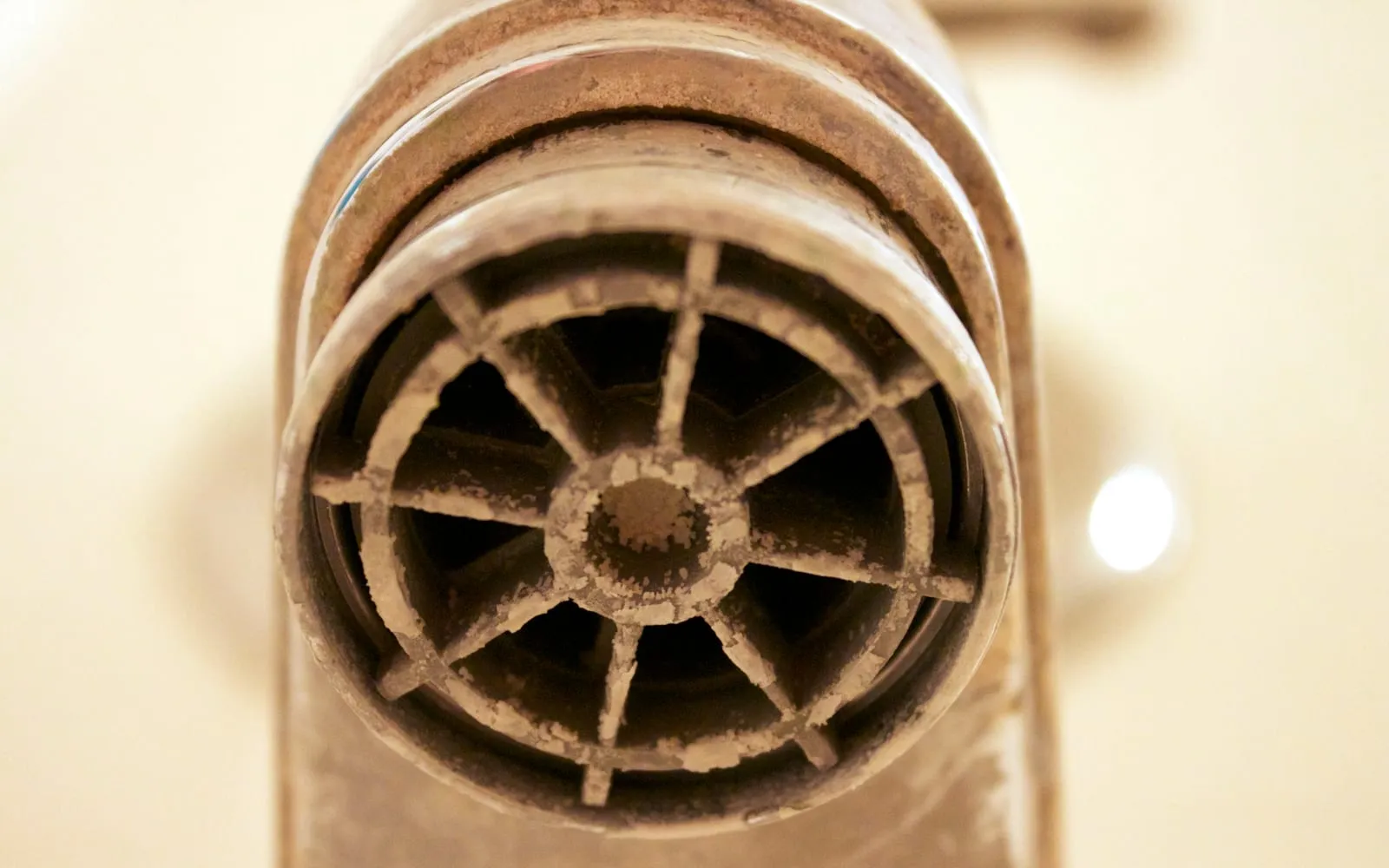
A hard white or buff crust on the surface of the compost, around the drainage holes and up the outside of a terracotta pot. It is gritty rather than fluffy, it does not spread onto the plant, and it comes back after you scrape it off.
On the plant, brown crisp leaf tips and margins, usually with a narrow yellow band between the brown and the green. Calatheas, marantas, maidenhair ferns, dracaenas and spider plants show it first.
On lime-haters in the garden, something different. Yellowing between the veins while the veins themselves stay green, worst on the newest leaves, on blueberries, camellias, rhododendrons and pieris.
Two problems with one cause
Tap water in much of Britain carries dissolved calcium and magnesium, and fertiliser is a salt. Both arrive in a pot dissolved in water, and when the water evaporates or is used by the plant, they stay.
In the ground that hardly matters, since rain washes it down through a large volume of soil. In a container, with a fixed volume of compost and no drainage away, it accumulates. Over a year or two the concentration rises far enough to damage roots, and damaged roots cannot supply the far end of a leaf, so the tips go brown. The white crust is the same material appearing where the water evaporates.
The second problem is chemical rather than physical. Hard water is alkaline, and it raises the pH of the compost over time. Iron is present in almost every compost and it becomes unavailable to a plant above about pH 6.5, so a lime-hater watered with hard water starves of iron while sitting in plenty of it. That is lime-induced chlorosis, and it is why a camellia in a pot yellows over a couple of seasons.
What standing the water does and does not do
Leaving tap water in a can overnight is standard advice and it is worth doing for two reasons that are not this one. It lets chlorine gas off, which some plants mind, and it brings the water to room temperature, which tropical plants appreciate.
It does nothing whatever to the calcium and magnesium. Those are dissolved minerals and they do not evaporate off. A plant with brown tips from hard water gets no benefit from standing the water, and the crust builds at the same rate.
Rainwater is the answer, and a butt on a shed roof supplies far more than a houseplant collection needs.
Softened water from a domestic softener is worse than the hard water it replaced, because most softeners exchange calcium for sodium and plants tolerate sodium very poorly.
What to do about it
Put a water butt on a shed or greenhouse and use rainwater for the plants that mind.
Water thoroughly until it drains from the bottom, and tip the saucer out afterwards.
Flush the pot through with several potfuls of water twice a year.
Scrape the crusted top centimetre off and replace it with fresh compost.
Feed at the stated rate, and stop feeding in winter.
Repot every couple of years, or top-dress anything too big to lift.
Grow blueberries, camellias and rhododendrons in ericaceous compost in containers, watered with rainwater.
Use a sequestered iron feed as a holding measure on a chlorotic lime-hater while you sort the water and the compost out.
Never use domestically softened water on plants.
What it gets mistaken for
Drought browns leaf tips and margins on a plant that is dry, without the yellow band and without a crust on the pot.
Low humidity browns the tips of calatheas and ferns in a centrally heated room, and the two commonly happen together.
Magnesium deficiency yellows between the veins on the older leaves rather than the newest ones, which is the opposite way round from iron.
Powdery mildew is a white bloom that rubs off living tissue and spreads. Mineral crust sits on pot and compost and goes nowhere.
Perlite and vermiculite in the compost look like white grit and are supposed to be there.
Harmless white moulds on the compost surface are fluffy and cobweb-like rather than hard, and they wipe away.
What to do, in order
Start here
Prevention, and the changes that stop the problem returning. Most of these pages should end at this tier.
- Collect rainwater and use it on the plants that mind
- A water butt on a shed or a greenhouse costs very little and solves this entirely. Use rainwater for calatheas, marantas, ferns, carnivorous plants, orchids and everything ericaceous, and save the tap for everything else, which will not notice.
- Grow lime-haters in ericaceous compost and containers
- Blueberries, camellias, rhododendrons and pieris cannot take up iron from alkaline conditions. In a pot of ericaceous compost, watered with rainwater, they are straightforward. In alkaline garden soil no amount of feeding will hold them, and the answer is a container rather than a struggle.
- Feed at the stated rate and no more
- Fertiliser is salt. Overfeeding, or feeding a plant that is barely growing in winter, leaves what the plant cannot use in the compost, and that accumulates. Most crusted pots have been fed generously by someone being kind.
- Water enough to drain, every time
- Little and often leaves everything dissolved in the water behind as it evaporates. Watering thoroughly, until it runs out of the bottom, and then tipping away what collects in the saucer, carries the salts out rather than concentrating them.
- Repot every couple of years
- Fresh compost resets the accumulated minerals along with everything else. On a plant too large to repot, replace the top few centimetres each spring.
Then reach for a barrier
Netting, hand removal and water. Nothing here harms anything except the target.
- Flush the pot through
- Stand the plant in a sink or outside and run water slowly through the compost for several minutes, three or four times the volume of the pot, letting it drain freely away. This dissolves and removes the built-up salts. Do it twice a year on anything crusted, and use rainwater or cooled boiled water where the tap is very hard.
- Scrape the crust off the surface
- Take the top centimetre or two of crusted compost away and replace it with fresh. That removes the worst concentration in one go. Do it before flushing rather than after.
- Leave tap water standing, and know what it does
- Standing water overnight lets chlorine off and takes the chill off, and it does nothing at all to the dissolved calcium and magnesium that cause the crust. Standing water is widely recommended for mineral build-up, but it cannot remove dissolved salts.
- Wipe mineral spots off the foliage
- Where hard water has been misted onto leaves, the white spotting is deposit rather than disease. A cloth wrung out in soft water takes it off, and misting with rainwater avoids it.
Plants affected
Guides that name it among the problems to watch for. The list is the plants it is characteristic of rather than everything it will feed on.
A common houseplant pest
This is one of the pests and problems that houseplant owners meet most often. See it alongside the others, with a quick table for telling them apart, on the houseplant pests guide.
Common houseplant pests