
Edible
Snake Gourd
Trichosanthes cucumerina
Also known as Serpent cucumber, Padwal, Chichinda, Pudalangai
How to grow snake gourd, Trichosanthes cucumerina. The metre-long fruit that needs weighting straight, the night-opening lace flower, and the wild form nobody eats.
At a glance
- Difficulty
- Difficult
- Water
- Two or three times a week, daily in fruit
- Light
- Full sun
- Temperature
- 25-32 deg C, and nothing below 18
- Humidity
- High, which is why it suits a closed polytunnel
- Hardiness
- USDA 10-12, RHS H1b, hardy to 10 C
- Type
- Tender annual climber
- Height
- 4-6 m in a season
- Native to
- India, South East Asia
- Best month
- May in the Northern Hemisphere, November in the Southern Hemisphere
One of the most heat-demanding vegetables in cultivation, wanting 25 to 32 deg C and stopping below 18, so it belongs to the wet tropics and to a heated glasshouse anywhere else. Flowers open at night for moths. The fruit curls unless weighted, which is why growers hang a stone from the tip.
Hardiness zones describe winter cold alone. Summer heat, humidity, rainfall and the length of the growing season decide as much, so treat the range as the outer limit rather than as a recommendation.
Every month named in this guide is for the temperate Northern Hemisphere. If you garden in the Southern Hemisphere, shift each one by six months, so May becomes November. Closer to the equator the wet and dry seasons matter more than the calendar, and the shift stops being a useful guide.
Edible, with limits
- Safe to eat
- The young cultivated fruit, the shoots and the young leaves
- Do not eat
- The wild variety, whose small fruit is intensely bitter and purgative
- Harm from
- Eating it
- Affects
- People
The cultivated long-fruited form is an everyday vegetable in India, Sri Lanka and South East Asia and is safe to eat. The species also contains a wild variety, Trichosanthes cucumerina var. cucumerina, with small fruit only a few centimetres long that is violently bitter and acts as a purgative. It is used medicinally rather than eaten, and a plant grown from unnamed seed can turn out to be it. The test is the same as for every cucurbit. Taste a small piece of raw flesh, and if it is bitter, discard the whole fruit rather than cooking it. Related species in the genus contain trichosanthin, a protein with real pharmacological activity, which is a reason to treat medicinal preparations from any Trichosanthes as outside the scope of a kitchen. Neither the RHS nor the ASPCA lists the species, and cooked cultivated fruit in small amounts is harmless to cats and dogs.
Sources: RHS potentially harmful garden plants, ASPCA toxic and non-toxic plants
About
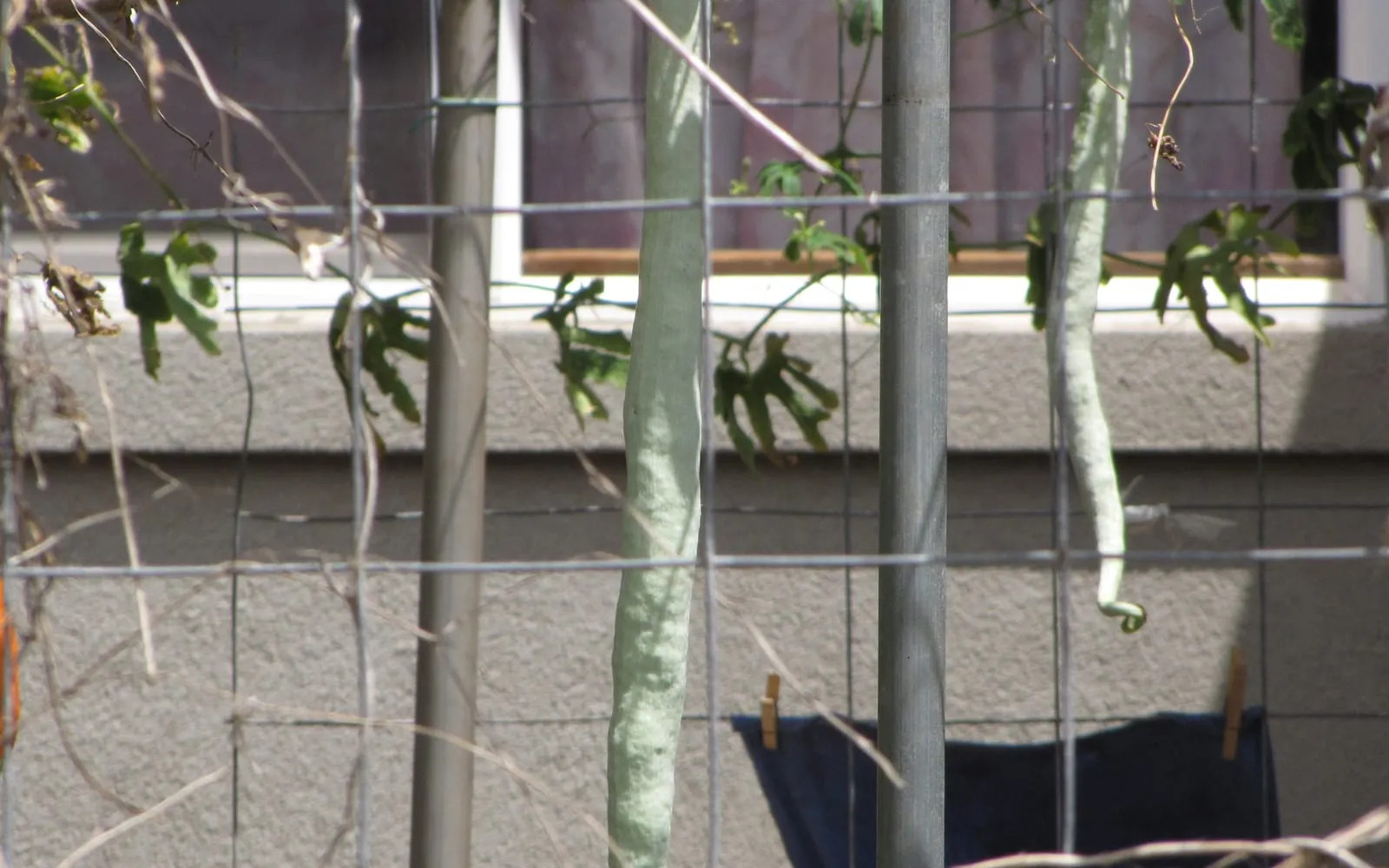
Snake gourd produces the longest fruit of any vegetable grown for the table, and a metre and a half is ordinary. Left to hang it twists into a coil, so growers tie a stone to the flower end and let gravity pull it straight.
It appears in South Asian grocers as padwal or chichinda, a pale green ribbed rope with white marbling, usually cut into lengths. Cooked, it is mild and slightly sweet, softer than courgette, and it takes up spice well.
The flower is worth staying up for. It opens after dark, white, with each of the five petals fringed into a mass of fine threads that unroll in a few minutes into something closer to lace than to a petal. Hawkmoths pollinate it and it is finished by dawn.
Appearance and character
A slender climbing annual, 4 to 6 m in a season, lighter and less coarse than bottle gourd.
Leaves are 8 to 20 cm across, kidney-shaped to rounded with three to seven shallow lobes and a slightly rough surface.
Tendrils branch into two or three arms.
Flowers open at night and are white and 3 to 5 cm across, with the petal margins divided into long fine threads. Males come in racemes, females singly with the young fruit already elongated behind them.
The fruit is the plant’s signature. Cultivated forms run from 40 cm to over 2 m, narrow, tapering, ribbed and marbled in pale and dark green stripes.
Left on the vine past eating size it turns bright orange to scarlet, softens, and fills with a red pulp around the seeds. It is ornamental at that stage and inedible.
The wild variety of the same species makes fruit only 2 to 6 cm long, egg-shaped and bitter, which is a useful warning if a plant grown from unnamed seed sets something small.
Where it is from
Snake gourd comes from India and South East Asia, with the wild variety growing across tropical Asia, northern Australia and parts of Africa as a weed of disturbed ground.
Domestication happened in India, and Tamil, Sanskrit and Sinhala names for it are old. The cultivated form is treated as var. anguina, separated from the wild plant only by fruit size and the loss of bitterness.
It travelled with Indian and Chinese communities rather than through European trade, which is why it is a staple in Sri Lanka, Kerala, Bengal, Java and the Philippines and almost unknown in European kitchens.
West Africa and the Caribbean grow it where South Asian communities settled.
How it grows
Sow in April or May at 25 deg C, which is warmer than the other gourds need. Soak the seed for 24 hours first.
Germination is slow and uneven, often two to three weeks, and cold compost makes it worse.
Plant out into a polytunnel or greenhouse border in June once nights hold above 15 deg C. Outdoors in a cool summer it rarely does more than survive.
Train up strings or an overhead frame. Growing it over a horizontal frame at head height is how it is done in South Asia, and it lets the fruit hang clear.
Weight the fruit. Tie a smooth stone or a small sandbag to the flower end of each young fruit with soft string so it hangs straight rather than curling.
Pinch the leader at about 2 m to bring on laterals.
Hand-pollinate in the evening, since the flowers open after dark and are over by morning. Use a stripped male flower on a female just after the petals unfurl.
Harvest young, at 40 to 60 cm for most cultivars, while the flesh is still tender and a thumbnail marks the skin.
Pick every few days. A fruit allowed to redden signals the plant to stop.
Through the seasons
April and May are for sowing in real warmth, on a propagator rather than a windowsill.
June is planting out under cover, with the frame or strings already up.
July is growth and training, and the month to get the leader pinched.
Late July and August bring the night flowers, evening hand pollination and the first fruit.
August and September are the picking months, with fruit ready roughly every three days on a well-fed plant.
October is the end, and any fruit left will redden rather than ripen for the kitchen.
Winter does not apply. Save seed from a red fruit and start again.
Care difficulty
Difficult outside the wet tropics, and the hardest of the eight gourds here.
It wants more heat than the others, with 25 to 32 deg C by day and nothing below 18 at night.
Germination is slow and unreliable below 25 deg C.
Night flowering means hand pollination happens after dark, and a missed evening is a missed fruit.
Long fruit needs weighting, or it curls into a spiral that is awkward to use.
Given a hot polytunnel and attention, it crops well and quickly.
Watering
Water two or three times a week from planting, daily once fruit is swelling.
Keep the root evenly damp, since a dry check stops the fruit lengthening and it never resumes.
Water at the root in the morning.
Keep humidity up, which suits the plant and is easy in a closed tunnel.
Mulch to hold moisture.
Ease off in late September.
Warning signs, diseases and pests
White powder on the leaves from midsummer is powdery mildew.
Fine speckling with webbing is red spider mite, which thrives in the same heat the plant wants.
Sticky leaves with black mould mean aphids or whitefly.
A young fruit that yellows and drops was not pollinated, which under glass means the evening was missed.
Fruit that stops lengthening and thickens instead has gone short of water.
Fruit curling into a tight spiral was never weighted.
A fruit that turns orange has been left too long and is finished as a vegetable.
A plant that sets only small round bitter fruit is the wild variety, and it should be pulled out.
Growing environment
A heated greenhouse or a warm polytunnel. Outdoors is not realistic where summers are cool.
Full sun.
Minimum 18 deg C at night, with 25 to 32 deg C by day.
High humidity.
Rich moisture-retentive soil with compost dug in.
An overhead frame or tall strings, so the fruit can hang free.
Space to work under the fruit, since weighting and picking both happen from below.
Feeding
Dig in compost or rotted manure before planting.
Feed a balanced liquid feed fortnightly from planting out.
Switch to a high-potash tomato feed once flowering starts.
Feed weekly during heavy cropping, since the plant is carrying a great deal of fruit at once.
Stop in late September.
Keep nitrogen moderate, since a lush vine flowers late.
Troubleshooting
Why is my fruit curled into a spiral? Nothing was hanging on the end. Tie a smooth stone or a small weight to the flower end with soft string as soon as the fruit is a few centimetres long.
When do the flowers open? After dark. They are hawkmoth flowers, white and fringed, and they are finished by dawn. Hand-pollinate in the evening.
Nothing germinated. The compost was too cold. Snake gourd wants 25 deg C, which means a heated propagator rather than a windowsill, and the seed benefits from a 24 hour soak.
My fruit turned red. It was left too long. At that point it is ornamental rather than edible. Pick at 40 to 60 cm while the skin still marks with a thumbnail.
It tastes bitter. Do not eat it. Either the plant is the wild variety or the fruit has built up cucurbitacins. Taste a raw sliver of every fruit before cooking.
Can I grow it outdoors in a cool climate? Not with any reliability. It needs more heat than a cool summer offers and it will sit and sulk.
Is padwal the same thing? Yes, along with chichinda, pudalangai and serpent gourd. All are Trichosanthes cucumerina.
How do I cook it? Peel lightly if the skin is tough, scoop out the seedy core of anything larger than about 50 cm, slice, and cook it in a curry or a stir-fry. It absorbs flavour and softens quickly.
Snake Gourd problem guides
Not sure what is wrong? See the common vegetable pests guide.