
Outdoor plant
Spring Starflower
Ipheion uniflorum
Also known as Starflower, Spring star
How to grow spring starflower, Ipheion uniflorum. Planting a true bulb whose crushed leaves smell of onion, its sweetly scented flowers, and why it thrives on neglect.
At a glance
- Difficulty
- Easy
- Water
- Occasional through active growth, little needed once established
- Light
- Full sun to light shade
- Temperature
- Hardy to moderate cold, evergreen where winters are mild
- Hardiness
- USDA 6-9, RHS H5, hardy to -15 C
- Type
- Bulbous perennial, evergreen in mild climates
- Height
- 10-20 cm
- Native to
- Argentina and Uruguay
Very cold-tolerant for a bulb from the temperate lowlands of Argentina and Uruguay, surviving winter cold well below what its origin would suggest. The zone number says less about drought, since it copes with a dry summer perfectly well but performs best where some summer moisture reaches the bulb instead of a completely baked dormancy. In the mildest zones within its range the foliage stays evergreen through winter instead of dying back, which changes when to expect the flush of new leaves each year.
Hardiness zones describe winter cold alone. Summer heat, humidity, rainfall and the length of the growing season decide as much, so treat the range as the outer limit rather than as a recommendation.
Harmful to pets if eaten
- Do not eat
- Bulb and foliage
- Harm from
- Eating it
- Affects
- Cats, dogs and horses
Spring starflower belongs to Allioideae, the onion subfamily within Amaryllidaceae, and shares the same family of thiosulfinate compounds that make culinary onion and garlic dangerous to cats and dogs in quantity. The crushed leaves smell distinctly of onion for exactly this reason, though the plant itself is not grown as a food crop. A pet eating a large amount of bulb or foliage risks the same kind of red blood cell damage associated with onion poisoning, causing lethargy, vomiting and pale gums in serious cases, though the small size of the bulb and the strong smell that puts most animals off make a dangerous ingestion unlikely in practice compared with, say, a dog getting into a bag of cooking onions. There is no listing of concern for people, and the plant does not appear on the RHS harmful plants page.
Sources: RHS potentially harmful garden plants, ASPCA toxic and non-toxic plants
About
Crush a leaf of spring starflower between your fingers and it smells unmistakably of onion, a giveaway that the plant sits in the same family as onion and garlic, tucked into the subfamily Allioideae within the wider Amaryllidaceae. The bulb is small and the flavour, where it has been tasted at all, is nowhere near worth the trouble, and the plant works in a garden entirely for the flower rather than the family it belongs to.
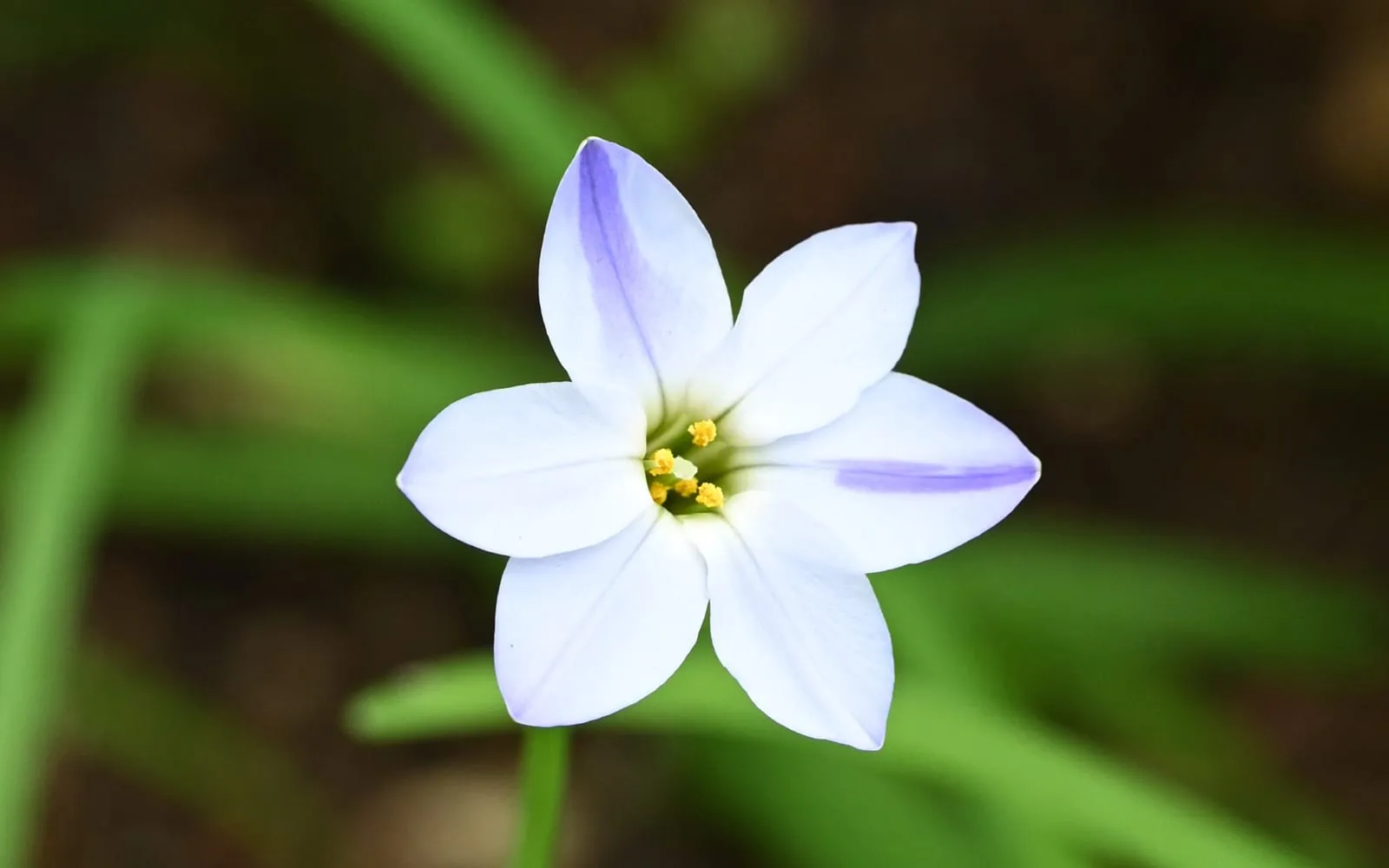
The flowers are very different from the leaves. Where the foliage smells sharp and pungent when bruised, the pale blue, star-shaped flowers carry a sweet fragrance, held just clear of the grassy leaves on slender stems.
It is one of the easiest bulbs, corms and tubers covered here, tolerating poor soil, considerable neglect and a wide swing of winter temperatures, and it responds to very little effort with a reliable spring display that spreads on its own from one planting.
Appearance and character
Narrow, grass-like leaves grow in loose tufts from a small bulb, staying close to the ground and persisting through winter in mild climates rather than dying back completely the way most spring bulb foliage does.
Each flower stem carries a single upward-facing, star-shaped bloom, six pointed petal-like segments in pale blue with a darker stripe down the centre of each, opening flat to around 3 cm across. White and deeper violet-blue selections exist alongside the species type, though the pale blue original remains the most widely grown.
The bulb is small, rarely more than 2 cm across, with a fibrous outer covering and a habit of producing offset bulblets freely at its base, which is the main mechanism behind the plant’s steady spread once established.
Flowering runs for several weeks in spring, considerably longer than many comparably sized bulbs manage, since new flower stems continue to appear from the clump over that period instead of opening all at once and finishing together.
Where it is from
The temperate lowlands and grassland of Argentina and Uruguay, part of the Rio de la Plata basin in southern South America, where it grows in open grassy ground instead of woodland or mountain habitat.
That native range is the useful clue: it is temperate grassland, not Mediterranean habitat. This accounts for two things about how the plant behaves in cultivation: tolerance of more winter cold than a South American origin might suggest, and a lack of the strict dry summer dormancy that bulbs from a true Mediterranean or Central Asian climate demand. It copes readily with occasional summer moisture instead of needing to bake completely dry.
The plant reached European cultivation in the nineteenth century and has since naturalised in parts of the Mediterranean, the southern United States and elsewhere with a broadly compatible climate, spreading from gardens into waste ground and roadside verges in places where conditions particularly suit it.
How it grows
A bulbous perennial that multiplies steadily through offset bulblets formed at the base of the parent bulb, producing an expanding clump from a single initial planting within a few years.
Plant bulbs about 8 cm deep and 5 to 8 cm apart in early to mid autumn, in any reasonably free-draining soil. It is unfussy about soil type and copes with poor, thin ground far better than many spring bulbs, provided drainage is adequate.
Growth appears in autumn in mild climates, where the foliage stays green right through winter, or in early spring in colder areas where the leaves die back completely over the cold months. Flowering follows in early to mid spring regardless of when the foliage first appeared.
Left in place, a planting increases both in the size of individual clumps and in the number of clumps across a bed, spreading gradually into surrounding ground. Division is rarely necessary but can be done after flowering if a particular clump has become congested or if pieces are wanted for a new area.
Through the seasons
Autumn is planting time, in September or October, and in mild climates also the point at which the evergreen foliage begins its main flush of fresh growth.
Winter sees the foliage persist through mild winters or die back completely where the cold is more severe, with growth resuming as temperatures rise in late winter.
Spring is the main flowering period, typically March through May, running for several weeks as successive flower stems open from the clump.
Summer brings a gradual dying back of the foliage as temperatures rise and the soil dries, though in the mildest and dampest climates some green growth can persist through the year instead of a complete summer dormancy.
Care difficulty
Easy, and about as low-maintenance as a garden bulb gets. It tolerates poor soil, a fair range of winter cold, and long stretches of complete neglect, and once planted it largely gets on with spreading and flowering without further attention.
The main consideration is where to put it, since a spot it likes will see it spread steadily over the years, filling gaps in a border or a gravel garden in a way that is either a welcome bonus or a mild nuisance depending on how tidy the surrounding planting is meant to look.
Watering
Water occasionally through active growth in autumn, winter and spring to keep the soil from drying out completely, though established plantings generally cope on natural rainfall alone in most temperate climates.
Little to no watering is needed through the summer dormant period, and the plant tolerates a dry summer without difficulty, unlike some of the more demanding true desert and steppe bulbs that need a strictly baked rest.
Overwatering in heavy, poorly drained soil is a greater risk to the bulb than underwatering at any point in the year.
Warning signs, diseases and pests
Slugs occasionally graze the softest new leaves in a wet spring, though established clumps generally tolerate minor damage without any noticeable effect on flowering.
Bulb rot is uncommon and appears only where the soil stays consistently waterlogged for extended periods, showing as clumps that fail to appear or that come up weak. Improving drainage is the only useful fix, since the bulb otherwise tolerates a wide range of conditions with little trouble.
The plant’s own vigorous spread is the closest thing to a recurring problem. In a favourable spot with free-draining soil and reasonable light, a planting can colonise further than intended within a handful of years, and controlling it means lifting and removing unwanted clumps rather than treating any pest or disease.
Growing environment
Full sun to light shade both suit it well, with full sun generally giving the strongest flowering, particularly in a cooler climate where extra warmth helps.
Free-draining soil is the main requirement, and beyond that it copes with a wide range of soil types and fertility levels, including poor ground where richer plants would struggle.
It performs particularly well at the front of a border, in a gravel garden, or naturalised in short grass, since the low, grassy foliage blends easily into a range of settings and does not demand a dedicated bed of its own.
Space bulbs 5 to 8 cm apart for an immediate effect, though a looser scattering fills in on its own within a season or two given the plant’s natural tendency to spread.
Feeding
Very little feeding is required. The plant is adapted to open grassland instead of rich cultivated soil, and richer feeding tends to encourage leafy growth instead of improving the flower display.
On poor or exhausted soil, a light application of balanced granular feed in early spring, as new growth appears, gives a struggling clump a boost, though most established plantings need nothing at all from one year to the next.
Troubleshooting
Why do the leaves smell like onion? It is a relative of onion and garlic, sitting in the same subfamily within Amaryllidaceae. The scent comes from the same family of sulphur compounds, though the plant is grown for its flowers instead of as a food crop.
The flowers smell completely different from the leaves. That is normal and one of the plant’s contrasts. The star-shaped flowers carry a sweet fragrance despite the pungent, oniony smell of the crushed foliage.
How deep should I plant the bulbs? About 8 cm deep, 5 to 8 cm apart, in early to mid autumn.
It has spread well beyond where I planted it. That is typical, vigorous growth via offset bulblets not a problem. Lift and remove unwanted clumps if it needs containing, ideally after flowering has finished.
Does the foliage die back in winter? It depends on climate. In mild areas it stays evergreen through the cold months; in colder gardens it dies back and re-emerges the following spring.
It barely flowered this year. Usually overcrowding in an old clump, or too little sun. Established plantings occasionally benefit from thinning if flowering visibly declines after several strong years.
Is it dangerous to my dog or cat? It contains the same class of compound found in onion and garlic, and a large ingestion could cause the same kind of red blood cell damage. The small bulb size and strong smell make a dangerous amount unlikely in practice, but keep an eye on a pet that digs in the border.