
Edible
Shallot
Allium cepa var. aggregatum
Also known as Banana shallot, Echalion, Eschalot
How to grow shallots, Allium cepa var. aggregatum. Planting sets in autumn or spring, why one bulb becomes a dozen, and drying them properly for storage.
At a glance
- Difficulty
- Easy
- Water
- Weekly in a dry spring, and stop once the bulbs swell
- Light
- Full sun
- Temperature
- Fully hardy. Autumn-planted sets stand a temperate winter
- Hardiness
- USDA 3-9, RHS H5, hardy to -15 C
- Type
- Biennial grown as an annual
- Height
- 30-45 cm
- Native to
- Central and south-west Asia
- Best month
- March in the Northern Hemisphere, September in the Southern Hemisphere
The same daylength rule that governs onion governs shallot, so a cultivar bred for one latitude splits poorly ten or fifteen degrees away. Autumn-planted sets stand a cold winter and start away earlier. Warm-winter growers plant in late winter instead and accept a smaller cluster.
Hardiness zones describe winter cold alone. Summer heat, humidity, rainfall and the length of the growing season decide as much, so treat the range as the outer limit rather than as a recommendation.
Every month named in this guide is for the temperate Northern Hemisphere. If you garden in the Southern Hemisphere, shift each one by six months, so March becomes September. Closer to the equator the wet and dry seasons matter more than the calendar, and the shift stops being a useful guide.
Toxic to pets if eaten
- Safe to eat
- The bulbs and the green leaves, for people
- Harm from
- Eating it
- Affects
- Cats, dogs and horses
Shallots are a food crop and entirely safe for people. They are not safe for pets. Every Allium, including onion, garlic, leek, chives and shallot, contains N-propyl disulphide and related organosulphur compounds that damage red blood cells in cats, dogs, horses and cattle, causing Heinz body haemolytic anaemia. The ASPCA lists the genus as toxic to all three, and cats are the most sensitive. Symptoms appear over one to several days rather than immediately, and include lethargy, pale gums, rapid breathing and reddish urine. Cooking does not destroy the compounds, so cooked leftovers, gravy, stuffing and onion powder all carry the same risk, and powdered forms are more concentrated by weight than fresh. A dog that has eaten shallots needs veterinary advice rather than observation at home. For people the only caution is that the sulphur compounds irritate eyes when cutting, which is the same mechanism as an onion and milder.
Sources: ASPCA (Onion, Allium species), RHS potentially harmful garden plants
About
A shallot is an onion that divides. Plant one set and you lift a cluster of six to twelve bulbs, which is the best return on effort of anything in the vegetable garden and the reason shallots have always been a staple of the small plot.
They are also easier than onions. Shallots go in earlier, stand harder winters, tolerate poorer soil, store far longer, and are less troubled by most of the things that spoil an onion crop.
The flavour is worth the ground they take. Sweeter and more concentrated than an onion, without the harshness, which is why French cooking uses them where British cooking reaches for an onion.
Two types are sold. Traditional round shallots divide into many small bulbs. Banana shallots, sold as echalion, are longer and produce two or three larger bulbs, and they are easier to peel.
Appearance and character
A clump of hollow, cylindrical, blue-green leaves rising 30 to 45 cm from a cluster of bulbs at soil level.
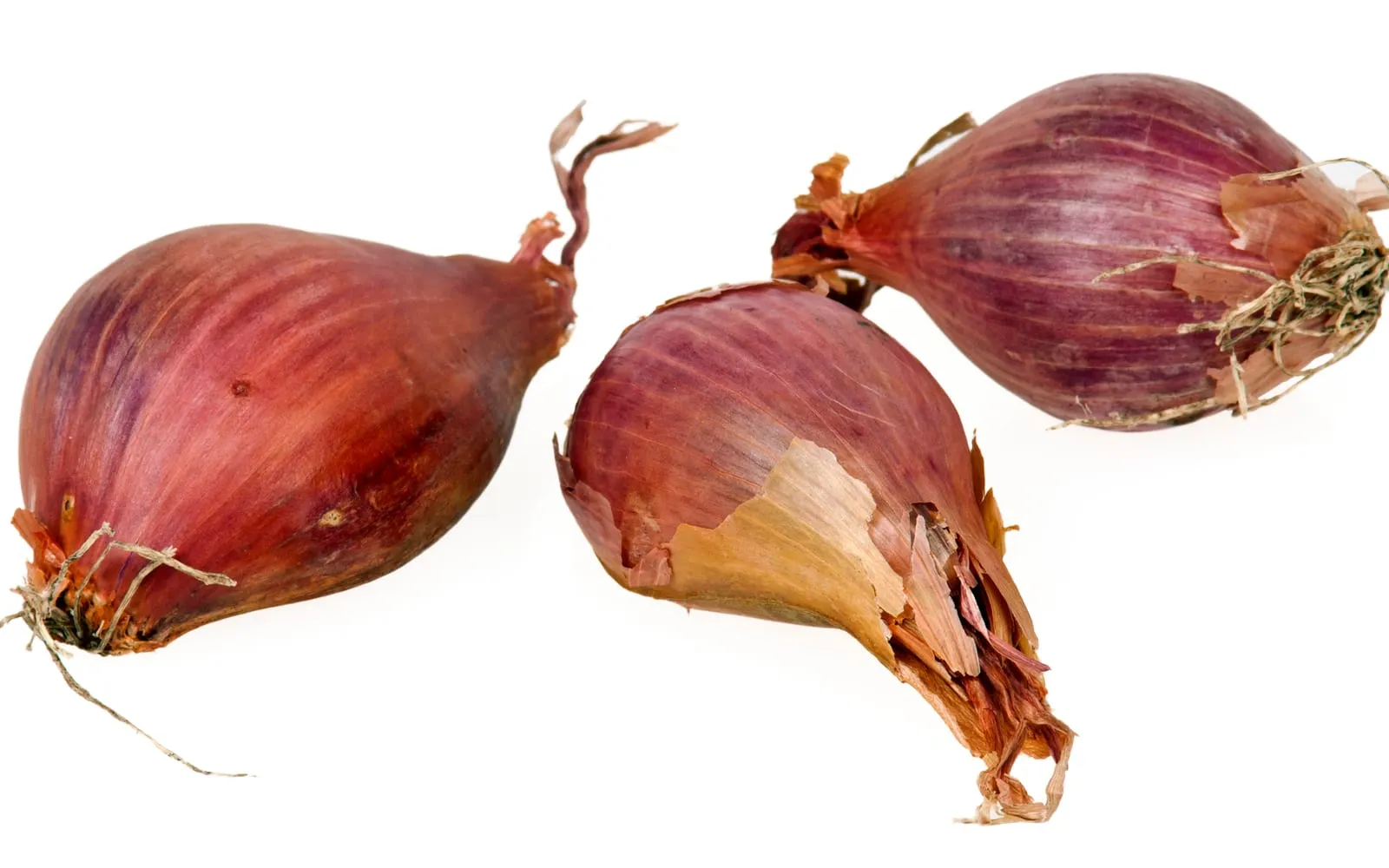
Bulbs are the crop. Round shallots are squat and angular where they press against each other, in copper-brown, red or yellow skin. Banana shallots are elongated, 8 to 12 cm long, with a smoother pink-brown skin.
Flesh is white, sometimes tinged pink or purple, in fine concentric layers tighter than an onion’s.
Flowers appear only if the plant bolts, on a hollow stem to 60 cm carrying a rounded head of small pale flowers.
Flavour is sweeter and more delicate than an onion, with a nutty note, and it does not turn harsh when raw.
Where it is from
Shallots are a form of Allium cepa, the same species as the onion, selected for a dividing habit. They are usually treated as var. aggregatum, the aggregate onion group, which also contains potato onions and ever-ready onions.
The wild ancestor of Allium cepa is unknown, which is unusual for such an important crop, and central and south-west Asia is the presumed homeland.
The name comes through Old French eschalotte from Latin Ascalonia, referring to Ascalon in the Levant, which mediaeval Europeans believed was the plant’s source.
Crusaders are traditionally credited with bringing them to western Europe, though they were probably already there.
France made them a culinary staple, and the Brittany and Loire regions still produce most of the European crop. Britain has grown them on allotments for centuries, largely because a single set gives a dozen bulbs.
How it grows
Plant sets rather than seed. Sets are small bulbs and are what almost everybody uses, though seed-raised shallots such as ‘Ambition’ avoid the virus that builds up in sets over years.
Plant in autumn, from October to November, or in spring from February to March. Autumn planting gives larger bulbs and carries a bolting risk.
Push each set into firm soil so the tip is just showing, 15 cm apart in rows 30 cm apart. Do not push them into hard ground, which pushes the roots back out as they grow.
Firm the soil around each set and net against birds, which pull newly planted sets out for the first fortnight.
Keep the rows weed-free. Shallots have shallow sparse roots and compete badly.
Stop watering once the bulbs start to swell in June.
Lift in July when the foliage yellows and falls over. Do not bend the tops down by hand, which was long advised and damages the neck.
Through the seasons
Autumn is the first planting window, from October to November, for the largest bulbs. Firm the sets in and net against birds.
Late winter and early spring take the second planting, from February to March, which is the safer option in a cold garden.
Spring is weeding and watering. Keep the rows clean and give a potash dressing in March.
Early summer swells the bulbs. Stop watering and feeding in June and let the clusters ripen.
Midsummer is the harvest. Lift in July when the foliage yellows, dry the bulbs thoroughly in the sun or under cover for two to three weeks, then separate the cluster and store.
Care difficulty
One of the easiest crops in the collection, with one serious caveat.
Allium white rot is the disease that ends onion growing on a plot. It shows as yellowing wilting plants with white fluffy fungus and small black bodies at the base, and the resting bodies survive in soil for fifteen to twenty years. There is no cure and no treatment. Rotate on at least four years, never move soil from an infected bed, and never plant sets into ground where it has appeared.
Weed control is the routine job, because shallots compete poorly.
Firm planting matters. A set pushed into hard ground lifts itself out as the roots grow.
Drying properly is what decides whether the crop stores for nine months or rots by Christmas.
Bolting is the risk of autumn planting.
Watering
Water weekly in a dry spring while the leaves are growing.
Stop watering once the bulbs begin to swell in June. Water at that stage produces soft bulbs that rot in store, and this is the most useful watering rule for any allium.
Water at the base rather than over the foliage, which reduces downy mildew and rust.
Avoid mulching heavily against the bulbs, which keeps the necks damp and encourages rot.
Shallots tolerate dry conditions much better than wet ones.
Container growing works in a pot 25 cm deep, and yields are lower than in the ground.
Warning signs, diseases and pests
Allium white rot is the one that matters. Leaves yellow and wilt, the plant pulls up easily, and the base carries white fluffy growth with small black resting bodies. It persists in soil for up to twenty years. Remove and destroy affected plants, do not compost them, and grow alliums elsewhere.
Onion fly larvae tunnel into the bulbs and the plants yellow and collapse. Cover with fine mesh from planting, and avoid disturbing the soil in warm weather, since the smell attracts the adults.
Downy mildew shows as pale patches and grey furry growth on the leaves in a wet spring. Space the plants, water at the base, and remove affected leaves.
Rust brings orange pustules on the leaves and rarely reduces the crop significantly.
Bolting sends up a flower stem, most often on an autumn-planted set that met a cold spell. Remove the stem, and use that bulb first since it will not store.
Birds pull newly planted sets out of the ground. Net for the first fortnight.
Soft bulbs rotting in store mean they were lifted too green or dried too little.
Growing environment
Full sun.
Free-draining, firm, moderately fertile soil. Shallots dislike heavy wet ground and rot in it over winter.
Neutral soil, pH 6.5 to 7.
Firm ground rather than freshly dug. Plant into a bed that has settled after an earlier crop.
Never plant into freshly manured ground, which gives soft bulbs that store badly. Manure the previous autumn for a preceding crop.
Rotate on at least four years with onions, garlic, leeks and chives, which is the only defence against white rot.
Raised beds help on heavy soil, particularly for autumn planting.
Feeding
Shallots need little. Compost dug in the autumn before is enough on most soils.
A dressing of sulphate of potash at 15 g per square metre in March suits them.
Avoid nitrogen, which gives soft bulbs with thick necks that store badly.
Never use fresh manure.
Stop all feeding in June when the bulbs start to swell.
Troubleshooting
The sets were pulled out of the ground. Birds, in the first fortnight after planting. Net the bed, and firm each set in properly.
One set gave one bulb rather than a cluster. Either a banana shallot type, which naturally divides into two or three larger bulbs, or a plant checked by drought or poor soil.
Yellowing wilting plants with white fluff at the base. Allium white rot. There is no cure. Remove and destroy the plants, and do not grow any allium on that ground for at least eight years, though the fungus can persist for twenty.
A flower stem appeared. Bolting, usually on an autumn-planted set after a cold spell. Remove the stem and eat that bulb first.
The bulbs rotted in store. Lifted too green, dried too little, or fed nitrogen. Lift when the foliage yellows, dry for two to three weeks, and skip the nitrogen.
Tunnels through the bulbs. Onion fly larvae. Cover with fine mesh from planting.
Should I plant in autumn or spring? Autumn gives bigger bulbs and carries a bolting risk and a rot risk on heavy soil. Spring is safer. On free-draining ground in a mild garden, autumn is worth it.
Should I bend the tops over? No. It was standard advice for decades and it damages the neck and lets rot in. Let the foliage fall naturally.
Shallot problem guides
Not sure what is wrong? See the common vegetable pests guide.