
Edible
Welsh Onion
Allium fistulosum
Also known as Japanese bunching onion, Negi, Ciboule, Spring onion
How to grow Welsh onions, Allium fistulosum. The perennial spring onion that never makes a bulb, dividing the clump, and cutting it through the winter.
At a glance
- Difficulty
- Easy
- Water
- Weekly in a dry summer
- Light
- Full sun to light shade
- Temperature
- Fully hardy to about -20 deg C, evergreen in a mild winter
- Hardiness
- USDA 4-9, RHS H6, hardy to -20 C
- Type
- Hardy perennial, clump-forming
- Height
- 30-50 cm, and 60 cm in flower
- Native to
- China
- Best month
- April in the Northern Hemisphere, October in the Southern Hemisphere
It never forms a bulb, which frees it from the daylength rule that ties onions and shallots to a latitude. That is what makes it the most portable allium of the group, cropping from the subarctic to the subtropics off the same seed. Cold cuts it back and it returns, and in a mild winter it stays green and is picked all year.
Hardiness zones describe winter cold alone. Summer heat, humidity, rainfall and the length of the growing season decide as much, so treat the range as the outer limit rather than as a recommendation.
Every month named in this guide is for the temperate Northern Hemisphere. If you garden in the Southern Hemisphere, shift each one by six months, so April becomes October. Closer to the equator the wet and dry seasons matter more than the calendar, and the shift stops being a useful guide.
Toxic to pets if eaten
- Safe to eat
- The leaves and the white stem bases, raw or cooked
- Harm from
- Eating it
- Affects
- Cats, dogs and horses
Welsh onion is a food crop and entirely safe for people. It is not safe for pets. Every Allium contains N-propyl disulphide and related organosulphur compounds that damage red blood cells in cats, dogs, horses and cattle, causing Heinz body haemolytic anaemia. The ASPCA lists the genus as toxic to all three, and cats are the most sensitive. Signs develop over one to several days and include lethargy, pale gums, rapid breathing and reddish urine. Cooking does not destroy the compounds, so cooked scraps and leftovers carry the same risk. A pet that has eaten a quantity needs veterinary advice rather than watching at home. The plant is a useful one to site thoughtfully for that reason, since it is perennial and evergreen and a dog has months in which to find it. For people the only caution is that the sulphur compounds irritate the eyes when cutting, and less than an onion does.
Sources: ASPCA (Onion, Allium species), RHS potentially harmful garden plants
About
The Welsh onion is a perennial spring onion that never forms a bulb. Plant it once and it makes an expanding clump that gives cuttable green leaves for years, including through most of a temperate winter, when nothing else in the allium bed is doing anything.
It is the plant most of what is sold as spring onion should be, and often is. Many commercial spring onion varieties are Allium fistulosum or hybrids with it, chosen because they stay slim rather than bulbing up.
The name is a puzzle worth clearing up. It has nothing to do with Wales. The word comes from Old German welsch, meaning foreign, and the plant is Chinese.
Appearance and character
A dense clump of hollow, cylindrical, upright leaves 30 to 50 cm tall, in a fresh mid-green, spreading slowly outwards from the base.
The stem base is white and thickened but never swells into a true bulb, which is the diagnostic difference from an onion or a spring onion grown from Allium cepa.
Leaves are thicker-walled and coarser than chives and finer than a leek.
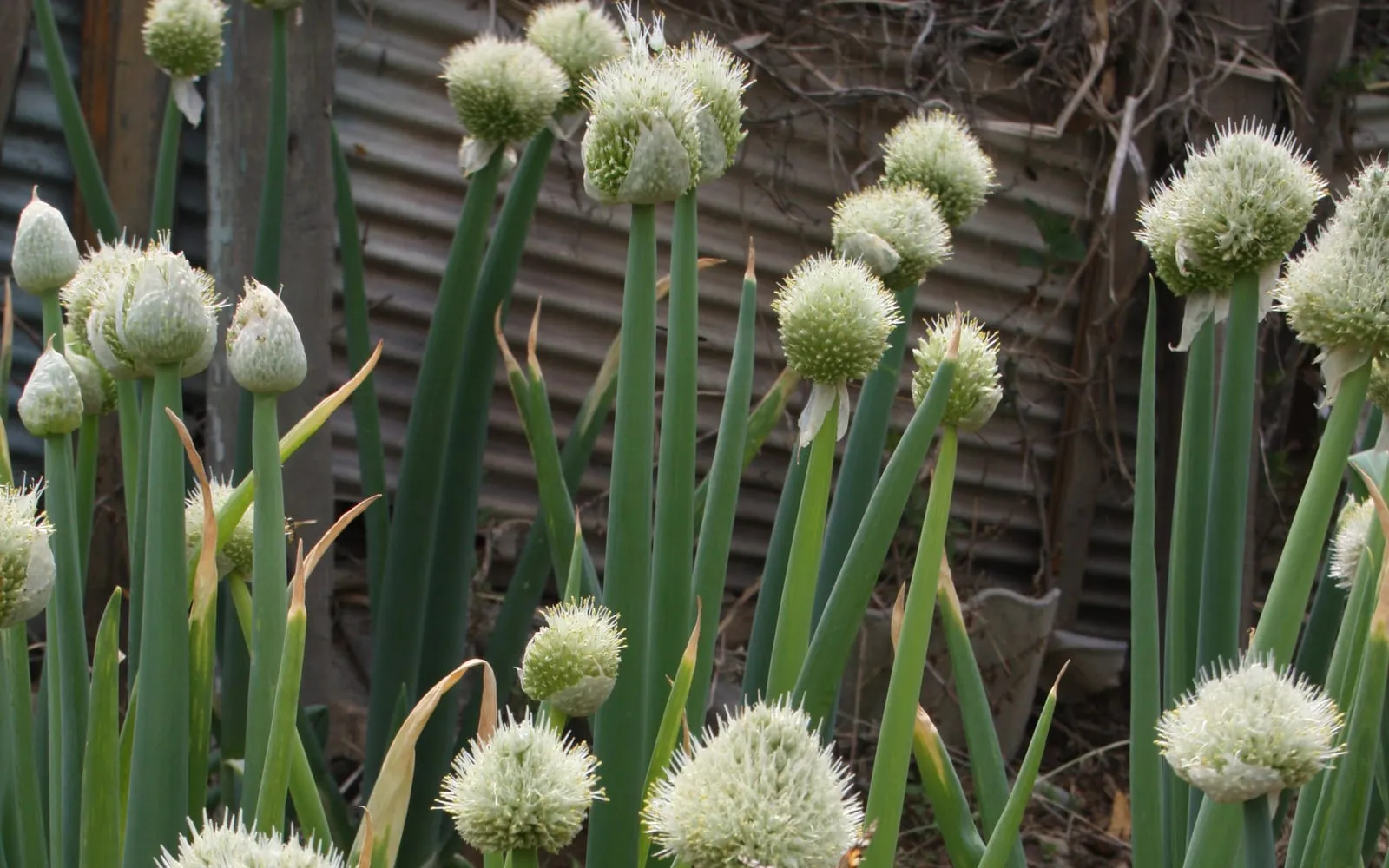
Flowers appear in the second year on hollow stems to 60 cm, in dense round heads of small greenish-white or cream flowers, and they are attractive to bees.
Small bulbils sometimes form in the flower head and can be planted.
Flavour is milder than an onion and stronger than chives, clean and slightly sweet, and the white bases are the best part.
Where it is from
Allium fistulosum is native to China, where it has been cultivated for at least two thousand years and is one of the foundational vegetables of the cuisine.
Japan grows it as negi and selected the long-white types that are blanched by earthing up, which are a different thing again from the thin green ones.
Russia and eastern Europe adopted it early through the steppe trade routes, and it reached western Europe in the Middle Ages, which is when the welsch name attached to it.
Britain has grown it in kitchen gardens since the sixteenth century and largely forgotten it in favour of annual spring onions, which have to be resown every few weeks.
It crosses with Allium cepa to produce the tree onion and several commercial spring onion hybrids.
How it grows
Sow direct from March to August at 1 cm deep in rows 25 cm apart, thinning to 10 cm, or start in modules and plant out.
Alternatively divide an established clump in spring or autumn, which is faster and gives an instant crop.
Germination takes ten to fourteen days.
Pick from twelve weeks. Cut individual leaves at the base, or lift whole stems from the edge of a clump and let the centre carry on.
Cut hard rather than picking over. A clump cut to 5 cm regrows within a fortnight through the growing season.
Divide the clump every three or four years in spring or autumn. Congested clumps produce thin weak leaves, and division is what keeps the plant productive.
For blanched Japanese-style stems, earth up around the plants through the summer as you would leeks.
Through the seasons
Early spring brings the first flush of growth, which is the best of the year. Divide congested clumps now, and mulch with compost.
Late spring takes sowings for new clumps. Cut regularly.
Summer is steady cutting. Water in dry weather to keep the leaves tender. Remove flower stems unless you want seed or the bees, since flowering coarsens the leaves.
Autumn is a second good flush as the weather cools. Divide clumps now if you did not in spring.
Winter is the crop’s real advantage. Welsh onion stays green through most temperate winters and is cuttable in January when nothing else is. Growth is slow, so cut sparingly.
Care difficulty
Among the easiest crops in this collection. Plant it once and it looks after itself.
Dividing every three or four years is the only maintenance that matters. An undivided clump becomes congested, and the leaves get thin and tough.
Removing flower stems keeps the leaves in better condition.
White rot is the disease that would end it, as with every allium, and rotation is impossible for a perennial. Plant it in ground with no allium history and keep it there.
Nothing else troubles it much. It is hardier than chives, tougher than spring onions, and largely ignored by pests.
Watering
Water weekly in a dry summer to keep the leaves tender.
An established clump has a good root system and survives drought, producing tougher leaves through it.
Water immediately after a hard cut, which drives the regrowth.
Water at the base rather than over the foliage, which reduces rust and downy mildew.
Avoid winter waterlogging, which rots the crowns on heavy ground.
Container growing works well in a pot 25 cm deep and is a good way to keep it away from dogs.
Warning signs, diseases and pests
Allium white rot yellows and wilts the plants, with white fluffy growth and small black bodies at the base. There is no cure and the resting bodies survive in soil for up to twenty years. Since this is a perennial that cannot be rotated, plant it in clean ground and never move soil or divisions from an infected bed.
Downy mildew brings pale patches and grey growth on the leaves in a wet season. Divide congested clumps to improve airflow and water at the base.
Rust brings orange pustules on the leaves. Cut the clump hard and the regrowth is usually clean.
Onion fly attacks it less than it does bulb onions, and larvae occasionally tunnel the stem bases.
Leek moth caterpillars mine the leaves wherever that pest has established. Cover with fine mesh from May where it is a known problem.
Thin weak leaves mean a congested clump. Divide it.
Growing environment
Full sun to light shade. It crops usefully in less sun than most alliums need.
Free-draining, moderately fertile soil. Heavy wet ground rots the crowns over winter.
Neutral soil, pH 6.5 to 7.
A permanent position outside the rotation, since this is a perennial that will stay put for years.
Ground with no history of allium white rot, which matters more here than for an annual crop because the plant cannot be moved on a rotation.
Raised beds help on heavy soil.
Site it away from where a dog has free run, given the toxicity to pets and the plant’s year-round presence.
Feeding
Mulch with compost each spring, which is all an established clump needs.
Feed with a balanced liquid feed after each hard cut through the growing season.
Avoid heavy nitrogen, which gives soft floppy leaves.
Never use fresh manure.
A newly divided clump benefits from compost worked into the planting hole.
Troubleshooting
Thin, tough, weak leaves. A congested clump. Lift it in spring or autumn, split it into pieces of three or four shoots, and replant.
It never made a bulb. Correct. Welsh onion does not form bulbs. That is the difference between it and a true onion, and the reason it is perennial.
Flower heads appeared and the leaves got coarse. Normal from the second year. Cut the stems off as they rise unless you want seed or want the bees to have them.
Yellowing plants with white fluff at the base. Allium white rot. There is no cure. Remove and destroy the plants, and never plant alliums in that ground again for at least eight years.
Orange pustules on the leaves. Rust. Cut the clump to 5 cm and the regrowth is usually clean.
The crowns rotted over winter. Waterlogging on heavy ground. Grow in a raised bed or a container.
Is this the same as a spring onion? Often, yes. Many commercial spring onion varieties are Allium fistulosum or hybrids with it, chosen because they stay slim. The difference is that this one is perennial.
Why is it called Welsh? From Old German welsch, meaning foreign. The plant is Chinese and has no connection to Wales.
Welsh Onion problem guides
Not sure what is wrong? See the common vegetable pests guide.