
Edible
Roman Chamomile
Chamaemelum nobile
Also known as English chamomile, Perennial chamomile, Lawn chamomile
How to grow Roman chamomile, Chamaemelum nobile. The perennial mat for a chamomile lawn, the non-flowering Treneague form, and how it differs from the German chamomile in a tea bag.
At a glance
- Difficulty
- Moderate
- Water
- Weekly in dry weather until established, then rarely
- Light
- Full sun
- Temperature
- Hardy to about -15 deg C
- Hardiness
- USDA 4-9, RHS H5, hardy to -15 C
- Type
- Hardy evergreen perennial
- Height
- 10-30 cm
- Native to
- western Europe, the Mediterranean
- Best month
- June and July in the Northern Hemisphere, December and January in the Southern Hemisphere
A perennial mat rather than an annual, and it takes being walked on, which is what made chamomile lawns possible. For a lawn the cultivar matters, since the non-flowering 'Treneague' stays even where the seed-raised plant throws flower stems. Sharp drainage and full sun keep it dense.
Hardiness zones describe winter cold alone. Summer heat, humidity, rainfall and the length of the growing season decide as much, so treat the range as the outer limit rather than as a recommendation.
Every month named in this guide is for the temperate Northern Hemisphere. If you garden in the Southern Hemisphere, shift each one by six months, so June becomes December. Closer to the equator the wet and dry seasons matter more than the calendar, and the shift stops being a useful guide.
Skin irritant
- Safe to eat
- Flowers, for tea
- Do not eat
- The foliage, which causes contact dermatitis in sensitive people
- Harm from
- Handling it and eating it
- Affects
- People
Roman chamomile is used for tea and it is safe for most people in that use. Two cautions matter. The first is contact dermatitis: handling the foliage repeatedly causes a rash in some people, and the RHS lists chamomile among plants that may cause skin allergy. The second is the daisy family allergy. Anyone allergic to ragweed, chrysanthemum or other Asteraceae can react to chamomile, and reactions to chamomile tea, although rare, have included anaphylaxis. The ASPCA lists chamomile, naming Anthemis nobilis, as toxic to dogs, cats and horses, with vomiting, diarrhoea and dermatitis after prolonged exposure. That describes an animal grazing quantities of it rather than a plant in a garden. Roman chamomile is a common lawn plant and it is not a poisoning risk for ordinary garden use.
Sources: ASPCA (Chamomile, Anthemis nobilis), RHS potentially harmful garden plants
About
Roman chamomile is the perennial one, and it is the plant to use for a chamomile lawn or a chamomile seat. It creeps, roots as it spreads and forms a dense green mat of fine feathery foliage that smells of apples when you tread on it.
German chamomile is the annual in the tea bag. Both are used for tea and the German one is what almost every commercial product contains, being an upright annual grown by the hectare. If you want tea, sow German chamomile. If you want ground cover, plant this.
The form to look for in a lawn is Treneague, which does not flower at all. A flowering chamomile lawn looks charming for a fortnight and then looks untidy for two months, and Treneague avoids that entirely by never producing a bud.
Appearance and character
A low spreading mat, 10 to 30 cm tall in flower and much flatter in the non-flowering form, rooting from the stems as it creeps outwards.
Leaves are finely divided into thread-like segments, soft, bright green and slightly hairy, holding through mild winters.
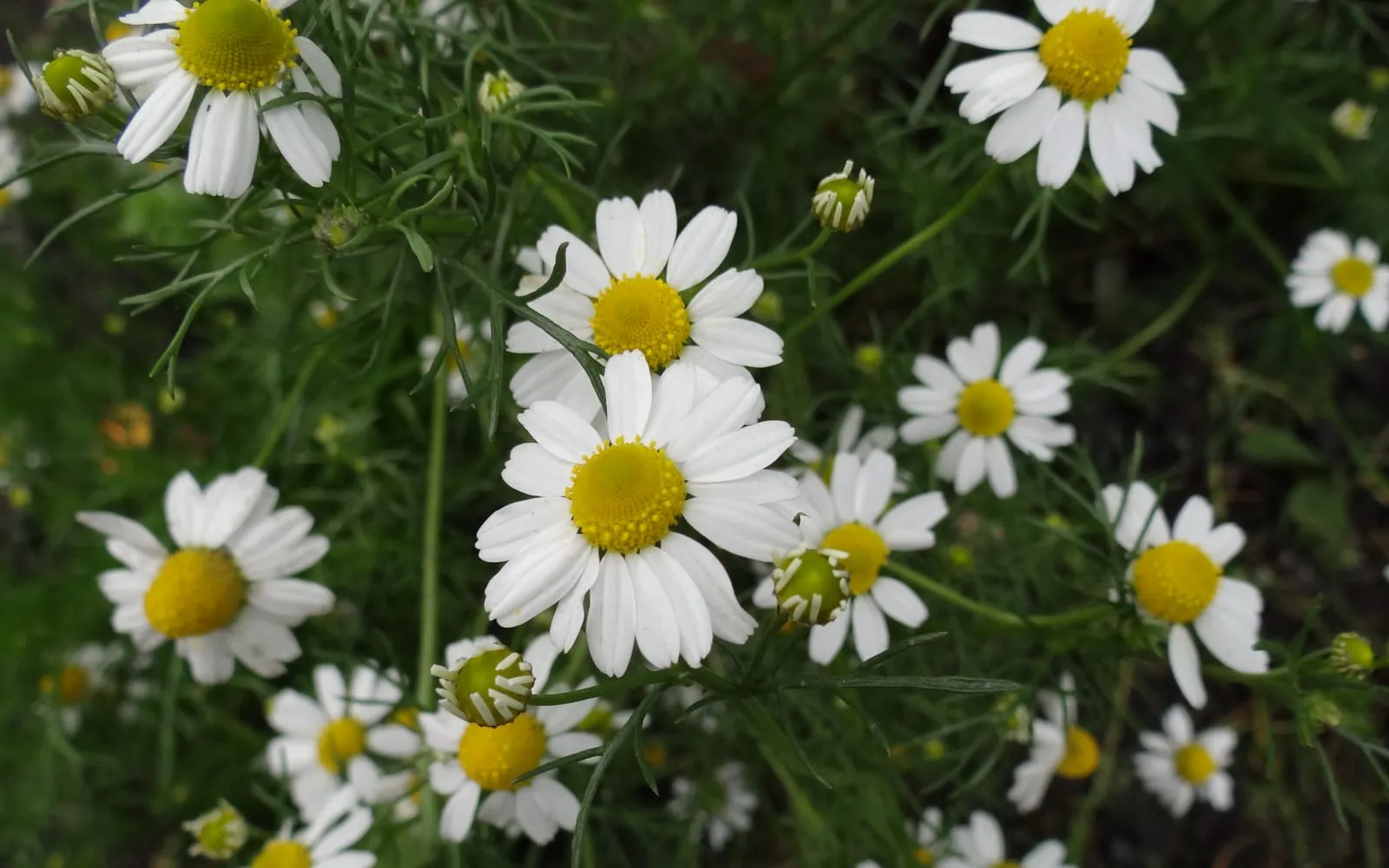
Flowers are small daisies, 2 cm across, with white petals around a solid domed yellow centre. The petals reflex downwards as the flower ages.
The solid centre is the character that separates it from German chamomile, whose flower centre is hollow. Split one in half to check.
The scent is apples, released by pressure, and it is stronger and sweeter than German chamomile’s.
Double-flowered forms exist and are grown for ornament rather than for tea. The double flower has more petals and less of the useful centre.
Where it is from
Roman chamomile is native to western Europe and north Africa, growing on sandy commons, heaths and short grassland, and it is a scarce British native found mostly in the New Forest and parts of the south-west.
The name Roman is misleading. The plant was named in the sixteenth century by a botanist who found it growing near Rome, and its actual centre of distribution is Atlantic western Europe rather than Italy.
Chamomile lawns are a real English tradition rather than a modern invention. Chamomile was grown as a lawn plant in Tudor gardens, and one of the best known examples is at Buckingham Palace.
Its medicinal use ran alongside German chamomile for centuries, and both were used for digestion, sleep and inflammation. The essential oil is still produced, mostly in England and France, and English chamomile oil is a recognised commercial grade.
Grazing kept it in the landscape. Roman chamomile survives where turf is short and heavily grazed, and it declined as commons were enclosed and improved.
How it grows
Buy plants for a lawn and use the non-flowering Treneague form, which comes only from cuttings or division. Seed produces flowering plants that vary.
Sow seed in spring at 18 deg C for ordinary plants, surface sown and pressed in rather than covered.
Take cuttings or divide rooted pieces in spring or early autumn. Both root readily.
For a lawn, prepare the ground thoroughly. Remove every perennial weed, add sand or grit to anything heavy, firm and level it, and plant at 15 to 20 cm spacing.
Weed by hand for the first two seasons while the mat knits. This is the whole job, and there is no selective weedkiller that will help.
Trim a flowering lawn after the flowers fade, using shears or a mower on its highest setting. Treneague needs no cutting at all.
Harvest flowers for tea on a dry morning as they open fully, and dry them on a tray in a warm airy place.
Replant bare patches with rooted pieces from the edge each spring.
Through the seasons
Winter keeps the mat green in a mild year. Sweep leaves off, since anything lying on chamomile kills the patch beneath.
Spring brings growth from March. Plant, divide and take cuttings now, and weed the lawn while the weeds are small.
Early summer is flowering, from June, on any form except Treneague. Pick the flowers for tea as they open.
Midsummer is the time to trim a flowering lawn once the display finishes.
Autumn is a second planting season. Keep leaf litter off the mat, which is the main autumn job and the one most often skipped.
Care difficulty
Moderate as a lawn and easy as a plant, which is a wider gap than it sounds.
A single chamomile in a border is undemanding. It wants sun and sharp drainage and nothing else.
A chamomile lawn is a project. It takes two seasons to knit, it needs hand weeding throughout that time, it will not tolerate the traffic grass takes, and it thins out in shade and in wet ground. People who have seen one at a great house tend to underestimate all of that.
Weeding is the real difficulty. Once a perennial weed roots inside the mat there is no way to remove it without tearing the chamomile, and no chemical option exists that leaves the chamomile standing.
Drainage decides survival. On heavy wet clay the mat rots out over winter.
Choose Treneague for any lawn. Flowering forms look untidy for months after the display and need cutting back.
Watering
Water new plants weekly through their first summer while they root and knit together.
An established mat needs little watering, and it survives a dry summer by going brown and recovering in autumn.
Water a lawn in a prolonged drought if you want it to stay green, giving a thorough soak rather than a daily sprinkle.
Water a container weekly in summer and let it dry between times. Shallow pans suit it better than deep pots.
Avoid watering in the evening onto the foliage, which encourages mildew in a dense mat.
Keep it on the dry side through winter, which mostly means keeping the drainage right rather than doing anything.
Warning signs, diseases and pests
Root rot in wet ground is the usual cause of a lawn failing. Patches go brown, die and lift away. There is no cure beyond improving the drainage before replanting.
Weeds rooted in the mat are the commonest complaint. Pull them by hand, accept some damage, and clean the ground thoroughly before planting next time.
Bare patches from foot traffic mean the lawn is taking more use than chamomile can stand. Put stepping stones through it.
Powdery mildew whitens the foliage in a damp crowded position. Improve the airflow.
Aphids gather on flower buds and rarely need action.
Moss taking over means too much shade and too much wet.
A mat that goes brown in August is dormant from drought rather than dead, and it usually greens up again in September.
Growing environment
Full sun. Roman chamomile in shade thins, opens up and is taken over by moss and weeds.
Light, free-draining, sandy soil. This is a plant of heaths and sandy commons. Heavy clay needs a great deal of sand and grit worked in, and even then a lawn on clay is a struggle.
Slightly acid to neutral, around pH 5.5 to 7.
A small area is the right scale. A chamomile lawn of a few square metres in a sunny sheltered spot works. An entire garden of it does not.
Paths, seats and the gaps between paving are all traditional positions and all work better than open lawn, because the traffic is concentrated where the plant is not.
A chamomile seat, which is a raised bed planted with it, is the historical use and the one that suits the plant best.
Feeding
None. Fed chamomile grows lax, opens up and lets weeds in, which is the opposite of what a lawn needs.
Do not use lawn fertiliser on a chamomile lawn. It feeds the grass and weeds far more than the chamomile.
Sharp sand as a top dressing in spring is more useful than any feed, filling hollows and helping the stems root.
A container plant takes a weak balanced feed once in spring and needs nothing else.
Poor soil is the plant’s natural condition and improving it works against you.
Troubleshooting
Which chamomile do I want? Roman chamomile for a lawn or ground cover, since it is perennial and mat-forming. German chamomile for tea, since it is the annual that commercial tea is made from and it produces far more flowers.
My chamomile lawn is full of weeds. The usual outcome of planting into ground that was not cleared first. Hand weed, replant bare patches, and clear completely before starting again.
It died out in patches over winter. Wet ground. Chamomile needs sharp drainage, and clay will not support a lawn without heavy sand incorporation.
The lawn looks untidy after flowering. Use Treneague, which never flowers. Trim the flowering forms with shears once the display ends.
Can I walk on it? Lightly. It takes far less traffic than grass and wears through on a route used daily.
How do I tell the two chamomiles apart? Split a flower head. Roman chamomile has a solid domed centre; German chamomile has a hollow one. Roman chamomile also creeps and German chamomile stands upright.
I got a rash after weeding it. Contact dermatitis, which chamomile causes in some people. Wear gloves.