
Edible
Garlic Chives
Allium tuberosum
Also known as Chinese chives, Chinese leek, Gau choy, Nira
How to grow garlic chives, Allium tuberosum. Flat leaves with a garlic flavour, the white flowers worth eating, and stopping it seeding itself across the garden.
At a glance
- Difficulty
- Easy
- Water
- Weekly in a dry summer
- Light
- Full sun to light shade
- Temperature
- Fully hardy to about -20 deg C, dying back in winter
- Hardiness
- USDA 4-9, RHS H6, hardy to -20 C
- Type
- Hardy perennial, clump-forming from rhizomes
- Height
- 30 cm in leaf, 50-60 cm in flower
- Native to
- China and Mongolia
- Best month
- May in the Northern Hemisphere, November in the Southern Hemisphere
Heat suits it far better than it suits ordinary chives, and it crops through a subtropical summer that would stop the other dead. Winters below about -20 deg C cut it to the ground and it returns. It seeds itself freely and has naturalised across parts of North America and Australia, so cutting the flowers off before they set is worth the trouble.
Hardiness zones describe winter cold alone. Summer heat, humidity, rainfall and the length of the growing season decide as much, so treat the range as the outer limit rather than as a recommendation.
Every month named in this guide is for the temperate Northern Hemisphere. If you garden in the Southern Hemisphere, shift each one by six months, so May becomes November. Closer to the equator the wet and dry seasons matter more than the calendar, and the shift stops being a useful guide.
Toxic to pets if eaten
- Safe to eat
- The leaves, the flower buds and the open flowers
- Harm from
- Eating it
- Affects
- Cats, dogs and horses
Garlic chives are a food crop and entirely safe for people. They are not safe for pets. Every Allium contains organosulphur compounds that damage red blood cells in cats, dogs, horses and cattle, causing Heinz body haemolytic anaemia, and the ASPCA lists the genus as toxic to all three. Cats are the most sensitive. Signs develop over one to several days and include lethargy, pale gums, rapid breathing and reddish urine, and cooking does not destroy the compounds. A pet that has eaten a quantity needs veterinary advice. This species deserves particular thought because it is perennial, it self-seeds freely, and a garden that grows it for a few years tends to have it in several places, which gives a dog many opportunities. Keep it out of a lawn or a run where a dog grazes. For people the leaves and flowers are eaten raw and cooked with no caution beyond the usual eye irritation when cutting a large quantity.
Sources: ASPCA (Chives, Allium species), RHS potentially harmful garden plants
About
Garlic chives look like ordinary chives with the tube flattened out and taste of garlic rather than onion. They are perennial, hardy, and produce leaves from April to November from a clump that needs almost nothing.
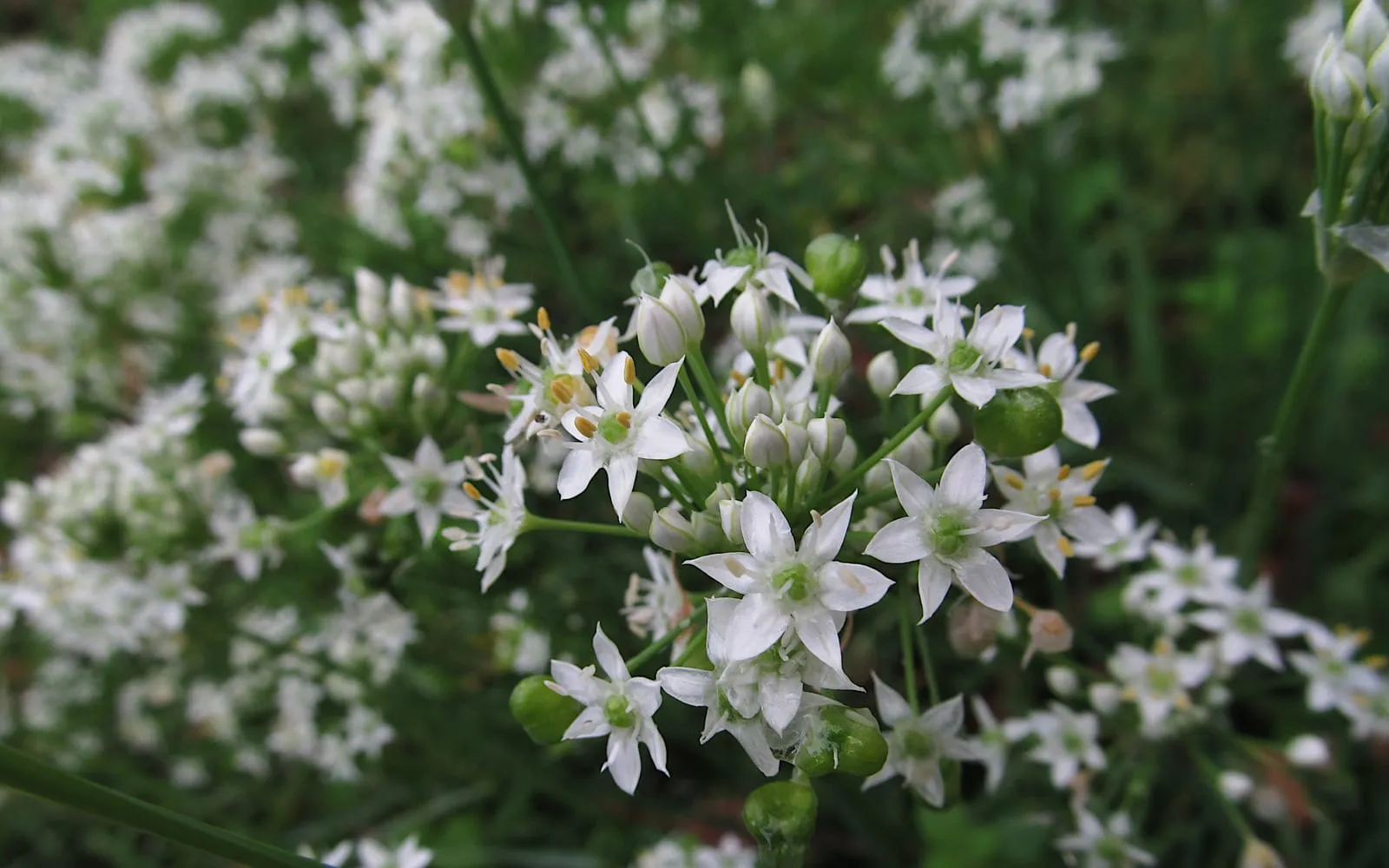
The white flowers in August and September are the second reason to grow them. They come in loose starry heads on stems above the foliage, they smell sweet rather than oniony, bees work them heavily, and both the unopened buds and the open flowers are eaten.
The one thing to stay ahead of is seeding. A clump left to ripen its seed heads puts garlic chives across a border, and the seedlings have a persistent little rhizome that makes them tedious to remove. Cut the flowers before the seed darkens and the problem disappears.
Appearance and character
A clump of flat, solid, strap-shaped leaves 20 to 30 cm long, in a dull grey-green, arising from short creeping rhizomes.
Flat leaves are the key identification. Common chives, Allium schoenoprasum, have round hollow tubular leaves. Garlic chives are flat and solid in cross section.
Flower stems rise to 50 or 60 cm in August and September, carrying loose umbels of small white star-shaped flowers with a green midrib on each petal.
The scent of the flowers is sweet and violet-like rather than oniony, which surprises people.
Seed follows in black angular grains from ripe capsules, and they germinate readily wherever they fall.
Flavour is a clean mild garlic, closer to a young green garlic than to a clove, and it is much better raw or briefly cooked than boiled.
Where it is from
Allium tuberosum is native to China and Mongolia, and it has been cultivated in China for at least three thousand years.
Chinese cooking uses it in several forms. Green garlic chives are the ordinary leaf, yellow chives are the same plant blanched under cover, and flowering chives are the stems cut with the buds still closed, each sold and cooked separately.
Japan, Korea, Vietnam and Nepal all use it heavily, as nira, buchu, he and dunduko respectively.
It reached Europe in the late eighteenth century as a botanical curiosity and took until the late twentieth to become a garden herb here.
It is naturalised across parts of North America and is a listed invasive plant in several states, which is a reasonable warning about its seeding habit.
How it grows
Sow direct or in modules from March to May at 1 cm deep. Germination takes two to three weeks and is slower than most alliums.
Alternatively divide an established clump in spring or autumn, which is quicker and gives a crop at once.
Thin or plant to 20 cm apart. The clumps expand and fill the space within two seasons.
Pick from the second year for a decent crop, and lightly in the first.
Cut the leaves at 2 cm above the ground rather than snipping the tips, which gives a tidier clump and better regrowth. Expect three or four cuts a season.
Cut the flower stems for the kitchen while the buds are still closed, which is the best way to eat them and stops the seeding.
Divide every three or four years in spring, since congested clumps give thin leaves.
Through the seasons
Early spring brings the first shoots in April. Divide congested clumps and mulch with compost.
Late spring and summer are the cutting season. Cut hard every few weeks, water in dry weather, and feed after each cut.
Late summer brings the flowers in August and September. Cut the stems with buds closed for the kitchen, and leave a few to open for the bees if you can deadhead them before the seed ripens.
Autumn gives a last flush of leaves before the plant dies back in November. Clear the dead foliage.
Winter is dormancy. The clump disappears entirely and returns in April. Mulch with compost in February.
Care difficulty
Easy, and among the least demanding perennials in the kitchen garden.
Deadheading is the one job that matters. Cut the flower stems before the seed ripens, or accept garlic chives as a permanent feature of the border.
Dividing every three or four years keeps the leaves thick and tender.
Cutting to the base rather than snipping the tips gives better regrowth and a tidier plant.
White rot is the disease that would end it, and since a perennial cannot be rotated, plant it into clean ground.
Nothing else needs doing. It is hardier than common chives, less prone to rust, and largely ignored by pests.
Watering
Water weekly in a dry summer to keep the leaves tender.
An established clump survives drought and produces tougher, stronger-tasting leaves through it.
Water immediately after each hard cut.
Water at the base rather than over the foliage, which reduces rust.
Avoid winter waterlogging, which rots the rhizomes on heavy ground.
Container growing suits it well in a pot 25 cm deep, and it has the useful side effect of containing the seeding and keeping the plant away from pets.
Warning signs, diseases and pests
Allium white rot yellows and wilts the plants with white fluffy growth and small black bodies at the base. There is no cure, and the resting bodies survive in soil for up to twenty years. Since a perennial cannot be rotated, plant into ground with no allium history.
Rust brings orange pustules on the leaves in a wet summer. Cut the clump to the ground and the regrowth is usually clean.
Downy mildew brings pale patches with grey growth in a wet season. Divide congested clumps for airflow and water at the base.
Slugs graze the young spring shoots, and the plant grows away from them.
Self-seeding is the main problem and is not a pest. Cut the flower stems before the seed darkens.
Thin weak leaves mean a congested clump that needs dividing.
Growing environment
Full sun to light shade.
Free-draining, moderately fertile soil. Heavy wet ground rots the rhizomes over winter.
Neutral to slightly acid, pH 6 to 7.
A permanent position outside the rotation, since it is a long-lived perennial.
Ground with no history of allium white rot.
Away from a lawn or a run where a dog grazes, given the toxicity to pets and the plant’s tendency to spread.
A container is a good answer to both the seeding and the pet question.
Feeding
Mulch with compost each spring, which is all an established clump needs.
Feed with a balanced liquid feed after each hard cut.
Avoid heavy nitrogen, which gives soft floppy leaves that flatten in rain.
Never use fresh manure.
A newly divided clump benefits from compost worked into the planting hole.
Troubleshooting
Garlic chives are coming up all over the border. The flower heads were left to seed. Cut the stems before the seed darkens. The seedlings have a small rhizome and are easier to remove when young.
Thin weak leaves. A congested clump. Lift it in spring, split it into pieces of five or six shoots, and replant.
Orange pustules on the leaves. Rust in a wet summer. Cut the clump to the ground and the regrowth is usually clean.
The plant vanished over winter. Normal. Unlike Welsh onion it is fully deciduous and disappears from November to April.
Yellowing plants with white fluff at the base. Allium white rot. There is no cure. Remove and destroy the plants and never plant alliums in that ground again.
The leaves taste of onion rather than garlic. Almost certainly common chives rather than garlic chives. Check the leaf. Round and hollow means common chives; flat and solid means garlic chives.
Can I eat the flowers? Yes, and they are the best part. Cut the stems with the buds still closed and cook them whole, or scatter the open flowers over a salad.
What are yellow chives? The same plant grown under a cover to exclude light, in the way sea kale and chicory are blanched. The leaves come up pale yellow and milder, and it is a standard Chinese market vegetable.
Garlic Chives problem guides
Not sure what is wrong? See the common vegetable pests guide.