
Edible
African Rice
Oryza glaberrima
Also known as Red rice, Glaberrima rice
How to grow African rice, Oryza glaberrima. A second independent domestication in the Niger delta, the red grain that crossed the Atlantic with the people who knew how to grow it.
At a glance
- Difficulty
- Moderate
- Water
- Kept flooded through the season, though it tolerates drying better than Asian rice
- Light
- Full sun
- Temperature
- 25-30 deg C, and it stops below 15
- Humidity
- High, with standing water for most types
- Hardiness
- USDA 9-11, RHS H2, hardy to 10 C
- Type
- Annual grass
- Height
- 80-120 cm
- Native to
- the inland delta of the Niger, west Africa
Domesticated independently in the inland Niger delta, and it carries traits Asian rice lacks. It tolerates drought, flooding, poor acid soil and shade, competes with weeds through vigorous early growth, and resists rice yellow mottle virus and African rice gall midge. It yields less and shatters more, which is why the NERICA hybrids were bred to cross its toughness onto Asian rice yields. It needs the same sustained heat as any rice.
Hardiness zones describe winter cold alone. Summer heat, humidity, rainfall and the length of the growing season decide as much, so treat the range as the outer limit rather than as a recommendation.
Edible, with limits
- Safe to eat
- The grain, milled or whole
- Do not eat
- None in the plant itself
- Harm from
- Eating it
- Affects
- People
African rice is not toxic and contains no gluten. The two points that apply to Asian rice apply here as well. Rice grown under flooded conditions takes up inorganic arsenic from soil and water more readily than other cereals, and the red bran of African rice, like the bran of any brown rice, holds more of it than milled white grain does. The Food Standards Agency advises that children under five should not be given rice drinks. Separately, cooked rice left standing warm allows Bacillus cereus to germinate and produce a heat-stable toxin, so cool it quickly, refrigerate within an hour and eat it within a day.
Sources: Food Standards Agency on arsenic in rice, NHS on food poisoning
About
Rice was domesticated twice. The better-known event happened in the Yangtze valley and produced Oryza sativa. The other happened in the inland delta of the Niger, in what is now Mali, around three thousand years ago, from a different wild species and by farmers who had no contact with Asia. That second crop is Oryza glaberrima.
It is a tougher plant than Asian rice and a lower yielding one. African rice tolerates drought, flooding, acid soils, iron toxicity and poor fertility better, resists rice blast and the local gall midge, and shades out weeds through fast early growth. What it does not do is yield well, and its panicles shatter and drop grain before a harvester reaches them.
Asian rice has displaced it across most of west Africa since the 1960s, and glaberrima now covers a small fraction of the region’s rice area. Breeders responded by crossing the two, producing the NERICA varieties that combine African toughness with Asian yield, and by keeping glaberrima populations in gene banks as a source of resistance genes.
Appearance and character
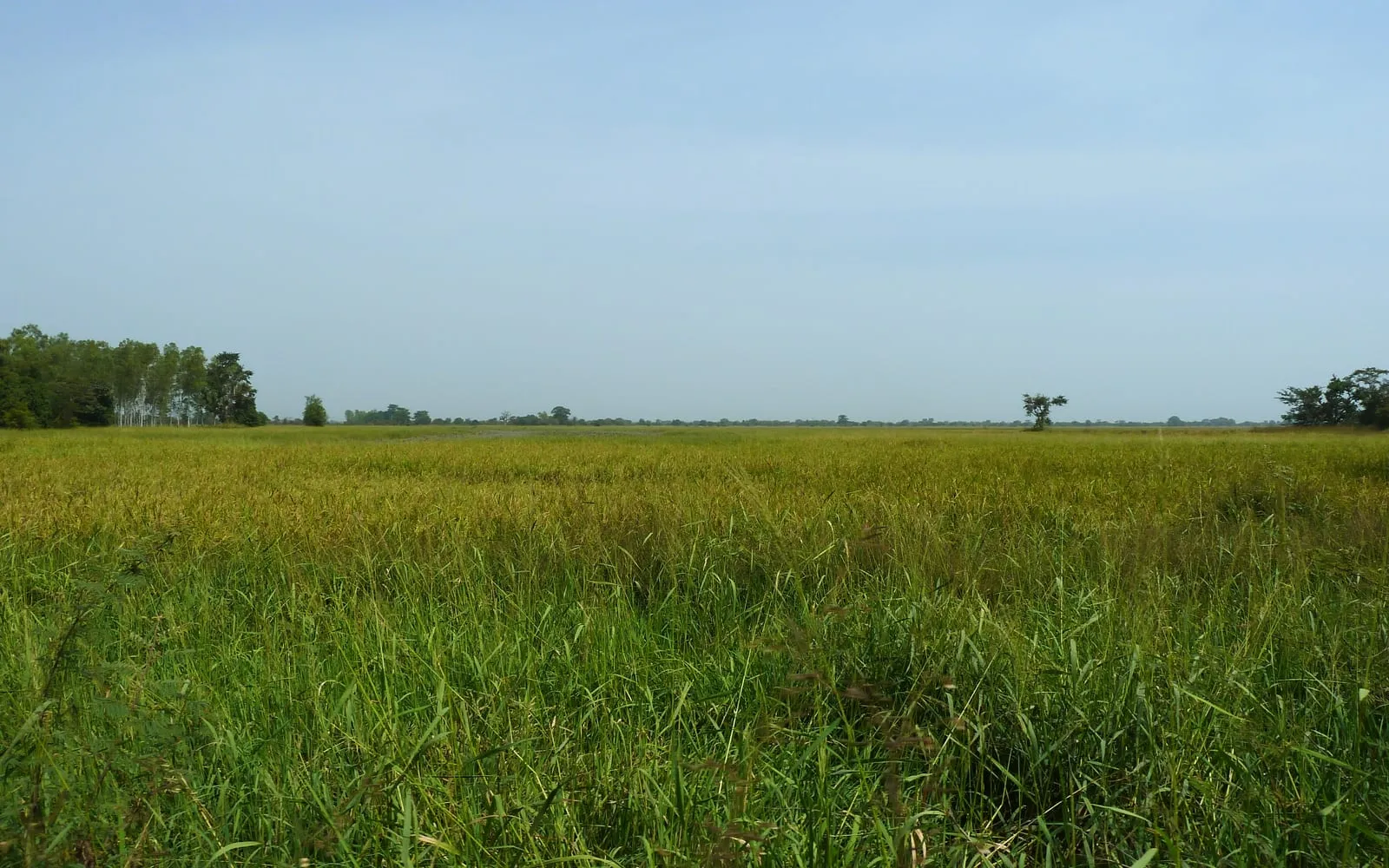
The photograph at the top of this page is a rice field in Mali rather than a determination. Nothing on Wikimedia Commons is identified as this species, and Asian rice now covers most of the west African crop area, so treat the picture as the country rather than the plant.
The plainest field mark is the panicle. African rice carries a stiff, upright, usually unbranched panicle where Asian rice carries a branched arching one, so a mixed field sorts itself visually at a glance.
The ligule, the small flap where the leaf blade meets the sheath, is short and rounded in glaberrima and long and pointed in sativa. Botanists use it as the definitive character, and it is visible with a hand lens on a young plant.
The grain is typically red-brown under the hull, from pigment in the bran layer, and milled white it looks much like any rice. Traditional west African cooking often uses it unmilled, and the red bran carries the flavour that people who grew up with it look for.
Where it is from
The wild ancestor is Oryza barthii, an annual wild rice of seasonal pools and floodplains across the west African savanna. Domestication is placed in the inland delta of the Niger river in present-day Mali, with the archaeological and genetic evidence pointing to somewhere between 3000 and 1000 BC.
From there the crop spread across west Africa, from Senegal to Chad, adapting to tidal, floodplain, upland and mangrove systems. The mangrove rice cultivation of the Casamance and Guinea-Bissau coast, with its salt-excluding bunds and careful freshwater management, is among the most technically sophisticated farming systems developed anywhere.
The crop crossed the Atlantic in the transatlantic slave trade, and so did the knowledge of how to grow it. Rice agriculture in South Carolina and Georgia was built on techniques of tidal irrigation and water control that enslaved west Africans brought with them, and glaberrima grains have been recovered from plantation sites and from maroon communities in Suriname.
How it grows
African rice grows on the same pattern as Asian rice, with the same tillering, panicle formation, flowering and grain fill, and it self-pollinates.
The differences are in vigour and timing. Glaberrima grows fast early, producing broad drooping lower leaves that shade the ground and smother weeds within weeks of establishment, which is a large part of why it persisted on farms with no herbicide. It also matures faster than most Asian varieties.
The weakness arrives at the end. The panicle shatters readily, dropping grain as soon as it is ripe, which is a survival trait the domestication never fully removed. Harvesting is done panicle by panicle with a knife in the traditional system, and that timing sensitivity is one of the reasons the crop resists mechanisation.
Through the seasons
In its home range the crop follows the rains, sown as they begin and harvested as they end, with the exact calendar set by whether the field is upland, floodplain or tidal.
Under glass in a cool climate, sow in April in warmth, move into a container without a drainage hole in May, and keep water standing over the compost. The plant grows through the summer and may panicle in August.
Harvest in October, cutting individual panicles as they ripen rather than waiting for the whole plant, because shattering will otherwise take the crop. In a cool summer expect a plant rather than a harvest.
Care difficulty
Where it belongs, African rice is the easier of the two rices. It handles poor soil, iron-rich waterlogged ground, drought spells, acidity and weed competition better than Asian rice, and needs less from the farmer at every stage.
In a greenhouse in a cool climate the difficulty is the same as with any rice, and it is heat. The plant needs sustained warmth above 20 deg C, and an unheated greenhouse in a cool summer produces a green plant that never flowers.
Shattering is the practical nuisance if you do get a panicle. Watch it daily as it colours and cut it as soon as the grain is hard, or the floor of the greenhouse will get the harvest.
Watering
Keep water standing over the compost from establishment to about three weeks before harvest, as with any paddy rice. Five to ten centimetres is right.
Glaberrima tolerates the water going away better than sativa does, which is one of its agricultural strengths. A container that dries out for a few days will check the plant rather than kill it.
Drain it before harvest so the grain dries evenly and the plant firms up. Use rainwater where you can, since the crop is adapted to soft acid water rather than to hard tap water.
Warning signs, diseases and pests
African rice carries useful resistance to rice blast, which is the reason breeders keep going back to it. Blast on a susceptible plant shows as diamond-shaped grey-centred lesions on the leaves and can kill the neck of the panicle so the head dies green.
In west Africa the African rice gall midge is the significant insect pest, and glaberrima resists it better than sativa. It produces a tubular gall in place of a tiller, sometimes called an onion shoot, and it is confined to sub-Saharan Africa.
Under glass the problems are the ordinary greenhouse ones. Aphids gather on the soft growing tips, red spider mite arrives if the air is allowed to dry, and algae colonise the standing water within a few weeks.
Shattering is what will cost you the crop in a greenhouse. Check ripening panicles daily and cut them individually.
Growing environment
Full sun and sustained warmth, at 25 to 30 deg C, with high humidity. The crop does nothing below 15 deg C.
Soil can be poorer than Asian rice will accept, including acid soils and soils with high iron that cause bronzing in sativa. A heavy loam-based compost in an undrained container works under glass.
The plant tolerates variable water, which helps if you are growing it alongside Asian rice. Glaberrima came from seasonal pools that fill and dry, and it carries that flexibility.
Feeding
Feed lightly. African rice was selected over three thousand years on soils nobody was fertilising, and it produces a reasonable crop where Asian rice would be starving.
A fortnightly balanced liquid feed under glass is enough, stopping once the panicle has emerged and the grain is filling.
Heavy nitrogen produces tall soft growth that lodges, and in this species it also lengthens the time to maturity, which is the opposite of what a short season needs.
Troubleshooting
How is African rice different from ordinary rice? It is a separate species, domesticated independently in Mali about three thousand years ago from a different wild ancestor. It is tougher, more disease-resistant and lower yielding, and its panicle is stiff and unbranched where Asian rice’s arches and branches.
Why is it hardly grown any more? Yield. Asian rice out-produces it, and glaberrima panicles shatter and drop grain before harvest, which makes mechanisation difficult. Its genes live on in the NERICA hybrids, which cross the two species.
What is NERICA? New Rice for Africa, a set of varieties bred from crosses between Oryza glaberrima and Oryza sativa from the 1990s onward, aiming to keep African rice’s weed competitiveness and stress tolerance while lifting yield.
Is the red colour natural? Yes. It comes from pigment in the bran layer, so it disappears if the grain is milled white. Traditional west African cooking often uses it unmilled.
Did African rice reach the Americas? Yes, along with the people who knew how to grow it. Glaberrima grains have been found at plantation sites and in maroon communities in Suriname, and the tidal water management of the Carolina rice fields drew on west African practice.
Can I grow it outdoors where I am? Only in USDA zone 9 and warmer. Like Asian rice it needs four to six months above 20 deg C, and a cool summer will not bring it to flower.
Why does my panicle keep dropping grain? Shattering, which glaberrima does readily. It is a wild trait the domestication never fully removed. Cut panicles individually as soon as the grain hardens.
African Rice problem guides
Not sure what is wrong? See the common vegetable pests guide.