
Disease
Rice blast
Magnaporthe oryzae
Also called Blast disease, Pyricularia oryzae
Grey-centred, diamond-shaped lesions spreading across the leaves of a rice plant, caused by a fungus that also rots the neck of the panicle so the whole head dies while still green. The single most damaging disease of rice worldwide, destroying enough grain most years to feed tens of millions of people.
At a glance
- Type
- Disease
- Cause
- Fungus
- Severity
- Destroys the crop or display
- Affects
- Herbs and edibles
- Active
- June to September
- Established in
- Worldwide
What you are seeing
- Grey or white-centred, diamond or spindle-shaped lesions with brown or reddish-brown margins on the leaves
- Lesions coalescing to blight whole leaves in a severe attack, giving the field a scorched appearance from a distance
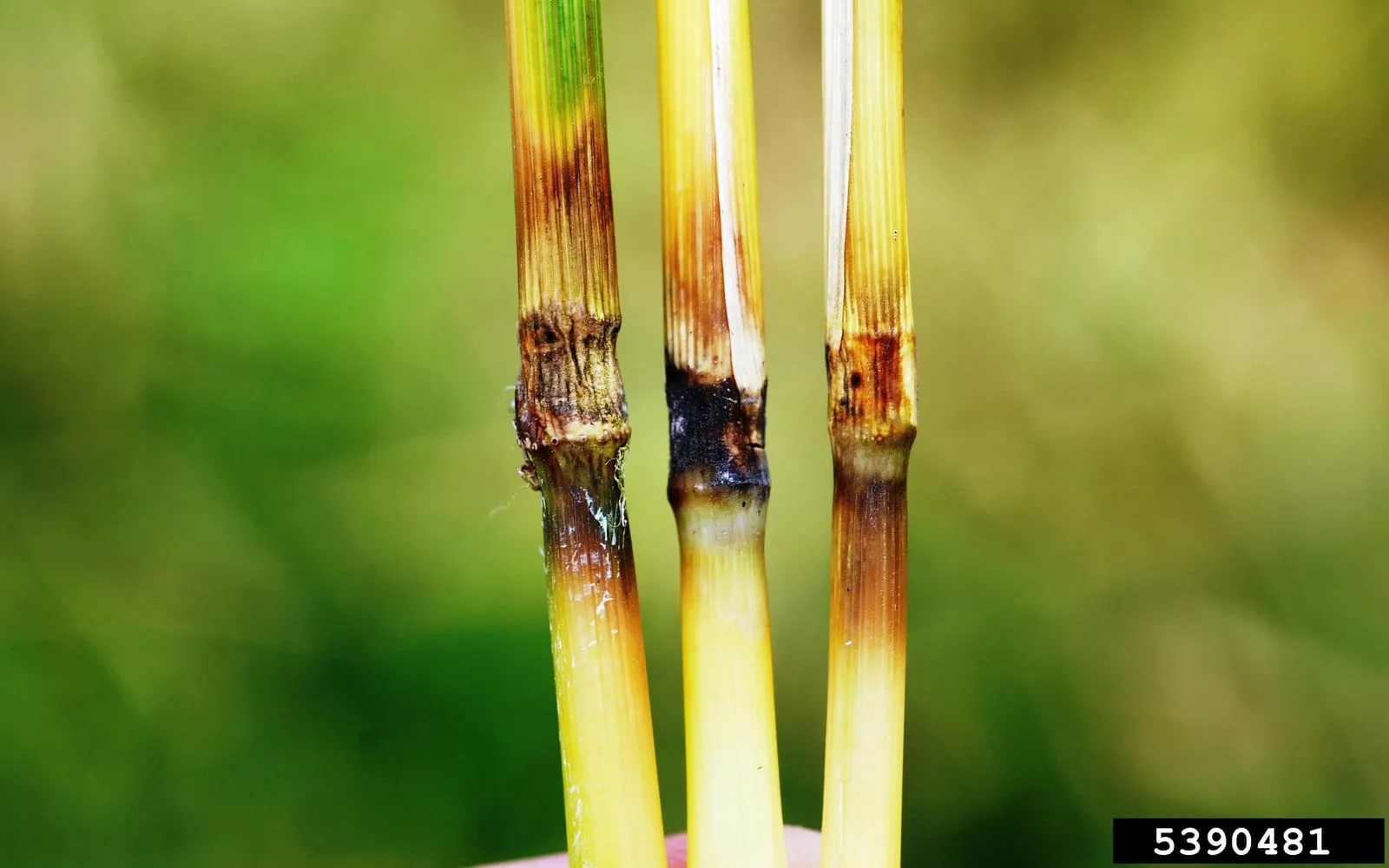
- A blackened, constricted rot at the base of the panicle, called neck blast, which kills the developing head while it is still green and prevents grain filling entirely
- Grey lesions on leaf collars, nodes and the stem itself, weakening the plant at those points and causing it to break
- Lesions on the seed itself, which can carry the fungus into the next season's crop from saved seed
What you are looking at
Grey or whitish-centred lesions shaped like a diamond or a spindle, edged in brown or reddish-brown, scattered across the leaves of a rice plant. In a bad attack these coalesce until whole leaves look scorched from a distance, though the individual lesion shape is what separates this from a simple environmental leaf browning.
The more serious form of the disease attacks the neck of the panicle rather than the leaves. A blackened, constricted rot girdles the stem just below the developing head, called neck blast, and it kills the whole panicle while it is still green, before any grain can fill. A field can look green and healthy from a distance while a large share of its panicles have already been killed this way. Lesions can also appear on leaf collars, nodes and stems, weakening the plant at those points, and on the seed itself, which is one of the ways the fungus carries over into the next season.
The most damaging disease of the world’s most important staple crop
Rice blast is present wherever rice is grown, including documented outbreaks in the United States, Europe and South America, though it does its worst damage across the major rice-growing regions of Asia, where warm, humid conditions, dense planting and continuous cropping all favour it. Estimates put global losses at 10 to 30 percent of the rice crop most years, enough lost grain to have fed tens of millions of people, with the economic cost running into the tens of billions of dollars. Because rice is the staple food for more than half the world’s population, this single disease is counted among the most consequential plant pathogens on earth.
What makes it difficult to control long-term is how fast the fungus adapts. A resistance gene bred into a new variety can be overcome by the local blast population within as little as three to five years, which is why regional guidance on which varieties currently hold up matters more than a single resistant variety chosen once and relied on indefinitely.
What to do about it
Grow a variety with resistance suited to the blast races present locally, and follow current regional guidance rather than assuming a resistant variety stays effective indefinitely.
Avoid heavy nitrogen, particularly late in the season, since lush growth is markedly more susceptible.
Start from certified, disease-free seed, and destroy or bury crop debris after harvest rather than leaving it on the surface.
Keep standing water on the crop where the growing system allows it, since continuous flooding suppresses the disease compared with intermittently dry conditions, and space plants at the recommended density rather than crowding them, since a dense, humid canopy favours infection.
Reach for fungicide only where a resistant variety is not available or cultural measures have already failed to hold a high-pressure season back; timed to booting and heading, the stages when neck blast does the most damage, it works as a last-resort supplement to resistant varieties rather than a substitute for them.
What it gets mistaken for
Leaf scorch and other physiological leaf browning follow a simple environmental cause, such as drought, salt or nutrient stress, and spread as a single browning margin from the leaf tip and edge inward. Rice blast produces individually shaped, scattered diamond lesions with a grey centre rather than one advancing scorched margin, and it is the neck rot that kills a healthy-looking panicle outright that has no equivalent in a straightforward physiological scorch.
What to do, in order
Nothing available to a gardener will cure this once a plant has it. The steps below are about limiting the spread and deciding what to plant in its place.
Start here
Prevention, and the changes that stop the problem returning. Most of these pages should end at this tier.
- Grow a resistant variety suited to the local blast population
- Resistance is the primary defence used across major rice-growing regions, though the fungus evolves quickly enough to overcome a given resistance gene within a handful of years in some areas. Local extension and seed suppliers track which varieties currently hold up against the blast races present regionally, and following that guidance matters more than picking a variety once and assuming it stays effective.
- Avoid excess nitrogen, especially late in the season
- Lush, nitrogen-rich growth is markedly more susceptible to blast than a crop fed a moderate, split nitrogen programme, and heavy late-season nitrogen is one of the most consistent risk factors growers can control directly.
- Use certified, disease-free seed, or hot-water treat saved seed before sowing
- The fungus survives on infected seed and in crop debris between seasons. Starting from certified clean seed avoids the problem entirely; where seed is saved from a previous crop, soaking it in hot water at a controlled temperature before sowing kills surface fungus without a chemical seed dressing. Combined with destroying or deeply burying stubble after harvest rather than leaving it on the surface, this reduces how much inoculum carries over locally.
- Keep standing water on the crop where the system allows it
- Continuous flooding suppresses blast development compared with intermittently dry conditions, and maintaining consistent standing water where the growing system is a flooded paddy is a meaningful, low-cost part of an integrated control programme.
Then reach for a barrier
Netting, hand removal and water. Nothing here harms anything except the target.
- Space plants to keep the canopy from staying wet and humid
- Dense planting keeps humidity high within the canopy for longer after rain, dew or irrigation, favouring infection. Standard recommended spacing for the variety and region, rather than crowding for a higher plant count, reduces the time leaves stay wet.
Then bring in the predators
Encourage what already lives in the garden, and buy predators in where the problem is under glass and nothing will arrive on its own.
- Rotate or mix rice varieties across a growing area
- Planting a mix of varieties with different resistance genes across a district, an approach used at scale in parts of China, has reduced blast severity significantly by denying the fungus a uniform host population to adapt to.A matter of what seed is planted and where, not a purchased product.
Biological controls are live organisms and their sale and release are regulated country by country. An agent sold freely in one place may be unapproved in another, so buy from a licensed supplier where you live and never import or move one yourself.
Plants affected
Guides that name it among the problems to watch for. The list is the plants it is characteristic of rather than everything it will feed on.