
Edible
Cumin
Cuminum cyminum
Also known as Jeera, White cumin
How to grow cumin, Cuminum cyminum. Why it needs a greenhouse in a cool climate, sowing it under glass in April, and telling it from caraway.
At a glance
- Difficulty
- Difficult
- Water
- Weekly while growing, then kept dry as the seed fills
- Light
- Full sun under glass. Outdoors is rarely enough
- Temperature
- Needs 3 to 4 months above 20 deg C to ripen seed
- Hardiness
- USDA 9-11, RHS H3, hardy to -2 C
- Type
- Half-hardy annual
- Height
- 20-50 cm
- Native to
- western Asia, the eastern Mediterranean
- Best month
- April and September in the Northern Hemisphere, October and March in the Southern Hemisphere
Three to four months above 20 deg C with a dry finish is the requirement, and rain during ripening brings alternaria blight and stains the seed. That combination confines the crop to India, Iran, Turkey, Syria and China, and makes it close to impossible in a cool wet climate outside a polytunnel.
Hardiness zones describe winter cold alone. Summer heat, humidity, rainfall and the length of the growing season decide as much, so treat the range as the outer limit rather than as a recommendation.
Every month named in this guide is for the temperate Northern Hemisphere. If you garden in the Southern Hemisphere, shift each one by six months, so April becomes October. Closer to the equator the wet and dry seasons matter more than the calendar, and the shift stops being a useful guide.
Not known to be toxic
- Safe to eat
- Seeds and leaves
Non-toxic. Cumin is one of the most widely eaten spices in the world and it appears on neither the RHS list of potentially harmful garden plants nor the ASPCA list. The seed is used in enormous quantity across south Asia, the Middle East and Latin America with no toxicity concern in food use. Cumin essential oil is a concentrated product and should be handled as such. The identification caution that runs through this family applies here too: cumin is an Apiaceae, and hemlock and hemlock water-dropwort share the family and can kill. A plant grown from a labelled seed packet is safe, and a wild umbellifer is not something to harvest on a guess.
Sources: RHS potentially harmful garden plants, ASPCA toxic and non-toxic plants
About
Cumin is the second most traded spice in the world after black pepper, and it is one of the hardest things in this collection to grow in a cool climate. The plant needs three to four months of real heat to flower and fill its seed, and an ordinary cool summer gives it neither the temperature nor the length.
Under glass it works. A greenhouse or polytunnel border, sown in April and kept warm, will ripen seed by September in most years, and a large pot on a sunny windowsill produces a small crop.
The plant itself is unremarkable, thin and wiry, with a few white flowers. The reward is a jar of seed that smells nothing like the tired supermarket version, which is the argument for growing it.
Appearance and character
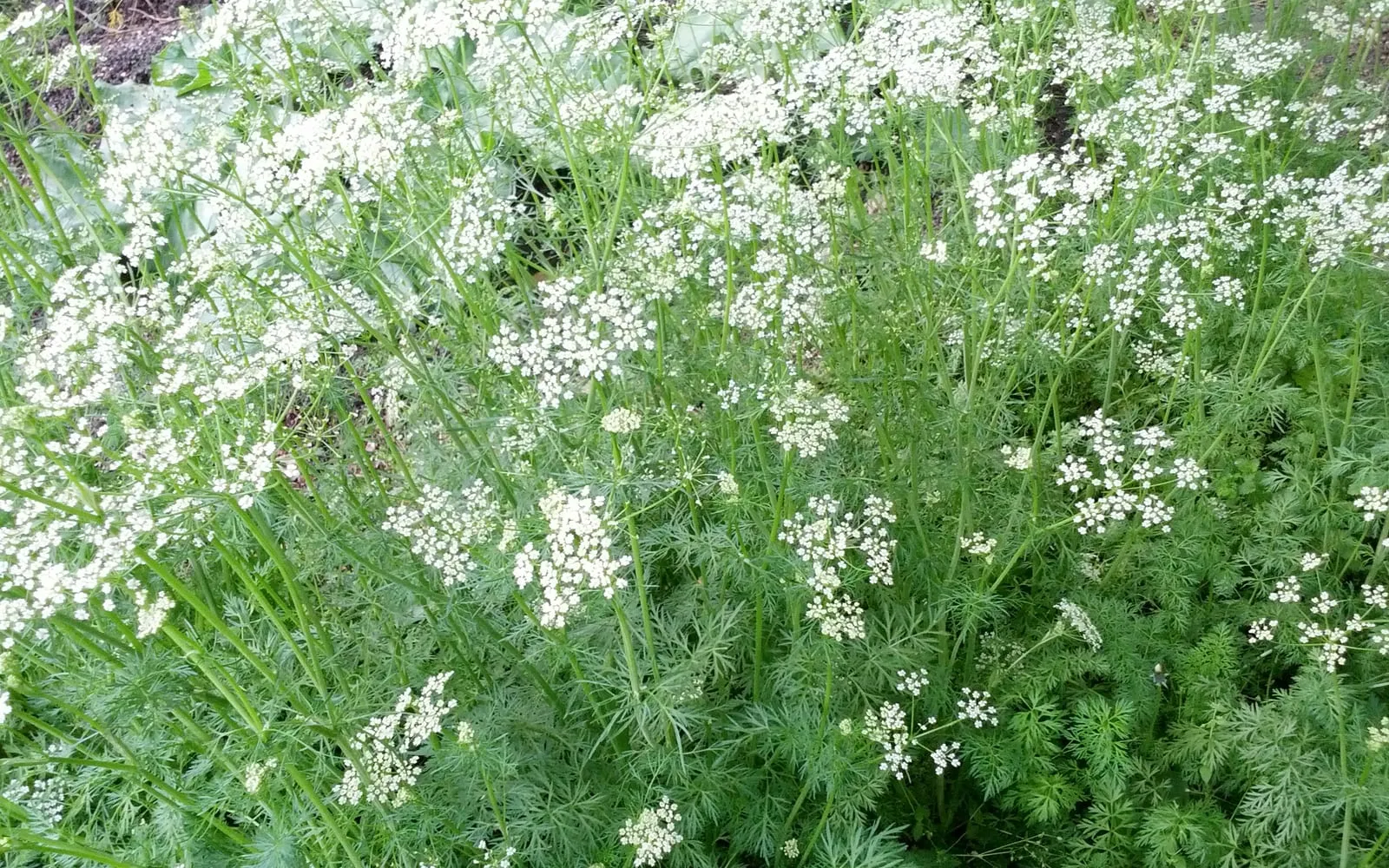
A small slender annual, 20 to 50 cm, wiry and thin, branching from low on the stem.
Leaves are divided into long narrow thread-like segments, dark blue-green, and sparse enough that the plant looks skeletal.
Flowers are small, white to pale pink, in tiny flat umbels 2 to 3 cm across, opening from July under glass.
Seeds are the point. Oblong, ridged, pale brown, about 5 mm long and covered in tiny bristles, and easily told from caraway by being straight rather than curved.
The scent is warm, earthy and slightly bitter, quite unlike caraway despite the constant confusion between them.
The whole plant is delicate and easily lost. It never looks like a crop.
Where it is from
Cumin is native to western Asia, probably Iran, Turkmenistan and the eastern Mediterranean, and it has been cultivated for at least four thousand years.
Egyptian tombs contain it, Minoan Crete has it in Linear B records, and the Old Testament and the New both mention it, so its use in the region is continuous and very old.
The Romans used it as a table condiment in the way pepper is used now, and Pliny describes it as the appetiser most favoured.
Medieval Europe used it heavily and then largely lost it to caraway and pepper, except in Spain and Portugal, which kept it and carried it to Latin America. Mexican cooking uses it as a result.
India grows most of the world’s cumin now, with Gujarat and Rajasthan producing the bulk of it, and Iran, Syria and Turkey supplying the rest.
How it grows
Sow in April under glass. Cumin needs warmth from the start and a cold sowing fails.
Sow into deep modules or straight into a greenhouse border, since the taproot dislikes disturbance and transplanting checks the plant badly. Deep root trainers are the compromise if you must raise plants to move.
Germination takes one to two weeks at 20 deg C.
Thin or space at 15 to 20 cm. The plants are small and can be grown close.
Keep the temperature up. A polytunnel, greenhouse or conservatory is the right place, and outdoors in a cool climate is a gamble even in a good year.
Water while the plant grows and reduce it as the seed sets.
Ventilate. A closed humid greenhouse brings on aphids and mildew on a plant this thin.
Harvest in September when the seed heads turn brown. Cut the whole plant, dry it head-down in paper bags and thresh out the seed.
Expect a small crop. Each plant produces a modest quantity, so grow a dozen rather than two.
Through the seasons
Winter there is nothing. It is a tender annual.
Spring is sowing, in April, under glass and in warmth.
Early summer is slow growth. The plants stay small through June and need warmth more than anything else.
Midsummer brings the flowers, in July, and this is when heat matters most.
Late summer is when the seed fills. Keep the greenhouse warm and ventilated, and reduce watering.
Autumn is harvest, in September, cutting the plants as the heads brown. A cool August usually means no crop at all.
Care difficulty
Difficult where summers are cool and straightforward where they are hot, which is the whole story.
Heat is the requirement. Cumin wants three to four months above 20 deg C, and a cool summer outdoors does not supply it.
Under glass the difficulty largely disappears. A greenhouse or polytunnel, sown in April, produces seed in most seasons.
Transplanting is the other pitfall. The taproot resents it, so sow into deep modules or direct.
Under glass the pest pressure rises. Aphids and spider mite both build up fast on a thin plant in a warm still greenhouse, so ventilate and check regularly.
Yields are small. Realistic expectations help, and a dozen plants gives a worthwhile jar rather than a year’s supply.
Watering
Water regularly while the plants are growing, keeping the soil evenly damp without saturating it.
Water at the base rather than over the plant. Wet foliage in a closed greenhouse invites mildew.
Reduce watering once flowering finishes and the seed starts to fill. Dry conditions at ripening give better seed.
A container needs watering every two or three days in a warm greenhouse, and a deep pot suits the taproot.
Do not let the plant dry out completely at any stage before ripening. A check sets the crop back and there is no spare time in the season.
Stop watering entirely a week before harvest.
Warning signs, diseases and pests
Seed that never fills is the main failure and it means the plant did not get enough heat or enough time. Grow under glass, sow in April and keep the temperature up.
Damping off kills seedlings in cold wet compost. Sow into warm fresh compost and avoid overwatering.
Aphids colonise the growing tips under glass and multiply quickly. Rub them off or use a biological control, since the plant is a food crop.
Spider mite produces fine stippling and webbing in a hot dry greenhouse. Raise the humidity and introduce a predatory mite.
Plants that stayed tiny were sown too cold, transplanted, or both.
Yellowing and collapse at the base in a wet greenhouse is root rot from overwatering.
Seed heads that go mouldy were dried in a damp place. Dry them warm and airy.
Growing environment
Under glass. A greenhouse, polytunnel or conservatory is the right environment where summers are cool, and everything else is a compromise.
Full sun and as much heat as you can supply. Twenty degrees and above is what the plant wants through its whole life.
Light, free-draining soil of moderate fertility, or a good multipurpose compost in a deep pot.
Neutral to slightly alkaline, around pH 6.8 to 7.5.
Ventilation matters as much as heat, because a still humid greenhouse produces pests and disease on a plant this delicate.
Outdoors in a hot southern garden against a south wall it will sometimes work in an exceptional summer. Treat that as a bonus rather than a plan.
Feeding
Nothing is needed. Cumin is a small short-lived plant that finds enough in ordinary compost or greenhouse border soil.
Avoid nitrogen, which delays flowering. In a season this tight, anything that slows the plant costs the crop.
A weak balanced feed every three weeks suits a container plant, and even that is optional.
Fresh compost each year is more useful than feeding, since a greenhouse border that has grown several crops runs down.
Poor lean growing conditions concentrate the flavour of the seed, as they do with most spices.
Troubleshooting
Nothing ripened. Not enough heat. Cumin needs three to four months above 20 deg C. Grow it in a greenhouse or polytunnel, sown in April.
Is cumin the same as caraway? No. Cumin seed is straight, pale and bristly with a warm earthy flavour. Caraway seed is curved, brown and sharper, and the plant is a hardy biennial. The names overlap in several languages, which is where the confusion comes from.
The seedlings collapsed. Damping off from cold wet compost. Sow into warm fresh compost and water carefully.
Can I grow it outside? In an exceptional summer, against a sunny wall, sometimes. Treat outdoor cumin as an experiment rather than a crop.
The plants are covered in aphids. Common under glass. Rub them off, ventilate more, and use a biological control rather than a spray on a food crop.
How much seed will I get? Not much per plant. Grow a dozen or more if you want a useful jar.
Can I use the leaves? They are edible and mildly flavoured, and they are not why anyone grows the plant. The seed is the crop.
Cumin problem guides
Not sure what is wrong? See the common vegetable pests guide.