
Edible
Jerusalem Artichoke
Helianthus tuberosus
Also known as Sunchoke, Sunroot, Fartichoke
How to grow Jerusalem artichokes, Helianthus tuberosus. Why they take over a plot, using them as a windbreak, lifting every tuber, and the inulin problem.
At a glance
- Difficulty
- Easy
- Water
- In a dry summer only. It fends for itself the rest of the time
- Light
- Full sun to partial shade
- Temperature
- Fully hardy to about -20 deg C, dying back each winter
- Hardiness
- USDA 3-9, RHS H6, hardy to -30 C
- Type
- Hardy herbaceous perennial
- Height
- 2-3 m
- Native to
- Eastern and central North America
- Best month
- November in the Northern Hemisphere, May in the Southern Hemisphere
Tubers form only as the days shorten, so the crop is always a late autumn one whatever the sowing date, and cutting the tops early costs the harvest. The tubers themselves survive freezing solid. Left in the ground they regrow, and a bed becomes permanent unless every tuber is lifted.
Hardiness zones describe winter cold alone. Summer heat, humidity, rainfall and the length of the growing season decide as much, so treat the range as the outer limit rather than as a recommendation.
Every month named in this guide is for the temperate Northern Hemisphere. If you garden in the Southern Hemisphere, shift each one by six months, so November becomes May. Closer to the equator the wet and dry seasons matter more than the calendar, and the shift stops being a useful guide.
Not known to be toxic
- Safe to eat
- The tubers, cooked or raw
Jerusalem artichoke is a food crop and carries no toxicity concern. The RHS does not list Helianthus tuberosus as a potentially harmful garden plant and the ASPCA does not list it as toxic to cats and dogs. The digestive effect it is famous for is not toxicity. The tuber stores its carbohydrate as inulin rather than starch, and humans have no enzyme to break inulin down, so it passes to the large intestine where gut bacteria ferment it. The result is a large volume of gas, which is why the plant has acquired a rude nickname in several languages and why John Goodyer wrote in 1621 that the tubers caused "a filthie loathsome stinking winde". The effect is genuinely severe in some people and barely noticeable in others, and it lessens with repeated exposure as the gut flora adapt. Small portions, a long slow cooking, and tubers lifted after several frosts, which converts some inulin to fructose, all reduce it. Nobody comes to harm from it. The stems and leaves are coarse and hairy and are not eaten.
Sources: RHS potentially harmful garden plants, ASPCA toxic and non-toxic plants
About
Jerusalem artichokes are the easiest crop in this collection and the hardest to get rid of. Plant a dozen tubers in March and you will lift a bucketful in November, and you will go on lifting them from that spot for years afterwards, because every fragment left behind regrows.
Choose the site accordingly. Given a corner where nothing else does well, the plant is an asset. It crops on poor soil, tolerates shade, needs no feeding, and its three-metre stems make a summer windbreak for more tender crops.
The plant is a North American sunflower with no connection to Jerusalem. Its tubers taste faintly of globe artichoke, which accounts for half the name, and the Jerusalem half is usually explained as a corruption of girasole, the Italian for sunflower, on evidence thinner than the confidence with which it is repeated.
Appearance and character
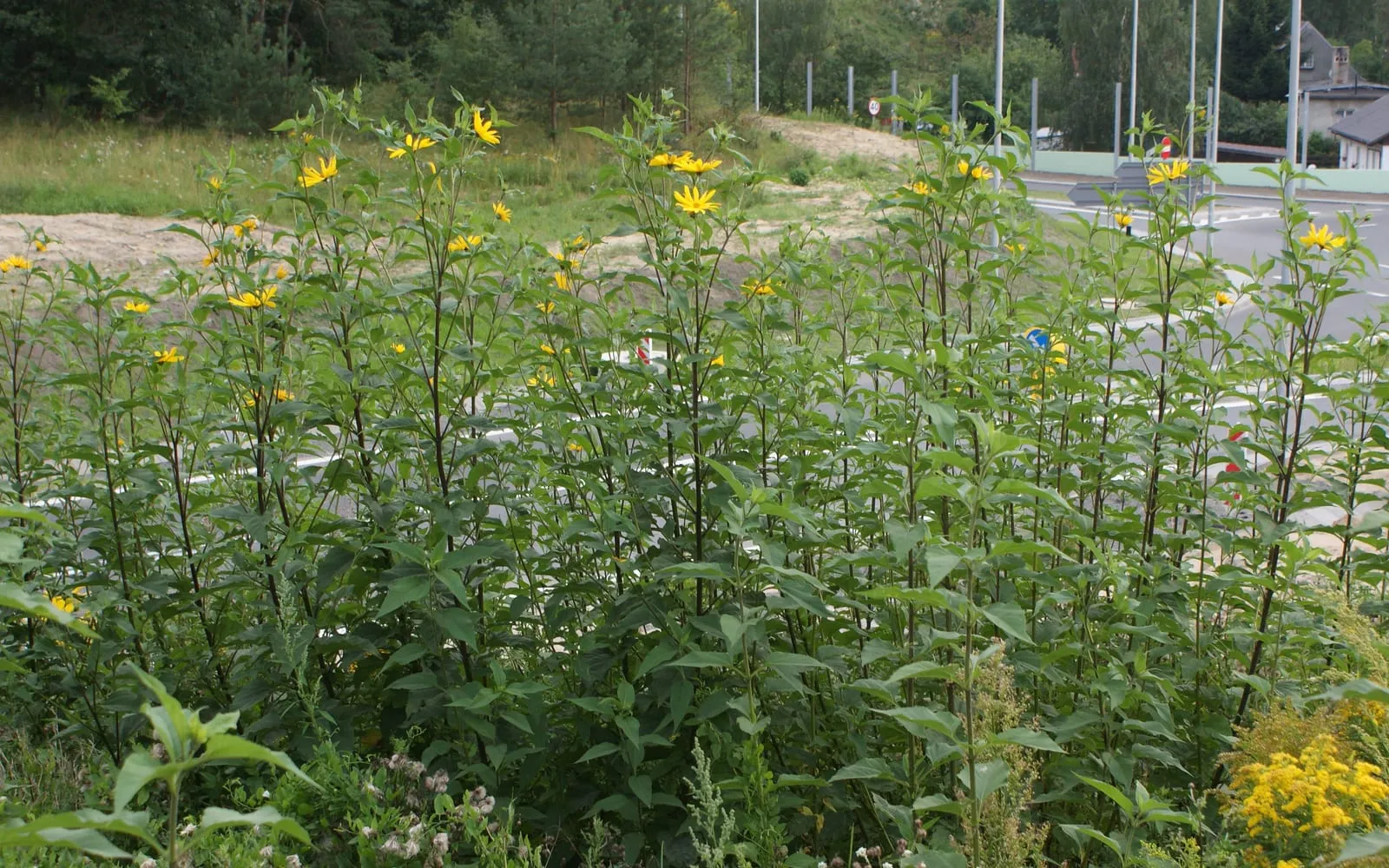
Tall, coarse, rough-hairy stems, 2 to 3 m in a good year, growing in a dense clump from a mass of underground tubers.
Leaves are large, oval to lance-shaped, rough as sandpaper on both sides, borne opposite low down the stem and alternate higher up.
Flowers open from September, small yellow sunflowers 5 to 8 cm across, sometimes in quantity and sometimes hardly at all in a cool summer.
Tubers are knobbly, irregular and pale buff to purple-red depending on variety. The knobbliness varies enormously, and ‘Fuseau’ is the smooth-skinned variety worth seeking out, since knobbly tubers are a misery to peel.
Flesh is white, crisp when raw and turning sweet, nutty and slightly smoky when roasted.
Where it is from
Jerusalem artichoke is native to eastern and central North America, where it grows on damp ground and river banks.
Indigenous peoples across the eastern woodlands and prairies cultivated it long before European contact, and it was an established crop when Samuel de Champlain recorded it at Cape Cod in 1605.
It reached Europe in the early seventeenth century and spread fast, because it grew anywhere and needed nothing. For a time it was a staple, then the potato arrived and did the same job with a better flavour and no digestive consequences.
Britain kept it as an allotment crop and a curiosity. It had a revival during the Second World War for the same reason it had its first one, which is that it crops on ground and with inputs that nothing else tolerates.
Commercial interest now centres on inulin, extracted as a prebiotic food ingredient and a sugar substitute.
How it grows
Plant tubers in March, or in February in a mild garden, at 12 to 15 cm deep and 30 cm apart in rows 90 cm apart. Any tuber the size of a hen’s egg does.
Contain the bed if you can. A row along a fence or a boundary works, and a bed edged with buried slates or a sunk barrier keeps it tidier.
Earth up around the stems in June as you would potatoes, which steadies them against wind.
Cut the stems down to 30 cm in October once the leaves brown. Leaving 30 cm marks the row and gives you something to pull against.
Lift from November onwards, after a frost or two, which improves the flavour. Dig the whole clump and sieve the soil, because anything you leave regrows.
Replant a dozen of the best tubers straight away for next year, and remove everything else.
Through the seasons
Early spring is for planting, in February or March. Prepare the ground by digging over and adding compost if it is poor, and plant the tubers deep.
Late spring brings the shoots through in April and May. Slugs take an interest and rarely do lasting damage.
Summer grows the stems to full height. Earth up in June, and stake or tie in a windy garden. Water in a genuine drought and otherwise leave it alone.
Autumn brings the flowers in September and the die-back in October. Cut the stems down once the leaves brown, which is the signal that the tubers have finished filling.
Winter is the harvest. Lift from November through to March as needed. Tubers keep far better in the ground than out of it, since they shrivel within days in a shed.
Care difficulty
The easiest crop in this collection to grow and the hardest to remove.
Containment is the decision that matters, and it has to be made before planting. Put it where it can spread without damage, or edge the bed with a buried barrier.
Complete lifting is the corresponding skill. Sieve the soil as you dig, because a tuber the size of a marble regrows into a three-metre plant.
Wind is the routine problem. Three-metre stems in an exposed garden go over in an August gale, taking the crop’s growth with them. Earth up in June and tie the clump to a stake or a wire.
Everything else looks after itself. The plant does not need feeding, watering, spraying or thinning, and pests barely touch it.
Watering
Water only in a genuine drought. An established clump has a deep root system and finds its own water.
A fortnightly soak in a dry July and August keeps the tubers swelling, and skipping it gives a smaller crop rather than a failed one.
Newly planted tubers benefit from watering in a dry April while they establish.
Mulch in spring with compost to hold moisture and suppress weeds, though the plant shades out most weeds by June without help.
Waterlogged ground rots the tubers over winter. On heavy wet soil, lift the crop in November rather than leaving it in the ground.
Container growing works in a very large pot of 40 litres or more, and yields are modest.
Warning signs, diseases and pests
Spreading is the main problem and it is not a pest. Lift every tuber, sieve the soil, and never rotavate a bed that has held them.
Slugs graze the emerging shoots in April. The plant grows away from them.
Sclerotinia rot collapses stems in a wet summer, showing white fluffy growth and hard black bodies inside the stem. Remove and destroy affected stems, and do not compost them.
Wind rock snaps or flattens the tall stems. Earth up in June and tie the clump.
Powdery mildew coats the leaves in a dry late summer and does little harm at that stage of the crop.
Aphids sometimes cluster on the growing tips and are dealt with by predators.
Small tubers usually mean overcrowding from an unlifted bed rather than a disease. Lift completely and replant a dozen tubers each year.
Growing environment
Full sun gives the biggest crop, and Jerusalem artichoke crops acceptably in partial shade, which few vegetables do.
Almost any soil suits it. It grows on heavy clay, thin chalk and poor sand, and this tolerance is the main argument for growing it.
Free drainage over winter is worth having if you intend to leave the tubers in the ground.
Give it a permanent corner rather than a place in a rotation bed, since it is a perennial that returns whether or not you plant it.
Use it as a summer windbreak on the north side of a plot, where the height shelters rather than shades.
Keep it away from boundaries you cannot dig, and away from ornamental beds.
Feeding
Jerusalem artichokes need no feeding. This is one of the few crops where that is a plain statement rather than a caveat.
Work compost into the ground when planting a new bed on poor soil, and nothing after that.
Avoid nitrogen. It gives taller stems, which is the last thing this plant needs, and no more tubers.
An established bed lifted and replanted each year renews itself without any input.
Troubleshooting
They have come up all over the plot. Tubers were left in the ground. Lift everything and sieve the soil, then pull any regrowth as it appears through the following summer. It usually takes two seasons to clear.
The stems blew over in August. Wind rock on a three-metre plant. Earth up in June, tie the clump to a stake or a wire, and choose a sheltered corner.
The tubers are tiny. An overcrowded bed that has not been lifted, or a very dry summer. Lift the lot, replant a dozen good tubers at 30 cm spacing, and water in a drought.
Stems collapsed with white fluff inside. Sclerotinia. Remove and destroy the affected stems and do not compost them.
The tubers shrivelled in the shed. They keep poorly out of the ground. Leave them where they grew and lift as needed through the winter.
They gave me terrible wind. Inulin, fermented by gut bacteria. Eat small portions, cook them long and slow, and lift after several frosts. The effect lessens with regular exposure.
Do they ever flower here? Sometimes, from September, and often not at all in a cool summer. The crop is unaffected either way.
Which variety should I grow? ‘Fuseau’ if you can find it. The tubers are long and smooth rather than knobbly, which makes the difference between a pleasant vegetable and an hour with a peeler.
Jerusalem Artichoke problem guides
Not sure what is wrong? See the common vegetable pests guide.