
Pest
Rosemary and mint beetles
Chrysolina americana and Chrysolina herbacea
Also called Rosemary beetle, Mint beetle, Mint leaf beetle, Lavender beetle
Rosemary and mint beetles are small jewel-bright beetles that strip lavender, rosemary and mint. They feed through cooler months, and hand-picking is the safest control on herbs you eat.
At a glance
- Type
- Pest
- Cause
- Insect
- Severity
- Weakens the plant
- Affects
- Garden plants, Herbs and edibles
- Active
- March to February
- Established in
- Europe, Africa and Asia
What you are seeing
- Small oval beetles about 8 mm long, metallic green with purple or bronze stripes along the wing cases
- Beetles a plain metallic green or blue-green, on mint and water mint, without stripes
- Leaves and flower shoots grazed away in irregular notches from the edges
- Grey-white slug-like grubs with darker stripes feeding alongside the adults
- Damage worst from autumn through to spring, which is when nobody is looking
- Whole shoots of lavender or rosemary stripped bare and dying back
- Black specks of frass caught in the foliage and on the ground under the plant
- Beetles dropping off and playing dead when the plant is disturbed
Before you treat anything
Neither beetle harms people, pets or the plant's use in cooking. Wash herbs before use as you would anyway. The reason no insecticide appears on this page is that these are plants picked and eaten all year and grown largely to feed bees, so a broad-spectrum spray would cost more than the beetles do.
What you are looking at
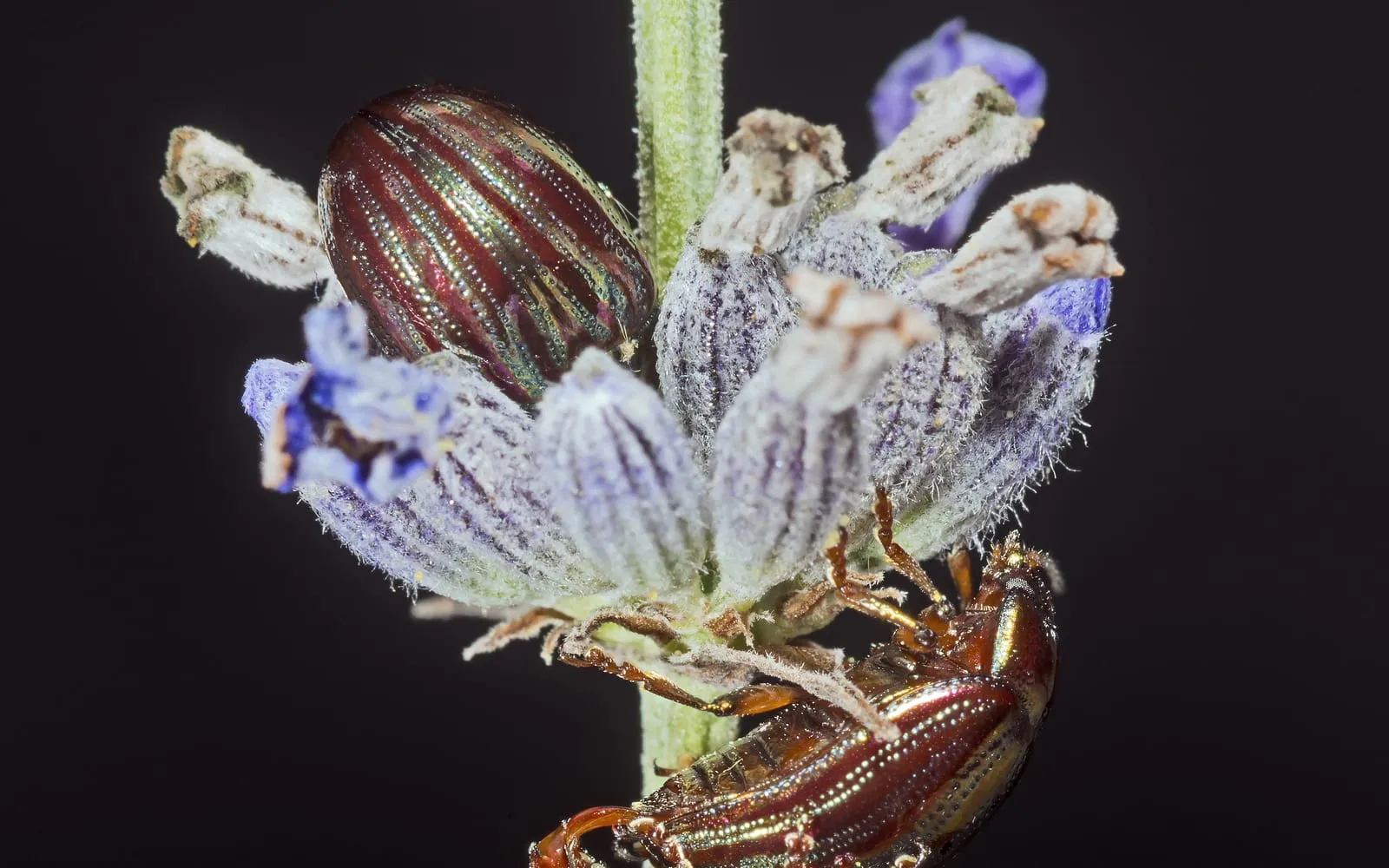
A small oval beetle, about 8 mm long, that looks like a piece of jewellery. Rosemary beetle is metallic green with purple or bronze stripes running the length of the wing cases. Mint beetle is a plain metallic green or blue-green without the stripes.
They sit openly on the foliage rather than hiding, and when you disturb the plant they let go and drop rather than flying off.
The damage is grazing. Leaves and young flower shoots are eaten away in irregular notches from the margins, and on a bad infestation whole shoots of lavender or rosemary are stripped and die back. There are black specks of frass caught in the foliage and scattered on the ground beneath.
Feeding alongside the adults are grey-white grubs, plump and slug-like with darker stripes along the body.
They feed when nobody is looking
Rosemary beetle runs on a calendar that hides it.
The adults are active from late summer through the autumn, all through the winter in a mild climate, and on into spring. They rest through the hottest part of the summer, which is exactly when a gardener walks the herb bed and looks at the plants.
So the usual sequence is a lavender that seemed fine in June and is half bare by March, with nobody having seen anything. Anyone who has had them once should put an inspection in the diary for October and again for February, which is worth more than any treatment.
Mint beetle keeps more conventional hours, feeding through the spring and summer, and it is the one people find because they are picking mint at the time.
Why nothing here is sprayed
There is no chemical tier here and that is a decision rather than an omission.
These are culinary herbs. Rosemary, thyme, sage and mint are picked a few leaves at a time throughout the year, so a harvest interval means nothing on them. Anything strong enough to kill a chrysomelid beetle would sit on leaves someone is about to put in a stew.
Lavender and rosemary are also two of the best bee plants in a garden, and are often planted for that reason. A broad-spectrum spray applied to them in flower would take a great deal more than the beetles.
What works instead is straightforward. Hold a newspaper under a branch and tap it. The beetles drop, they do not fly, and they land where you can pick them up. Two or three passes a week through the autumn will clear a garden shrub, and both adults and grubs sit out in the open where you can see them.
The other half is knowing when a plant is worth the effort. An old leggy lavender bare at the base will not reshoot from old wood, so beetle damage on top of that is usually the end of it. Replace it and grow the new one hard in poor free-draining soil.
Where it came from
Rosemary beetle is native to southern Europe and North Africa. It reached Britain in the 1990s, was confined to a few London gardens for some years, and is now common across much of the country.
It travelled on container-grown lavender and rosemary through the nursery trade, so looking over the foliage of a new shrub takes a moment and keeps a clean bed clean.
Mint beetle is native across Europe and temperate Asia and has always been here.
What to do about it
Inspect the herb bed in October and again in February.
Tap the branches over a newspaper and collect what drops.
Pick the adults and the slug-like grubs off by hand.
Rake the litter out from under an infested plant in late autumn.
Check new lavender and rosemary before it joins the bed.
Replace an old leggy lavender rather than nursing it through.
Leave a few beetles on a large healthy shrub.
Leave the birds and the ground beetles alone.
Do not spray a plant you eat and the bees rely on.
What it gets mistaken for
Lily beetle is plain scarlet, on lilies and fritillaries, with grubs covered in their own excrement.
Viburnum beetle is a dull yellowish brown and reduces viburnum leaves to lace.
Caterpillars are soft-bodied with legs at both ends and leave larger ragged holes.
Flea beetles are tiny, jump when disturbed, and pit the leaf with small round holes.
Capsid bugs pucker and distort young growth around the holes they make.
What to do, in order
Start here
Prevention, and the changes that stop the problem returning. Most of these pages should end at this tier.
- Look in autumn and winter, since that is when they feed
- Rosemary beetle is active from late summer right through the winter and into spring, resting through the hottest part of the summer. Most people inspect a herb bed in June and find nothing, and the damage is done in the months the garden is not being walked. Put the inspection in the diary for October and February.
- Accept a low population on an established plant
- A large healthy rosemary or lavender carries a few beetles without suffering, and clearing every one is neither achievable nor necessary. What needs acting on is a shrub losing whole shoots, or a young plant that cannot outgrow the grazing.
- Replace old woody lavender rather than nursing it
- Lavender and rosemary that have gone leggy and bare at the base take beetle damage badly, because they have little growth to spare and will not reshoot from old wood. A plant at that stage is better replaced, and the new one grown hard in poor free-draining soil.
- Do not spray a plant you are going to eat
- These are culinary herbs picked a few leaves at a time all year round, and there is no useful harvest interval on a plant like that. The insecticides that would work are also broad spectrum and would take the bees that lavender and rosemary exist to feed. Hand picking clears a garden shrub completely, which few controls on this site can claim.
Then reach for a barrier
Netting, hand removal and water. Nothing here harms anything except the target.
- Shake them onto a sheet of paper
- Hold a newspaper or a light-coloured tray under a branch and tap it sharply. The beetles let go and drop rather than flying, so they land where you can see them and collect them. Two or three passes a week in the autumn clears most of a population on a garden-sized plant.
- Pick the adults and grubs off by hand
- Both stages sit openly on the foliage and neither moves quickly. This is a five-minute job on a shrub and it clears the plant.
- Clear the litter under the plant
- The grubs drop to the soil to pupate, so raking out the debris beneath an infested lavender or rosemary in late autumn removes part of the next generation. It also helps the plant, which resents a damp mulch against its base.
- Check new plants before they come home
- The beetle has spread largely through the nursery trade on container lavender and rosemary. Look over the foliage of anything you buy, since a plant carrying a few beetles introduces them to a bed that had none.
Then bring in the predators
Encourage what already lives in the garden, and buy predators in where the problem is under glass and nothing will arrive on its own.
- Leave the birds and the ground beetles to it
- Blue tits and other small birds take both adults and grubs off open shrubs, and ground beetles take the pupae. Nothing here controls an infestation, and every bit of it is free.
Biological controls are live organisms and their sale and release are regulated country by country. An agent sold freely in one place may be unapproved in another, so buy from a licensed supplier where you live and never import or move one yourself.
Plants affected
Guides that name it among the problems to watch for. The list is the plants it is characteristic of rather than everything it will feed on.