
Edible
Clary Sage
Salvia sclarea
Also known as Clear eye, Muscatel sage
How to grow clary sage, Salvia sclarea. The biennial with two-metre flower spikes, the perfume crop behind it, and the seed once used to wash grit out of an eye.
At a glance
- Difficulty
- Easy
- Water
- Rarely once established. Weekly for the first season
- Light
- Full sun
- Temperature
- Hardy to about -15 deg C. The rosette overwinters
- Hardiness
- USDA 5-9, RHS H5, hardy to -15 C
- Type
- Hardy biennial, occasionally short-lived perennial
- Height
- 60-120 cm, occasionally 150 cm
- Native to
- the Mediterranean, western Asia
- Best month
- June and July in the Northern Hemisphere, December and January in the Southern Hemisphere
A biennial that spends its first year as a rosette and needs to come through a winter before it will flower, so a spring sowing gives nothing until the following summer. It is grown commercially for sclareol, a perfume fixative, on dry ground in France, Bulgaria and Russia. Wet winter soil rots the rosette.
Hardiness zones describe winter cold alone. Summer heat, humidity, rainfall and the length of the growing season decide as much, so treat the range as the outer limit rather than as a recommendation.
Every month named in this guide is for the temperate Northern Hemisphere. If you garden in the Southern Hemisphere, shift each one by six months, so June becomes December. Closer to the equator the wet and dry seasons matter more than the calendar, and the shift stops being a useful guide.
Edible, with limits
- Safe to eat
- Leaves and flowers, in small quantities
- Do not eat
- The concentrated essential oil
- Harm from
- Eating it
- Affects
- People
Clary sage does not appear on the RHS list of potentially harmful garden plants and the ASPCA holds no record for it. The leaves have been used in cooking and in flavouring wine and beer for centuries, and the flowers are eaten in salads, so the plant itself is not a hazard in a garden. The essential oil is the part that carries warnings. It is used in perfumery and aromatherapy, it contains sclareol and linalyl acetate, and standard herbal references advise against it in pregnancy and caution that it can intensify the effect of alcohol. Those cautions describe the distilled oil rather than a leaf in a glass of wine. Treat the oil as a concentrated product and the plant as an ordinary garden salvia.
Sources: RHS potentially harmful garden plants, NC State Extension, Salvia sclarea
About
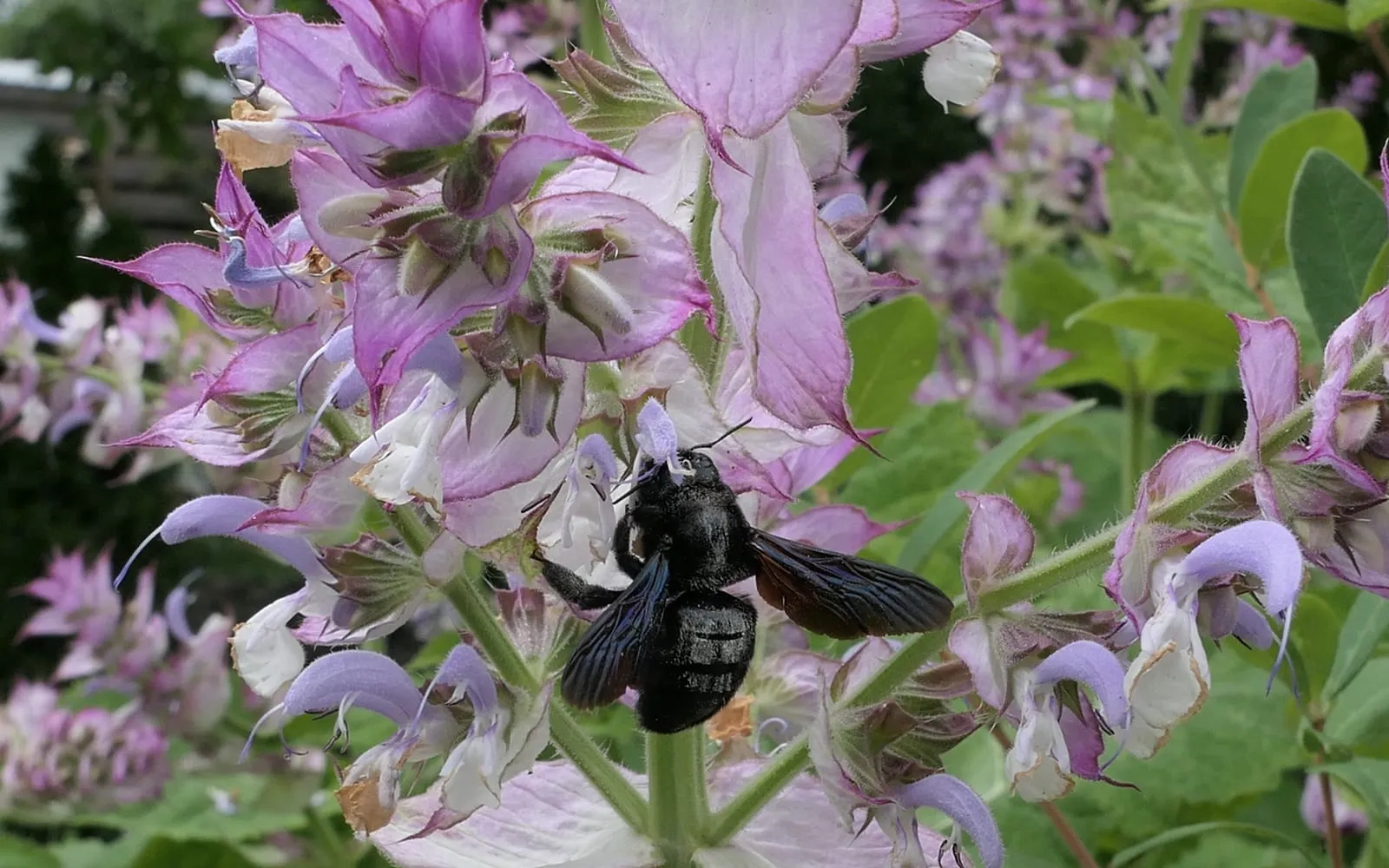
Clary sage spends a year making a rosette of enormous wrinkled leaves and then, in its second summer, sends up a branched flower spike over a metre tall covered in pale blue flowers set among pink or lilac bracts. The bracts are the showy part and they hold their colour long after the flowers have gone.
It is a biennial, so a plant that flowers is a plant that dies. It seeds itself freely enough that a clary sage patch, once started, tends to continue without help, with rosettes and flowering plants side by side.
The perfume industry is the reason it is grown commercially. Clary sage oil yields sclareol, which is converted into a substitute for ambergris, and fields of it are grown in France, Bulgaria and Russia for the purpose.
Appearance and character
In its first year, a flat rosette up to 60 cm across of very large leaves, heart-shaped at the base, deeply wrinkled, grey-green and covered in soft hairs.
In its second year, a stout branched flower stem 1 to 1.5 m tall, square in section and sticky to the touch.
Flowers are pale blue to white, two-lipped and hooded, small in relation to the plant. The bracts behind them are the display, being papery, veined and coloured pink, lilac or cream depending on the form.
The whole plant is aromatic and the scent is unusual. Musky, sweet and slightly sweaty, which is where the name muscatel sage comes from, and it is not to everyone’s taste.
Seed is large, dark and produces the mucilage described below when wet.
The dead flower stem stands through the winter and looks good doing it, which is a reason to leave it rather than cut it down in October.
Where it is from
Clary sage is native to the northern Mediterranean, north Africa and central Asia, growing on dry stony hillsides and rough ground.
The name comes from the Latin clarus, meaning clear, and describes its old use on the eye. A seed placed under the eyelid swells into a mucilaginous coat that grit sticks to, and the whole thing was then washed out. That is where the English name clear eye comes from, and it is not a practice to revive.
German winemakers used it. Adding clary sage and elderflower to wine gave it a muscatel character, and the plant was used in England to flavour beer before hops took over.
The perfume industry took it up in the twentieth century. Sclareol extracted from clary sage oil is converted into ambrox, a synthetic replacement for ambergris, and that trade is why fields of clary sage are grown across Provence and Bulgaria.
In Britain it has been a garden plant since the sixteenth century and it occasionally escapes onto waste ground in the south.
How it grows
Sow in late spring, either in modules or direct where it is to grow. Seed germinates in two to three weeks at around 18 deg C.
Sow in May or June for a rosette that overwinters and flowers the following summer. A very early sowing sometimes flowers in its first year, which cuts short the display.
Plant out at 45 to 60 cm spacing. The rosette is large and crowding it produces mildew.
Choose a sunny, well-drained position. The rosette sitting on wet ground through winter is the one thing that reliably kills it.
Do nothing in the first year beyond weeding and watering in drought.
Stake in the second year on an exposed site. The flower spike is heavy and a wet summer will lay it flat.
Leave some seed heads to ripen if you want it to continue. It self-seeds generously, and pulling the surplus seedlings is easier than sowing fresh.
Cut the flowered plant out in autumn or leave the stems for winter structure. Either way, that plant is finished.
Through the seasons
Winter is the rosette sitting flat on the ground. Keep it clear of fallen leaves and standing water, and expect the outer leaves to look ragged.
Spring brings rapid growth from the rosette. The flower stem starts to extend in May.
Early summer is when it flowers, from June, and it goes on into August. Bees work it hard.
Midsummer is the time to sow next year’s plants.
Late summer brings the seed. Collect some if you want control over where it grows, and shake the rest where you want more.
Autumn ends the flowering plants. Pull them, or leave the skeletons standing for winter and pull them in March.
Care difficulty
Easy, and the main thing to understand is that it is a biennial. A gardener expecting a perennial concludes the plant has died when it has done what it was always going to do.
Wet winter ground is the practical risk. The rosette sits flat on the soil for six months and rots if the drainage is poor. Free-draining soil or a raised bed solves it.
Spacing matters more than it looks. The rosettes are large, and plants set at 30 cm crowd each other and mildew from the base up.
Self-seeding is generous. That is convenient if you want a permanent patch and tiresome in a tidy border, and deadheading before the seed ripens controls it.
Nothing else needs doing. It needs no feeding, little water, and no protection.
Watering
Water plants in weekly through their first summer while the rosette establishes.
After that, water only in a long dry spell. Clary sage is drought tolerant and the flavour and scent are stronger on the dry side.
Keep the crown dry over winter. This mostly means choosing the right position rather than doing do for it, and it mostly means choosing the right position rather than doing anything.
Water a container weekly in summer. The plant is large for a pot and dries out faster than you expect.
Water at the base rather than over the leaves, which are hairy, hold water and mildew.
Warning signs, diseases and pests
Root and crown rot over winter is the main killer. The rosette blackens at the centre and lifts away. There is no treatment. Choose a drier position next time.
Powdery mildew coats the large lower leaves in late summer, particularly on crowded plants. Space them properly, remove affected leaves and accept some of it in August.
Slugs graze the young rosette in its first autumn and can destroy a small plant. Protect it until the leaves are large.
Capsid bugs distort the developing flower spike, leaving ragged holes and twisted growth. The damage is cosmetic on a plant this size.
The flower stem falling over means wind and rain on a heavy spike. Stake it in an exposed garden.
A plant that flowered and then died has completed its life. That is the plant rather than a problem.
Rosettes appearing everywhere mean the seed ripened. Hoe them off or move them.
Growing environment
Full sun. The plant is stiff and free-flowering in sun and lax and mildewed in shade.
Free-draining soil of moderate fertility. Rich ground gives you a soft rosette that rots more readily in winter.
Neutral to alkaline, around pH 6.5 to 7.5. Chalk suits it.
Give it room. A mature rosette is 60 cm across and the flower spike is a metre above that, so it needs a proper place rather than a gap.
Shelter helps in the second year, since the flower spike is tall and heavy.
It is a strong plant for pollinators, and the long-flowering bracts hold colour in a dry border into September when little else does.
Feeding
Nothing is needed. Clary sage on poor stony ground in Provence grows better than clary sage in a fed border.
Compost worked into the ground at planting is enough for both years.
Avoid nitrogen. It produces a soft floppy rosette, a weaker flower spike and more mildew.
A container plant takes a weak balanced feed monthly through its first summer and needs nothing in its second.
Leave the ground alone otherwise. Overfeeding is the commonest way to spoil a Mediterranean salvia.
Troubleshooting
It died after flowering. That is a biennial. Sow again, or let it seed and you will have a permanent supply.
It made a huge rosette and no flowers. That is the first year. It flowers next summer.
The rosette rotted over the winter. Wet ground. Move to somewhere free-draining, or grow it in a raised bed.
White powder on the big lower leaves. Powdery mildew, common in August on crowded plants. Space them wider and remove the worst leaves.
The flower stem fell over. A heavy spike in wind and rain. Stake it in exposed gardens.
It smells odd. It does. Musky and slightly sweaty is normal for the species, and the perfume industry values exactly that.
Can I eat it? The leaves have been used in fritters and to flavour wine, and the flowers go in salads. Use it in small amounts, and treat the essential oil as a separate product rather than a strong version of the herb.