
Edible
Wild Thyme
Thymus serpyllum
Also known as Creeping thyme, Breckland thyme, Mother of thyme
How to grow wild thyme, Thymus serpyllum. The creeping thyme for paving and banks, using it as a lawn, and where it grows on British downland.
At a glance
- Difficulty
- Easy
- Water
- Almost never once established
- Light
- Full sun
- Temperature
- Fully hardy, to about -20 deg C
- Hardiness
- USDA 4-8, RHS H6, hardy to -20 C
- Type
- Hardy evergreen creeping sub-shrub
- Height
- 5-10 cm
- Native to
- Europe
- Best month
- June and July in the Northern Hemisphere, December and January in the Southern Hemisphere
Hardier and lower than common thyme, mat-forming rather than bushy, and it takes being walked on. Poor thin soil is a requirement rather than a tolerance, since anything rich gives soft growth that rots over winter. It is a foodplant of the large blue butterfly across Europe.
Hardiness zones describe winter cold alone. Summer heat, humidity, rainfall and the length of the growing season decide as much, so treat the range as the outer limit rather than as a recommendation.
Every month named in this guide is for the temperate Northern Hemisphere. If you garden in the Southern Hemisphere, shift each one by six months, so June becomes December. Closer to the equator the wet and dry seasons matter more than the calendar, and the shift stops being a useful guide.
Not known to be toxic
- Safe to eat
- Leaves and flowers
Non-toxic. The ASPCA lists thyme as non-toxic to dogs, cats and horses, and no thyme appears on the RHS list of potentially harmful garden plants. Wild thyme is edible, and it was gathered for cooking and for tea long before garden thyme was widely grown. The flavour is milder than Thymus vulgaris and the leaves are smaller, so it takes more of it. The distilled oil is the usual exception across this family, being a concentrated source of thymol that irritates skin undiluted and should not be given to pets.
Sources: ASPCA (Thyme, Thymus vulgaris), RHS potentially harmful garden plants
About
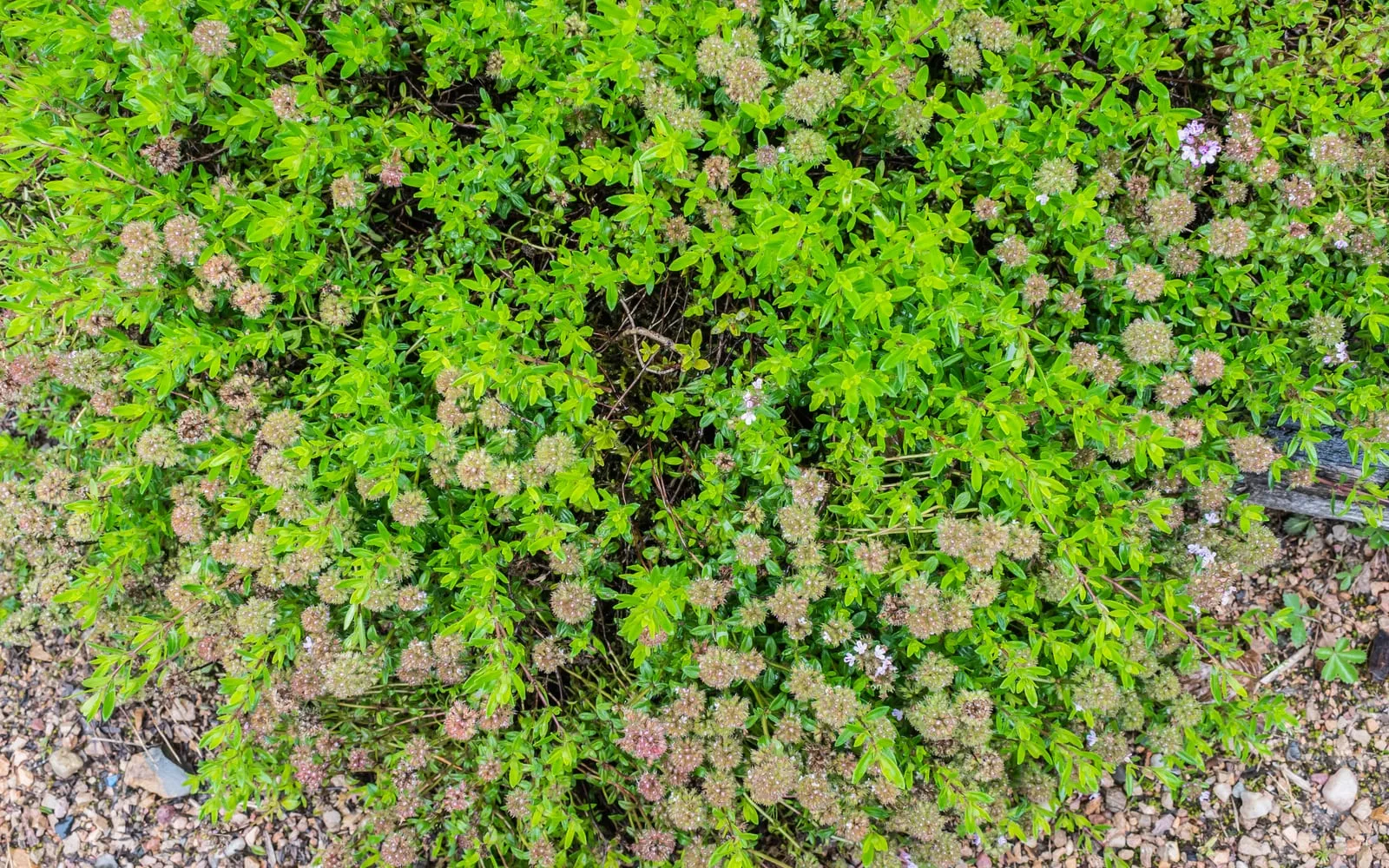
Wild thyme is the flat one. Where garden thyme makes a small upright bush, this creeps across the ground in a mat a few centimetres deep, rooting as it goes, and covers itself in pink-purple flower through June and July.
Its main use in a garden is as ground cover rather than as a kitchen herb. It takes light foot traffic, it releases scent when trodden on, it grows in the gaps between paving slabs, and a thyme lawn on poor dry ground is one of the few alternatives to grass that works in Britain.
It is edible and mild, and picking enough of it for cooking takes patience because the leaves are tiny. Grow common thyme for the kitchen and this one for the ground.
Appearance and character
A flat creeping mat, 5 to 10 cm deep, spreading to 40 cm or more, with wiry stems that root wherever they touch soil.
Leaves are very small, 4 to 8 mm, oval, dark green, held in opposite pairs. They are evergreen and the mat stays green through winter.
Flowers cover the plant from June to August, in dense rounded heads of pink to purple, and they are worked constantly by bees. A thyme bank in flower hums audibly.
Stems are thin, wiry and slightly hairy, woody at the base of an old plant.
The scent is thyme, released by pressure rather than by touch. Walking on it is what makes it worth planting near a path.
Named forms vary a good deal in flower colour and vigour, and several plants sold as Thymus serpyllum belong to related creeping species. For garden purposes the distinction rarely matters.
Where it is from
Wild thyme is native across most of Europe, including Britain, and east into Asia.
In Britain it grows on chalk and limestone downland, on sandy heath, on coastal cliffs and on the Breckland of East Anglia, always on thin poor dry soil in full sun.
On that thin, limy ground it comes into its own in a wildflower meadow, one of the low species that hold their place on poor soil where richer ground grows grass rank enough to smother them.
Its ecology matters beyond the garden. Wild thyme is the food plant of the large blue butterfly, which lays on the flower heads before its caterpillars drop to the ground and are taken into red ant nests. The butterfly went extinct in Britain in 1979 and reintroductions since have depended on getting the thyme, the ants and the grazing right together.
It has been gathered rather than cultivated for most of its history, used in cooking, in tea and as a strewing herb.
Its garden career is recent. Creeping thymes became popular for paving, gravel gardens and green roofs in the twentieth century, and that is now the main reason people plant it.
How it grows
Buy plants or take cuttings. Seed is available and germinates well, though seedlings vary and named forms come only from cuttings or division.
Take cuttings in early summer, or lift and divide a rooted section of an established mat in spring. Both are quick.
Plant in spring into sharply drained soil in full sun, spacing at 20 to 30 cm for ground cover. A mulch of grit or sharp sand around the plants helps them establish and keeps the stems dry.
For a thyme lawn, prepare the ground thoroughly first. Remove every perennial weed, add plenty of grit, and plant at 20 cm spacing. It is slow to knit and weeding it afterwards is difficult, so prepare the site properly before planting.
Between paving slabs, plant into gritty compost in the joints and keep them watered for the first summer.
Trim after flowering with shears to keep the mat dense and stop the centre opening up.
Replace or replant sections every four or five years, since old mats go bare and woody in the middle.
Through the seasons
Winter it stays green and does nothing. Sweep leaves off the mat, since anything lying on it holds moisture and kills patches.
Spring brings new growth in April. Divide or plant now, and pull out weed seedlings while they are small enough to grip.
Early summer is flowering, from June, and the mat disappears under it. Leave it alone and let the bees have it.
Midsummer is the time to shear over the plant once flowering finishes. Trim lightly rather than hard, keeping to green growth.
Autumn needs nothing beyond keeping leaf litter off. This is when a mat sitting under fallen leaves starts to rot.
Care difficulty
Easy on the right soil and impossible on the wrong one. Wild thyme wants poor, sharp, dry ground in full sun, and it will not last on wet clay in shade.
The main long-term problem is the mat opening up in the middle. Trimming after flowering each year delays it, and replanting rooted pieces every few years solves it.
Weeding is the practical difficulty with any thyme lawn or paving planting. Once a perennial weed roots inside the mat there is no way to pull it out without tearing the thyme, and no selective treatment. Clean ground before planting is the only real answer.
Foot traffic is fine in moderation. Wild thyme takes occasional walking and fails under a daily route.
Beyond that it needs no feeding, no watering, no staking and no protection.
Watering
Water new plants weekly through their first summer while they root in. After that, leave them.
An established mat needs no watering in a temperate climate. It grows on dry chalk downland and copes with months of drought.
Water thyme in paving joints more than thyme in open ground, since the root run is small and the stone heats up.
Water a container weekly in summer, letting it dry between times. Shallow terra- cotta pans suit creeping thyme better than deep pots.
Never water in the evening onto the foliage. A wet mat overnight is what rots the centre.
Keep it dry through winter, which mostly means keeping fallen leaves off it.
Warning signs, diseases and pests
Root rot in wet ground is the usual cause of death. Patches turn brown and pull away from the soil with no roots. Improve the drainage or move the plant.
Bare centres on an old mat are the normal ageing pattern rather than a disease. Lift rooted sections from the edge, replant them and discard the middle.
Powdery mildew whitens the foliage in a damp still position. Improve the airflow and cut the affected growth out.
Moss growing through the mat means too much shade or too much moisture. Thyme loses that competition.
Weeds rooted inside the mat are the commonest complaint and the hardest to solve. Grip the weed at its base and pull slowly, or accept some damage.
Leggy stems with bare bases mean the plant has not been trimmed after flowering.
Brown patches where something has been left lying on it recover slowly and sometimes not at all.
Growing environment
Full sun. Wild thyme in shade thins, opens up and gets taken over by moss.
Sharp drainage above everything. Gritty, sandy or stony soil is ideal, and clay needs a great deal of grit worked in or a raised bed instead.
Poor soil. Fertility makes the growth soft and lax, shortens the plant’s life and reduces the scent.
Neutral to alkaline, around pH 6.5 to 8. It grows on chalk downland naturally.
Paving joints, gravel gardens, dry walls, banks, green roofs and sunny raised beds all suit it, and all of them beat a conventional border.
As a lawn substitute it works on small dry sunny areas with light traffic and fails on large shaded ones with heavy use.
Feeding
None. Wild thyme fed with anything grows soft, flops, flowers less and dies younger.
Do not mulch with compost. Grit or gravel is the correct mulch and it does the job compost cannot, which is keeping the stems dry.
A container plant needs no more than a weak balanced feed once in spring, and even that is optional.
Refresh a pot with fresh gritty compost every second spring rather than feeding it.
Poor ground is the point. Anywhere a thyme looks starved, the cause is more likely shade or wet than a shortage of nutrients.
Troubleshooting
The middle has gone brown and bare. Normal ageing. Lift rooted pieces from the edge, replant them in refreshed gritty soil and discard the old centre.
Can I walk on it? Occasionally, yes, and it smells wonderful when you do. Daily traffic wears it through. Put stepping stones through a thyme lawn.
It died in patches over winter. Wet, or something left lying on it. Keep leaves swept off and improve the drainage.
Can I cook with it? Yes. The flavour is milder than common thyme and the leaves are much smaller, so it takes a good handful. Common thyme is the better kitchen plant.
Weeds have grown right through it. The hardest problem with thyme ground cover and the reason to clear the ground completely before planting. Pull what you can, accept some damage, and replant bare areas.
It has stopped flowering. Too much shade, too rich a soil, or an old mat that needs replanting.
Moss is taking over. Too damp and too shaded for thyme. Move it somewhere sunnier and sharper.